May 22, 2026
The Industrial Paradox at the Heart of European Aluminium Recycling
Few sectors illustrate the tension between environmental ambition and economic reality as sharply as industrial-scale aluminium recycling. A country can simultaneously hold world-class recycling credentials and watch its production volumes deteriorate. That paradox sits at the centre of Germany's current aluminium situation, where a mature, high-performing recovery infrastructure is being undermined not by consumer behaviour or system failure, but by the grinding pressures of scrap scarcity, energy costs, and weakening downstream demand.
Understanding this distinction is essential before drawing any conclusions about what Germany's Q1 2026 production figures actually mean for the sector's longer-term trajectory. Furthermore, European supply chain pressures are increasingly compounding these domestic challenges in ways that deserve careful analysis.
When big ASX news breaks, our subscribers know first
Cyclical Correction or Something More Persistent?
When Germany aluminium recycling output drops 3% in a single quarter, the instinctive response is to reach for a cyclical explanation. Markets contract, demand softens, inventories normalise. However, the Q1 2026 data carries characteristics that go beyond a typical short-cycle correction, and several of the structural indicators embedded in the figures warrant closer examination.
The directional shift alone is striking. Germany produced approximately 703,000 tonnes of recycled aluminium in Q1 2025, representing a +3% year-on-year gain that pointed toward a strengthening recovery. The subsequent reversal to a 3% contraction in Q1 2026, bringing total output to 684,564 tonnes, is not a continuation of a downtrend. It is a reversal of an uptrend, and that distinction matters considerably when assessing whether this represents a temporary trough or the early evidence of capacity erosion.
Q1 2026 Output: Reading the Segment-Level Detail
Headline figures rarely tell the full story in industrial production data, and the sub-segment breakdown for Q1 2026 is considerably more informative than the aggregate 3% decline suggests.
| Segment | Q1 2026 Output (Tonnes) | YoY Change |
|---|---|---|
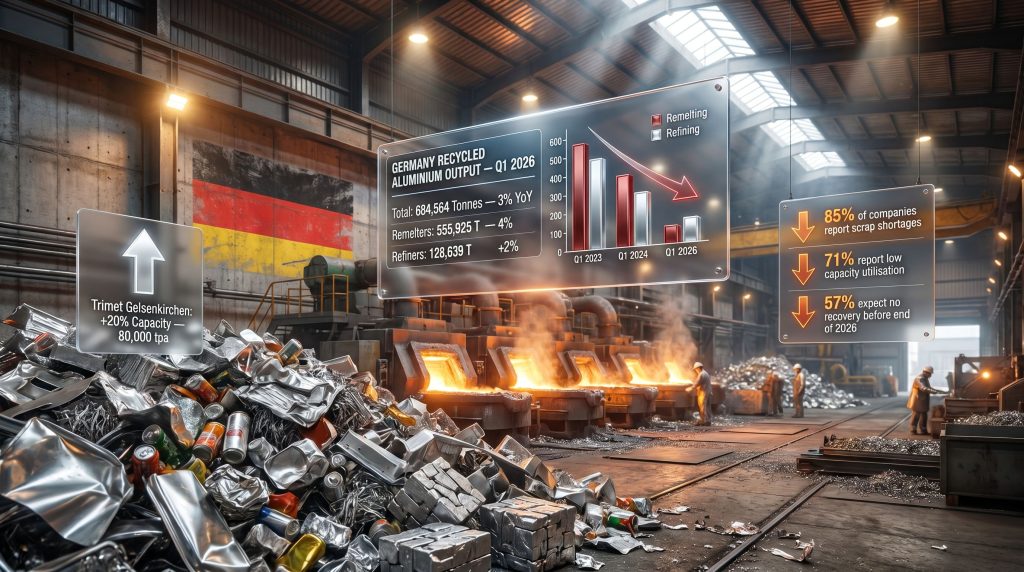
| Total Recycled Aluminium | 684,564 | -3% |
| Refiners | 128,639 | +2% |
| Remelters | 555,925 | -4% |
| Semi-Finished Products | 567,688 | -1% |
| Rolled Products | 452,894 | -1% |
| Extruded Products | 115,794 | -4% |
The refiner versus remelter split is particularly revealing. Refiners grew output by 2%, while remelters contracted by 4%, and this divergence reflects fundamentally different business models within the recycled aluminium sector.
Refiners produce secondary aluminium alloys, predominantly for the automotive casting sector, using a blend of post-consumer scrap, process scrap, and dross. Their product typically has higher value-add content and serves more specialised end markets. Remelters, by contrast, operate on higher throughput volumes, processing clean post-industrial scrap and UBC (used beverage can) material into wrought alloy billets and slabs. Their economics are acutely sensitive to scrap availability and energy input costs, which makes the -4% decline in remelter output a direct expression of the sector's two most acute operational constraints.
Why Extruded Product Output Deserves Particular Attention
Among the downstream segments, the 4% decline in extruded product output to 115,794 tonnes is arguably the most instructive data point. Extrusions serve construction, industrial machinery, and transport applications, and are closely correlated with broader capital expenditure cycles. When extrusion output contracts at twice the rate of rolled products, it signals that the weakness is concentrated in investment-sensitive end markets rather than consumer-oriented ones.
This distinction is relevant for any assessment of recovery timing, since construction and capital equipment demand typically lags broader economic recovery cycles by several quarters. Consequently, the aluminum and alumina markets are experiencing similar downstream pressures that reinforce this broader pattern.
The Scrap Availability Crisis: A Constraint Hiding in Plain Sight
The most underappreciated aspect of Germany's recycling output challenge is the feedstock problem. 85% of surveyed companies reported aluminium scrap shortages during Q1 2026, making raw material access the single most cited operational constraint across the sector.
This deserves more analytical attention than it typically receives. Germany's ~99% aluminium can recycling rate is frequently cited as evidence of system maturity, and it is. However, scrap availability for industrial remelting and refining depends on a much broader universe of material flows than beverage cans alone. End-of-life vehicles, demolished construction profiles, industrial process scrap, and post-consumer packaging collectively feed the secondary aluminium production chain, and each of these streams is subject to its own supply dynamics.
Several forces are converging to tighten scrap availability:
- Automotive production volumes in Germany have remained subdued, reducing the generation of new manufacturing scrap from vehicle assembly
- Extended product lifespans in construction and machinery are deferring the release of embedded aluminium back into the scrap pool
- Cross-border scrap trade flows have been disrupted by shifting tariff environments and logistics cost pressures
- Rising scrap prices globally have created incentives to export European scrap to higher-bidding markets outside the EU
This last point connects to a less-discussed dynamic in the recycling economics literature. When European scrap prices fail to compete with export bids from Asian or Middle Eastern buyers, collected material leaves the continent rather than entering domestic secondary production. The result is a situation where collection performance remains high but domestic processing capacity goes underutilised, precisely the pattern visible in Germany's Q1 2026 remelter data.
Business Sentiment: The Survey Data Behind the Production Numbers
Industry surveys conducted alongside the Q1 2026 production data reveal a sector operating under significant psychological and economic strain. The figures are difficult to read as anything other than a sector in distress.
| Indicator | Share of Companies |
|---|---|
| Order situation described as poor or very poor | 66% |
| Reporting low capacity utilisation | 71% |
| Not expecting improvement before end of 2026 | 57% |
The 71% low capacity utilisation figure carries particular economic significance. In capital-intensive manufacturing, fixed costs do not scale proportionally with output reductions. When more than two-thirds of companies are running below optimal utilisation thresholds, the fixed cost burden per unit of output escalates, compressing margins and accelerating the financial case for restructuring decisions such as production cuts, headcount reductions, or facility closure.
When the majority of an industry's participants simultaneously report poor order books, low utilisation, and no expectation of near-term improvement, the conditions for accelerated structural consolidation are firmly in place.
The forward guidance picture is equally sobering. Industry association Aluminium Deutschland has indicated that no meaningful recovery in the semi-finished products segment is expected in the near term, a signal that downstream buyers and procurement planners are likely already factoring into their inventory and sourcing strategies.
Energy Costs and Regulatory Pressure: The Twin Competitiveness Drains
Germany's industrial energy cost environment has been structurally elevated since the energy market disruptions of 2021 to 2023, and while spot prices have partially normalised, the cumulative impact on long-term investment decisions has not reversed. Aluminium processing is among the most energy-intensive manufacturing activities in the industrial economy, and cost differentials between German production and competing regions in the Middle East, Asia, and North America continue to widen the gap in landed cost competitiveness.
Regulatory compliance requirements add a further cost layer. While decarbonisation objectives embedded in EU industrial policy are broadly aligned with secondary aluminium's environmental proposition (recycled aluminium requires approximately 95% less energy than primary smelting), the administrative and compliance burden associated with evolving reporting frameworks, carbon accounting requirements, and environmental permitting creates friction that disproportionately affects smaller operators without dedicated compliance functions.
The combination of elevated energy costs and increasing regulatory overhead is producing an escalating migration response among producers. In addition, aluminium industry leaders have begun factoring these cost pressures into their longer-term strategic planning across the continent:
- Initial response: Cost reduction through operational efficiency improvements
- Second stage: Workforce reductions and production curtailments
- Third stage: Plant closures and capacity rationalisation
- Fourth stage: Relocation of operations outside Germany to lower-cost jurisdictions
The progression to stage four, which Aluminium Deutschland has explicitly flagged as an emerging trend, represents a qualitative shift from cyclical adjustment to structural capacity loss. Unlike plant closures, which leave the physical infrastructure available for potential restart, operational relocation removes not just equipment but institutional knowledge, supplier relationships, and workforce skills from the domestic industrial base.
The next major ASX story will hit our subscribers first
The U.S. Tariff Dimension: An External Shock on Top of Domestic Weakness
Germany's aluminium sector is navigating its domestic headwinds against the backdrop of a materially altered global trade environment. The 25% U.S. tariff on aluminium imports introduced in 2025 has created significant distortions in European aluminium trade flows, compressing export opportunities and redirecting material volumes that would otherwise have moved to U.S. buyers back into an already-saturated European market.
For German producers specifically, this dynamic exacerbates the demand weakness already visible in domestic order books. The broader impact of US aluminium tariffs has been felt across European secondary processors, further constraining the export options available to already-pressured German operators. Furthermore, aluminium and steel tariffs have collectively reshaped European trade flows in ways that compound the difficulty of long-term investment planning, a particularly damaging effect for an industry where capital expenditure decisions carry 15 to 25 year payback horizons.
Where Confidence Still Exists: Refiner Growth and Counter-Cyclical Investment
Against a broadly negative picture, two data points suggest the sector's longer-term fundamentals remain intact for operators with the financial resilience to look through the current cycle.
The 2% growth in refiner output to 128,639 tonnes demonstrates that secondary alloy production for casting applications, primarily automotive components, continues to find commercially viable demand. This segment benefits from tighter supply chains, longer-term offtake relationships with automotive OEMs, and product specifications that are less exposed to commodity-like pricing dynamics than the broader remelter segment.
More significantly, Trimet's ongoing capacity expansion at its Gelsenkirchen facility is projected to lift recycling output at that site by approximately 20%, toward 80,000 tonnes per year. This represents a meaningful commitment of capital at a point in the cycle where the majority of the industry is retrenching. Counter-cyclical investments of this nature typically reflect one of two things: either a conviction that current conditions represent a trough rather than a structural new normal, or a strategic land-grab for market share ahead of a recovery phase.
Capacity additions made during industrial downturns frequently generate outsized returns during recovery phases, as they enter service into a market where competitor capacity has been permanently retired rather than temporarily idled.
Germany's Recycling Rate vs. Output Volume: A Critical Distinction
One of the most important analytical clarifications in the context of Q1 2026 data is the distinction between recycling rate and recycling output volume. These are related but fundamentally different metrics, and conflating them leads to systematically incorrect conclusions about sector health.
| Country / Region | Aluminium Can Recycling Rate |
|---|---|
| Germany | ~99% |
| Japan | 97% |
| Brazil | 96% |
| Norway | 94% |
| Europe (average) | 76.3% (2023) |
Germany's near-perfect can recycling rate, underpinned by the Pfand deposit return system and decades of consumer habituation, places it at the apex of global recycling performance. The European average of 76.3% in 2023, itself up from 74.6% in 2022, confirms that system-level performance across the continent continues to improve.
Output volume, however, is a function of both recovery rate and the quantity of material entering the system in the first place. When industrial production contracts, when vehicles are driven longer before scrapping, and when construction activity slows, the generation of aluminium-containing end-of-life material slows with it. Germany aluminium recycling output drops therefore reflect the economic conditions that determine scrap generation, not any deterioration in the infrastructure or institutional capacity to recover that material once it becomes available.
The Three-Pillar Recovery Framework
Industry stakeholders have converged on a consistent set of conditions required to stabilise and eventually reverse the current output trajectory:
-
Lower and more stable energy costs: Structural reductions in industrial electricity prices, rather than temporary relief measures, are needed to restore the economic viability of domestic aluminium processing relative to competing production regions.
-
Improved scrap availability: This requires action at multiple levels, including enhanced domestic collection for non-beverage-can streams, EU-level policy to retain collected scrap within the European processing system rather than allowing export to higher-bidding external buyers, and industrial policy that incentivises scrap-intensive secondary production.
-
Predictable and proportionate regulatory conditions: Investment decisions in capital-intensive manufacturing require policy stability. Frequent or unpredictable changes to environmental compliance frameworks create uncertainty that deters the long-horizon commitments the sector needs.
These conditions exist within a broader EU industrial policy context that increasingly recognises secondary metal production as strategically important for both supply chain resilience and decarbonisation objectives. The extent to which policy instruments are actually deployed to support domestic secondary aluminium capacity, however, remains a function of political prioritisation rather than declared strategic interest.
Frequently Asked Questions
Why did Germany's aluminium recycling output fall 3% in Q1 2026?
Output declined to 684,564 tonnes, driven by a combination of aluminium scrap shortages (reported by 85% of surveyed companies), weak demand from automotive, construction, and packaging sectors, elevated energy costs relative to competing production regions, and increasing regulatory compliance burdens on domestic operators.
Which production segment drove the most significant decline?
Remelters were the primary driver, with output falling 4% to 555,925 tonnes. Refiners were the only sub-segment to record growth, expanding output by 2% to 128,639 tonnes, reflecting more resilient demand from automotive casting applications.
Does the output decline mean Germany's recycling system is failing?
No. Germany maintains a world-leading aluminium can recycling rate of approximately 99%, comparable to Japan and ahead of the European average of 76.3%. The output decline reflects economic and industrial conditions affecting scrap generation volumes and processing economics, not any deterioration in collection infrastructure or consumer recycling behaviour.
When is recovery expected?
Industry surveys indicate that 57% of companies do not anticipate improvement before the end of 2026. Aluminium Deutschland has stated that no meaningful near-term recovery is expected in the semi-finished products segment, suggesting the sector may face a prolonged trough through at least late 2026. Furthermore, Germany aluminium recycling output drops of this magnitude historically take multiple quarters to reverse once upstream scrap generation and downstream demand conditions realign.
What would accelerate recovery?
Industry stakeholders have identified three priorities: structurally lower industrial energy costs, improved domestic scrap availability through enhanced collection and export retention measures, and more stable and predictable regulatory conditions to support long-term capital investment decisions.
This article contains forward-looking statements and industry forecasts based on available survey data and publicly reported production figures. These projections are subject to material uncertainty and should not be relied upon as investment advice. Readers should conduct independent research before making any financial or business decisions related to the aluminium sector.
Want to Know When the Next Major ASX Mineral Discovery Hits the Market?
Discovery Alert's proprietary Discovery IQ model scans ASX announcements in real time, delivering actionable insights across more than 30 commodities — including aluminium and the raw materials underpinning the green metals supply chain — so investors can act before the broader market catches on. Explore historic discoveries and the returns they generated, then begin your 14-day free trial to position yourself ahead of the next significant find.