May 22, 2026
When Civilian Infrastructure Becomes a Target: Oil Markets Enter a New Risk Paradigm
The history of oil price shocks is largely a story of supply disruptions, pipeline failures, and production outages. But a subtler and arguably more destabilising category of event has grown increasingly prominent in modern energy markets: the deliberate targeting of civilian infrastructure in conflict zones. When hostile actors demonstrate both the capability and willingness to strike facilities that sit outside conventional military frameworks, the psychological impact on commodity markets often exceeds the physical damage by a significant margin.
This dynamic came into sharp focus on 18 May 2026, when a drone strike hit the Barakah nuclear power plant in Abu Dhabi's Al Dhafra region. The immediate consequence was a surge in crude oil prices to multi-week highs, with oil prices after the drone attack on the UAE nuclear power plant becoming a defining market conversation across trading floors globally. What followed was not simply a supply-fear reaction, but a complex repricing of geopolitical risk across the entire Gulf energy complex.
When big ASX news breaks, our subscribers know first
The Anatomy of a Geopolitical Price Spike
Understanding why oil prices respond so sharply to events like the Barakah strike requires unpacking how risk is actually priced into commodity markets. Crude oil benchmarks do not move in lockstep with confirmed physical supply changes. Instead, traders and algorithms respond to probability-weighted scenarios, factoring in worst-case outcomes even when those outcomes have not yet materialised.
This is sometimes called the fear multiplier effect. When a hostile actor targets a nuclear facility, even a civilian electricity-generating one, the signal sent to markets is qualitatively different from a strike on a refinery or an oil terminal. It indicates a willingness to cross thresholds previously considered inviolable, which dramatically expands the range of potential escalation scenarios that traders must price in. Furthermore, the broader context of crude oil trade geopolitics means that any single flashpoint carries amplified significance across interconnected markets.
Key Price Movements Following the Barakah Attack
The market reaction was swift and measurable:
| Benchmark | Stabilised Level | Intraday Peak | Change | Context |
|---|---|---|---|---|
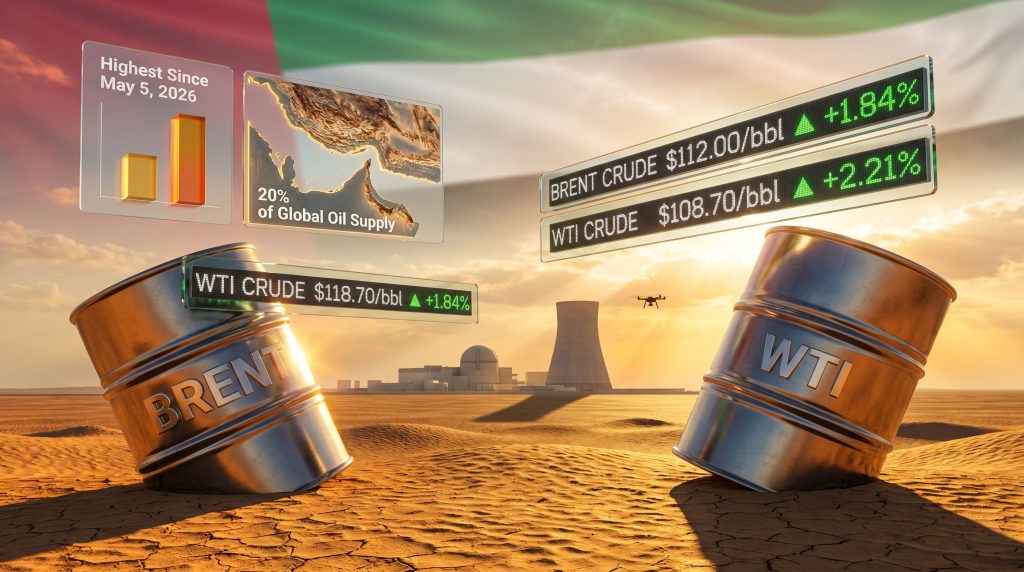
| Brent Crude | $111.27/bbl | $112.00/bbl | +$2.01 (+1.84%) | Highest since 5 May 2026 |
| WTI Crude | $107.75/bbl | $108.70/bbl | +$2.33 (+2.21%) | Highest since 30 April 2026 |
| Weekly prior gain | Both contracts | Both contracts | +7%+ | As peace deal hopes faded |
The gap between the intraday peaks and the stabilised prices is analytically important. Markets initially overshot on fear before partially correcting, which is a textbook geopolitical risk repricing pattern rather than a response to a confirmed physical supply shock. The Brent June contract expiry falling on the following Tuesday added additional short-term volatility pressure to an already tense trading session.
The distinction between confirmed disruption and perceived escalation risk is where most retail investors misread oil market moves. Prices can surge 3–5% on zero actual supply loss if the signal from a geopolitical event is alarming enough.
What the Barakah Strike Represents Beyond the Headlines
The UAE's Nuclear Ambitions and Why Barakah Is a Symbolic Target
The Barakah plant is not simply an energy asset. It is the Arab world's first operational nuclear power station, operated by the Emirates Nuclear Energy Corporation (ENEC), and its construction and operation represent decades of strategic investment by the UAE in civilian nuclear capability. The facility sits in Abu Dhabi's Al Dhafra region and feeds electricity into the UAE's national grid.
Targeting Barakah carries a message that extends well beyond disrupting power generation. It is a signal that Gulf states' most prestigious and strategically sensitive civilian infrastructure projects are not beyond reach. Emirati officials confirmed they were investigating the source of the attack and stated clearly that the UAE retained the full right to respond to what they characterised as a terrorist strike.
Saudi Arabia's Simultaneous Interception: A Coordinated Pattern
On the same day as the Barakah strike, Saudi Arabia intercepted three drones that had entered from Iraqi airspace. Riyadh issued a formal warning that it stood ready to take necessary operational measures against any attempt to violate its sovereignty or security.
The near-simultaneous nature of both incidents is significant. Isolated drone attacks are tactically opportunistic. Coordinated strikes across two separate Gulf states on the same day suggest organised, planned proxy activity with strategic intent. This is the kind of pattern that moves oil markets not just for a day, but for weeks, because it implies an actor with both resources and a demonstrated willingness to escalate systematically.
The Strait of Hormuz: The Chokepoint That Amplifies Everything
No analysis of oil prices after the drone attack on the UAE nuclear power plant is complete without examining the Strait of Hormuz. This 33-kilometre-wide waterway at the mouth of the Persian Gulf is the most consequential oil transit chokepoint on the planet. Approximately 20% of the world's daily oil supply moves through it, encompassing crude exports from Saudi Arabia, Iraq, Kuwait, the UAE, and Iran itself.
The scale of exposure is illustrated starkly by a single data point: Iraq alone exported 10 million barrels of oil through the Strait in April 2026. That figure represents one month, one country. The aggregate daily flow is extraordinary, which is precisely why any credible threat to Hormuz transit creates an immediate and disproportionate price response.
Even a temporary Hormuz closure would be the single most disruptive event in global oil markets since the 1973 embargo. The physical alternatives, including the East-West pipeline across Saudi Arabia, have insufficient capacity to absorb the volume at risk.
The planned joint naval mission by the United Kingdom and France to the Strait of Hormuz, aimed at securing commercial shipping lanes, is a stabilising signal if operationalised. However, Western naval presence in the Strait also introduces its own escalation dimension, particularly if Iranian forces interpret the deployment as a hostile posture rather than a neutral security measure.
Stalled Diplomacy and the Prolonged Risk Premium
Why the Trump-Xi Meeting Outcome Matters for Oil
The prior week's talks between US President Donald Trump and Chinese President Xi Jinping ended without any commitment from Beijing to assist in resolving the Iran conflict. This outcome is materially significant for energy markets because China is the world's largest oil importer. Its participation in or support for a diplomatic resolution would represent a powerful off-ramp for the conflict.
Without that engagement, market participants have begun pricing in a scenario where the Iran conflict transitions from an acute crisis into a prolonged, low-intensity proxy war punctuated by periodic escalation spikes. The US-China oil price tensions add a further structural layer to this uncertainty, embedding a geopolitical premium into crude prices that does not resolve quickly, even during periods of relative calm.
Trump's Military Options Meeting: The Binary Risk Event
According to reporting from Axios, President Trump was scheduled to meet top national security advisers on Tuesday, 19 May, to discuss military options regarding Iran. For oil traders, this meeting represented a binary risk catalyst with highly asymmetric outcomes:
- If military action is authorised: Immediate supply disruption risk, potential Hormuz navigation threats, and Brent crude testing the $120+ per barrel range within hours of any announcement.
- If diplomatic pressure is maintained: A partial unwinding of the fear premium, with prices potentially retracing toward the $105 per barrel range over the following days.
Tony Sycamore, market analyst at IG Markets, articulated the market's concern clearly: the drone strikes function as a pointed warning that any renewed US or Israeli military action against Iran could trigger retaliatory proxy attacks against Gulf energy infrastructure at significant scale. This assessment reflects a broader understanding that the conflict has entered a phase where the proxy network available to Iran across the region is both extensive and demonstrated to be active.
The Russia Sanctions Wildcard: A Second Pressure Point
While the Barakah attack dominated headlines, a second supply-side development was compounding oil price pressure simultaneously. On Saturday, 17 May 2026, the Trump administration allowed a sanctions waiver to lapse that had previously permitted countries including India to purchase Russian seaborne crude oil. The waiver had been extended for one month before its expiry was allowed to stand. In addition, the Russian oil sanctions impact was already being felt across Asian supply chains before this latest development.
How the Waiver Lapse Affects Global Supply Dynamics
| Factor | Market Effect | Pressure Direction |
|---|---|---|
| Reduced Russian oil access for India | India redirects demand toward Middle East suppliers | Upward on Gulf crude |
| Tighter global supply availability | Reduces bearish pressure from discounted Russian barrels | Upward on benchmarks |
| Combined with Hormuz risk | Creates confluence of bullish catalysts | Amplified upward pressure |
| Timing alignment with drone attacks | Removes offsetting bearish factors | Significant near-term support |
Vandana Hari, founder of oil market analysis provider Vanda Insights, captured the dual dynamic: the combination of renewed Iranian strike fears worsening supply anxiety, alongside the removal of the Russian sanctions waiver, created an environment with very little bearish counterweight in the short term.
The next major ASX story will hit our subscribers first
A Framework for Classifying Geopolitical Oil Shocks
Not all geopolitical events affect oil markets equally. Analysts generally classify them into three distinct categories, each with different price implications and duration profiles:
- Physical Supply Disruption Events: Direct damage to production or export infrastructure. The 2019 Abqaiq attack is the clearest modern example, temporarily removing 5% of global supply. These events produce sharp spikes with extended recovery periods.
- Chokepoint Threat Events: Actions threatening transit routes without direct production loss. The Houthi Red Sea shipping attacks of 2023–2024 fall into this category, driving insurance premiums and rerouting costs rather than supply shortfalls.
- Escalation Signal Events: Strikes that communicate capability and intent without immediate physical impact on supply. The Barakah attack is a Category 3 event, designed to send a strategic message rather than cripple infrastructure.
Category 3 events historically add between $3 and $8 per barrel to Brent crude in the short term. Prices typically normalise within two to four weeks, provided no further escalation follows. The critical variable is whether the initial signal event remains isolated or triggers a response that elevates the conflict to Category 1 or Category 2 territory.
Scenario Analysis: Where Oil Prices Go From Here
The trade war impact on oil and broader geopolitical pressures form a critical backdrop to any forward scenario assessment. Furthermore, OPEC's market influence remains a key variable in determining how swiftly any supply shock could be absorbed or amplified.
| Scenario | Trigger Conditions | Brent Price Range | Assessment |
|---|---|---|---|
| Escalation Spiral | US/Israeli strikes on Iran; Hormuz disruption | $120–$135/bbl | Elevated probability given military options discussion |
| Status Quo Conflict | Ongoing proxy activity; no major escalation | $108–$115/bbl | Most likely near-term base case |
| De-escalation | Diplomatic breakthrough; ceasefire signals | $98–$105/bbl | Lower probability given stalled diplomatic channels |
The status quo conflict scenario represents the base case for most professional energy analysts. It implies a market that sustains a meaningful geopolitical premium above fundamental supply-demand levels, with periodic spikes driven by individual incidents. For investors, this environment historically favours energy sector equities, commodity-linked instruments, and positions in oil-exporting currencies.
Disclaimer: Scenario projections and price range estimates represent analytical frameworks based on historical precedent and current reported conditions. They do not constitute financial advice. Oil markets are subject to rapid and unpredictable change, and past geopolitical price patterns do not guarantee future outcomes.
FAQ: Oil Prices and the UAE Nuclear Plant Attack
Why Did Oil Prices Rise After the Drone Attack on the UAE Nuclear Power Plant?
Prices rose primarily due to escalation risk, not confirmed supply disruption. Striking a civilian nuclear facility signals a willingness to cross previously respected boundaries, which markets interpret as a meaningfully higher probability of broader conflict threatening Gulf production and Hormuz transit.
How High Did Brent Crude Go After the Attack?
Brent reached an intraday peak of $112.00 per barrel, its highest level since 5 May 2026, before stabilising at $111.27 per barrel. WTI peaked at $108.70 per barrel before settling at $107.75, up 2.21% on the session.
What Is the Barakah Nuclear Power Plant?
Barakah is the Arab world's first operational nuclear power station, located in Abu Dhabi's Al Dhafra region and operated by the Emirates Nuclear Energy Corporation. It generates civilian electricity for the UAE national grid and carries significant strategic and symbolic weight for the country.
What Would Trigger a Sustained Rally Above $115 Per Barrel?
The most likely trigger would be confirmed US or Israeli military strikes on Iranian territory, physical damage to Hormuz transit infrastructure, or significant strikes on Saudi Aramco production facilities. Any of these events would shift the situation from a Category 3 escalation signal to a Category 1 physical disruption event.
How Does the Russia Sanctions Waiver Lapse Affect Oil Prices?
The lapsed waiver previously allowed major Asian buyers, including India, to purchase Russian seaborne crude at discounted prices. Its removal tightens effective global supply availability by pushing those buyers toward higher-priced alternative sources, adding upward pressure to benchmark crude prices at precisely the wrong moment for markets already dealing with Gulf escalation fears.
Want to Stay Ahead of the Next Major Resource Discovery Amid Market Volatility?
While geopolitical shocks reshape energy markets overnight, Discovery Alert's proprietary Discovery IQ model scans ASX announcements in real time, instantly alerting subscribers to significant mineral discoveries before the broader market reacts — explore historic discoveries and their returns, or begin your 14-day free trial today to position yourself ahead of the next major opportunity.