May 22, 2026
The Hidden Mechanics of OPEC+ Supply Policy in a Fractured Geopolitical Era
Global oil markets have rarely faced a challenge quite like the one confronting them in 2026: a major producer alliance attempting to methodically restore supply volumes while the physical infrastructure required to move those barrels remains partially paralysed by conflict. Understanding how OPEC+ navigates this contradiction requires looking beyond the headline numbers and examining the architecture of supply management itself, including how targets are set, how compliance is enforced, and how geopolitical shocks distort the relationship between policy and physical reality.
The OPEC+ July oil output increase of 411,000 barrels per day is not simply a production decision. It is a signal, a test of market tolerance, and a window into how the coalition intends to reclaim volumes it surrendered during an earlier period of restraint, all while operating under conditions that make actual delivery deeply uncertain.
When big ASX news breaks, our subscribers know first
Why OPEC+ Is Unwinding Its Cuts Faster Than Markets Expected
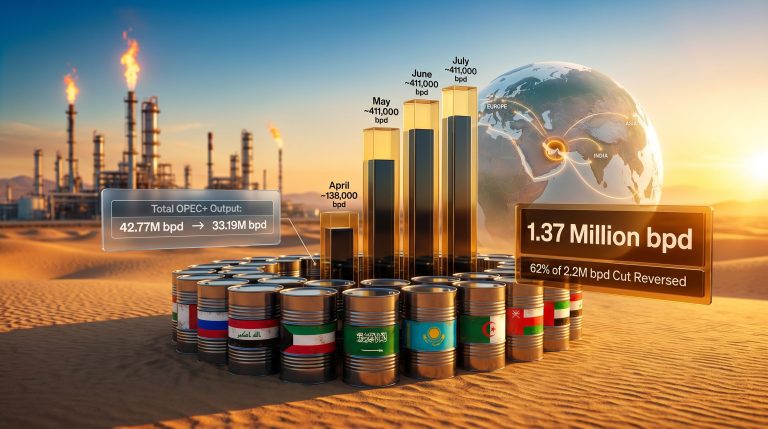
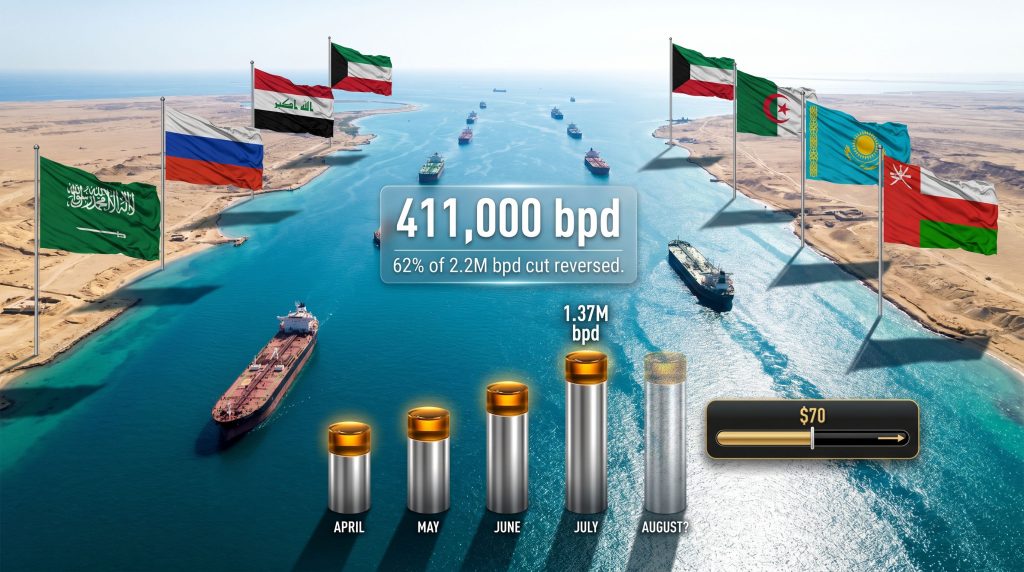
Throughout the first quarter of 2026, OPEC+ maintained flat production, preserving the output discipline it had established over the prior two years. That posture shifted sharply in April, when the group initiated the first in a sequence of monthly output hikes. By July, the coalition has sustained this pace across four consecutive months, each increase sized at approximately 411,000 bpd.
The cumulative arithmetic of this strategy is significant. Adding up the April through July increases produces a total reversal of roughly 1.37 million bpd, which accounts for approximately 62% of the 2.2 million bpd cut the group had previously put in place. Critically, a separate 2 million bpd group-wide reduction agreed in 2022 is still scheduled to remain fully intact through the end of 2026, establishing a firm structural floor beneath total OPEC+ output.
This distinction matters enormously for market interpretation. OPEC+ is not abandoning supply discipline — it is selectively restoring volumes within a preserved ceiling. Furthermore, OPEC production decisions of this kind suggest the group is using successive modest increases to probe how much incremental supply global demand can absorb without triggering a significant price correction.
Analytical Note: The consistency of the monthly hike size across April, May, June, and July suggests a deliberate, formulaic approach rather than opportunistic expansion. This is supply management as calibrated experiment.
How the UAE Departure Reshaped the Group's Monthly Mathematics
One underappreciated dimension of the current OPEC+ output trajectory is the impact of the UAE's exit from the seven-member core group ahead of the May 2026 meeting. The departure had two immediate mathematical consequences.
First, the UAE's 160,000 bpd allocation within the 2022 group-wide cut structure was effectively removed from the coalition's collective accounting. Second, monthly hike volumes have been scaled back since May, reflecting the adjusted baseline. The aggregate result is a group that commands a smaller share of global supply influence but may benefit from tighter internal alignment among its remaining seven members.
Analysts tracking OPEC+ dynamics have noted that smaller coalitions often enforce compliance more effectively than larger ones, where free-rider dynamics and divergent fiscal pressures tend to erode collective discipline. Whether the UAE's absence ultimately strengthens or weakens OPEC's market influence will become clearer as the second half of 2026 unfolds.
The Hormuz Paradox: When Policy Targets Exceed Physical Capability
Perhaps the most consequential factor shaping the OPEC+ July oil output increase is one that the group itself cannot directly control: the disruption of shipping through the Strait of Hormuz resulting from the Iran conflict. This single geographic chokepoint handles a substantial share of global crude and liquefied natural gas exports, and its restriction has created a profound gap between what OPEC+ is officially targeting and what is physically reaching global markets.
The scale of the production collapse visible in OPEC+ figures is stark. Total group output fell from approximately 42.77 million bpd in February 2026 to 33.19 million bpd in April 2026, a reduction of nearly 9.58 million bpd in the space of just two months. Gulf producers alone contributed a decline of approximately 9.9 million bpd over this period. For a broader oil geopolitics analysis, these figures underscore how rapidly regional conflict can overwhelm supply management frameworks.
| Producer | Role in OPEC+ | Spare Capacity Status |
|---|---|---|
| Saudi Arabia | Dominant swing producer | Constrained by Hormuz disruptions |
| Iraq | Second-largest OPEC producer | Export routes partially disrupted |
| Kuwait | Conservative capacity holder | Affected by regional conflict |
| UAE | Recently departed from core group | Full Hormuz restoration not expected until H1 2027 |
| Kazakhstan | Frequently above quota | Production tied to international consortiums |
| Russia | Major non-Gulf member | Navigating separate logistics constraints |
| Oman | Aligned non-OPEC member | Stable but limited spare capacity |
The paradox embedded in this situation is one of structural irony. The members with the greatest capacity to actually deliver incremental barrels when needed — specifically Saudi Arabia, Iraq, and Kuwait — are precisely the exporters whose output routes remain most exposed to Hormuz-related disruption. This means that OPEC+'s stated policy increases are, at least in part, aspirational rather than immediately deliverable under current conditions.
According to reporting from Reuters on OPEC+ July output, full restoration of Hormuz shipping flows is not anticipated until the first half of 2027, a timeline that significantly constrains the group's ability to translate paper targets into physical supply additions for the remainder of 2026.
Critical Insight: Markets tracking OPEC+ output should focus not on the published targets but on the delivery gap — the difference between stated production quotas and actual barrels reaching global trading hubs. In the current environment, this gap is the primary driver of effective supply scarcity.
Kazakhstan's Compliance Problem: The Chronic Weak Link
Among the seven members driving the July decision, Kazakhstan occupies an analytically interesting position. The country has a well-documented history of producing above its agreed OPEC+ quota, creating recurring internal tension within the coalition. Unlike Gulf producers whose output routes pass through Hormuz, Kazakhstan's export infrastructure runs primarily through the Caspian Pipeline Consortium (CPC) system to the Black Sea, giving it a degree of insulation from the Hormuz disruption that other members lack.
This creates an asymmetric compliance dynamic. Kazakhstan faces less physical constraint on its ability to deliver barrels than Gulf producers, but it also has the weakest historical track record of respecting its quota ceiling. During periods when Gulf output is involuntarily suppressed by geopolitical disruption, Kazakhstan's above-quota production becomes proportionally more visible in global supply data, complicating OPEC+'s collective messaging on discipline.
Scenarios for the Second Half of 2026: Three Pathways for Oil Markets
With the OPEC+ July oil output increase now established, market participants are increasingly focused on the trajectory for August and beyond. Three distinct scenarios capture the range of plausible outcomes.
Scenario 1: Controlled Restoration (Base Case)
- Monthly hikes continue at approximately 411,000 bpd through Q3 2026
- Hormuz disruptions ease gradually, progressively narrowing the delivery gap
- Brent crude stabilises in the $68 to $75 per barrel range as supply and demand find a new equilibrium
- OPEC+ retains credibility as a price management mechanism
Scenario 2: Accelerated Reversal (Supply Surge Case)
- A faster-than-expected geopolitical resolution reopens Hormuz shipping more rapidly
- Actual production surges to meet or exceed official targets simultaneously
- Global crude supply materially overshoots demand growth
- Downward pressure on prices accelerates, potentially testing the low $60s per barrel range
Scenario 3: Prolonged Disruption (Constrained Supply Case)
- Hormuz restrictions persist well into late 2026 or beyond the H1 2027 estimate
- OPEC+ output targets remain detached from physical delivery reality
- Prices hold at elevated levels despite sequential policy signals of supply expansion
- Energy importers face sustained cost pressures, with downstream inflation implications
Investor Perspective: Crude oil price volatility during this period is likely to be driven as much by geopolitical developments around Hormuz as by OPEC+ meeting outcomes. Treating OPEC+ decisions in isolation from the Iran conflict misreads where the real price-discovery mechanism currently sits.
Reading Brent's Resilience: What $70 Oil Tells Us About Demand
Despite four consecutive months of planned supply additions, Brent crude has maintained a level in the vicinity of $70 per barrel, a data point that carries significant analytical weight. At face value, price stability in the presence of supply increases suggests that global demand conditions are robust enough to absorb incremental volumes without generating material surpluses.
OPEC+'s internal assessment appears to align with this reading. The group's stated rationale for the July increase references a stable global economic backdrop and characterises current market conditions as fundamentally sound, pointing specifically to inventory levels that remain below multi-year seasonal averages.
However, a more cautious interpretation is also defensible. The oil market trade risks stemming from broader macroeconomic pressures add another layer of complexity, since if the Hormuz disruption is preventing Gulf barrels from reaching markets, then the apparent demand resilience may partly reflect the fact that stated supply increases are not fully manifesting as real-world volume additions. Separating these two drivers requires close monitoring of physical crude inventory data and tanker tracking metrics.
Is the US Shale Sector Filling the Gap?
In addition to the OPEC+ dynamics at play, the US shale slowdown presents a further complication for global supply balances. If American producers are pulling back on drilling activity precisely when Gulf barrels are constrained by Hormuz disruption, the effective supply deficit could be larger than headline figures suggest. This confluence of factors may help explain why Brent has remained relatively supported despite the sequential hike announcements.
The next major ASX story will hit our subscribers first
The August Decision and What Comes Next
Preliminary discussions within OPEC+ have flagged the possibility of a further 411,000 bpd increase for August, which would extend the current restoration cadence into a fifth consecutive month. If confirmed, the cumulative April through August reversal would reach approximately 1.78 million bpd, representing more than 80% of the 2.2 million bpd cut being unwound within a five-month window.
The speed of this reversal, if it materialises, is historically rapid by OPEC+ standards. The group spent years carefully constructing its supply restriction framework and has previously demonstrated a willingness to hold firm through extended periods of price weakness. The current pace of unwinding reflects either elevated confidence in demand durability, a strategic decision to recapture market share from non-OPEC producers who have expanded during the restriction period, or both simultaneously.
Non-OPEC supply growth, particularly from producers in Guyana and Brazil, has been a persistent competitive pressure on OPEC+ market share. Consequently, if the coalition determines that its continued restraint is primarily benefiting rival producers rather than supporting prices, the economic logic of extending cuts weakens considerably. According to analysis from CNBC on the July output hike, internal OPEC+ deliberations have increasingly reflected this market share calculus in recent months.
Key Takeaways for Energy Market Participants
- The OPEC+ July oil output increase of 411,000 bpd is the fourth in an unbroken sequence of monthly hikes beginning in April 2026
- Cumulative restoration from April through July totals approximately 1.37 million bpd, or about 62% of the 2.2 million bpd cut
- The 2022 group-wide 2 million bpd cut remains structurally intact through end-2026, preserving a meaningful supply ceiling
- A near-9.58 million bpd collapse in OPEC+ output between February and April 2026 illustrates the scale of Hormuz-related disruption
- Full Hormuz shipping restoration is not expected until at least H1 2027, keeping the target-to-delivery gap open for months
- Kazakhstan's chronic compliance gap and the UAE's departure from the core group are two structural variables reshaping the coalition's internal dynamics
- Brent crude near $70 per barrel may reflect constrained physical delivery as much as genuine demand strength
This article contains forward-looking scenarios and analytical interpretations of publicly available data. It does not constitute financial advice. Oil market conditions, geopolitical developments, and OPEC+ policy decisions are subject to rapid and material change. Readers should conduct independent research before making any investment decisions related to energy markets or commodity-linked assets.
Want To Stay Ahead of Major Commodity Discoveries Driving the Next Market Surge?
While geopolitical forces reshape global oil supply, the commodity landscape is constantly throwing up transformative opportunities beyond crude — and Discovery Alert's proprietary Discovery IQ model delivers real-time alerts the moment significant ASX mineral discoveries are announced, turning complex data across 30+ commodities into clear, actionable insights. Explore historic examples of major discovery returns on Discovery Alert's dedicated discoveries page and begin a 14-day free trial to position yourself ahead of the broader market.