May 22, 2026
How Oil Markets Price War: The Mechanics of Conflict Premiums and Why Pauses Matter
Energy markets have always served as the world's most efficient real-time geopolitical scoreboard. Long before diplomatic cables are decoded or press conferences are transcribed, crude futures traders are already repositioning. The pricing mechanism is brutally simple: perceived supply risk goes up, prices go up. Perceived risk retreats, prices retreat. Yet the speed and precision of this process, and the structural forces that prevent a full unwind even when tension eases, reveal something far more complex than a binary risk dial.
Understanding why oil falls as Trump pauses attack on Iran requires examining not just the headline event, but the layered architecture of conflict premiums, physical chokepoint dynamics, reserve buffer mechanics, and the psychology of markets navigating genuine uncertainty. Furthermore, the crude oil geopolitics at play here extend well beyond a single presidential statement.
The Anatomy of a Conflict Premium: How War Risk Gets Priced Into Crude
When military action is anticipated or underway near a major hydrocarbon corridor, traders add what is known as a geopolitical risk premium to benchmark crude prices. This premium is not calculated from a spreadsheet. It reflects the collective probability-weighted expectation of supply disruption, and it can shift within minutes of a presidential statement, a diplomatic cable, or a vessel tracking report.
The premium is not uniform. Its size depends on several factors:
- How critical the threatened region is to global supply chains
- How credible the military threat appears to traders
- Whether alternative supply routes or reserves can absorb a potential shortfall
- The current level of global inventory buffers
Historically, geopolitical risk premiums during acute Middle East tensions have added anywhere from $10 to $30 per barrel above fundamental supply-demand pricing. During the 2019 Abqaiq attacks on Saudi infrastructure, premiums spiked by roughly $8 overnight before partially retracing. The current conflict, involving a fully closed Strait of Hormuz corridor, represents a structurally larger threat vector than most prior episodes.
What the Numbers Reveal: May 19, 2026 Crude Benchmark Snapshot
When Trump announced a pause in planned military action against Iran on May 19, 2026, crude markets responded with immediate but measured relief. The price declines were significant in percentage terms, yet notably incomplete in their reversal of the conflict premium.
| Benchmark | Price Move | Settlement Level | Prior Session High Context |
|---|---|---|---|
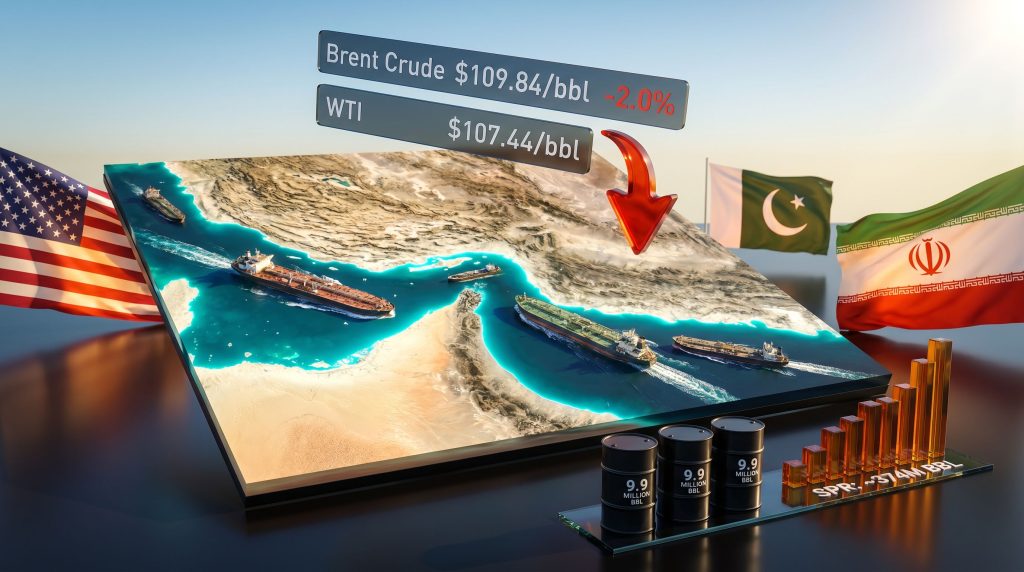
| Brent Crude (July) | -$2.26 / -2.0% | $109.84/bbl | Highest since May 5 in prior session |
| WTI Crude (June) | -$1.22 / -1.1% | $107.44/bbl | Highest since April 30 in prior session |
| WTI Crude (July, active contract) | -$1.63 / -1.6% | $102.75/bbl | Most actively traded forward contract |
The critical detail buried inside these figures is that Brent crude, even after shedding more than two dollars, remained above $109 per barrel. That level is historically elevated. It signals that while the market repriced the immediate probability of military escalation, it did not conclude that the conflict was over or that supply corridors had been secured. The pause reduced fear; it did not eliminate it.
This is a textbook example of an incomplete premium unwind, a pattern where prices partially correct on de-escalation signals but retain a structural floor because the underlying supply risk has not been physically resolved. The oil volatility trends observed here are consistent with prior episodes of geopolitical de-escalation that stopped short of full resolution.
When big ASX news breaks, our subscribers know first
The Diplomatic Architecture: What Trump Said and What Markets Heard
Trump stated publicly that there was a strong probability of reaching an agreement with Iran that would prevent Tehran from acquiring nuclear weapons. Critically, he framed the pause as a negotiating window rather than a withdrawal of military capability. The threat remained intact. The timeline was simply extended.
This distinction matters enormously for how markets interpret leadership signals. A genuine ceasefire with verified terms would trigger a much larger premium unwind. A tactical pause, explicitly conditional on diplomatic progress, keeps the war premium alive at a reduced level. Markets priced exactly that nuance, with a 2% decline rather than the 5–8% collapse that a confirmed resolution would likely generate. This kind of oil price shock dynamic is something energy executives have grown increasingly attentive to.
Pakistan's Intermediary Role: Back-Channel Mechanics in Practice
Iran's Foreign Ministry confirmed that Tehran's negotiating position had been relayed to Washington through Pakistani intermediaries. A Pakistani official, speaking anonymously, confirmed that Islamabad had transmitted a new proposal between the two sides while characterising progress as slow.
Pakistan's role as a diplomatic conduit is not accidental. Islamabad maintains functional relationships with both Washington and Tehran, a rare combination given the bilateral hostility between the United States and Iran. This back-channel capacity has been used episodically over decades, though its effectiveness in the current, more acute confrontation remains unverified.
The detail of slow progress was itself a market-moving signal. Initial optimism from the pause announcement was consequently tempered by the acknowledgment that no substantive breakthroughs had occurred.
The Sanctions Contradiction That Amplified Uncertainty
A confusing set of competing signals emerged around sanctions. Iran's semi-official Tasnim news agency reported that the United States had agreed to waive sanctions on Iranian oil exports during the negotiating period. A U.S. official directly and publicly denied this claim.
For traders, this created a hedging imperative. If the sanctions waiver report was accurate, Iranian oil flowing back into global markets would represent a meaningful supply addition, pushing prices lower. If the denial was accurate and sanctions remained fully enforced, supply tightness would persist. Faced with that binary uncertainty, traders held positions rather than aggressively selling, which partially explains why the price decline was not larger despite the positive diplomatic signal.
The Strait of Hormuz: Why This 33-Kilometre Passage Controls Global Energy
No single geographic feature has greater influence over global oil pricing than the Strait of Hormuz. This narrow waterway, connecting the Persian Gulf to the Gulf of Oman, carries approximately one-fifth of the world's daily oil and liquefied natural gas supply. At its narrowest point, the shipping lane is only about 3.2 kilometres wide in each direction.
The current Middle East conflict has effectively disrupted normal tanker transit through the strait. This is not merely a theoretical risk. Physical vessel movements have been affected, rerouting costs have risen, and war risk insurance premiums for tankers operating in the region have spiked sharply, adding a secondary cost layer to global energy supply chains that does not disappear even when diplomatic talks begin.
Tim Waterer, Chief Market Analyst at KCM Trade, highlighted that the actual status of tanker movements through the strait was as important a price determinant as any political headline. Physical flow data provides ground truth that diplomatic statements cannot.
Why Supply Disruption Risk Compounds Over Time
ING analysts noted in a client communication that the scale of supply disruptions had grown more concerning with each passing day that oil flows remained halted. This is a critical structural observation that many casual market observers miss.
A sudden supply shock is recoverable. Strategic reserves can be deployed, alternative routing can be organised, and markets can adjust. However, a prolonged corridor disruption creates cumulative supply deficits that cannot be unwound overnight. Every day the Hormuz passage operates below normal capacity adds to a structural gap in global inventory that takes weeks or months to refill, even after physical access is restored.
This compounding dynamic explains why oil prices remain structurally elevated during diplomatic pauses rather than collapsing to pre-conflict levels. The pipeline of physical barrels that failed to reach the market during the disruption period represents a real deficit that persists long after the political situation changes.
Scenario Framework: Three Paths From Here and What Each Means for Oil
With the situation genuinely uncertain, a structured scenario analysis is more useful than a single price forecast. Each pathway carries meaningfully different implications for crude benchmarks and energy-importing economies.
Scenario 1: Negotiations Reach a Verified Agreement
A formal, verified nuclear agreement with credible inspection mechanisms would likely trigger a significant unwinding of the conflict premium. Brent could fall toward pre-conflict levels, potentially a $15 to $25 per barrel decline from current levels, depending on how quickly the Hormuz corridor normalises and whether Iranian export volumes recover. This would be broadly deflationary for energy-importing economies and welcome relief for central banks fighting energy-driven inflation.
Scenario 2: Diplomatic Breakdown and Resumed Military Action
A collapse in negotiations would likely push Brent back toward or above prior session highs. Emergency International Energy Agency reserve coordination would become a near-certainty. Energy-intensive economies in Asia and Europe, already managing elevated import costs, would face acute additional pressure. Shipping insurance premiums would spike further.
Scenario 3: Extended Diplomatic Limbo (Highest Near-Term Probability)
Markets oscillate between risk-on and risk-off positioning as each news cycle brings new signals. Saxo Bank analyst Ole Hansen has characterised this environment as one where traders jump from headline to headline without a clear directional anchor. Prices likely remain in a structurally elevated band of $100 to $115 per barrel with high intraday volatility driven by incremental diplomatic signals rather than fundamental supply-demand shifts.
"The market is not pricing a resolution. It is pricing uncertainty. That distinction carries enormous implications for energy hedging strategies and for economies that cannot simply absorb sustained triple-digit oil costs."
Strategic Petroleum Reserve: America's Emergency Buffer Is Thinning
The United States drew a record 9.9 million barrels from the Strategic Petroleum Reserve in a single week, according to Energy Department data released in the days surrounding the pause announcement. Total SPR stockpiles fell to approximately 374 million barrels, the lowest level since July 2024.
| SPR Metric | Figure | Significance |
|---|---|---|
| Weekly drawdown | 9.9 million barrels | Highest single-week withdrawal on record |
| Current SPR level | ~374 million barrels | Lowest since July 2024 |
| Estimated commercial crude inventory change | -3.4 million barrels (week to May 15) | Based on Reuters poll of four analysts |
| EIA official inventory data release | May 20, 2026 | Scheduled confirmation |
The record SPR drawdown serves a dual purpose. It adds domestic supply to partially offset the reduced inflow from disrupted import channels, and it signals to retail fuel markets that the government is actively managing price pressures. However, this strategy carries a structural cost that is easy to overlook.
Each barrel drawn from the SPR reduces the government's capacity to respond to a future supply shock. If the diplomatic pause collapses and the conflict intensifies, the United States would be entering that escalation with meaningfully less emergency buffer than it had at the conflict's outset. That asymmetry is itself a form of strategic vulnerability.
Commercial inventories running parallel deficits, estimated at 3.4 million barrels for the week ending May 15, reinforce the picture of genuine physical supply tightness rather than merely elevated sentiment-driven prices.
The Russia Sanctions Variable: A Second Supply Shock Running in Parallel
Independent of the Iran situation, U.S. Treasury Secretary Scott Bessent extended a sanctions waiver by 30 days allowing energy-vulnerable nations to continue purchasing Russian seaborne crude. This decision reflects the practical reality that abruptly cutting off discounted Russian oil access for multiple import-dependent economies would layer a second acute supply shock onto an already strained global market.
The interaction between the Russia sanctions framework and the Iran-U.S. conflict creates what analysts call a dual supply shock dynamic. Furthermore, the trade war oil prices dimension adds yet another layer of complexity, as global oil markets are simultaneously managing geopolitical risk vectors from two of the world's major crude-producing regions.
Nations in South and Southeast Asia face compounded exposure. Many rely heavily on Russian crude at discounted prices as a buffer against Middle East supply disruptions. If either supply channel narrows further, the cost pressures on these economies would intensify rapidly.
The next major ASX story will hit our subscribers first
Key Catalysts Shaping Oil's Next Move
Several specific data points and events will determine whether oil prices move meaningfully higher or begin a more sustained retreat in the days and weeks following the pause announcement:
- EIA Inventory Report (May 20): Official U.S. crude inventory data will confirm or contradict the analyst consensus estimate of a 3.4 million barrel draw for the week ending May 15. A larger-than-expected draw would reinforce supply tightness; a surprise build would pressure prices lower.
- Iran's Formal Diplomatic Response: Whether Tehran issues verifiable concessions or signals continued military posture will be the dominant price driver in the near term.
- Strait of Hormuz Tanker Traffic Data: Real-time vessel tracking from commercial maritime intelligence services will reveal whether physical flows are recovering independent of political statements.
- U.S. Sanctions Clarification: Washington's definitive response to the Tasnim report on oil export sanctions waivers will resolve a significant market uncertainty.
- SPR Policy Signals: Any indication of further emergency reserve releases would confirm that the administration views current supply conditions as critically stressed.
The Broader Economic Consequence: What Triple-Digit Oil Means in 2026
Sustained Brent crude above $100 per barrel creates a cascading set of pressures that extend well beyond energy sector pricing. For central banks in oil-importing economies, energy-driven inflation complicates the policy calculus significantly. Raising interest rates to combat price pressures risks slowing already fragile economic growth. Holding rates risks allowing inflation expectations to become entrenched.
In addition, OPEC demand forecasts are being closely scrutinised by analysts seeking to understand how sustained elevated prices might dampen global consumption. There is also a longer-cycle observation worth noting. Historically, periods of prolonged elevated oil prices have accelerated structural shifts away from fossil fuel dependency.
Investment in liquefied natural gas infrastructure, renewable energy capacity, and alternative transportation technologies tends to increase when energy costs make alternatives economically competitive without policy subsidy. The current environment may ultimately prove to be another accelerant for an energy transition that was already underway, compressing timelines that might otherwise have stretched across additional decades.
For now, however, the immediate reality where oil falls as Trump pauses attack on Iran is a market caught between relief and residual fear, with physical supply constraints, thinning emergency reserves, and unresolved diplomatic processes collectively preventing any clean resolution of the conflict premium that took oil prices to multi-month highs in the sessions preceding the announcement.
This article contains forward-looking analysis based on publicly available market data and analyst commentary as of May 19, 2026. It does not constitute financial advice. Oil market conditions and geopolitical developments can change rapidly, and readers should consult licensed financial advisers before making investment decisions based on any information contained herein.
Want to Stay Ahead of Major Resource Discoveries Driven by Energy Market Shifts?
When geopolitical disruptions reshape commodity markets at speed, Discovery Alert's proprietary Discovery IQ model scans ASX announcements in real time, instantly identifying significant mineral discoveries and delivering actionable alerts to subscribers before the broader market reacts — explore historic discovery returns on Discovery Alert's dedicated discoveries page and begin your 14-day free trial today to secure a market-leading edge.