July 21, 2026
The metals industry stands at a critical inflection point where geopolitical tensions intersect with technological innovation. As supply chains face unprecedented disruption risks, European policymakers are pursuing radical alternatives to traditional metal processing frameworks. Germany backing DEScycle for circular metals ambition represents a strategic shift that extends beyond simple supplier diversification strategies, targeting fundamental changes in how critical materials move from waste streams back into productive industrial applications.
Deep within this shift lies a recognition that circular economy principles must evolve from aspirational concepts to concrete industrial capabilities. The convergence of advanced chemistry, regulatory pressure, and strategic necessity is creating new pathways for metal recovery that challenge decades-old assumptions about processing economics and supply chain architecture.
The Strategic Context Behind SPRIND's Investment Decision
Germany's Federal Agency for Disruptive Innovation operates under a fundamentally different mandate compared to traditional research funding mechanisms. SPRIND's challenge-based approach specifically targets technologies at the demonstration and early commercial phases, addressing what German policymakers identified as a critical gap in the European innovation ecosystem. The Tech Metal Transformation Challenge represents this philosophy in practice, moving beyond theoretical research toward industrial capability creation.
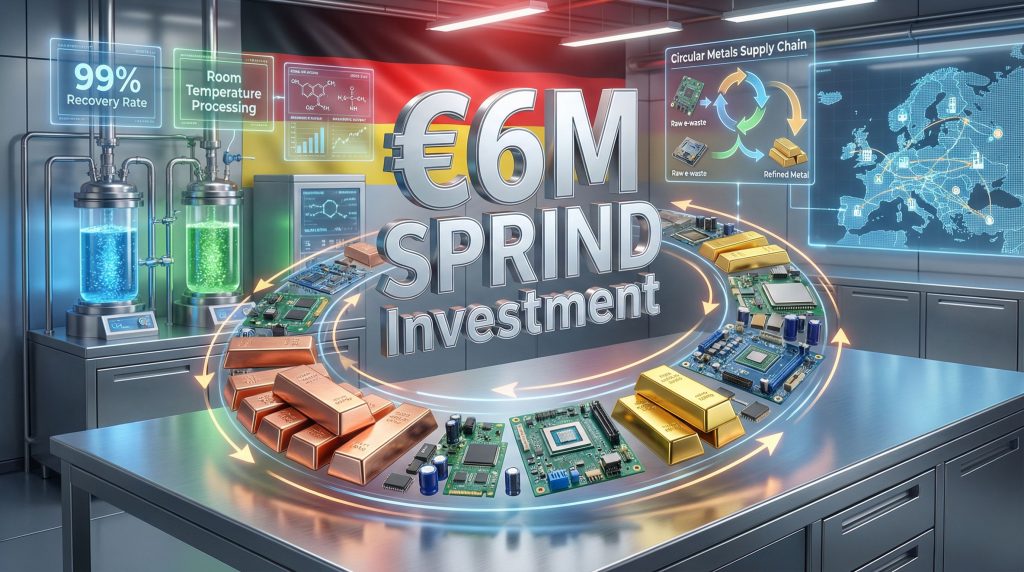
The selection of DEScycle for initial €1.5 million funding, with potential total support reaching €6 million, reflects Germany's interpretation of the EU Critical Raw Materials Act requirements. Rather than pursuing supplier substitution strategies, German policy frameworks emphasise process-level innovation as the foundation for strategic autonomy. Furthermore, this approach distinguishes Germany's circular metals strategy from conventional stockpiling or diplomatic diversification methods, demonstrating how mining decarbonisation benefits align with technological advancement.
Regulatory Framework Integration
The EU Critical Raw Materials Act, formally adopted in December 2023, establishes specific targets for domestic processing capacity and circular economy contributions. Germany's national strategy interprets these requirements as necessitating breakthrough technologies rather than incremental improvements to existing systems. The milestone-dependent funding structure employed by SPRIND aligns with these regulatory timelines, creating accountability mechanisms for commercial viability demonstration.
SPRIND's staged funding criteria operate through performance-gate releases rather than traditional upfront disbursement models. This structure targets Technology Readiness Levels (TRL) 6-9, focusing on demonstration and early commercial deployment phases where critical minerals energy transition initiatives have historically stalled. The approach reflects German federal recognition that process innovation requires sustained support through scale-up validation periods.
Multi-Jurisdictional Collaboration Architecture
The DEScycle consortium structure illustrates post-Brexit European research integration patterns. The collaboration includes:
- DEScycle (UK): Lead technology developer
- Seloxium (UK): Process optimisation partner
- University of Nottingham (UK): Research validation
- Esy Labs (Germany): Industrial integration specialist
This multi-jurisdictional framework (UK-Germany research coordination) demonstrates how European innovation networks continue to function across political boundaries when addressing shared strategic challenges. In addition, the consortium architecture reflects both technical complementarity and regulatory navigation requirements across different European jurisdictions.
When big ASX news breaks, our subscribers know first
Why Circular Metals Recovery Has Become a National Security Priority
European dependency on geographically concentrated processing infrastructure has created systematic vulnerabilities across critical metals supply chains. Current data indicates that Europe generates approximately 57-59 million tonnes of electronic waste annually, yet existing processing capacity captures only 20-30% of generated materials for secondary metal recovery. Consequently, the remaining 70-80% either exports to third countries or enters landfill systems, representing massive resource losses and continued import dependency.
Supply Chain Concentration Risks
China's dominance in secondary metals processing creates particular challenges for European strategic autonomy objectives. Analysis of global processing capacity reveals concerning concentration patterns:
| Metal Category | Chinese Processing Share | European Recovery Rate | Strategic Risk Level |
|---|---|---|---|
| Secondary Copper | 40-50% | 25-30% | High |
| Secondary Gold | 35-40% | 15-20% | Critical |
| Specialty Electronics Metals | 60%+ | 5-15% | Extreme |
| Rare Earth Elements | 80%+ | <5% | Extreme |
These concentration levels create systematic vulnerabilities during geopolitical tensions or supply chain disruptions. The 2020-2021 Indonesian nickel ore export restrictions demonstrated how processing location determines supply access, with Chinese facilities benefiting disproportionately from sourcing alternatives.
Defence Sector Implications
NATO defence electronics systems require high-purity metals and specialty alloys where supply chain reliability directly impacts operational readiness. A 2023 European Commission industry consultation found that 65% of European defence contractors reported supply chain vulnerabilities related to secondary metal sourcing. These dependencies extend beyond cost considerations to encompass material traceability and quality assurance requirements essential for defence applications.
Current defence supply chain models assume continued access to Asian refining and processing capabilities. Alternative sourcing options remain limited, creating operational risks during extended geopolitical tensions. For instance, the integration of circular metals infrastructure into defence supply chains requires not only technical validation but also certification processes that meet military specification requirements.
Comparative International Approaches
The United States has pursued regional hub strategies through its Critical Materials Institute, emphasising geographic distribution rather than centralised national capacity. This approach differs from Germany's model in both scale and integration timeline. While U.S. initiatives focus on research coordination and early-stage technology development, Germany backing DEScycle represents more direct commercial pathway support.
France and other EU member states maintain different circular metals priorities, often emphasising existing smelting infrastructure optimisation rather than breakthrough technology adoption. However, Germany's willingness to fund disruptive approaches reflects both industrial capability gaps and strategic patience for longer-term technology validation cycles.
How Advanced Chemistry is Reshaping Metal Recovery Economics
Traditional metallurgical processes rely on high-temperature pyrometallurgical methods that consume substantial energy inputs while requiring homogeneous feedstock preparation. Primary copper smelting typically consumes 12-15 MWh per tonne of refined metal, while secondary smelting from pre-sorted scrap reduces this to 3-5 MWh per tonne. These energy requirements represent both cost structures and environmental impact profiles that limit processing facility locations and economic viability.
Deep Eutectic Solvents Technology Development
Low-temperature chemistry approaches, particularly deep eutectic solvents (DES), represent a fundamental departure from conventional metallurgical frameworks. Laboratory-scale research indicates potential energy consumption of 0.5-2 MWh per tonne for extraction and recovery phases, though these figures typically exclude solvent regeneration costs and downstream purification requirements.
The technology development timeline shows DES applications for metal recovery under investigation since approximately 2015-2018, with most published research remaining at laboratory or small pilot scale. DEScycle's selection by SPRIND suggests achievement of or demonstrated pathways to industrial-scale viability, though specific technical details remain proprietary pending commercial validation.
Recovery Rate Comparisons
Traditional smelting achieves the following recovery rates under optimal conditions:
- Copper: 95-98% recovery
- Gold: 92-97% recovery
- Specialty metals (Indium, Gallium): 70-85% recovery
Low-temperature chemistry processes target 99%+ metal extraction efficiency, though independent validation at industrial scale remains pending. The economic viability of these higher recovery rates depends critically on processing costs, solvent regeneration expenses, and feedstock preparation requirements.
Economic Viability Assessment Framework
Cost-per-tonne analysis requires consideration of multiple variables beyond energy consumption alone. Capital equipment costs for low-temperature systems may differ substantially from traditional smelting infrastructure, affecting break-even calculations across different processing scales. Furthermore, decentralised processing facilities could reduce transportation costs while increasing operational complexity and regulatory compliance expenses.
Investment Consideration: Traditional secondary copper processing achieves profitability at scales exceeding 10,000 tonnes annually. Low-temperature alternatives may enable profitable operations at smaller scales, potentially supporting distributed processing networks, though validation of these economics remains under development.
What Are the Real-World Applications and Market Opportunities?
The practical implementation of circular metals technology faces complex feedstock availability and quality challenges. Electronic waste streams contain varying concentrations of target metals, requiring sophisticated sorting and preprocessing capabilities. Industrial residues from manufacturing processes offer more predictable compositions but may require different recovery approaches compared to consumer electronics waste.
Target Materials Strategic Value
Critical metals prioritisation reflects both supply risk profiles and downstream application requirements:
High Priority Targets:
- Copper: Essential for electrical infrastructure, renewable energy systems
- Gold: Critical for electronics reliability, defence applications
- Rare earth elements: Permanent magnets, advanced electronics
- Specialty metals: Indium, gallium, germanium for semiconductor applications
Medium Priority Targets:
- Silver: Industrial applications, renewable energy components
- Platinum group metals: Catalysis, hydrogen economy applications
- Lithium: Battery supply chain integration opportunities
E-Waste Volume Projections
European electronic waste generation is projected to reach 65-70 million tonnes annually by 2030, driven by shorter device replacement cycles and expanding digitalisation across industrial sectors. This growth represents both opportunity and challenge for circular metals infrastructure development.
Current recovery systems capture approximately 20-25% of available metals from e-waste streams, with significant variations by material type and processing facility capabilities. Improved recovery rates could substantially impact European metals supply security while reducing environmental disposal challenges. Additionally, these sustainability transformation insights demonstrate how circular economy principles can reshape traditional processing approaches.
Integration with Manufacturing Supply Chains
Successful circular metals infrastructure requires seamless integration with downstream manufacturing processes. Quality standards for recycled metals in electronics applications often exceed those for traditional industrial uses, necessitating sophisticated purification and quality assurance systems.
Semiconductor manufacturing represents the most demanding application environment, requiring materials with extremely low impurity levels and consistent quality specifications. Defence electronics occupy a similar category, with additional traceability and certification requirements that extend beyond purely technical specifications.
Which Industries Stand to Benefit Most from This Circular Metals Shift?
Electronics manufacturing faces increasing pressure to demonstrate supply chain sustainability while managing cost structures and quality requirements. The semiconductor industry, in particular, operates under tight material specifications where recycled inputs must meet identical performance standards to primary materials. Successful circular metals integration could provide both cost advantages and supply chain diversification benefits for electronics manufacturers.
Defence and Aerospace Applications
Military electronics systems require materials with verified provenance and consistent quality profiles. Supply chain security considerations extend beyond cost optimisation to encompass operational reliability during extended conflict scenarios. Domestic circular metals capability could significantly enhance defence supply chain resilience while meeting NATO interoperability requirements.
Strategic metals requirements in defence applications include:
- High-purity copper: Radar systems, communications equipment
- Gold: Critical circuit connections, satellite systems
- Tantalum: Military-grade capacitors, advanced electronics
- Rare earth elements: Precision-guided munitions, electronic warfare systems
The integration timeline for defence applications typically extends 3-5 years beyond commercial validation due to qualification and certification requirements. However, once established, defence supply chains offer stable demand profiles and premium pricing for qualified suppliers.
Renewable Energy Infrastructure
Wind turbine generators, solar panel systems, and energy storage infrastructure require substantial quantities of critical metals. Circular recovery systems could provide cost-effective inputs for renewable energy expansion while reducing dependence on primary mining operations. This sector's growth trajectory creates sustained demand for recovered metals across multiple technology categories.
Electric vehicle manufacturing represents another high-growth application area, particularly for copper, lithium, and specialty battery metals. Integration of circular metals into EV supply chains could support European automotive industry evolution trends while advancing sustainability objectives.
How Will This Technology Scale Across Europe and Beyond?
Regulatory framework requirements vary significantly across European jurisdictions, creating complex compliance challenges for distributed processing networks. Environmental permitting processes typically require 18-36 months for new metallurgical facilities, while waste processing licences add additional regulatory layers. Successful scaling requires coordinated regulatory approaches that balance environmental protection with strategic supply chain objectives.
Commercial Deployment Milestones
SPRIND's staged funding criteria establish specific technical and commercial benchmarks:
- Phase 1: Laboratory-to-pilot scale demonstration (€1.5M funding)
- Phase 2: Industrial scale validation and economic modelling (additional €2-3M)
- Phase 3: Commercial facility design and regulatory approval (final €1.5-2M)
These milestones reflect recognition that technology development alone insufficient for commercial success. Economic viability, regulatory compliance, and market integration require sustained support through scale-up phases where many innovations historically fail.
Partnership Network Development
The consortium structure linking UK and German capabilities demonstrates how technological innovation transcends political boundaries when addressing shared strategic challenges. University of Nottingham provides research validation expertise, while Esy Labs contributes industrial integration knowledge specific to German manufacturing requirements.
Technology transfer potential to North American markets depends partly on intellectual property arrangements and partly on regulatory coordination between European and U.S. agencies. Similar technologies under development globally create both competitive pressures and collaboration opportunities for European initiatives.
Furthermore, the development of a European critical materials facility demonstrates how coordinated international approaches can accelerate technology deployment across multiple jurisdictions.
Market Penetration Scenarios
Conservative Adoption Timeline (2025-2035):
- 2025-2028: Technical validation and regulatory approval
- 2028-2032: Limited commercial deployment in specialised applications
- 2032-2035: Broader market adoption pending cost competitiveness demonstration
Aggressive Adoption Timeline (2025-2030):
- 2025-2027: Accelerated technical validation with regulatory fast-tracking
- 2027-2029: Commercial facility construction and commissioning
- 2029-2030: Market-scale deployment across European processing networks
The actual timeline will depend critically on feedstock availability, regulatory coordination, and cost competitiveness compared to traditional processing methods.
The next major ASX story will hit our subscribers first
What Does This Mean for Investors and Industry Stakeholders?
Investment evaluation frameworks for circular metals technologies require analysis beyond traditional venture capital metrics. Technical risks include scalability challenges from laboratory to industrial processing scales, while market risks encompass feedstock security and demand volatility across target industries. Regulatory risks involve permitting delays and compliance costs that could significantly impact project economics.
Technical Risk Assessment
Scale-Up Challenges:
- Solvent regeneration efficiency at industrial volumes
- Materials handling for complex feedstock compositions
- Quality control systems for variable input streams
- Energy consumption validation at commercial scales
Market Validation Requirements:
- Feedstock availability and pricing stability
- Downstream customer acceptance of recycled materials
- Competition from traditional processing cost reductions
- Technology adoption timeline uncertainty
Strategic Positioning Opportunities
First-mover advantages in circular metals infrastructure could provide sustained competitive benefits as regulatory requirements tighten and supply chain resilience becomes increasingly valued. Partnership opportunities with established mining and processing companies offer risk mitigation while accelerating market access for new technologies.
Vertical integration possibilities span from feedstock collection through refined materials production, though capital requirements increase substantially across broader value chain participation. Focused specialisation in specific processing stages may offer more attractive risk-return profiles for individual investors.
Financial Modelling Considerations
Revenue Model Variables:
- Processing fees per tonne of feedstock
- Recovered metal sales at market prices
- Potential premium pricing for certified circular materials
- Government incentives for circular economy activities
Cost Structure Components:
- Capital equipment and facility construction
- Operating expenses including labour, energy, consumables
- Regulatory compliance and certification costs
- Feedstock acquisition and logistics expenses
Future Scenarios: Three Pathways for Circular Metals Development
Scenario 1: Rapid European Leadership (2026-2030)
In this optimistic scenario, DEScycle successfully demonstrates industrial-scale viability by 2027, with regulatory approvals accelerated through strategic government support. Commercial facilities become operational by 2028-2029, processing 50,000+ tonnes annually of electronic waste and industrial residues across multiple European locations.
Market penetration reaches 15-20% of European secondary metals processing capacity by 2030, with cost parity achieved against traditional smelting for complex feedstock applications. Defence sector qualification occurs by 2029, providing stable demand foundation for continued expansion.
Key Success Factors:
- Sustained government funding through commercial validation
- Coordinated regulatory fast-tracking across EU member states
- Major electronics manufacturer partnership agreements
- Successful technology transfer to industrial partners
Scenario 2: Gradual Integration (2026-2035)
The moderate scenario assumes technical validation succeeds but commercial scaling faces economic and regulatory challenges. Initial deployment focuses on high-value specialty metals where premium pricing justifies higher processing costs. Market penetration remains limited to 5-10% of secondary metals processing by 2030.
Niche applications in defence and aerospace provide early commercial traction, while broader industrial adoption awaits cost reduction through incremental improvements. Traditional processing methods maintain dominance in commodity metal recovery applications.
Development Timeline:
- 2026-2028: Technical validation and limited pilot deployment
- 2028-2032: Specialty applications market development
- 2032-2035: Selective expansion into commodity applications
Scenario 3: Technical or Economic Barriers (2026-2030)
The conservative scenario acknowledges potential roadblocks to commercial viability, including energy consumption validation challenges, feedstock quality variability, or regulatory approval delays. Technical performance meets laboratory targets but industrial-scale economics remain uncompetitive against optimised traditional processing.
Alternative pathways for European metals security emphasise supplier diversification, strategic stockpiling, and incremental improvements to existing smelting infrastructure. Lessons learned inform future circular economy technology development approaches.
Risk Mitigation Strategies:
- Diversified technology portfolio approaches
- Enhanced due diligence on technical scalability
- Regulatory reform advocacy for circular economy support
- International cooperation on alternative supply chain development
Strategic Recommendations for Market Participants
For Policymakers
Regulatory framework optimisation requires balancing environmental protection with strategic supply chain objectives. Coordinated permitting processes across EU member states could accelerate deployment timelines while maintaining safety and environmental standards. Integration with broader European Green Deal objectives creates policy coherence that supports sustained investment in circular economy infrastructure.
International cooperation opportunities include technology sharing agreements with allied nations facing similar supply chain challenges. Joint research and development programmes could accelerate innovation while distributing development costs across multiple government agencies.
For Industry Leaders
Technology adoption timeline considerations should account for both technical validation requirements and market readiness factors. Early engagement with circular metals suppliers could provide competitive advantages as these technologies mature, while maintaining flexibility to adapt procurement strategies based on commercial validation results.
Supply chain diversification strategies benefit from portfolio approaches that combine traditional sourcing with emerging circular alternatives. Partnership evaluation criteria should emphasise technological maturity, financial stability, and regulatory compliance capabilities of potential suppliers.
For Investors
Due diligence frameworks for circular metals technologies require comprehensive assessment of technical, market, and regulatory risk factors. Portfolio diversification across multiple technology approaches and development stages can mitigate individual project risks while maintaining exposure to potentially transformative innovations.
Risk-adjusted return projections should account for extended development timelines and substantial capital requirements for industrial-scale validation. However, successful technologies could capture significant market value as regulatory requirements tighten and supply chain resilience becomes increasingly valued by downstream customers.
The Germany circular economy framework demonstrates how coordinated policy approaches can accelerate technology adoption. Furthermore, initiatives like the Descycle EU Horizon grant showcase the broader European commitment to advancing circular metals ambition across multiple funding mechanisms.
Disclaimer: This analysis contains forward-looking statements and projections based on current information and assumptions. Actual technology development timelines, market adoption rates, and commercial viability may differ significantly from scenarios presented. Investment decisions should consider comprehensive due diligence and professional advice regarding specific opportunities and risk factors.
Ready to Invest in the Next Major Mineral Discovery?
Discovery Alert instantly alerts investors to significant ASX mineral discoveries using its proprietary Discovery IQ model, turning complex mineral data into actionable insights. Understand why major mineral discoveries can lead to significant market returns by exploring Discovery Alert's dedicated discoveries page, showcasing historic examples of exceptional outcomes, and begin your 30-day free trial today to position yourself ahead of the market.