August 22, 2026
Germany's Critical Materials Crisis: A Strategic Assessment
The global transition toward electric vehicles and renewable energy technologies has fundamentally altered the strategic importance of critical materials. For Europe's largest economy, this shift has exposed vulnerabilities that extend far beyond traditional supply chain management into the realm of national security. Germany's rare earth supply chain infrastructure, built on decades of manufacturing excellence, now faces an unprecedented dependency crisis that threatens the foundation of its economic competitiveness.
Furthermore, the concentrated nature of Germany's industrial base creates compounding risk factors that distinguish it from other European economies. Unlike nations with diversified manufacturing portfolios, Germany's strength in precision engineering, automotive excellence, and defense technologies creates a perfect storm of rare earth dependency. This concentration means that supply disruptions cascade through multiple critical sectors simultaneously.
Table: Germany's Rare Earth Import Dependency by Sector (2024)
| Industrial Sector | REE Dependency Level | Primary Applications | Economic Impact Risk |
|---|---|---|---|
| Automotive | 65% value-added dependency | Electric motors, catalysts | €45+ billion at risk |
| Electronics | 78% critical components | Semiconductors, displays | €38 billion exposure |
| Defense/Aerospace | 85% mission-critical systems | Guidance systems, radar | Strategic vulnerability |
| Renewable Energy | 92% wind turbine magnets | Permanent magnet generators | Energy transition threat |
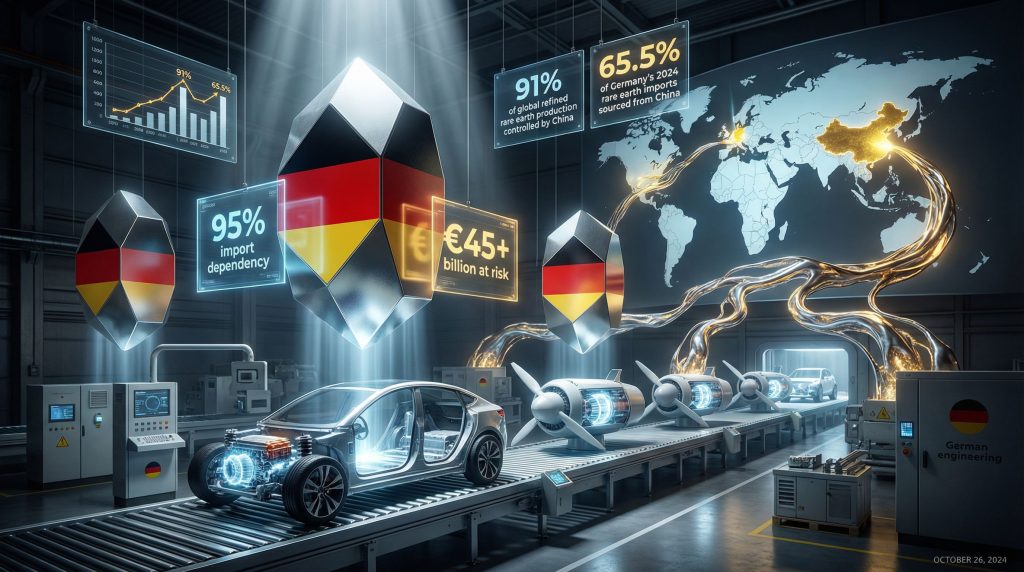
China's control over 91% of global refined rare earth production represents more than market dominance; it constitutes a strategic chokepoint that can be activated with immediate economic consequences. The recent implementation of export controls followed by selective twelve-month suspensions demonstrates Beijing's sophisticated approach to leveraging critical materials access as a diplomatic and economic tool.
Critical Vulnerability Metrics:
- 91% of global refined rare earth production controlled by China
- 65.5% of Germany's 2024 rare earth imports sourced from China
- Zero domestic separation and refining capacity
- 12-month tactical suspension represents temporary reprieve, not structural solution
When big ASX news breaks, our subscribers know first
What Makes Germany Europe's Most Exposed Economy?
Germany's position as Europe's manufacturing powerhouse creates unique vulnerabilities in the Germany rare earth supply chain. The country's industrial concentration spans precisely those sectors most dependent on critical materials, from automotive manufacturing requiring neodymium-iron-boron magnets for electric vehicle drivetrains to defense systems utilising rare earth elements in guidance and radar technologies.
Moreover, critical minerals energy security considerations compound these vulnerabilities across multiple industrial sectors simultaneously.
Industrial Concentration Creates Systemic Risk
The automotive sector alone represents over €45 billion in potential disruption exposure, encompassing major manufacturers including Volkswagen Group, BMW, and Mercedes-Benz. These companies require continuous access to high-grade permanent magnets for electric vehicle production, with each vehicle typically requiring 0.5 to 1.0 kilograms of rare earth permanent magnets.
Volkswagen's commitment to producing 70% of European vehicle sales as battery electric vehicles by 2030 directly correlates to exponentially increased rare earth magnet demand. The company's ID series production targets alone require approximately 750 metric tons of permanent magnets annually, representing substantial exposure to supply chain disruptions.
Consequently, the electronics manufacturing sector compounds this vulnerability through its 78% dependency on rare earth elements for critical components. German companies like Infineon, Siemens, and Bosch utilise rare earth materials in semiconductor manufacturing, industrial electronics, and consumer technology applications. This creates cross-sector exposure where disruption in one industry reverberates throughout German manufacturing.
Geographic Concentration Amplifies Strategic Risk
Germany's manufacturing clusters in Bavaria, Baden-Württemberg, and North Rhine-Westphalia create geographic concentration of rare earth dependency. These regions house the majority of automotive manufacturing, electronics production, and defense contractors, meaning localised supply disruptions can halt production across multiple industrial sectors simultaneously.
The just-in-time manufacturing practices adopted throughout German industry eliminate buffer inventory that might otherwise provide temporary protection against supply interruptions. This lean approach, while economically efficient during normal operations, creates acute vulnerability when rare earth supply chains experience disruption.
Unlike other European economies that maintain more diversified industrial bases, Germany's concentration in high-tech manufacturing creates what supply chain experts term "single-point-of-failure" risk. When rare earth access becomes constrained, German industry cannot easily substitute alternative materials or production methods without fundamental redesign of established manufacturing processes.
Why Are Beijing's Export Controls More Than Trade Policy?
China's approach to rare earth export restrictions operates as a sophisticated instrument of strategic influence rather than conventional trade policy. The selective nature of export controls, combined with tactical suspensions and regulatory complexity, enables Beijing to calibrate economic pressure whilst maintaining diplomatic flexibility.
For instance, Germany's dependency on Chinese supplies has reached critical levels that threaten industrial autonomy across multiple sectors.
The Strategic Leverage Framework
Chinese rare earth export controls function through multiple regulatory mechanisms that create layered complexity for dependent industries. Export licensing requirements, customs processing delays, environmental compliance standards, and quality certification processes provide Beijing with numerous intervention points in the supply chain.
The recent twelve-month suspension granted to European importers exemplifies this calibrated approach. Rather than implementing comprehensive export bans that would trigger immediate alternative sourcing efforts, Beijing applies selective pressure that maintains dependency whilst demonstrating leverage capability.
Historical analysis reveals consistent patterns in Chinese rare earth policy. The 2010-2011 export restrictions reduced Chinese rare earth quotas by approximately 40%, creating significant market disruption that prompted emergency alternative sourcing initiatives. However, after several years of market adaptation, China resumed more normalised export patterns once geopolitical objectives shifted.
Tactical Suspensions vs. Structural Solutions
The current twelve-month suspension represents crisis management rather than structural policy reform. German Foreign Minister Johann Wadephul's diplomatic mission to Beijing reflects recognition that standard trade negotiation mechanisms prove inadequate when dealing with strategic material dependencies.
China's refining monopoly ensures that even alternative raw ore sourcing from countries like Australia, Myanmar, or Brazil provides no meaningful independence without access to Chinese separation and processing facilities. This technical dependency means that diversifying raw material sources fails to address the fundamental strategic vulnerability.
The sophistication of Chinese export control implementation includes plausible regulatory justification through environmental compliance requirements and domestic demand prioritisation. This approach allows Beijing to apply economic pressure whilst maintaining diplomatic cover and avoiding direct confrontation over trade restrictions.
How Realistic Are Europe's Re-shoring Ambitions?
European ambitions for Germany rare earth supply chain independence face substantial technical, economic, and temporal constraints that current policy frameworks inadequately address. Whilst political commitment appears genuine, the practical challenges of developing alternative rare earth processing capabilities require realistic assessment of feasible timelines and investment requirements.
However, the European raw materials facility initiative represents a significant step toward reducing dependency on Chinese sources.
The Multi-Billion Euro Reality Check
Europe's announced multi-billion-euro plan for rare earth independence encompasses domestic extraction, separation facility development, and magnet manufacturing capacity. Nevertheless, each phase presents distinct challenges that compound the overall complexity of achieving meaningful supply chain diversification.
Table: European Rare Earth Development Timeline Challenges
| Development Phase | Estimated Timeline | Investment Required | Primary Technical Barriers |
|---|---|---|---|
| Domestic extraction | 8-12 years | €15-20 billion | Low-grade deposits, environmental permits |
| Separation facilities | 5-7 years | €8-12 billion | Technology transfer, skilled workforce |
| Magnet manufacturing | 3-5 years | €5-8 billion | Intellectual property, quality standards |
| Full supply chain | 10-15 years | €30-45 billion | Integration complexity, market volatility |
Domestic extraction represents the most challenging component of European rare earth independence. Germany possesses no significant commercial rare earth ore deposits, whilst potential European sources in Scandinavia require extensive exploration, environmental assessment, and infrastructure development spanning decades.
The Kvanefjeld project in Greenland, operated by Greenland Minerals, represents one of few Western rare earth projects approaching commercial viability. However, environmental concerns and permitting complexities have delayed development for over a decade, illustrating the regulatory challenges facing new extraction projects.
Friend-shoring: Opportunities and Limitations
Germany's pivot toward allied suppliers, particularly Australia, Canada, and Japan, offers medium-term diversification potential but cannot eliminate Chinese dependency within current industrial timelines. Furthermore, Australian green metals leadership provides valuable insights into alternative sourcing strategies.
Australian rare earth projects like Lynas Corporation provide processing capacity alternatives, yet remain insufficient to meet German industrial demand at required scales. Additionally, a comprehensive rare earth reserves overview demonstrates the global distribution challenges facing supply diversification efforts.
Canadian rare earth deposits, including those controlled by companies like Appia Energy and Defense Metals, offer long-term potential but require massive infrastructure investments and environmental approvals that could span multiple decades. The technical complexity of developing high-grade separation facilities in jurisdictions without existing rare earth processing infrastructure creates additional timeline and cost uncertainties.
Japanese rare earth recycling technology presents promising opportunities for urban mining and recovery from electronic waste. However, recycling cannot provide the scale necessary to replace primary production for Germany's expanding electric vehicle and renewable energy manufacturing requirements.
Partnership structures between German industrial companies and allied rare earth producers create mutual benefit opportunities that receive preferential treatment in government procurement and strategic material stockpiling programs. These joint ventures often qualify for accelerated permitting and financial incentives designed to encourage supply chain diversification.
What Investment Opportunities Emerge from Strategic Vulnerability?
Germany's recognition of rare earth dependency as a national security priority creates substantial investment opportunities across multiple sectors. Government funding programmes, regulatory support, and strategic procurement preferences combine to create attractive risk-adjusted returns for investors with appropriate technical expertise and market positioning.
Additionally, the recent battery recycling breakthrough in neighbouring China highlights the importance of developing independent recycling capabilities.
Subsidy Acceleration and Policy Support
German government initiatives targeting supply chain independence offer significant financial incentives for domestic processing infrastructure development. Federal funding programmes prioritise separation and refining facility construction through grants, loan guarantees, and tax incentives designed to accelerate private investment.
The European Union's Critical Raw Materials Act provides additional regulatory framework supporting rare earth processing investments. This legislation includes streamlined permitting procedures, strategic project designation, and financial support mechanisms that reduce development risk for qualified initiatives.
Recycling technology development represents a particularly attractive investment category with strong regulatory tailwinds and environmental benefits. Urban mining and rare earth recovery from electronic waste qualify for multiple government support programmes whilst addressing both supply security and sustainability objectives.
Research and development investments in rare earth substitutes and efficiency improvements receive increasing government support through direct research grants and collaborative funding programmes. Alternative material development offers potential breakthrough opportunities with substantial commercial application across German industrial sectors.
Strategic Partnership Opportunities
Joint ventures between German industrial companies and allied rare earth producers create structured investment opportunities that align supply security objectives with commercial returns. These partnerships often receive preferential access to government contracts and strategic material stockpiling programmes.
Investment in Australian and Canadian rare earth processing expansion provides exposure to growing demand from European markets whilst benefiting from allied government support for supply chain diversification. These projects typically feature long-term offtake agreements with German manufacturers seeking supply chain security.
Technology transfer agreements between European companies and established rare earth processors create opportunities for intellectual property monetisation and manufacturing licence revenue. German engineering expertise in precision manufacturing and process optimisation provides competitive advantages in rare earth processing technology development.
Financial instruments supporting supply chain diversification, including strategic material financing and trade credit insurance specifically designed for critical materials commerce, represent emerging investment categories with government backing and preferential terms.
FAQ: Understanding Germany's Rare Earth Challenge
How quickly could Germany reduce Chinese rare earth dependency?
Realistic timelines suggest 10-15 years for meaningful dependency reduction, requiring sustained political commitment and massive capital investment across the entire supply chain. Separation facility development alone requires 5-7 years, whilst domestic extraction projects span 8-12 years from initial exploration to commercial production.
What happens if China implements permanent export restrictions?
German automotive and electronics production would face immediate disruption, potentially triggering broader European industrial recession and accelerating emergency re-shoring investments. The automotive sector's €45 billion exposure would translate to production halts, supply chain failures, and significant economic contraction across dependent industries.
Are there viable alternatives to Chinese rare earth processing?
Limited alternatives exist through Australian and Canadian suppliers, but current global processing capacity outside China cannot substitute for Chinese supply at required industrial scales. Lynas Corporation represents the largest non-Chinese processor but produces less than 10% of Germany's current consumption requirements.
How do rare earth recycling technologies impact supply security?
Recycling and urban mining provide supplementary supply sources but cannot replace primary production for expanding electric vehicle and renewable energy manufacturing. Current recycling yields approximately 5-10% of total rare earth demand, with technical limitations preventing higher recovery rates from existing electronic waste streams.
The next major ASX story will hit our subscribers first
Strategic Implications for Global Supply Chains
Germany's rare earth vulnerability represents a microcosm of broader Western industrial dependency on Chinese critical materials. The diplomatic scramble to Beijing signals recognition that traditional trade relationships cannot address strategic material dependencies when supply access becomes weaponised for geopolitical objectives.
Investment flows toward supply chain diversification will accelerate regardless of short-term diplomatic outcomes, creating sustained opportunities in alternative sourcing, processing technology, and recycling innovation. The fundamental tension between industrial efficiency and supply security ensures continued policy support for rare earth independence initiatives.
European recognition of rare earth dependency as existential threat rather than trade issue creates paradigm shift in industrial policy that prioritises supply security over cost optimisation. This reframing generates sustained political commitment and financial resources necessary for long-term supply chain restructuring.
The strategic implications extend beyond Germany to encompass broader European industrial competitiveness and technological sovereignty. Success or failure in achieving Germany rare earth supply chain independence will determine Europe's ability to maintain industrial leadership in electric vehicles, renewable energy, and advanced manufacturing technologies.
For investors and strategic planners, Germany's rare earth challenge represents both warning and opportunity. Whilst current vulnerabilities create immediate risks, the massive investment commitments and policy support for supply chain independence generate substantial commercial opportunities for those positioned to capitalise on Europe's strategic pivot away from Chinese dependency.
In addition, Germany's industrial concerns about rare earth security reflect broader European supply chain vulnerabilities that require coordinated response.
Disclaimer: This analysis is for informational purposes only and does not constitute investment advice. Rare earth market investments carry significant risks including commodity price volatility, regulatory changes, and geopolitical disruption. Readers should conduct independent research and consult qualified professionals before making investment decisions.
Looking to Capitalise on Critical Materials Market Disruptions?
Germany's rare earth crisis represents exactly the type of supply chain vulnerability that creates substantial market opportunities for informed investors. Discovery Alert's proprietary Discovery IQ model delivers real-time alerts on significant ASX mineral discoveries, particularly those involving critical materials like rare earth elements, instantly empowering subscribers to identify actionable opportunities ahead of the broader market. Begin your 30-day free trial today and position yourself to capture the next major critical materials discovery as global supply chains reshape.