June 15, 2026
The Structural Fragility Beneath Europe's Industrial Ambitions
Across the past decade, Europe's industrial base has confronted a paradox that policymakers have struggled to resolve: the continent simultaneously champions advanced manufacturing leadership while watching the energy-intensive foundations of that manufacturing erode beneath rising power costs. Primary aluminium production sits at the sharpest edge of this contradiction. It is a process that demands vast, continuous electricity consumption, and when European wholesale electricity prices surged to historic levels between 2021 and 2023, smelters across the continent faced a binary choice between operating at a loss or shutting down entirely.
The story unfolding in central Slovakia around the Slovalco facility in Žiar nad Hronom is not simply a corporate restart announcement. It is a test case for whether European industrial policy has matured enough to create conditions where energy-intensive production can survive on the continent at all. Slovakia restarting Žiar nad Hronom aluminium smelter operations would represent one of the more significant industrial reversals in Central Europe since the energy crisis peak, and the mechanics behind how that becomes possible tell a much larger story.
When big ASX news breaks, our subscribers know first
How Europe Lost Its Primary Aluminium Capacity
The Energy Crisis and Its Disproportionate Industrial Toll
Primary aluminium smelting ranks among the most electricity-intensive industrial processes in existence. Producing a single metric tonne of primary aluminium through the Hall-Héroult electrolytic reduction process consumes approximately 13,000 to 15,000 kilowatt-hours of electricity depending on plant efficiency and technology generation. At scale, this means electricity typically accounts for between 30 and 40 percent of total production costs at a European smelter operating under normal market conditions.
When European day-ahead electricity prices in key markets surged past €500 per megawatt-hour during the 2021 to 2022 energy crisis, a figure that dwarfed historical norms that had averaged closer to €40 to €60 per megawatt-hour in prior years, the arithmetic of primary smelting collapsed entirely. Facilities that had operated profitably for decades found themselves spending more on power alone than the market price of the aluminium they were producing.
The contraction that followed was measurable and severe. Multiple European smelters curtailed output partially or completely between 2021 and 2023. According to European Aluminium industry data, the continent's primary aluminium production capacity fell significantly during this period, deepening a structural import dependency that had already been building for years. Furthermore, Europe, which had once supplied a meaningful share of its own primary metal needs, became increasingly reliant on imports from regions where electricity costs bore no resemblance to European market rates.
Slovalco's Place in the Regional Supply Picture
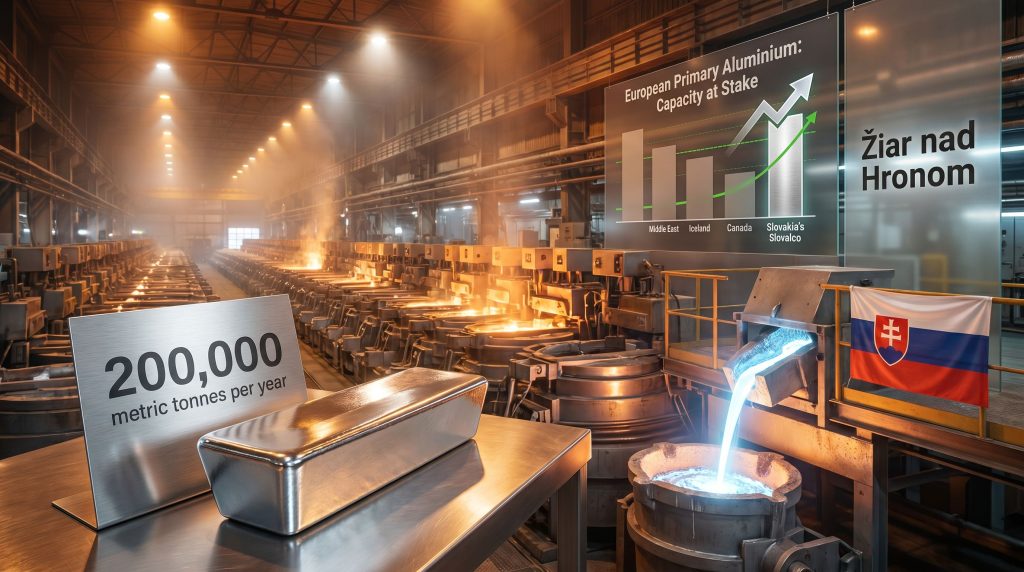
The Slovalco facility, located in Žiar nad Hronom within Slovakia's Banská Bystrica region, had operated as one of Central Europe's more significant primary aluminium production sites. At its operational peak, the plant held a capacity of approximately 200,000 metric tonnes per year, a volume that places it among the larger single-site primary aluminium assets in the region. Slovalco's product range spans a variety of aluminium alloys serving multiple industrial sectors across Europe.
A production footprint of 200,000 metric tonnes annually is not a marginal contributor. In the context of a European primary aluminium industry that has been systematically losing capacity, Slovalco's absence from the active supply base since 2022 represents a tangible and ongoing gap in regional output.
The facility is operated by Slovalco, in which Norwegian aluminium and renewable energy company Hydro holds a controlling interest. The 2022 shutdown decision was driven directly by the electricity price environment making sustained production commercially indefensible. Crucially, however, the asset was not abandoned. Hydro's continued maintenance of the idle facility has been widely interpreted within the industry as a deliberate preservation of restart optionality rather than a prelude to permanent decommissioning.
Technical Realities of Reactivating a Dormant Smelter
What Three Years of Idling Actually Means for Pot Line Integrity
A critical distinction in assessing smelter restart feasibility is the difference between a cold shutdown and a maintained idle state. In a cold shutdown, the electrolytic pot lines that house the reduction cells are allowed to cool completely, causing the molten cryolite and aluminium bath to solidify. Restarting from this state requires extensive relining of the pots, a capital and time-intensive process that can cost hundreds of millions of euros at a facility of Slovalco's scale.
A maintained idle state, by contrast, involves keeping the pot infrastructure in a condition that avoids complete solidification and preserves the structural integrity of the cathode lining. The additional operational expense of maintaining an idle smelter is significant, but it is substantially lower than the cost of a full cold restart. Hydro's decision to continue maintaining the Žiar nad Hronom asset through more than three years of non-production reflects a calculated bet that restart conditions could eventually emerge.
Industry assessments suggest the facility remains technically viable for restart. This is not a given after extended idling periods, and the maintained status of the asset is a genuine commercial differentiator compared to other European smelters that were more fully decommissioned during the same crisis period.
The Three-Layer Viability Test
Any smelter reactivation decision can be evaluated across three distinct dimensions, each of which must be satisfied before a commercially rational restart can proceed:
| Viability Dimension | Key Requirements | Status at Žiar nad Hronom |
|---|---|---|
| Technical Feasibility | Pot line integrity, cathode condition, infrastructure maintenance | Reported as technically viable after 3+ years of maintained idling |
| Energy Economics | Long-term power price certainty below breakeven threshold | Primary unresolved constraint as of mid-2025 |
| Commercial Certainty | Minimum production horizon to justify capital outlay | Slovak government targeting minimum 10-year production commitment |
The technical dimension appears to have been largely addressed through Hydro's maintenance programme. The commercial certainty question is being addressed through government engagement. However, the energy economics dimension is the unresolved variable that determines whether the other two factors translate into actual production.
The Policy Architecture Attempting to Bridge the Gap
Government Facilitation and the MoU Framework
Slovak Prime Minister Robert Fico has been publicly and persistently engaged on the Slovalco restart, framing it as both an industrial priority and a national employment issue for the Banská Bystrica region. Fico has indicated that preparations for an official announcement regarding the restart are in their final stages, with a Memorandum of Understanding between the Slovak government and the facility forming a central pillar of the framework being constructed.
The government's role appears focused on facilitating a structured energy pricing arrangement rather than providing direct financial subsidies, a distinction with significant implications for EU state aid compliance. The EU metals action plan places strict limits on direct industrial subsidies, but structured long-term energy contracts and regulated pricing arrangements have been used by other member states to support energy-intensive industries within those constraints.
The identification of a minimum ten-year production horizon as the threshold for commercial justification reflects the capital recovery logic of smelter investment. Restart expenditure, even from a maintained idle state, requires a sufficient production runway to generate the returns needed to justify the outlay. A decade-long commitment provides the investment horizon that Hydro would need to allocate capital with confidence.
The Electricity Cost Challenge in Comparative Perspective
European smelting faces a structural cost disadvantage relative to competing production regions that is not easily resolved through policy instruments alone. The following comparison illustrates the magnitude of the competitive gap:
| Production Region | Approximate Cost Positioning vs. Europe | Primary Driver |
|---|---|---|
| Middle East (UAE, Bahrain) | Significantly lower | Subsidised energy, gas-based power at regulated rates |
| Iceland | Moderately lower | Geothermal and hydro electricity at competitive contracted rates |
| Canada | Moderately lower | Hydro-based power through long-term industrial agreements |
| China | Variable | Domestic energy policy, scale economies, regional variation |
| Europe (post-restart) | Baseline reference | Dependent on policy-supported or specially contracted energy pricing |
For a Slovak restart to be commercially sustainable, the effective electricity price secured by Slovalco would need to sit at a level that allows the facility to compete on global markets. This likely requires a price well below prevailing European market rates, achievable only through a dedicated long-term supply arrangement, structured support mechanism, or combination of both.
EU-Level Dimensions and State Aid Constraints
The broader EU policy environment creates both opportunities and complications for the Slovak restart. Europe's critical minerals supply chain and associated competitiveness initiatives have sought to address the structural challenges facing energy-intensive manufacturing, but aluminium's status within EU strategic materials classifications has not historically been as unambiguous as sectors like semiconductors or batteries.
The tension between EU state aid rules and member-state ambitions to support smelting capacity is genuine. Several EU members have navigated this by structuring support through regulated network tariffs, capacity mechanisms, or direct power purchase agreements with state-affiliated energy companies, approaches that sit in a different regulatory category than outright production subsidies. Whether Slovakia's eventual package follows a similar path is one of the key structural questions the Žiar nad Hronom case will answer.
Market Implications of Restored European Capacity
What 200,000 Tonnes Means for Regional Supply Dynamics
European primary aluminium consumption across all downstream sectors, including automotive, aerospace, packaging, construction, and electrical applications, runs into the millions of tonnes annually. A single facility contributing 200,000 metric tonnes would not by itself transform the supply picture, but the symbolism and precedent of a successful restart carries weight beyond its physical volume.
The import substitution effect is more meaningful at the regional level. Central European automotive and industrial manufacturers that currently source primary aluminium through import channels would gain access to a proximate domestic supply source, reducing logistics costs, carbon intensity, and supply chain exposure to geopolitical disruption. In addition, the packaging and construction sectors in the region would similarly benefit from increased domestic availability.
European aluminium premiums, which reflect the regional supply-demand balance above the LME benchmark price, are sensitive to shifts in available tonnage. A 200,000 tonne addition to the regional supply base would exert some moderating pressure on premiums, though the magnitude of that effect depends on broader market conditions and demand trends at the time of restart.
A Template for Other Idled European Smelters?
The Žiar nad Hronom situation is not unique. Several other European primary aluminium smelters curtailed or fully stopped production during the energy crisis period, and the owners of those assets are watching the Slovak situation closely. A successful restart that demonstrates a viable policy-and-energy-pricing model could provide a template for other facilities to pursue similar arrangements. This aligns broadly with efforts to strengthen green iron in Australia and comparable energy-intensive industries worldwide.
This possibility carries a double-edged implication. On one hand, restoring European smelting capacity strengthens regional supply chains and reduces import dependency. On the other, if government intervention becomes a structural prerequisite for primary aluminium production in Europe, questions arise about the long-term competitiveness of the industry without ongoing policy support. The Žiar nad Hronom outcome will inform how investors, policymakers, and industry operators think about European smelting viability for years to come.
Scenario Analysis: Three Paths Forward
Scenario A: Full Restart Within 12 Months
This outcome requires the convergence of several conditions:
- The MoU between the Slovak government and Slovalco is signed and operationalised
- A durable, long-term electricity pricing arrangement is secured at commercially viable levels
- Any required EU state aid assessment proceeds without material obstruction
- Hydro formally allocates restart capital and initiates the reactivation process
If these conditions are met, industry estimates for similar restart processes suggest an approximately six to twelve month period from capital commitment to first metal production, accounting for pot line recommissioning, hiring and retraining of operational staff, and supply chain reestablishment. The regional employment impact in the Banská Bystrica area would be substantial, given that primary smelter operations support significant direct and indirect employment.
Scenario B: Delayed Restart Due to Energy Pricing Impasse
If electricity cost negotiations stall, the restart timeline extends indefinitely. Prolonged delay carries its own risks beyond the commercial: even a maintained idle facility undergoes gradual physical deterioration, and there is a threshold beyond which the capital cost of restart begins to escalate toward cold-restart levels. Political credibility costs for the Fico government would also accumulate if the publicly signalled announcement fails to materialise.
Scenario C: Permanent Closure
The conditions that would drive this outcome include sustained high European power prices, absence of an effective support mechanism, and a reassessment by Hydro of capital allocation priorities across its global portfolio. Permanent closure would have lasting consequences for Slovak industrial capacity and would set a discouraging precedent for other idled European smelters weighing their own restart optionality.
The single largest variable across all three scenarios remains the electricity cost resolution. Without a durable, long-term energy pricing solution, technical viability and political will are necessary but not sufficient conditions for a commercially sustainable restart.
The next major ASX story will hit our subscribers first
Frequently Asked Questions
What is the Žiar nad Hronom aluminium smelter and who operates it?
The Slovalco facility in Žiar nad Hronom is a primary aluminium smelter located in the Banská Bystrica region of central Slovakia. It is operated by Slovalco, with Norwegian energy and aluminium company Hydro holding a controlling ownership stake.
Why did the smelter cease production in 2022?
The shutdown was driven by the 2021 to 2022 European energy crisis, during which wholesale electricity prices rose to levels that made primary aluminium smelting commercially unviable. With electricity representing 30 to 40 percent of production costs, the surge in power prices eliminated operating margins entirely.
What is the facility's production capacity?
At full operation, Slovalco has a production capacity of approximately 200,000 metric tonnes of primary aluminium per year, placing it among the larger single-site smelters in Central Europe.
Is the smelter physically capable of restarting after more than three years idle?
Industry assessments indicate the facility has been maintained in a state that preserves technical restart viability, distinguishing it from smelters that underwent full cold shutdowns. Hydro's continued maintenance investment has been a key factor in keeping the restart option open.
What obstacles remain before production can resume?
The primary obstacle is securing a long-term electricity pricing arrangement that makes operations commercially sustainable. Secondary requirements include finalising the government-Slovalco Memorandum of Understanding, confirming EU regulatory compatibility of any support structure, and Hydro completing its formal capital allocation decision.
How would a restart affect European aluminium supply?
Restoring 200,000 tonnes of annual European primary aluminium production would partially offset the capacity lost during the energy crisis period, reduce regional import dependency, and strengthen supply chain proximity for Central European downstream manufacturers. Consequently, Slovakia restarting Žiar nad Hronom aluminium smelter would meaningfully reinforce the European raw materials supply picture at a time when the continent is actively seeking to reduce import exposure.
What Investors and Industry Stakeholders Should Monitor
Key Decision Triggers and Milestones
For those tracking the commercial and policy progress of the restart, the following milestones represent the critical decision points:
- MoU signing between the Slovak government and Slovalco, establishing the framework for restart commitments
- Long-term electricity pricing announcement, confirming whether a viable energy cost structure has been secured
- EU state aid assessment outcome, clarifying the regulatory permissibility of any structured support
- Hydro capital allocation decision, representing the company's formal commitment of restart expenditure
- First production restart date, confirming the transition from preparation to active smelting
The Broader Competitiveness Question Europe Cannot Avoid
The Žiar nad Hronom situation encapsulates a tension that extends well beyond one smelter in one country. Europe's decarbonisation agenda is fundamentally reshaping its energy system, and while the long-term destination of abundant renewable electricity at low marginal cost is theoretically consistent with competitive smelting, the transition period continues to impose costs that undermine energy-intensive industries in the near term.
The question of whether European primary aluminium production has a structurally viable future, or whether it persists only through ongoing policy support, will be shaped in part by what happens in Žiar nad Hronom. Advances in green iron production demonstrate how decarbonisation-aligned models can reshape energy-intensive industries, offering a potential reference point for aluminium's own transition. If Slovakia successfully constructs a model that makes the economics work, that model becomes a reference point for the industry across the continent.
If it fails, however, the erosion of European smelting capacity is likely to continue, deepening the region's dependence on aluminium produced under energy regimes and environmental standards that European policy explicitly seeks to move beyond. Slovakia restarting Žiar nad Hronom aluminium smelter therefore carries implications that resonate well beyond its borders.
Readers seeking ongoing coverage of European aluminium production developments, smelter economics, and primary metal market dynamics can explore industry reporting available through AL Circle, which provides continuous coverage of the global aluminium sector.
This article contains forward-looking analysis and scenario assessments that involve inherent uncertainty. Outcomes related to restart timelines, policy decisions, energy pricing arrangements, and market impacts are speculative in nature and should not be interpreted as investment advice. Readers should conduct independent research before making any investment or commercial decisions.
Want to Stay Ahead of Major Resource and Commodity Discoveries as They Happen?
Discovery Alert's proprietary Discovery IQ model delivers real-time alerts on significant ASX mineral discoveries — cutting through the complexity of 30+ commodities to surface actionable opportunities the moment they are announced. Explore how historic discoveries have generated substantial returns on Discovery Alert's dedicated discoveries page, and begin your 14-day free trial today to position yourself ahead of the broader market.