June 15, 2026
The Feedstock Bottleneck Nobody Talks About in Green Steel
The global conversation around decarbonising steel production tends to fixate on hydrogen availability, renewable energy costs, and electrolyser capacity. These are legitimate constraints, but they obscure an equally fundamental problem sitting upstream of the entire green steel value chain: most of the world's iron ore is the wrong grade for the technologies being built to replace the blast furnace.
Hydrogen iron ore reduction, widely regarded as the most commercially credible pathway to near-zero emissions steelmaking, was largely engineered around high-grade iron ore feedstocks with iron content typically exceeding 67% Fe. The inconvenient reality is that a substantial portion of globally traded iron ore sits below this threshold. That gap between ore supply and technology compatibility is not a minor technical footnote. It is one of the central constraints on how quickly, and how completely, the steel industry can actually decarbonise.
The recently concluded Rio Tinto China Baowu shaft furnace trials represent one of the most substantive attempts yet to close this gap at industrial scale.
When big ASX news breaks, our subscribers know first
Why Iron Ore Grade Is the Overlooked Variable in Green Steel Economics
To understand why the Rio Tinto China Baowu shaft furnace trials matter, it helps to understand why ore grade became a constraint in the first place.
In a conventional blast furnace, iron ore of varying quality can be processed because the high temperatures involved and the use of metallurgical coke create a relatively forgiving reduction environment. Impurities are managed through slag chemistry, and operators have centuries of accumulated knowledge in tuning the process around variable feedstocks.
Hydrogen-based shaft furnaces operate on a fundamentally different principle. Iron ore pellets descend through a vertical reactor by gravity while hot reducing gas, primarily hydrogen, flows upward through the bed. The hydrogen strips oxygen from the iron oxide, producing metallic iron, known as direct reduced iron or DRI, and water vapour rather than carbon dioxide. It is an elegant chemistry, but it is also sensitive.
Mid-grade ores present specific challenges in this environment:
- Higher gangue mineral content, including silica and alumina, increases the slag volume that must be managed downstream
- Certain mineralogical structures found in mid-grade ores can impede reduction kinetics, slowing the rate at which hydrogen penetrates ore pellets
- Sticking and clustering of pellets inside the furnace shaft, a known problem with some ore types, can disrupt gas flow and furnace productivity
- Lower iron content per tonne means more material must be processed to produce equivalent metallic iron output
For Western Australia's Pilbara region, which produces some of the highest volumes of iron ore on the planet and recently surpassed eight billion cumulative tonnes of shipments, these constraints carry enormous strategic weight. Furthermore, if hydrogen-based direct reduction scales exclusively around high-grade ores, Pilbara Blend, one of the world's most widely traded iron ore products, faces a structural relevance problem as blast furnace-based steelmaking contracts over coming decades.
How the Shaft Furnace Trial Was Structured
The Rio Tinto China Baowu shaft furnace trials were conducted at Baowu's Baoshan Iron and Steel Zhanjiang Steel Operations in China, an operating steelworks environment rather than a controlled laboratory, which carries significant weight for technology validation purposes. You can read more about these completed direct reduction trials on Rio Tinto's official site.
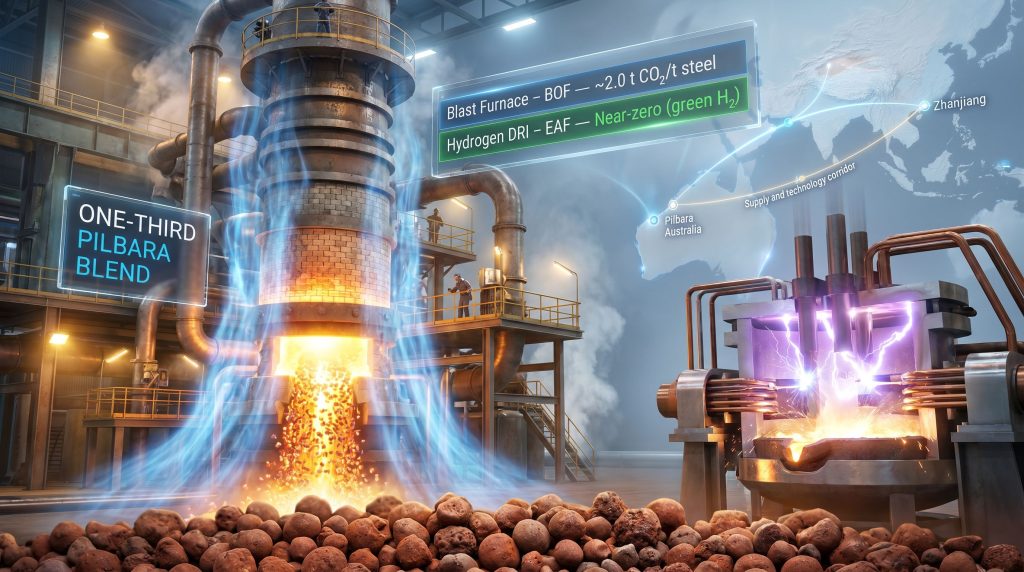
The trial used pellets incorporating one-third Pilbara Blend ore as part of the shaft furnace feedstock blend. The blended approach was deliberate: introducing Pilbara ore incrementally allows the technical team to isolate its behaviour within the reduction environment before advancing to higher blend ratios.
The pelletisation step itself deserves attention. Run-of-mine iron ore must be processed into pellets of consistent size, porosity, and strength before it can function effectively in a shaft furnace. Pellet quality directly influences gas permeability through the bed, reduction efficiency, and the likelihood of the clustering problems that can compromise furnace operation. Demonstrating that Pilbara Blend ore can be pelletised to the required specification is a prerequisite for everything that follows.
Once DRI was produced, validation extended across two distinct downstream processing routes:
- Industrial-scale basic oxygen furnace conversion: DRI was processed into steel using a BOF at commercial scale, confirming metallurgical compatibility with established steelmaking infrastructure
- Small-scale 500 kg electric smelting furnace testing: DRI was separately evaluated in an electric smelting furnace, a technology specifically engineered to handle the higher slag volumes associated with mid-grade ore-derived DRI
Testing across both conversion methods substantially strengthens the commercial case. It demonstrates that Pilbara-derived DRI is not locked into a single downstream pathway but can interface with both existing infrastructure and emerging low-carbon processing technologies.
The Comparison: Conventional vs. Low-Carbon Steelmaking Routes
| Process Route | Primary Reductant | CO2 Intensity | Ore Grade Requirement | Scalability Status |
|---|---|---|---|---|
| Blast Furnace + BOF | Metallurgical coke | ~2.0 t CO2/t steel | Medium to high | Fully commercial |
| Natural gas DRI + EAF | Natural gas (CH4) | ~1.0 to 1.4 t CO2/t steel | High grade preferred | Commercial (MIDREX, HYL) |
| Hydrogen DRI + EAF | Green hydrogen (H2) | Near-zero (green H2) | High grade preferred | Pilot to early commercial |
| H-DR + Electric Smelting Furnace | Green hydrogen (H2) | Near-zero potential | Mid-grade viable (emerging) | Industrial trial stage |
The H-DR combined with electric smelting furnace route sits at the frontier precisely because it is the combination that could unlock mid-grade ore compatibility, which is the critical differentiator this trial was designed to test.
The Electric Smelting Furnace: A Critical Enabling Technology
Among the less widely discussed elements of the Rio Tinto China Baowu shaft furnace trials, the 500 kg electric smelting furnace component deserves particular attention from anyone tracking the technical trajectory of green steelmaking.
An electric smelting furnace operates by using electrical energy to melt and refine DRI, with its design specifically accommodating elevated levels of slag generation. This characteristic makes it functionally suited to processing DRI produced from lower-grade ore inputs, where higher gangue content inevitably translates to greater slag volumes during downstream metallurgical processing.
The combination of hydrogen shaft furnace reduction with electric smelting furnace processing effectively creates a two-stage system that compensates for the grade limitations of mid-range iron ores, potentially transforming a supply chain constraint into a commercially viable green iron production pathway.
For context, conventional electric arc furnaces, the dominant downstream technology in most hydrogen DRI roadmaps, are optimised for high-metallisation DRI with minimal impurities. However, the ESF's tolerance for compositional variability makes it the essential bridge technology connecting mid-grade ore supply to hydrogen-based reduction.
What a 50-Year Partnership Brings to Technology Development
The Rio Tinto and China Baowu collaboration is unusual in the mining and steelmaking industries for its depth and duration. More than five decades of joint research and technology innovation have created institutional knowledge that is difficult to replicate quickly.
Joint decarbonisation work commenced formally in 2020, structured across multiple project phases. The 2023 Climate Partnership memorandum of understanding formalised specific workstreams including low-carbon shaft furnace-based direct reduction and pilot-scale electric melter development. The completed shaft furnace trials fulfil a concrete deliverable within that framework.
Mao Xiaoming, Executive Deputy Director of the Baowu Low Carbon Centre and Deputy Director of the Baowu Central Research Institute, characterised the trials as pragmatic actions under the Climate Partnership framework. He noted that the successful industrial-scale work advances both organisations' understanding of lower-emissions iron and steelmaking technologies and reflects the combined expertise each party brings across iron ore, process innovation, and industrial application.
Long-term industrial partnerships of this nature are increasingly recognised as structurally superior to transactional supply arrangements for hard-to-abate sector decarbonisation. Consequently, the depth of shared technical knowledge between Rio Tinto and Baowu, accumulated across decades of collaboration, creates the foundation for iterative problem-solving that technology development of this complexity requires.
Remaining Challenges on the Path to Commercial Deployment
The industrial-scale trial results are genuinely meaningful for technology readiness, but they represent one step in a multi-stage commercialisation journey. Investors and industry observers should understand the remaining constraints clearly.
Blend ratio progression: The current trial used one-third Pilbara Blend ore in the pellet mix. Advancing toward higher Pilbara ore proportions will require further trials to demonstrate performance stability and confirm that reduction efficiency and pellet behaviour remain within acceptable parameters as the mid-grade fraction increases.
Green hydrogen economics: The cost and availability of green hydrogen remains the dominant uncertainty underpinning all H-DR technology economics. Current green hydrogen production costs remain well above the levels required to make H-DR steel cost-competitive with conventional BF-BOF production at scale, though the trajectory of cost reduction in electrolyser manufacturing is a closely watched variable.
Pelletisation infrastructure: Scaling pellet production to meet the volumetric demands of industrial H-DR operations will require significant capital investment in pelletisation capacity. The Pilbara's existing ore preparation infrastructure was largely built around blast furnace-grade sinter fines rather than pellet feed specifications.
Carbon accounting complexity: Calculating genuine emissions reductions across the full value chain depends critically on the energy source used to produce hydrogen. Green hydrogen produced from renewable electricity delivers near-zero process emissions; however, hydrogen produced from fossil fuels with carbon capture introduces a range of emissions outcomes depending on capture efficiency.
Timeline to commercialisation: The gap between a successful industrial-scale trial and full commercial deployment of H-DR technology at the gigaton scale required to materially impact steel sector emissions is measured in decades, not years.
Disclaimer: The above analysis involves forward-looking assessments of technology development timelines, cost trajectories, and commercial deployment scenarios. These involve inherent uncertainty and should not be construed as investment advice. Actual outcomes may differ materially from projections.
The next major ASX story will hit our subscribers first
The Global Competitive Context for Green Steel Technology
The Rio Tinto China Baowu shaft furnace trials sit within a broader international race to solve exactly this feedstock compatibility problem. In addition, the broader China steel and iron ore market continues to shape the pace and direction of these technological developments.
Key competing technology pathways currently under active development globally include:
- Hydrogen direct reduction combined with electric arc furnace: the most commercially advanced low-carbon route, currently constrained to high-grade ore feedstocks
- Hydrogen direct reduction combined with electric smelting furnace: the pathway demonstrated by the Baowu trials, emerging as the candidate solution for mid-grade ore integration
- Molten oxide electrolysis: an electrolysis-based ironmaking approach that eliminates the need for a reducing gas entirely, though still at relatively early technology readiness levels
- Carbon capture and storage applied to existing blast furnace routes: offers incremental emissions reduction without feedstock constraints but does not achieve near-zero outcomes
The H-DR combined with ESF pathway is gaining particular traction among ore producers whose supply is concentrated in mid-grade material. The economic logic is straightforward: if this combination can be made commercially viable, it dramatically expands the raw material base available for green iron production in Australia and globally, protecting demand for iron ore grades that would otherwise face progressive exclusion from low-carbon supply chains.
Furthermore, the China iron ore outlook for mid-grade feedstocks could shift meaningfully if the H-DR and ESF combination achieves broader commercial validation. For a detailed breakdown of how these hydrogen-based DRI trials were conducted and their technical outcomes, independent reporting provides useful additional context.
FAQ: Rio Tinto China Baowu Shaft Furnace Trials Explained
What were the Rio Tinto China Baowu shaft furnace trials?
Industrial-scale technology trials conducted at Baowu's Zhanjiang Steel Operations in China, using a hydrogen-based shaft furnace to produce DRI from pellets containing one-third Pilbara Blend iron ore, with the resulting DRI converted to steel through both a basic oxygen furnace and a 500 kg electric smelting furnace.
Why does Pilbara Blend ore face challenges in hydrogen direct reduction?
Pilbara Blend is a mid-grade iron ore product with mineralogical characteristics that can create difficulties in shaft furnace environments, including higher slag volumes, potential pellet clustering, and variable reduction kinetics compared to the high-grade ores these processes were originally designed around.
What is an electric smelting furnace and why is it relevant?
An electric smelting furnace is a downstream processing technology designed to handle DRI with higher impurity content and greater slag volumes than conventional electric arc furnaces can efficiently manage. Its inclusion in the trial demonstrates a complete low-carbon processing pathway for mid-grade iron ore from mine to steel.
When did the Rio Tinto and China Baowu decarbonisation partnership begin?
Formal joint decarbonisation initiatives commenced in 2020, with a Climate Partnership memorandum of understanding signed in 2023 specifically targeting low-carbon shaft furnace direct reduction and electric melter technology development, building on a research and technology collaboration spanning more than 50 years.
What is the significance of industrial-scale testing versus laboratory trials?
Industrial-scale validation demonstrates that a technology performs within the physical and operational constraints of a real steelworks environment, not just under controlled laboratory conditions. This distinction is critical for assessing commercial readiness and attracting the capital investment required for full-scale deployment.
Trial Summary: Key Parameters at a Glance
| Trial Parameter | Detail |
|---|---|
| Trial location | Baoshan Iron and Steel Zhanjiang Steel Operations, China |
| Furnace type | Hydrogen-based shaft furnace |
| Pellet composition | One-third Pilbara Blend iron ore |
| Downstream processing route one | Industrial-scale basic oxygen furnace |
| Downstream processing route two | Small-scale 500 kg electric smelting furnace |
| Partnership framework | 2023 Climate Partnership MoU |
| Collaboration history | 50-plus years; decarbonisation phases since 2020 |
The successful conclusion of the Rio Tinto China Baowu shaft furnace trials does not resolve the full complexity of green steelmaking at scale. What it does establish, however, is that mid-grade Pilbara iron ore can function within a hydrogen-based reduction environment at industrial scale, and that the combined H-DR and electric smelting furnace pathway warrants continued development as a commercially credible route for iron ore grades that conventional wisdom had largely written off for the green steel era.
Want to Stay Ahead of the Next Major ASX Mineral Discovery?
Discovery Alert's proprietary Discovery IQ model delivers real-time alerts on significant ASX mineral discoveries, instantly translating complex data into actionable opportunities for investors at every level — explore the historic returns major discoveries have generated and begin your 14-day free trial today to position yourself ahead of the broader market.