
June 15, 2026
The Global Energy Chokepoint That Holds the World to Ransom
Every decade or so, global energy markets receive a blunt reminder that the physical infrastructure underpinning crude oil and gas trade is acutely concentrated in a handful of narrow maritime corridors. The Strait of Hormuz sits at the apex of that vulnerability. When that corridor closes, it does not merely inconvenience traders or nudge futures prices upward — it severs the primary export artery for nearly a fifth of all petroleum liquids traded globally. What is now unfolding in the wake of a reported Strait of Hormuz reopening deal is not simply a diplomatic milestone. It is a stress test of whether political agreements can translate into operational reality across one of the most complex and contested maritime environments on earth.
When big ASX news breaks, our subscribers know first
Understanding the Waterway That Controls a Fifth of Global Oil Supply
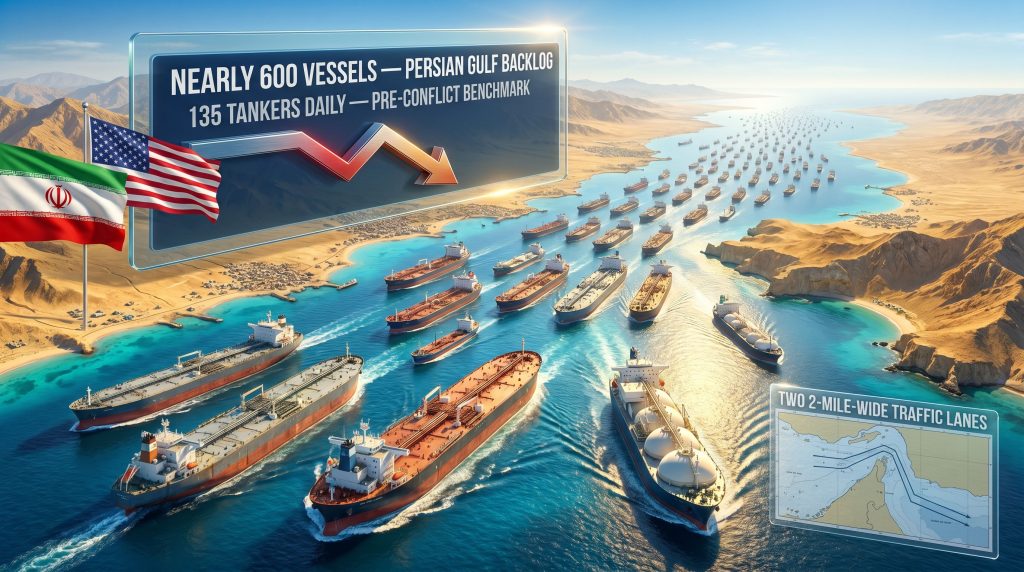
To appreciate the scale of what a Strait of Hormuz reopening deal would mean, it helps to understand the geometry of the problem. The Strait itself narrows to approximately 21 nautical miles at its most constrained navigable point, with commercial traffic funnelled through two lanes each just 2 miles wide, separated by a 2-mile median zone. This physical reality imposes a hard ceiling on throughput regardless of geopolitical goodwill.
Before the conflict disrupted traffic, the Strait carried an average of 135 tankers per day, handling roughly 20 to 21 percent of global petroleum liquids trade. Furthermore, the commodities flowing through this corridor included:
- Crude oil destined for Asian refiners, European terminals, and US strategic reserves
- Liquefied natural gas (LNG) exports primarily from Qatar, one of the world's largest LNG producers
- Refined petroleum products and petrochemical feedstocks
- Condensate and natural gas liquids from UAE and Iranian offshore fields
The nations most exposed to Strait access include Iran, Iraq, Kuwait, the UAE, Qatar, and Saudi Arabia. With the partial exception of the UAE's Habshan-Fujairah pipeline and Saudi Arabia's East-West pipeline, virtually all of their export infrastructure terminates at Persian Gulf loading terminals that depend entirely on Strait transit to reach global markets.
How the Conflict Turned a Shipping Lane Into a Geopolitical Instrument
Iran's long-standing strategic doctrine has always treated the Strait as a deterrent asset rather than a neutral commercial corridor. The conflict brought that doctrine into direct operational practice. Combining Iranian restrictions with a US naval blockade layer created what maritime analysts have described as a dual-pressure environment without modern precedent.
The result was a collapse in legitimate transit activity to a fraction of the pre-war daily average of 135 crossings. Producers that could find workarounds, including some with US coordination, continued limited shipments. Others resorted to dark transit operations, a practice where vessels disable their Automatic Identification System (AIS) transponders to move cargoes without appearing on commercial tracking platforms.
However, dark transits carry compounding risks: they violate international maritime safety conventions, void standard insurance coverage, and create collision hazard in a corridor already operating under heightened military tension. These geopolitical trade tensions have consequently reshaped how operators approach route risk across the entire region.
What the Reported Deal Actually Contains
The reported framework between the US and Iran is described as a memorandum of understanding, with a formal signing reportedly scheduled for June 19 in Switzerland. US President Donald Trump publicly declared that the Strait would reopen on the Friday following the announcement. The arrangement is understood to include a 60-day structured negotiation window to work through the deeper and more politically entrenched unresolved issues.
Critically, Iran has not publicly confirmed all terms of the arrangement, and key provisions remain under active discussion. The distance between a political declaration and a verified operational reopening is precisely where market risk concentrates.
The structural fault lines that could still derail implementation include:
| Unresolved Issue | Significance to Reopening |
|---|---|
| Iran's nuclear enrichment programme | Core political sticking point affecting full normalisation |
| Enriched uranium stockpile disposition | Tied to sanctions relief sequencing |
| Exact treaty language and legal commitments | Determines enforceability and international recognition |
| Mine clearance operations in the Strait | Direct operational barrier to safe commercial navigation |
| Security guarantees for commercial vessels | Insurance underwriters require verified protocols before cover is reinstated |
"A signed agreement does not equal a cleared and insured corridor. The maritime industry is conditioned by months of false starts to require verified, sustained evidence of safe passage before committing vessels and crews to transit."
The 600-Vessel Backlog: What the Data Reveals
Vessel-tracking data from Kpler paints a vivid picture of the scale of pent-up trade pressure. Approximately 600 vessels are currently positioned inside the Persian Gulf awaiting exit clearance. Simultaneously, more than 300 empty tankers are holding in the Gulf of Oman, waiting for access to enter the Persian Gulf to load cargoes once the corridor reopens.
The breakdown of trapped vessels inside the Persian Gulf is instructive:
| Vessel Category | Approximate Count |
|---|---|
| Crude oil tankers | ~98 vessels |
| Dirty petroleum product carriers | ~88 vessels |
| LNG tankers and other cargo vessels | Remainder of ~600 total |
These figures are likely conservative. Vessels that disabled their AIS transponders during the conflict period are being progressively added to tracking tallies as they reactivate systems, meaning the actual backlog count could revise higher.
The first vessel observed testing transit conditions following the deal announcement was the LNG tanker Disha, which was tracked moving toward the Strait in the hours after the news broke. This probe transit behaviour follows a well-documented pattern from prior maritime conflict resolutions: risk-tolerant operators and LNG carriers typically move first, effectively functioning as a real-world safety and security assessment before the broader commercial fleet commits to transit.
Why Shipowners Are Not Moving Yet
The cautious industry response to the Strait of Hormuz reopening deal is not irrational hesitation. It reflects a hardened risk framework shaped by direct operational experience. Brett Erickson, Managing Principal at Obsidian Risk Advisors, has noted that "the maritime industry is acutely aware that a single miscalculation, strike, or political decision can rapidly destabilise a fragile arrangement and place lives at risk." That understanding runs from corporate risk desks all the way to the captains and crews who bear the physical consequences.
Multiple prior ceasefire announcements during the conflict period resulted in Iranian forces firing on or seizing commercial vessels despite declared agreements. This pattern of false starts has consequently and permanently recalibrated the industry's risk tolerance threshold.
Three Additional Barriers
Three additional barriers compound the security concern:
1. The Mine Threat
Unconfirmed mine placements within the Strait represent a non-negotiable physical barrier that no political agreement can dissolve instantly. Mine clearance requires coordinated naval demining operations, hydrographic surveys, and verification by international maritime authorities. This process takes weeks under optimal conditions, not hours.
2. The Insurance Bottleneck
War risk insurance premiums for Hormuz transits surged to extraordinary multiples of pre-conflict rates during the disruption. Lloyd's of London market participants and Protection and Indemnity (P&I) clubs require demonstrated security stability — typically measured across weeks of incident-free transits — before premium normalisation begins. Without accessible and affordable insurance cover, even commercially willing shipowners face hard constraints on movement.
3. Hull Biofouling
A less-discussed but genuinely consequential barrier involves the condition of the vessels themselves. Tankers that have been idle in the warm, biologically active waters of the Persian Gulf for extended periods accumulate significant barnacle and marine growth on their hull surfaces. This biofouling increases hydrodynamic drag, reduces fuel efficiency and vessel speed, and in serious cases renders ships non-compliant with port state control inspections at destination ports.
The next major ASX story will hit our subscribers first
Three Scenarios: How the Reopening Could Unfold
Scenario 1: Rapid Normalisation (Optimistic Case)
Formal signing occurs on schedule on June 19, Iran confirms all terms publicly, and mine clearance operations commence immediately. Risk-tolerant operators begin transiting within 72 to 96 hours of signing, with laden crude tankers prioritised for outbound movement.
The approximately 600 trapped vessels begin systematic exit over a 2 to 3 week period, while empty tankers from the Gulf of Oman enter to load cargoes. Oil price response: a significant downward correction as potentially 150 to 200 million barrels of deferred crude re-enter global supply chains across multiple weeks. Estimated timeline to pre-conflict transit volumes: 6 to 10 weeks under optimal conditions.
Scenario 2: Phased and Contested Reopening (Base Case)
The deal is signed but Iran imposes control measures on vessel movements, potentially including inspection regimes, flagging restrictions, or transit quotas. Kpler's senior crude analyst Muyu Xu has flagged this scenario directly, noting that "while a rush of vessels could follow the opening of the gate, it remains uncertain whether Tehran will impose conditions on that movement."
Practical impediments compound the timeline: hull biofouling requires dry-dock treatment, and competition for the narrow navigable corridor creates queuing bottlenecks. The oil market response in this scenario would be partial price relief, with a sustained uncertainty premium remaining embedded in futures pricing. Indeed, oil price volatility of this nature has repeatedly demonstrated how rapidly sentiment can shift on supply disruption signals.
Scenario 3: Deal Collapse or Partial Implementation (Downside Case)
Negotiations break down during the 60-day window, or Iran withdraws from key commitments. Vessels that moved early face renewed security exposure. Insurance markets reprice aggressively upward, and dark transit operations resume as the only viable pathway for some producers.
The oil price response would be a sharp upward spike as supply disruption fears are re-amplified, with freight rates returning to crisis-level premiums. In this context, OPEC's market influence would also come under renewed scrutiny, as member states scramble to manage production signals amidst renewed uncertainty.
Cargo Sequencing and Transit Logistics: Who Moves First?
Even under the optimistic scenario, the physical mechanics of releasing hundreds of vessels through a 2-mile-wide outbound traffic lane create sequencing and coordination challenges that the industry has not previously encountered at this scale.
The general prioritisation framework expected to emerge:
- Laden crude tankers carrying full cargoes will be prioritised for outbound movement given the highest commercial value and the most acute supply chain pressure on global crude benchmarks.
- LNG carriers may receive preferential treatment given the strategic importance of gas supply continuity to European and Asian importing nations.
- Dirty product tankers (carrying refined fuels and fuel oil) represent the second-largest trapped category and will follow laden crude movement.
- Empty inbound tankers waiting in the Gulf of Oman will begin entering the Persian Gulf to position for cargo loading once outbound traffic reduces congestion.
Vessel Traffic Services (VTS) coordination and maritime authority oversight will be essential to managing the surge safely. A poorly managed transit surge that produces a collision or incident within the Strait itself could politically destabilise the fragile agreement and reset the entire process.
Global Oil Market Implications: Price Pressure and Trade Route Restructuring
The arithmetic of the backlog has direct implications for crude benchmarks. With approximately 98 crude tankers alone positioned for exit, and a Very Large Crude Carrier (VLCC) capable of carrying roughly 2 million barrels, the theoretical crude volume trapped inside the Persian Gulf approaches significant market-moving scale.
Beyond the immediate supply surge, the Strait of Hormuz reopening deal would unwind the rerouting premium embedded in tanker freight rates and insurance costs throughout the conflict period. Producers that rerouted cargoes via the Strait of Malacca, Cape of Good Hope, or Suez Canal absorbed significantly higher voyage costs. The restoration of direct Persian Gulf routes eliminates that premium, restructuring the competitive economics of global tanker operators.
Furthermore, these commodity price impacts extend well beyond oil, affecting petrochemical feedstocks, LNG pricing benchmarks, and broader energy input costs across multiple industries. One partially offsetting dynamic involves strategic petroleum reserves. Several major consuming nations drew down SPR holdings during the disruption period. A verified Hormuz reopening creates both the opportunity and the commercial incentive for SPR replenishment buying, which would provide some floor support for crude prices as physical supply floods back into the market.
The restoration of global LNG supply through the Strait is also particularly significant for European and Asian buyers who have been navigating rerouted Qatari cargoes and elevated spot market premiums throughout the closure period.
Geopolitical Risk Scorecard: Assessing the Deal's Durability
| Risk Factor | Current Assessment | Market Impact if Triggered |
|---|---|---|
| Iran nuclear programme negotiations | High complexity; 60-day window is tight | Deal collapse triggers oil price spike |
| US sanctions relief sequencing | Politically sensitive domestically | Delays produce partial implementation |
| Iranian hardliner opposition | Internal political resistance possible | Unilateral vessel actions trigger insurance crisis |
| Mine clearance verification | Technically complex; weeks minimum required | Delayed reopening sustains freight rate premiums |
| Third-party spoiler activity | Proxy forces not bound by state agreements | Isolated incidents generate market volatility |
What This Crisis Has Permanently Changed
Regardless of how the current Strait of Hormuz reopening deal ultimately unfolds, the conflict has recalibrated how energy security professionals, shipping companies, and insurance underwriters think about chokepoint concentration risk. According to Reuters reporting on the deal, oil prices slipped over 4 percent in immediate response to the announcement — a vivid demonstration of how much supply-disruption premium had been baked into global benchmarks.
The closure demonstrated that a single geographic bottleneck can simultaneously disrupt the supply chains of dozens of importing nations with minimal warning. Policy discussions around alternative pipeline infrastructure, LNG export terminal diversification, and strategic reserve adequacy have accelerated across Europe and Asia as a direct consequence.
War risk insurance market structures are also due for structural re-examination. The Hormuz closure exposed gaps in coverage frameworks designed for shorter, more discrete conflict events rather than prolonged state-level maritime blockades. Vessel routing algorithms and fleet positioning models at major shipping companies are expected to be updated to formally incorporate chokepoint concentration risk as a quantified variable in voyage planning.
The 60-day negotiation window that follows any formal signing is not a footnote. It is the primary event. If the deeper issues surrounding Iran's nuclear programme, sanctions architecture, and uranium stockpile disposition cannot be resolved within that compressed timeframe, the Strait reopening may prove to be temporary rather than structural. Energy markets, shipping operators, and insurance underwriters will be pricing that probability into every decision made in the weeks ahead.
Disclaimer: This article is for informational purposes only and does not constitute financial or investment advice. Forward-looking scenarios, price forecasts, and geopolitical assessments involve inherent uncertainty. Readers should conduct their own due diligence before making any decisions based on the information presented.
Want to Stay Ahead of the Market Moves Driven by Major Commodity Disruptions?
When geopolitical events like the Strait of Hormuz crisis reshape global energy and commodity markets in real time, Discovery Alert's proprietary Discovery IQ model ensures subscribers receive immediate alerts on significant ASX mineral discoveries — turning complex market signals into actionable opportunities before the broader market reacts. Start your 14-day free trial at Discovery Alert today, or explore how historic discoveries have generated substantial returns for investors who moved early.