August 22, 2026
Germany provides EUR 85m for transformation projects in mining areas explained
Industrial transition rarely succeeds on headlines alone. Regions built around extraction need new uses for land, power infrastructure, labour, and capital. That is why Germany provides EUR 85m for transformation projects in mining areas matters beyond a single funding announcement. It points to a broader strategy: turning former or transitioning mining zones into investable locations for modern industry, energy infrastructure, and regional redevelopment.
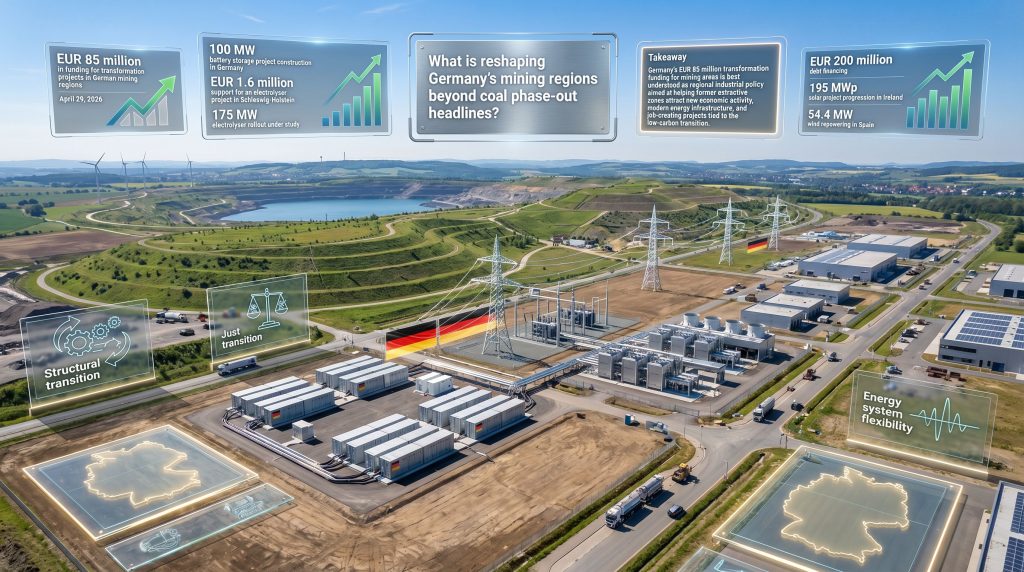
Germany’s EUR 85 million package for mining-area transformation is best understood as a regional industrial policy tool. Its purpose is not simply cleanup. It is about helping former extractive regions attract replacement activity, improve investment readiness, and connect post-mining land to the wider low-carbon economy.
Key facts at a glance
| Item | Detail |
|---|---|
| Funding amount | EUR 85 million |
| Reference date | April 29, 2026 |
| Geographic focus | Germany, with relevance to former or transitioning mining regions |
| Policy lens | Regulations, regional transition, redevelopment, energy-linked infrastructure |
| Adjacent market context | 100 MW battery storage construction in Germany |
| Additional German policy signal | EUR 1.6 million for an electrolyser project in Schleswig-Holstein |
| Broader European context | 175 MW electrolyser rollout under study, EUR 200 million debt financing for energy-transition infrastructure, 195 MWp solar progress in Ireland, 54.4 MW wind repowering in Spain |
Why Germany funds mining-area transformation in the first place
Mining-region policy is often misunderstood as an environmental repair story. In practice, it is usually much bigger than that. When mines close or shrink, regions can lose employers, supplier networks, municipal revenues, and the rationale for infrastructure originally built around extraction.
That creates a structural transition problem. In plain language, structural transition means a region must replace one economic model with another. In former mining areas, the challenge is not only job loss. It is also what happens to industrial land, substations, transport links, local skills, and political confidence.
Core policy concepts readers should know
- Just transition: managing industrial change in a way that limits social and regional dislocation
- Regional industrial policy: public intervention designed to steer investment towards specific places and sectors
- Brownfield redevelopment: reusing previously industrial or mined land instead of building exclusively on undeveloped sites
- Energy system flexibility: infrastructure such as batteries, demand response, and grid-supporting assets that help balance variable power systems
- Public co-financing: government funding used alongside municipal, private, or EU capital
- Project bankability: whether a project is credible enough for investors and lenders to support
Why governments back post-mining regions
- To replace lost economic activity
- To reuse land and existing grid connections
- To support new employers and SMEs
- To reduce regional inequality
- To spread clean-energy investment beyond already prosperous industrial hubs
When big ASX news breaks, our subscribers know first
How the EUR 85 million package fits into Germany’s wider policy framework
Germany’s mining-region support should be read within a larger policy architecture that combines regional transition, decarbonisation, industrial competitiveness, and energy security. In that context, the funding also aligns with broader themes around mining decarbonisation benefits.
That does not mean every funded project has special national status. However, it does mean the same policy environment is pushing multiple goals at once. This is increasingly relevant as Europe strengthens supply resilience through initiatives such as the European critical raw materials facility.
Former mining areas increasingly overlap with sectors such as:
- battery storage
- hydrogen and electrolysers
- industrial electrification
- logistics and industrial park reuse
- grid-supporting infrastructure
This overlap is important. Legacy mining zones often have industrial characteristics that energy developers value, including land availability and power infrastructure. Furthermore, public funding can help bridge the gap between potential and investable reality.
Why grants matter even when they seem modest
Transformation packages are rarely designed to pay for everything. Instead, their role is often catalytic. In many cases, public money targets the hardest early bottlenecks:
- Site preparation
- Planning and feasibility work
- Substation or connection upgrades
- Innovation pilots
- Workforce adaptation and training
A grant can therefore be economically significant even if it is smaller than the total capital eventually invested in a region. As highlighted in Germany’s funding announcement, the policy signal matters almost as much as the funding size.
Policy instrument comparison
| Policy instrument | Typical objective | Eligible project type | Time horizon | Expected economic impact |
|---|---|---|---|---|
| Direct grant | Remove early barriers | Site prep, pilots, infrastructure | Short to medium term | Catalytic |
| Concessional loan | Lower financing burden | Scalable industrial or energy assets | Medium term | Moderate to high |
| Regional infrastructure subsidy | Improve location readiness | Roads, substations, utilities, industrial parks | Medium to long term | High enabling effect |
| Innovation programme | Build technical capability | R&D, demonstration, test centres | Medium term | Ecosystem development |
| Workforce retraining support | Reduce labour mismatch | Training, reskilling, transition services | Medium to long term | Social and labour-market resilience |
What kinds of projects are likely to qualify
Based on the policy framing and the surrounding energy transition environment, likely projects in a mining-region transformation push may include:
- Energy storage installations
- Grid-supporting infrastructure
- Hydrogen and electrolyser-linked industrial activity
- Conversion of former mining or industrial land into new business parks
- Clean heat, efficiency, and electrification upgrades
- Logistics and transport infrastructure that supports new industrial tenants
- Skills centres, research hubs, and innovation facilities
A key caution is necessary here. The available source material confirms the EUR 85 million headline, but it does not provide a full eligibility rulebook. Any discussion of qualifying project types should therefore be treated as policy-informed analysis, not a definitive application guide.
Why energy storage stands out in former mining regions
The surrounding market context makes storage impossible to ignore. In the same Germany-focused news flow, 100 MW of battery storage construction was highlighted. In addition, related debate around renewable energy in mining shows how former extractive areas are becoming part of wider clean-energy planning.
Former mining zones can be attractive for battery energy storage systems because they may offer:
- industrially zoned land
- fewer land-use conflicts than dense urban areas
- stronger legacy grid interfaces than remote greenfield sites
- local political pressure to attract replacement industry
Brownfield redevelopment versus greenfield development
| Factor | Former mining land | Greenfield site |
|---|---|---|
| Land history | Previously industrial | Often undeveloped |
| Grid proximity | Sometimes advantageous | Can require longer build-out |
| Planning logic | Reuse and conversion | New land-use change often required |
| Local economic case | Strong transition narrative | May face more social trade-off questions |
| Development risk | Site remediation may be needed | Environmental and land-use conflict may be higher |
A practical example of catalytic funding
Imagine a former lignite-linked industrial area where public funding pays for land remediation, access roads, and a substation upgrade. That does not build the battery itself. But it can make the location financeable.
Private capital may then move in to develop storage, light manufacturing, hydrogen-linked equipment, or service facilities. Consequently, local engineering firms, contractors, and maintenance providers gain earlier benefit than they would from a purely speculative rezoning plan.
A relatively modest public package can matter if it removes the first barriers that keep private capital out of former mining regions.
How EUR 85 million could create impact larger than the headline number
Investors and municipalities should separate four very different figures:
- the grant amount
- the total project value
- the private capital induced
- the longer-run regional multiplier effect
A transformation fund is often judged too quickly by its face value. In reality, the better question is whether it changes project bankability. That is central to understanding why Germany provides EUR 85m for transformation projects in mining areas deserves more attention than a simple budget note.
Useful metrics to watch
- Jobs created or safeguarded
- Megawatts or megawatt-hours enabled
- Hectares of land repurposed
- Number of municipalities or projects supported
- Co-investment ratio
- Grid connection readiness
- Delivery speed from award to operation
Likely economic benefits by timeline
| Time horizon | Likely benefit | Key risk | Measurement indicator |
|---|---|---|---|
| 0 to 2 years | Planning activity, local procurement, site works, engineering demand | Delays in approvals or fragmented funding | Projects approved, contracts awarded, land prepared |
| 3 to 5 years | New tenants, improved investor confidence, diversified local business activity | Weak private follow-through | Capex committed, operating projects, local supplier participation |
| 5+ years | Stronger tax base, resilient industrial mix, integration into storage or hydrogen value chains | Overreliance on pilots without scale | Sustained employment, repeat investment, durable industrial occupancy |
The next major ASX story will hit our subscribers first
Risks and execution challenges that should not be overlooked
Funding announcements can create optimism, but post-mining redevelopment is difficult to execute. The most common risks include:
- too many small projects with limited strategic coherence
- grid access delays
- slow permitting
- weak coordination across federal, state, and municipal layers
- worker skill mismatch with incoming industries
- pressure to announce visible projects before they are commercially durable
Funding announcements matter less than delivery quality. In post-mining redevelopment, execution speed, land readiness, and investor confidence usually determine whether grants produce lasting regional renewal.
Critical questions to ask
- Is EUR 85 million enough relative to the scale of regional change required?
- Will the package support durable businesses or mostly symbolic pilots?
- Are communities involved in defining what redevelopment should look like?
- How will success be measured after allocation?
How this compares with other European energy-transition signals
The wider market backdrop helps explain the role of mining-region grants. For instance, broader analysis of the critical minerals energy transition shows how strategic infrastructure and industrial policy are becoming increasingly intertwined.
| Funding or project size | Instrument type | Country | Strategic purpose | Direct vs catalytic impact |
|---|---|---|---|---|
| EUR 85 million | Transformation funding | Germany | Redevelopment in mining areas | Primarily catalytic |
| 100 MW | Battery construction | Germany | Grid flexibility and storage deployment | Direct asset build |
| EUR 1.6 million | Project support | Germany | Electrolyser-related development in Schleswig-Holstein | Early-stage catalytic |
| 175 MW | Study phase | Swiss utility-linked initiative | Electrolyser rollout assessment | Pre-investment |
| EUR 200 million | Debt financing | Europe | Energy-transition infrastructure platform | Large-scale financing |
| 195 MWp | Solar progression | Ireland | Renewable generation build-out | Direct capacity expansion |
| 54.4 MW | Wind repowering | Spain | Upgrade existing renewable fleet | Direct operational impact |
The comparison shows why the headline should not be judged in isolation. Regional transformation grants are usually smaller than full project finance packages because their role is different. They are designed to de-risk locations, not necessarily to fully fund final assets.
Further context from critical minerals market trends also reinforces why former mining and industrial regions may attract renewed policy attention across Europe.
What municipalities, developers, and analysts should watch next
For municipalities
- eligibility rules
- co-funding requirements
- application timelines
- land-readiness criteria
- community engagement strategy
For developers and industrial investors
- whether grants reduce enabling infrastructure costs
- implications for grid access
- potential clustering with storage, hydrogen, or electrified industrial demand
- partnership models with local authorities
These considerations are also connected to wider mining electrification trends, especially where legacy energy systems are being repurposed for new industrial demand.
For analysts and policy watchers
- number and type of approved projects
- geographic concentration of awards
- follow-on private investment
- whether supported projects become replicable templates for other European transition regions
FAQ on Germany’s mining-area transformation funding
What does Germany’s EUR 85 million mining-region package aim to achieve?
It is aimed at regional economic diversification, site redevelopment, and support for new activity in former or transitioning mining areas. In particular, it seeks to create conditions where modern energy and industrial infrastructure can help replace legacy extraction-based economies.
Who can benefit from transformation projects in mining areas?
Typically, likely beneficiaries include municipalities, regional agencies, infrastructure initiatives, public-private redevelopment vehicles, and businesses participating in approved transition projects. Exact eligibility should still be checked against official programme rules.
Is EUR 85 million a large amount for regional transition policy?
It is meaningful as catalytic public funding, but not necessarily large enough on its own to transform entire regions. Its significance depends on leverage, project quality, and whether it attracts private capital afterwards.
Why are former mining areas relevant to storage and flexibility markets?
Because they may combine industrial land, legacy grid infrastructure, redevelopment urgency, and a local search for replacement industries. As a result, these factors can improve the case for batteries and related energy assets.
How should readers judge success?
Success should be measured by funded project delivery, land reuse, private co-investment, durable employment, and whether former mining areas gain commercially viable new industries rather than one-off demonstration projects.
Methodology note and final takeaway
This analysis evaluates the funding through three lenses: catalytic impact, regional economics, and implementation feasibility. Confirmed facts from the available source material include the EUR 85 million amount, the April 29, 2026 reference date, and the broader European clean-energy news context.
That includes 100 MW battery construction in Germany, EUR 1.6 million for an electrolyser project in Schleswig-Holstein, 175 MW electrolyser study activity, EUR 200 million debt financing, 195 MWp solar progress in Ireland, and 54.4 MW wind repowering in Spain. Where official programme rules were not available in the provided material, this article distinguishes analysis from confirmed eligibility detail.
The clearest takeaway is simple: Germany provides EUR 85m for transformation projects in mining areas should be viewed less as a one-off subsidy line and more as a signal of place-based industrial redesign. The real test is not the announcement itself.
It is whether the funding makes post-mining regions more bankable, more connected to storage and clean-energy infrastructure, and more capable of sustaining a new economic identity over time. Viewed that way, Germany provides EUR 85m for transformation projects in mining areas is not just a policy headline, but a measure of how seriously regional transition is being treated.
Could the Next Major Discovery Be Announced Tomorrow?
Discovery Alert’s proprietary Discovery IQ model delivers real-time alerts on significant ASX mineral discoveries, helping investors cut through complex market noise and spot actionable opportunities early. See how historic discoveries have driven exceptional returns on the Discovery Alert discoveries page and start a 14-day free trial today.