
August 23, 2026
The Quiet Revolution Reshaping Africa's Gold Economy
When analysts examine the structural forces remaking global gold supply, the most consequential shift of the past decade may not be found in the boardrooms of multinational miners or the vaults of central banks. It is happening in the laterite-rich soils of West Africa, where millions of small-scale operators have collectively built a production engine that now rivals — and in Ghana's case surpasses — the output of the world's most capital-intensive mining corporations. Ghana artisanal gold output has quietly become one of the defining stories in global gold production today.
Ghana's transformation from an economy defined by large-scale industrial gold extraction into one where artisanal and small-scale mining (ASM) drives the majority of national output represents a structural inversion that few economists anticipated at the speed or scale at which it occurred. Understanding how that shift unfolded, and where it leads, requires moving beyond headline production figures into the mechanics of formalization, price incentives, and sovereign economic strategy.
When big ASX news breaks, our subscribers know first
Ghana's Artisanal Gold Output: From Marginal Activity to National Pillar
Two decades ago, Ghana's ASM sector contributed less than 2% of total national gold production. The country's international reputation rested on the deep-shaft and open-pit operations of large multinationals, which anchored Ghana's identity as a dependable, infrastructure-heavy producer within the African mining landscape.
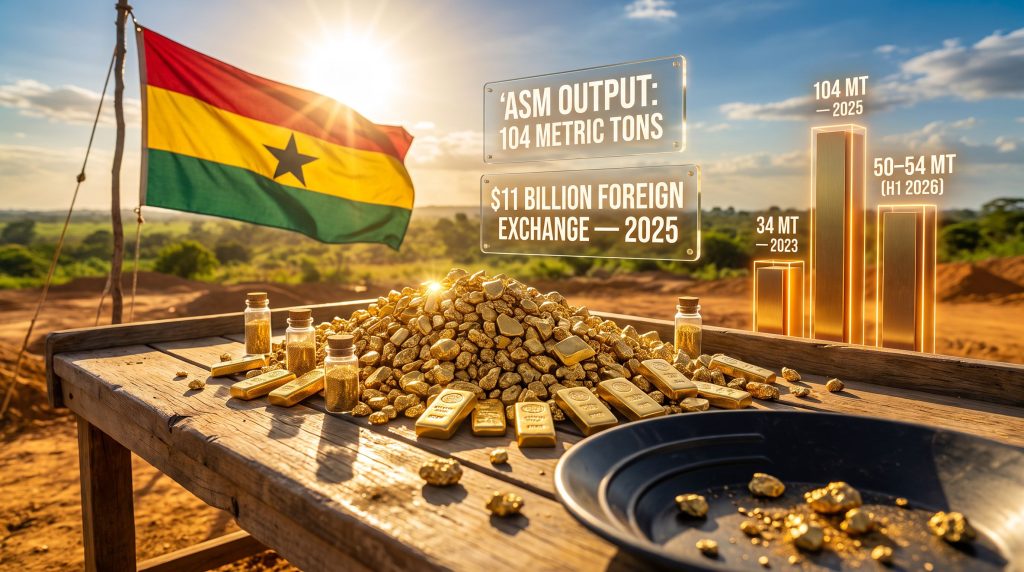
That identity has been fundamentally rewritten. By 2025, Ghana artisanal gold output had crossed a threshold that no analyst in the early 2000s would have predicted: the ASM sector produced approximately 104 metric tons of gold, surpassing large-scale industrial mining output for the first time in the country's recorded history. Ghana simultaneously secured its position as Africa's largest gold producer, with artisanal operations serving as the primary engine of that status.
This is not a story of large-scale mining declining. It is, however, a story of artisanal production scaling at a pace that the formal sector simply could not match. Furthermore, the broader context of record gold prices throughout 2024 and 2025 played a significant role in accelerating this dynamic.
The Numbers That Define the Shift
The 2025 production data illustrates just how complete this reversal has become:
| Metric | 2025 Figure | Share of National Total |
|---|---|---|
| ASM Gold Production | ~104 metric tons | ~52% |
| Large-Scale Mining Output | ~89 metric tons | ~48% |
| Total National Gold Output | ~193 metric tons | 100% |
| ASM Foreign Exchange Earnings | ~$11 billion | Majority of export revenue |
| Large-Scale Mining FX Earnings | ~$9 billion | Minority of export revenue |
The scale of this data deserves careful interpretation. Not only did ASM output exceed large-scale mining on a volume basis, it generated more foreign exchange earnings despite operating with a fraction of the capital investment. This dynamic reflects both the extraordinary price environment of 2025 and the structural effectiveness of Ghana's formalization architecture.
How Ghana's Gold Board Became the Sector's Defining Institution
No institution has shaped the trajectory of Ghana artisanal gold output more decisively than the Ghana Gold Board, known operationally as GoldBod. Established in 2025, GoldBod functions as a state-mandated purchasing entity that buys gold directly from ASM operators at competitive market rates.
The strategic logic behind GoldBod's design is subtle but important. Previous attempts to capture artisanal output through taxation or export licensing consistently failed because they imposed costs without offering compensating benefits. GoldBod inverted this model by making formalization economically rational for producers, offering market-linked pricing that eroded the premium previously commanded by smuggling networks.
The results have been measurable. GoldBod-facilitated purchases generated approximately $11 billion in ASM-sector foreign exchange earnings in 2025, compared to approximately $9 billion contributed by large-scale miners in the same period. For a country emerging from one of its most severe financial crises in modern history, that differential is not merely a statistical footnote. It represents a genuine reordering of Ghana's economic architecture.
Ghana's artisanal gold sector is no longer a peripheral or informal activity tolerated at the edges of the formal economy. It has become a sovereign foreign exchange instrument generating more dollar inflows than the entire large-scale mining industry combined.
GoldBod's 2026 planning framework was built around an average gold price assumption of approximately $5,000 per ounce and weekly purchase volumes of around 2.5 metric tons. While gold prices have retreated below that planning benchmark, average 2026 bullion prices remain above 2025 levels, sustaining strong revenue outcomes even as per-unit earnings compress. In addition, the gold price highs seen across this period provided a powerful tailwind for ASM operator participation in formal channels.
2026 Mid-Year Trajectory: Ghana's ASM Sector on Course for Another Record
The data emerging from 2026 suggests the structural momentum established in 2025 has not dissipated. According to Reuters, GoldBod reported purchasing between 50 and 54 metric tons of artisanal gold in the first half of 2026 alone. At a sustained weekly purchase rate of approximately 2.5 metric tons, the sector is tracking to match or exceed the record set just twelve months prior.
This trajectory matters for several reasons beyond the headline production figures:
- Volume growth as a price buffer: Even with gold prices trading below GoldBod's $5,000/oz planning assumption, higher volumes provide a meaningful hedge against per-unit revenue compression.
- Formalization momentum: Continued H2 2026 purchases at H1 rates would push full-year ASM purchases toward or beyond 104 metric tons, potentially validating the 127 metric ton annual formalization target Ghana has set as its long-term benchmark.
- Macroeconomic stabilisation: Gold export revenues are directly supporting Ghana's foreign exchange reserves and debt stabilisation efforts, with the exchange rate context of 1 USD = 11.48 Ghanaian cedi amplifying the domestic currency impact of sustained dollar inflows.
The Production Growth Timeline in Context
| Year | ASM Production (Approx.) | Key Structural Driver |
|---|---|---|
| 2023 | ~34 metric tons | Baseline pre-reform period |
| 2024 | Transitional growth phase | Early reform implementation |
| 2025 | ~104 metric tons | GoldBod activation and gold price surge |
| 2026 (H1) | 50–54 metric tons purchased | Sustained reform momentum |
The approximately 180% production increase between 2023 and 2025 represents one of the fastest documented expansions of formal ASM output anywhere in Africa's modern mining history. Critically, this was not purely a production volume story. A significant component of the growth reflects the migration of previously undeclared production into formal channels, meaning total physical output growth was likely more modest than the formalization-adjusted figures suggest.
Five Structural Forces Driving Ghana's ASM Expansion
Understanding what produced this outcome requires moving beyond the GoldBod architecture to examine the broader ecosystem of incentives and structural conditions that made rapid formalization possible.
- Sustained gold price elevation: The global gold price environment of 2024 and 2025 dramatically improved the economics of small-scale operations, drawing new participants into the sector and raising the opportunity cost of operating outside formal channels.
- Anti-smuggling disruption: Government-led interventions specifically targeted established smuggling corridors, reducing the practical capacity of informal networks to absorb undeclared production at competitive prices.
- Competitive state purchasing: GoldBod's market-linked pricing model eliminated a structural disadvantage that had previously made formal channels less attractive than black-market buyers.
- Workforce depth: The ASM sector directly employs over 1 million people across Ghana, creating an embedded production ecosystem where community-level participation is both economically and socially self-reinforcing.
- Integration-first regulatory philosophy: Rather than pursuing prohibition, Ghana's regulatory approach prioritised bringing operators inside formal structures gradually, accepting imperfect compliance in the near term to build systemic capacity over time.
The Undeclared Production Problem: Ghana's Most Significant Unresolved Challenge
Despite the progress, a meaningful gap persists between total ASM production and formally captured volumes. Estimates indicate that between 24 and 34 metric tons of artisanal gold exits Ghana annually through informal or undeclared channels, according to available industry assessments.
This leakage has dual significance. First, it represents a direct foreign exchange loss to the national economy. Second, it signals the limits of the current formalization framework and identifies where future policy intervention could generate additional economic value. Closing this gap entirely would push Ghana's formal ASM capture toward the 127 metric ton annual target the government has established as its long-term benchmark.
The distinction between total ASM production and formally purchased volumes is not merely a compliance question. It is the frontier along which Ghana's long-term gold economy will be built or lost.
ASM vs. Large-Scale Mining: A Structural Comparison
The displacement of large-scale mining as Ghana's primary gold production engine invites a more granular examination of how these two sectors differ in structure, risk profile, and economic contribution.
| Dimension | Artisanal and Small-Scale Mining | Large-Scale Industrial Mining |
|---|---|---|
| 2025 Output Share | ~52% of national total | ~48% of national total |
| Foreign Exchange Contribution (2025) | ~$11 billion | ~$9 billion |
| Direct Employment | 1+ million workers | Comparatively smaller workforce |
| Regulatory Formalization | Partial; rapidly evolving | Fully regulated |
| Taxation Burden | Minimal | Significant |
| Smuggling Risk | Elevated | Low |
| Capital Intensity | Low | High |
| Price Sensitivity Per Operator | High | Moderated by hedging |
The contrast in taxation burden is particularly important and often underappreciated in popular coverage of Ghana's gold economy. Large-scale miners operate under comprehensive royalty and corporate tax frameworks, while ASM operators remain lightly taxed relative to their economic contribution. This asymmetry means the government's fiscal capture from ASM growth significantly lags the sector's foreign exchange contribution, creating an important structural misalignment that future policy frameworks will need to address.
The next major ASX story will hit our subscribers first
Gold Price Dynamics and Revenue Outlook Through 2026
The revenue outlook for Ghana's ASM sector through the remainder of 2026 is shaped by the interaction between production volumes and gold price movements, with the two variables pulling in partially offsetting directions.
GoldBod constructed its 2026 forecasts around an average gold price of approximately $5,000 per ounce. Actual market prices have traded below this assumption, compressing per-unit revenue expectations. However, because average 2026 gold prices remain above 2025 levels, the volume-driven growth in ASM purchases is expected to more than compensate for price-driven margin compression.
This creates a structurally important dynamic: volume growth as a revenue stabiliser in a softening price environment. For a country whose macroeconomic recovery depends heavily on sustained gold export earnings, the ability to grow ASM output even as prices correct from multi-year highs represents a meaningful buffer against external commodity shocks. Consequently, gold as a safe haven for national economic strategy has taken on an entirely new dimension in the Ghanaian context.
Projecting further, if Ghana successfully formalises its full 127 metric ton ASM target at gold prices sustained above $3,000 per ounce, annual ASM foreign exchange earnings could stabilise in the range of $12 to $13 billion — a potentially transformative outcome for an economy that was in acute fiscal distress as recently as 2023.
These forward projections involve assumptions about gold price stability, formalization progress, and policy continuity that are inherently uncertain. Readers should treat scenario-based revenue estimates as analytical frameworks rather than guaranteed outcomes.
What Ghana's ASM Story Means for the Broader African Gold Landscape
Ghana's experience carries lessons that extend well beyond its borders. Several structural features of its ASM transformation are potentially replicable in other African gold-producing nations, though local conditions vary considerably. For instance, the approaches being explored in African gold expansion projects elsewhere on the continent reflect a growing recognition that formalization-led growth models can deliver meaningful results.
The core insight is that formalization and production growth are not inherently in tension. Ghana's experience suggests that when state purchasing mechanisms offer genuinely competitive pricing, the economic calculus for individual operators shifts meaningfully toward formal channels. The key variable is not regulatory pressure but market access.
For investors and analysts tracking African gold production more broadly, Ghana's trajectory also highlights a risk that is easily overlooked: the rapid scaling of ASM output creates price sensitivity at the national level that large-scale mining historically buffered through hedging and long-term offtake agreements. An economy now structurally dependent on unhedged spot-market gold production faces different macroeconomic volatility profiles than one anchored by multinational mining capital. Industry data from CNBC Africa confirms that Ghana's record 6 million ounces of total gold output in 2025 was driven largely by this ASM-led structural shift.
Key Takeaways: Ghana's ASM Sector at a Strategic Inflection Point
The evidence assembled across production data, institutional reform, and revenue outcomes points to a sector that has crossed a point of no return in its economic significance:
- Ghana artisanal gold output reached a record 104 metric tons in 2025, surpassing large-scale mining for the first time in the country's history and contributing ~$11 billion in foreign exchange earnings.
- GoldBod's H1 2026 purchases of 50 to 54 metric tons place full-year output on a trajectory to match or exceed the 2025 record.
- The 180% production growth between 2023 and 2025 reflects both genuine output expansion and the formalization of previously invisible supply chain volumes.
- An estimated 24 to 34 metric tons of annual production still exits through informal channels, representing both a revenue leakage risk and the clearest near-term opportunity for further economic capture.
- The ASM sector directly supports over 1 million workers, embedding it deeply into Ghana's social and political economy in ways that make it structurally resistant to policy reversal.
- Gold price volatility below GoldBod's $5,000/oz planning assumption is being offset by volume growth, maintaining a positive revenue trajectory for Ghana's broader economic recovery.
This article is intended for informational purposes only and does not constitute financial or investment advice. Production forecasts, revenue projections, and scenario analyses involve inherent uncertainty. Readers should conduct independent research and consult qualified advisors before making investment decisions related to commodities or mining equities.
Want to Stay Ahead of the Next Major Mineral Discovery?
Discovery Alert's proprietary Discovery IQ model delivers real-time alerts on significant ASX mineral discoveries, transforming complex geological data into actionable investment insights for both short-term traders and long-term investors — explore the historic returns major discoveries have generated and begin your 14-day free trial at Discovery Alert to position yourself ahead of the broader market.