
May 18, 2026
Commodity Nationalism in the Age of Monetary Fragmentation
Across the global economy, a quiet but consequential realignment is underway. Central banks that once held the bulk of their reserves in US Treasury bonds and euros are systematically rotating toward physical gold. The motivation is not purely sentimental — it reflects a rational recalculation of risk in an era defined by geopolitical fragmentation, surging sovereign debt levels in major economies, and persistent uncertainty over interest rate trajectories. For nations sitting atop vast mineral reserves, this global scramble for bullion creates a powerful political and economic imperative: if gold is becoming more strategically valuable, why should the terms under which foreign companies extract it remain unchanged?
Furthermore, central bank gold demand is reshaping the entire global monetary landscape, placing resource-rich nations in an increasingly powerful negotiating position. Ghana demands more gold from miners precisely because the strategic context has shifted so dramatically in bullion's favour.
This is precisely the question Ghana's government has placed at the centre of its resource governance agenda. As Africa's largest gold producer, Ghana occupies a uniquely consequential position in this debate — and the policy reforms now being pursued represent one of the most ambitious and comprehensive overhauls of gold sector governance undertaken by any African nation in recent memory.
When big ASX news breaks, our subscribers know first
Ghana's Gold Sector: Strategic Importance Before the Policy Shift
A Nation Built on Bullion
Gold is not merely an export commodity for Ghana — it is the structural foundation of the country's external financial position. The mineral accounts for approximately 40% of Ghana's total export earnings and remains the nation's single largest source of foreign exchange revenue. This concentration creates both strategic leverage and acute vulnerability: when gold prices rise, Ghana benefits enormously, but when external shocks erode the cedi or trigger capital outflows, the country's limited reserve cushion is exposed.
Major multinational operators including Newmont, AngloGold Ashanti, and Zijin Mining collectively account for a substantial share of Ghana's industrial gold output. These companies operate under long-term concession arrangements that were structured during periods when gold prices were considerably lower and fiscal terms more favourable to investors. The sharp appreciation of gold over the past 12 to 18 months — driven by gold safe-haven demand, dollar uncertainty, and geopolitical risk premiums — has fundamentally altered the calculus of those arrangements.
The 2022 Crisis That Changed Everything
Understanding Ghana's current policy posture requires appreciating the severity of the economic deterioration the country experienced in 2022. Inflation surged to multi-decade highs, the Ghanaian cedi lost a significant portion of its value against major currencies, and public debt accumulated to levels that were no longer serviceable under existing terms. The government was ultimately compelled to enter an IMF-backed debt restructuring programme, a humbling process that stripped away the fiscal buffers Ghana had accumulated over years of strong commodity revenues.
It was in this context of financial distress that Ghana launched its domestic gold purchase programme, using mandatory procurement from industrial miners as a tool to accumulate physical reserves without drawing on scarce foreign currency. The programme represented an unconventional but pragmatic response — leveraging the country's status as a major gold producer to build monetary resilience through direct resource capture rather than market purchases.
| Indicator | Pre-Programme Baseline (2021-2022) | Current Position (2025) |
|---|---|---|
| Gold Reserves | Low baseline (pre-programme) | 19.2 metric tons (Feb 2025) |
| Reserve Target by 2028 | Not established | 157 metric tons |
| Import Cover Target | Not established | ~15 months |
| Mandatory Supply Quota | 20% of annual output | Proposed 30% |
| Royalty Rate | 3%-5% fixed | Proposed sliding scale to 12% |
Decoding Ghana's New Gold Policy Framework
The 30% Mandatory Supply Mandate: Mechanics and Implications
The centrepiece of Ghana's proposed reforms is an increase in the mandatory gold supply obligation from the current 20% of annual production to 30%, with the full allocation required to be delivered in doré form. This distinction matters enormously from a value chain perspective. According to Ghana's record gold output of 6 million ounces in 2025, the scale of any mandatory supply increase becomes immediately apparent.
Technical Explanation: What Is Doré Gold?
Doré is a semi-refined alloy of gold and silver produced directly at mine sites during the initial smelting process, before the material undergoes final refinery processing to achieve investment-grade purity. By specifying doré delivery rather than refined bullion or cash equivalents, Ghana ensures that the final refining step — and the associated economic value addition — occurs within the country's own borders, rather than being exported to offshore facilities in Switzerland, the United Arab Emirates, or South Africa.
Paul Bleboo, head of the Bank of Ghana's Gold Management Programme, confirmed the government's position in statements to Reuters, making clear that the renegotiation of existing supply arrangements with industrial miners is a firm policy objective, with the doré delivery requirement forming a non-negotiable component of the proposed framework.
The strategic logic behind doré delivery extends beyond immediate revenue capture. By channelling semi-refined gold through domestic facilities, Ghana is deliberately building the operational throughput necessary to justify and sustain investment in its domestic refining infrastructure, consequently creating a reinforcing cycle between policy mandates and industrial capacity development.
GoldBod: Redesigning the Export Architecture
Alongside the supply quota expansion, Ghana is seeking to significantly expand the role of GoldBod, the state-backed gold trading entity, transforming it from a participant in the market into the primary regulatory gatekeeper for all gold exports from Ghanaian territory.
Under the proposed framework, GoldBod would perform three critical functions:
- Export authorisation oversight — no bullion shipment would proceed without GoldBod clearance, giving authorities complete visibility over export volumes and timing
- Supply chain traceability — improving documentation and tracking of gold flows from mine site through to final export destination
- Market participation restrictions — limiting foreign involvement in specific segments of the domestic gold trading market to increase local economic capture
The GoldBod mandate also connects directly to Ghana's longstanding challenge with artisanal mining and gold smuggling. A significant volume of gold produced by small-scale and informal operators has historically leaked out of Ghana's formal export channels, depriving the government of both royalty revenue and foreign exchange. By positioning GoldBod as an export gatekeeper, authorities aim to compress this leakage while simultaneously improving the accuracy of production statistics used for royalty calculations.
The Sliding-Scale Royalty Reform: From Fixed Rates to Price-Linked Extraction Fees
Perhaps the most commercially significant element of Ghana's proposed overhaul is the replacement of the existing fixed royalty structure — currently set between 3% and 5% of production value — with a sliding-scale mechanism that links extraction fees directly to prevailing gold prices.
| Gold Price Environment | Current Royalty Rate | Proposed Sliding-Scale Rate |
|---|---|---|
| Low-to-moderate prices | 3%-5% (fixed) | ~3%-5% |
| Elevated prices | 3%-5% (fixed) | 6%-9% |
| Exceptionally high prices | 3%-5% (fixed) | Up to 12% |
This reform reflects a structural insight that fixed royalty regimes systematically underperform during commodity price booms, transferring windfall gains almost entirely to mining operators rather than sharing them with the host nation. A price-linked structure corrects this asymmetry by ensuring that when bullion valuations surge — as they have done markedly over the past year — the government's fiscal take rises in proportion.
For mining companies operating in Ghana, the combined effect of a royalty escalation from 5% to potentially 10–12% during peak price periods, layered on top of a larger mandatory supply obligation, represents a material compression of operating margins that will require significant recalibration of financial models and investment cases.
Local Contractor Transition: The December 2026 Deadline
Ghana's reform programme extends beyond fiscal capture into the structure of mining operations themselves. The government has set a December 2026 deadline requiring major foreign miners to transition certain operational functions to locally-owned contractors. This local content mandate is designed to ensure that a larger share of the economic activity generated by gold extraction circulates within Ghana's domestic economy, rather than flowing back to offshore parent companies or foreign service providers.
The practical scope of the transition requirement encompasses surface operations, logistics, maintenance services, and potentially certain technical functions — though the precise boundaries of mandatory localisation remain subject to ongoing negotiation between the government and the affected companies. Furthermore, Ghana's push to prioritise local miners signals that this localisation agenda extends well beyond a single deadline.
The Royal Ghana Gold Refinery: Moving Up the Value Chain
Closing the Refining Gap
Ghana's decision to inaugurate the Royal Ghana Gold Refinery in 2024 as a public-private partnership with central bank backing is inseparable from the broader policy framework being constructed around it. Without domestic refining capacity, the doré delivery requirement would be operationally meaningless — Ghana would simply accumulate semi-refined material with no pathway to converting it into investment-grade bullion.
The refinery changes this equation fundamentally. It provides the downstream processing infrastructure that transforms the mandatory doré allocation into finished bullion capable of being held as monetary reserves, traded in international markets, or deployed as collateral in financing arrangements.
The economic logic is straightforward but often underappreciated: the difference in market value between doré gold and investment-grade refined bullion represents a margin that has historically been captured entirely by offshore refineries. Ghana's domestic refining ambition is an attempt to reclaim that margin permanently.
Positioning a domestic refinery at the centre of a mandatory supply programme also creates powerful network effects. As throughput volumes increase — driven by the 30% obligation — the refinery's economics improve, making it viable to process gold from smaller artisanal and small-scale mining operators who currently lack access to formal refining infrastructure. This secondary effect could meaningfully expand the scope of Ghana's formal gold economy over time.
Industry Pushback: The Commercial Disputes Behind the Headlines
What Mining Companies Are Actually Objecting To
The resistance from mining companies to Ghana's proposed reforms is not monolithic opposition to resource nationalism in principle. Rather, it centres on specific commercial terms that remain genuinely unresolved. Ghana Chamber of Mines CEO Kenneth Ashigbey has acknowledged publicly that the pricing and discount negotiations are ongoing and considerably more complex than a simple quota adjustment.
The key commercial sticking points include:
- Pricing structures on mandatory sales: miners are concerned that the central bank may seek to purchase the 30% allocation at a discount to prevailing spot prices, effectively imposing a hidden additional levy on top of the formal royalty structure
- Volume-based discount opposition: companies argue that applying percentage discounts to large mandatory sale volumes compounds the earnings impact beyond what the headline royalty figures suggest
- Treatment of silver by-products: doré alloys contain both gold and silver in varying proportions depending on the ore characteristics of each deposit — miners argue that requiring full doré delivery without appropriate compensation for the silver content imposes an additional uncompensated cost
- Implementation timeline concerns: existing offtake agreements, financing structures, and operational plans were built around the 20% framework and cannot be restructured to a 30% obligation without meaningful lead time
The Stability Agreement Question: Investor Confidence at Stake
One dimension of Ghana's reform agenda that carries particularly significant long-term implications is the government's apparent intent to revisit or terminate stability agreements — contractual arrangements that historically locked in fiscal and regulatory terms for major mining investors over multi-decade project timeframes.
These agreements exist for a specific reason: gold mines require enormous upfront capital investment, with payback periods spanning 10 to 20 years or more. Lenders and equity investors who finance these projects price their capital based on an assumed regulatory environment. When that environment is subject to unilateral revision, the risk premium applied to new investment in the jurisdiction rises — sometimes sharply.
For multinational mining companies evaluating new capital deployment in Ghana, the erosion of stability agreement protections introduces a material sovereign risk premium that will be reflected in required return thresholds. Projects that were viable at a 15% internal rate of return may require 18–20% under the revised risk framework, effectively making some marginal deposits uneconomic.
Modelling the Cumulative Fiscal Pressure: An Illustrative Scenario
To understand the combined impact of Ghana's proposed reforms on a hypothetical large-scale gold producer operating in the country, consider the following illustrative scenario:
| Cost Component | Previous Framework | Proposed Framework | Estimated Change |
|---|---|---|---|
| Royalty rate (elevated gold price) | 5% of revenue | ~10% of revenue | +5 percentage points |
| Mandatory supply discount (illustrative) | Market price on 20% | Below-market on 30% | Earnings reduction |
| Local contractor transition costs | Negligible | One-off restructuring costs | Margin compression |
| Silver by-product capture loss | Compensated | Potentially uncompensated | Additional loss |
The cumulative effect across these dimensions could reduce operating margins meaningfully, particularly for mines operating at the higher end of the cost curve where the margin available to absorb additional fiscal obligations is already thin.
The Fiscal Cost of Ghana's Gold Strategy
When Reserve-Building Becomes Financially Costly
Ghana's gold reserve accumulation programme has delivered measurable results in terms of physical holdings — reserves reaching 19.2 metric tons by February 2025 represent genuine progress from near-negligible pre-programme levels. However, this progress has come at a quantifiable financial cost.
The Bank of Ghana's financial statements for 2025 recorded an operating loss of approximately 15.6 billion Ghanaian cedis, equivalent to roughly $1.37 billion USD, a figure that reflects both the costs of monetary tightening conducted to stabilise the cedi and the direct costs associated with the gold reserve programme itself.
This raises a legitimate analytical question that deserves more attention than it typically receives in policy discussions: at what point does the cost of accumulating reserves outweigh the macroeconomic benefits those reserves are intended to provide? The relationship between gold and central banks has never been more consequential, and Ghana's programme sits squarely within that global dynamic.
The 157-Tonne Target: Ambition vs. Arithmetic
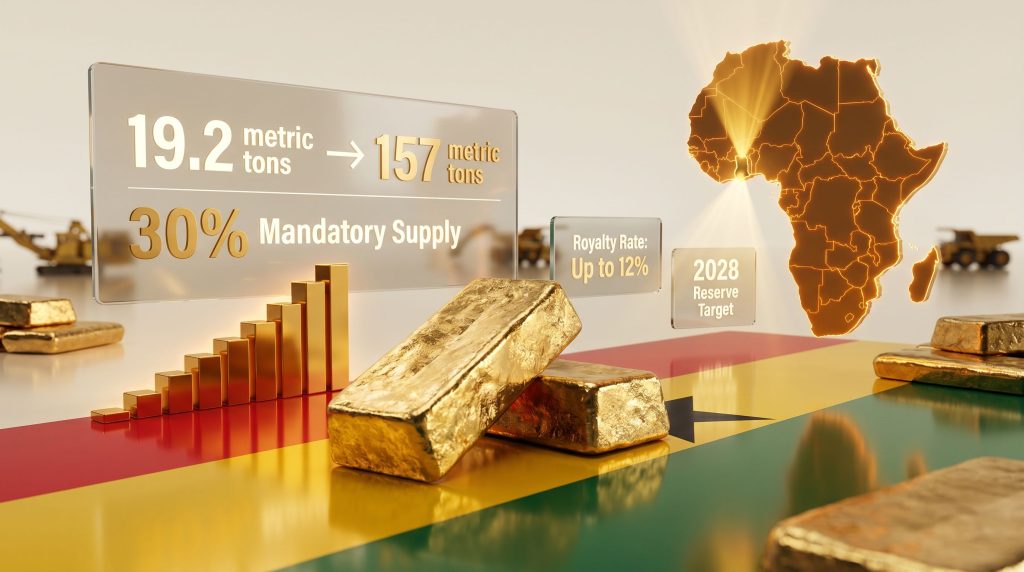
The government's stated objective of reaching 157 metric tons of gold reserves by 2028 is ambitious to the point of being mathematically demanding. With current holdings at 19.2 metric tons, Ghana needs to close a gap of approximately 137.8 metric tons within roughly three years.
Reserve Gap at a Glance:
- Current reserves: 19.2 metric tons (February 2025)
- 2028 target: 157 metric tons
- Gap to close: ~137.8 metric tons
- Timeframe: approximately 3 years
- Proposed mechanism: 30% mandatory annual supply from large-scale industrial miners
Whether the 30% mandatory supply mechanism alone is sufficient to close this gap depends critically on the aggregate annual gold output of the large-scale mining sector subject to the obligation. If Ghana's industrial miners produce approximately 80–100 tonnes annually — a reasonable estimate given its position as Africa's largest producer — then 30% of that output would yield roughly 24–30 tonnes per year, potentially reaching the target within the stated timeframe if combined with other accumulation channels. However, this calculation does not account for the pricing dynamics of mandatory purchases or the operational disruptions that could reduce output if the commercial disputes with mining companies remain unresolved.
The next major ASX story will hit our subscribers first
Is Ghana's Approach a Blueprint for Africa?
The Continental Pattern of Resource Sovereignty
Ghana is not acting in isolation. Across the African continent, resource-producing nations have been systematically tightening the fiscal terms under which multinational mining companies operate, particularly during the current period of elevated commodity prices. The broader geopolitical mining landscape across the continent is increasingly defined by this push for sovereign resource control.
- Tanzania has implemented significant royalty increases and introduced mandatory local processing requirements for a range of minerals
- Mali has revised its mining code to increase state participation in mining projects and raise extraction levies
- Zimbabwe has imposed export levies on unprocessed lithium and other battery minerals to incentivise domestic processing
- Democratic Republic of Congo has increased royalty rates on strategic minerals and imposed export restrictions on cobalt and other battery metals
What distinguishes Ghana's approach is its comprehensiveness. Rather than adjusting a single fiscal lever, Ghana is simultaneously deploying five distinct policy instruments: mandatory supply quotas, doré delivery requirements, sliding-scale royalties, export gatekeeping through GoldBod, and local contractor mandates. This multi-dimensional approach is more sophisticated than the single-lever adjustments seen in most comparable jurisdictions — and potentially more durable as a result.
What This Means for Foreign Direct Investment in African Mining
The tightening regulatory environment across Africa creates a genuine strategic dilemma for multinational mining companies. The continent holds enormous mineral wealth that is increasingly critical to global supply chains — not just gold, but copper, cobalt, lithium, and manganese essential for the energy transition. The surging critical minerals demand globally only intensifies the stakes of these regulatory shifts. Yet the regulatory environment in which that mineral wealth must be extracted is becoming progressively more demanding and less predictable.
Mining companies are adapting through several mechanisms:
- Accelerated community and social investment to build political goodwill that provides some insulation against abrupt policy changes
- Proactive local partnership structures that reduce the political visibility of foreign ownership and create domestic constituencies with interests aligned to project continuity
- More conservative capital allocation frameworks that apply higher discount rates to projects in jurisdictions with elevated sovereign risk profiles
- Portfolio diversification across multiple African jurisdictions to reduce concentration risk in any single regulatory environment
The net effect of these adaptations is likely to be a somewhat higher cost of capital for African mining projects and a longer decision-making timeline for major investment commitments — outcomes that could paradoxically reduce the speed at which Africa's mineral wealth is developed, even as policy reforms are designed to increase the share of that wealth retained domestically.
Frequently Asked Questions: Ghana's Gold Policy Reforms Explained
Why is Ghana demanding more gold from miners?
Ghana demands more gold from miners because the 2022 economic crisis exposed the country's vulnerability to currency shocks and balance of payments pressures. By accumulating physical gold reserves rather than holding conventional foreign currency assets, the Bank of Ghana is building a buffer that is insulated from the currency volatility and geopolitical risks that affect traditional reserve assets.
What is the practical difference between the current 20% and proposed 30% supply requirement?
The shift represents a 50% increase in the volume of production that miners must sell to the central bank. Combined with the doré delivery requirement — meaning the gold must be delivered in semi-refined form rather than processed bullion or cash — the change fundamentally alters the operational relationship between multinational miners and Ghanaian authorities, with significantly greater commercial implications than the simple percentage change might suggest.
Why does the form of delivery (doré vs. refined gold) matter so much?
Doré delivery ensures that the economic value added through the final refining process is captured within Ghana rather than flowing to offshore facilities. The Royal Ghana Gold Refinery, inaugurated in 2024, provides the domestic processing infrastructure to convert doré into investment-grade bullion, meaning the policy requirement and the industrial capacity are designed to function as an integrated system.
How would the sliding-scale royalty system work in practice?
The proposed mechanism replaces a static extraction fee — currently fixed between 3% and 5% regardless of gold prices — with a variable rate that escalates as bullion valuations rise. The practical effect is that mining companies pay a relatively modest premium above current rates when gold prices are moderate, but face royalties potentially reaching 12% during periods when gold prices are exceptionally elevated. This structure transfers a larger share of price cycle upside to the government while leaving miners with adequate margin when prices are lower.
What are the main commercial disputes between the government and mining companies?
The core disagreements centre on four issues: the pricing terms for mandatory gold sales to the central bank, whether volume-based discounts will be applied to those mandatory sales, how silver by-products within doré alloys will be treated and compensated, and the timeline for transitioning from the existing 20% arrangement to the proposed 30% obligation. In addition, Ghana's moves to rewrite mining laws for a bigger share of gold revenues signal that these disputes may intensify before any resolution is reached.
What is GoldBod and what authority would it exercise?
GoldBod is a state-backed gold trading entity that the government is positioning as the central oversight body for all bullion exports from Ghana. Under the proposed framework, GoldBod would issue export authorisations, improve traceability across the supply chain, and restrict foreign participation in certain domestic gold trading activities, giving authorities comprehensive visibility over gold production and export flows.
Key Takeaways: What Ghana's Reforms Signal for the Global Mining Industry
Ghana's comprehensive restructuring of its gold sector governance framework represents a significant evolution in how resource-rich nations are approaching the extraction of strategic minerals. Five structural shifts are simultaneously underway:
- Mandatory supply expansion from 20% to 30% of annual production directed to the central bank
- Doré delivery requirements that anchor economic value addition within Ghana's domestic refining infrastructure
- Sliding-scale royalty reform that replaces a fixed extraction fee with a price-linked structure reaching up to 12%
- GoldBod export gatekeeping providing comprehensive oversight of bullion exports and supply chain traceability
- Local contractor transition mandates with a December 2026 implementation deadline
Individually, each of these measures is significant. Collectively, they constitute a fundamental renegotiation of the terms on which multinational capital participates in Ghana's gold sector.
The outcome of the negotiations between Ghana's government and the mining companies that operate there will reverberate well beyond West Africa. Other resource-producing nations across the continent are watching closely, assessing whether Ghana's multi-instrument approach generates meaningful economic benefits without triggering investment withdrawal or production disruption. If the reforms succeed in building reserves toward the 157-tonne target while maintaining healthy mining sector activity, they will provide a powerful template for how sovereign resource governance can be restructured in the current era of elevated commodity prices and geopolitical realignment.
If, on the other hand, the commercial disputes remain unresolved and investment confidence deteriorates, Ghana's experience will serve as a cautionary example of the risks inherent in pursuing comprehensive policy reform without adequate stakeholder alignment.
This article is for informational purposes only and does not constitute financial or investment advice. The mining sector involves material regulatory, operational, and commodity price risks. Forecasts and projections referenced herein involve inherent uncertainty and should not be relied upon as predictions of future outcomes.
Want to Stay Ahead of the Next Major ASX Mineral Discovery?
As resource nationalism reshapes mining jurisdictions globally and gold's strategic value continues to climb, Discovery Alert's proprietary Discovery IQ model delivers real-time notifications on significant ASX mineral discoveries — instantly translating complex mineral data into actionable investment insights for both short-term traders and long-term investors. Explore how historic mineral discoveries have generated extraordinary returns on Discovery Alert's dedicated discoveries page, and begin your 14-day free trial today to position yourself ahead of the broader market.