May 18, 2026
Heap Leach Economics and the Art of the Ramp-Up: What Rio2's Early Numbers Actually Tell Us
The transition from development-stage asset to operating mine is one of the most financially consequential phases in the entire lifecycle of a gold project. Investors often fixate on first gold pour announcements as defining moments, but experienced mining observers know the real test begins in the months that follow. Ramp-up trajectories, not production starts, are what separate high-performing gold assets from costly capital traps. Understanding this distinction is essential context for interpreting Rio2 Limited's Q1 2026 results, which capture the company at precisely this inflection point across two countries and two commodity streams.
When big ASX news breaks, our subscribers know first
The Geology That Makes Fenix Gold Worth Watching
Chile's Maricunga Gold Belt occupies a strip of the Atacama Desert at elevations between roughly 3,500 and 5,000 metres above sea level, running north to south through the Atacama Region. The belt's geological setting involves epithermal and porphyry-related mineralisation that has historically produced significant oxide gold deposits, which are particularly attractive for heap leach processing due to their amenability to cyanide leaching without the energy-intensive crushing and grinding circuits required for sulphide ores.
The Rio2 Fenix Gold production start represents a landmark moment for this corridor. Oxide heap leach projects occupy a distinct niche in the mining world because their capital intensity is structurally lower than mill-based equivalents. When ore mineralogy cooperates, heap leach operations can achieve positive cash flow relatively quickly after commissioning, which in turn compresses payback periods on construction capital.
What makes Fenix Gold particularly notable among comparable projects is its scale. The deposit's size and its predominantly oxide character positioned it as a rare development-stage opportunity in a region where comparable assets have largely already been brought into production. The first commercial gold pour at Fenix Gold on January 23, 2026, producing approximately 897 ounces, followed by commissioning pours in December 2025 that added a further 358 ounces, confirmed the technical viability of the processing approach and moved Rio2 into the select group of operating gold producers in South America.
Q1 2026 Financial Results: Reading Beyond the Headline Numbers
Rio2's consolidated financial results for the first quarter of 2026 reflect a company that looks materially different from what it was twelve months prior. The dual catalyst of Fenix Gold commencing production and the Condestable acquisition closing in late January 2026 reshaped virtually every line of the income statement.
| Financial Metric | Q1 2026 Result |
|---|---|
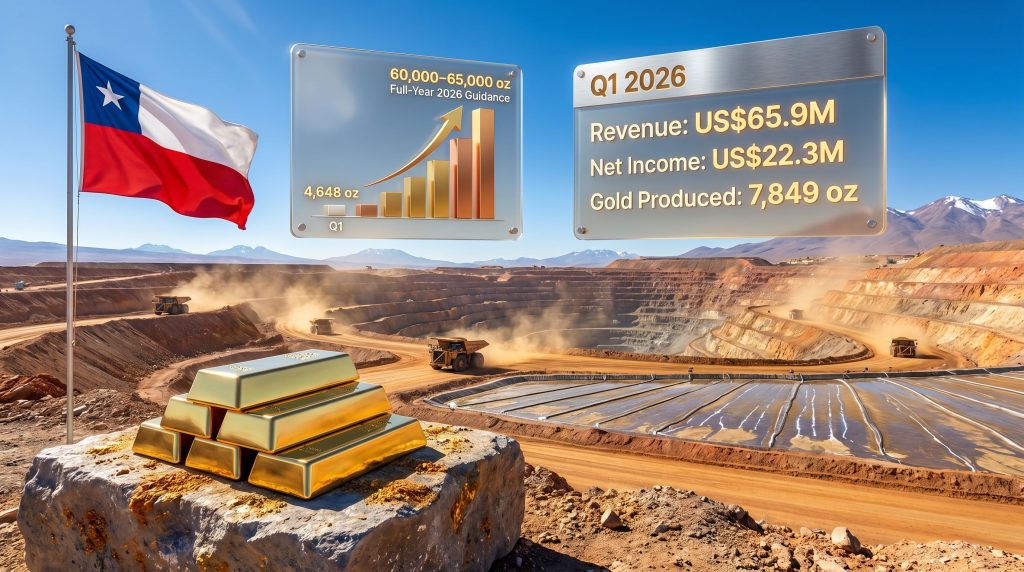
| Consolidated Revenue | US$65.9 million |
| Net Income | US$22.3 million |
| Cash and Equivalents (March 31, 2026) | US$93.1 million |
| Cash and Equivalents (December 31, 2025) | US$46.4 million |
The doubling of cash on hand from US$46.4 million to US$93.1 million within a single quarter is a striking outcome for a company that only months earlier was in the final stages of construction and commissioning. This improvement reflects the combined effect of Condestable's operational cash generation across its first two months under Rio2's ownership, Fenix Gold's initial gold sales, and the underlying capital structure established during the project development phase.
It is worth noting that Condestable was acquired in late January 2026, meaning its contribution to Q1 consolidated figures covers only February and March, not the full quarter. The revenue and income numbers are therefore structurally understated relative to what a full quarter of Condestable production would generate, a dynamic that should become clearer in Q2 2026 reporting.
Consolidated Production Across Both Operations
The multi-commodity production profile that emerged from Q1 2026 is a significant departure from Rio2's historical identity as a pure-play gold developer. The company now produces gold, silver, and copper across two countries, creating a diversified revenue base that provides partial insulation against single-commodity price movements. Furthermore, with a favourable gold price outlook underpinning revenue assumptions, this diversification strengthens the overall investment case.
| Commodity | Q1 2026 Consolidated Production |
|---|---|
| Gold | 7,849 oz |
| Silver | 49,198 oz |
| Copper | 6.4 million lbs |
Of the 7,849 ounces of gold produced, Fenix Gold contributed 4,648 ounces at cash costs of US$2,620 per ounce, while Condestable generated 3,201 ounces of gold as a byproduct credit alongside its dominant copper output. The silver production of 49,198 ounces is similarly split, with 48,671 ounces attributable to Condestable and the remainder from Fenix Gold.
This structure is important for investors to understand. Fenix Gold is a primary gold producer where gold revenue drives the economics. Condestable is a primary copper producer where precious metals, including gold and silver, reduce the net cost per pound of copper through byproduct credits. These are fundamentally different economic models operating within the same corporate structure.
Why the Ramp-Up Phase Is the Defining Period for Heap Leach Economics
For heap leach gold operations, the ramp-up phase presents a distinct set of challenges that differ from those facing mill-based operations. Understanding these dynamics provides critical context for evaluating Rio2's Q1 2026 performance at Fenix Gold.
Heap leach operations build inventory on the pad over time. Early in a project's life, ore stacked on the leach pad has not yet fully yielded its recoverable gold, meaning gold in circuit (often called "gold on the pad" in industry parlance) can represent significant value that does not yet appear in production figures. This creates a lag effect where early-quarter production output understates the actual mineralisation being processed, as gold continues to drain from leached ore for weeks or months after stacking. This dynamic is a structural feature of the technology, not a reflection of operational underperformance.
Four specific operational constraints affected Fenix Gold's early ramp-up trajectory during Q1 2026:
- Blasting permit delays that restricted access to planned mining zones during the quarter
- Operator availability limitations during the initial workforce mobilisation phase, a common challenge at remote high-altitude operations
- Haul truck fleet transition as older extraction vehicles were replaced with equipment matched to the planned operational scale
- Lower-than-planned ore movement volumes relative to the original mine schedule, a downstream consequence of the above factors
Each of these constraints is typical of the commissioning and early ramp-up phase for open-pit mine operations in remote locations. Blasting permit timelines in Chile's high-altitude desert regions can be affected by regulatory sequencing requirements, and workforce mobilisation at operations located in the Atacama at elevation requires time to build trained operator pools. Haul truck transitions are capital-intensive but temporary disruptions. Factors such as grade and permitting issues of this nature are well-understood variables in early-stage mine commissioning.
Investors interpreting Q1 2026 production figures should account for the cumulative effect of these temporary constraints. The operational baseline represented by Q1 is not indicative of what steady-state production will look like once these friction points are resolved. The full-year guidance range of 60,000 to 65,000 ounces implies a significant production acceleration across Q2 through Q4 2026.
The Path to Commercial Production: What 60,000 Ounces Requires
Rio2's full-year gold production guidance of 60,000 to 65,000 ounces from Fenix Gold, with commercial production targeted for Q4 2026, creates a clear mathematical framework for assessing ramp-up progress. With Q1 delivering 4,648 ounces, the remaining guidance midpoint requires approximately 57,852 ounces across Q2, Q3, and Q4 combined, or roughly 19,284 ounces per quarter on average for the balance of the year.
Achieving this trajectory requires the throughput rate to increase meaningfully toward the 20,000 tonnes per day target. For heap leach operations, throughput is primarily a function of:
- Mining rate (how quickly ore is excavated and moved from the pit to the pad)
- Crushing and stacking efficiency (throughput of the crushing circuit and stacking equipment)
- Solution application rates and recovery kinetics (how quickly gold is mobilised and collected)
- Available working days (which can be affected by permitting, weather, and maintenance scheduling)
The declaration of commercial production in Q4 2026 would represent a financial reporting milestone as well as an operational one. In mining accounting, operations typically capitalise certain costs during the pre-commercial production phase. Once commercial production is declared, operating costs flow through the income statement rather than being capitalised against the asset, which changes how financial performance is measured and reported. This transition closely resembles the shift that occurs following the completion of a definitive feasibility study in terms of its impact on how the market re-rates an asset.
The next major ASX story will hit our subscribers first
Condestable: The Copper Cash Engine in Peru
The Condestable mine in Peru functions as a fundamentally different type of asset within Rio2's portfolio. Operating as a copper-dominant underground and open-pit operation with associated precious metal credits, Condestable processed more than 470,000 tonnes of ore during its first two months under Rio2's ownership, at an average copper grade of 0.70%.
| Condestable Metric (February to March 2026) | Value |
|---|---|
| Copper Production | 6.4 million lbs |
| Gold Production (byproduct) | 3,201 oz |
| Silver Production (byproduct) | 48,671 oz |
| Ore Processed | 470,000+ tonnes |
| Average Copper Grade | 0.70% |
| Cash Cost per Pound of Copper | US$2.01 |
| All-In Sustaining Cost (AISC) | US$2.84/lb |
A cash cost of US$2.01 per pound of copper is competitive within the global copper mining industry. For reference, industry surveys of global copper producers consistently place the median cash cost in a range that has generally tracked between US$1.80 and US$2.50 per pound depending on the period and commodity price environment. The Chile copper price outlook adds further context here, as favourable long-run copper demand projections underpin the strategic logic of holding a cash-generating copper asset. Condestable's AISC of US$2.84 per pound reflects the total cost burden including sustaining capital, and provides a more complete picture of operational efficiency for investors comparing assets across the sector.
The strategic rationale for acquiring a copper asset alongside a gold mine relates to portfolio construction and cash flow generation. Copper provides more predictable, shorter-cycle revenue relative to gold heap leach operations where gold-on-pad dynamics create timing differences. Condestable's cash flow can theoretically support Fenix Gold's ongoing ramp-up costs and exploration expenditure without requiring Rio2 to access external capital markets during a period of elevated operational spending.
Managing Diesel Risk at High Altitude: Rio2's Hedging Approach
Diesel fuel represents a disproportionately high share of variable operating costs for open-pit mining and heap leach operations at high altitude in remote locations. The Fenix Gold operation faces elevated diesel consumption relative to lower-elevation projects due to the energy demands of operating heavy machinery in thin air, and the logistical costs of transporting fuel to the mine site.
Rio2 implemented financial hedging instruments covering approximately 1.57 million gallons of projected diesel consumption at Fenix Gold for the period from April through December 2026. This approach is notable for several reasons:
- It demonstrates active cost management during a phase when operating cost control directly affects the mine's cash generation capacity
- Fuel hedging at this scale provides meaningful protection against diesel price spikes that could otherwise compress already-sensitive early-stage margins
- The volume covered suggests Rio2 has reasonable visibility into its planned operational intensity for the remainder of 2026
Diesel price movements in Chile during Q1 2026 were cited by Rio2 as a factor affecting cost structures, making the hedging programme a timely and operationally relevant risk mitigation measure rather than a purely financial exercise.
Exploration at Fenix Gold: The First Drilling Program in Over a Decade
What Does the New Drill Programme Target?
The announcement of a 23,000-metre drilling program at Fenix Gold, the first systematic drilling since 2014, represents a forward-looking commitment that extends well beyond the immediate ramp-up narrative. At a planned cost of approximately US$9.5 million, this programme targets two distinct objectives: updating the existing mineral resource model and investigating mineralisation below the current open-pit shell.
The significance of the twelve-year exploration gap should not be underestimated. Deposit geology is rarely fully understood from historical drilling alone, and modern three-dimensional modelling tools combined with updated drilling data can reveal extensions, structural controls, or grade variations that were not apparent from earlier work. Sub-pit mineralisation is particularly relevant for heap leach operations because high-grade or deeper zones that were not economic under previous assumptions may become viable as the operation matures and infrastructure costs are sunk.
Separately, Rio2 is evaluating the feasibility of incorporating desalinated water into Fenix Gold's operational water supply. The Maricunga region, like much of northern Chile's mining corridor, faces constraints on freshwater availability, and desalination infrastructure has become an increasingly important component of long-term operational planning for large-scale mining operations in the Atacama. A positive outcome from these studies could support a future capacity expansion beyond the current planned throughput rate.
Key Risks and Catalysts for the Remainder of 2026
Investors monitoring Rio2's progress toward its full-year guidance should track several specific variables that will determine whether the 60,000 to 65,000 ounce target is achievable.
Upside catalysts to watch:
- Resolution of blasting permit constraints enabling uninterrupted access to planned ore zones
- Completion of haul truck fleet transition restoring planned haulage capacity
- Condestable's first full-quarter contribution in Q2 2026 providing a more accurate read on the asset's annualised earnings power
- Positive early results from the exploration drilling programme indicating potential resource upside
Downside risks to monitor:
- Continued permitting delays extending operational restrictions into Q2 or Q3
- Diesel price increases beyond the hedged portion of consumption
- Ramp-up delays at Fenix Gold that push commercial production declaration beyond Q4 2026
- Regulatory or environmental permitting timelines in Chile affecting operational flexibility
The commercial production declaration itself functions as a financial milestone that will alter how Rio2 reports its results, making the Q4 2026 timing target financially material as well as operationally significant.
What Q1 2026 Actually Signals About Long-Term Mine Potential
Interpreting the Rio2 Fenix Gold production start purely through the lens of Q1's 4,648-ounce output misses the more instructive signal embedded in the quarter's data. The constraints that limited production were operational and temporary in nature, not structural or geological. Permitting processes resolve. Operator pools are built. Truck fleets are upgraded. These are known, manageable friction points with finite duration.
What Q1 2026 confirmed is that the ore behaves as expected, that the processing circuit is functional, and that the pathway to full-rate production is not blocked by technical or geological surprises. For a project of Fenix Gold's scale and complexity, that is a meaningful data point. The dual-country strategy that pairs gold growth in Chile with copper cash flow from Peru provides Rio2 with a financial architecture that may prove resilient enough to absorb ramp-up costs without compromising balance sheet strength, as demonstrated by the cash position growing from US$46.4 million to US$93.1 million in a single quarter despite significant operational investment.
The months ahead will reveal whether the operational acceleration required to meet full-year guidance is achievable. However, the Q1 foundation, imperfect as it is, suggests the underlying asset quality at Fenix Gold may support a significantly more productive operating profile as the ramp-up matures through the second half of 2026.
This article is intended for informational purposes only and does not constitute financial advice. All production forecasts, cost estimates, and operational targets referenced are based on company disclosures and publicly available reporting. Mining operations involve inherent operational, geological, regulatory, and financial risks. Readers should conduct their own due diligence before making investment decisions.
Want to Stay Ahead of the Next Major ASX Mineral Discovery?
Discovery Alert's proprietary Discovery IQ model delivers real-time alerts on significant ASX mineral discoveries, instantly turning complex mineral data into actionable insights for investors at every experience level — explore historic discoveries and their exceptional market returns to understand what early positioning can mean, then begin your 14-day free trial at Discovery Alert to secure your market-leading edge.