
May 18, 2026
The Capital-Light Revolution Reshaping Junior Gold Development
The economics of building a gold mine have rarely favoured the small. For decades, junior developers faced an almost binary choice: raise hundreds of millions in capital to construct a standalone processing plant, or wait indefinitely for a major to acquire the project. That model is being quietly dismantled by a growing cohort of developers who recognise that existing regional infrastructure, when intelligently paired with high-grade ore bodies, can compress the traditional development timeline from years into months.
With gold prices at record highs throughout 2025, this shift in development philosophy is precisely what makes the Hualilan gold project low-cost startup approach so instructive for investors tracking the junior gold space in 2025 and 2026. Rather than treating the absence of on-site processing infrastructure as a liability, Challenger Gold has reframed it as an opportunity to generate early cash flow while deferring the most capital-intensive phase of development until the project has demonstrated its value in production.
When big ASX news breaks, our subscribers know first
Toll Milling as a Development Strategy: Mechanics and Investor Logic
At its core, toll milling involves mining ore, trucking it to a third-party processing facility, and receiving payment for the recovered metal content after deducting processing fees. It is not a novel concept in the broader mining industry, but its application as a deliberate startup strategy for a project of Hualilan's scale is relatively uncommon and worth unpacking carefully.
The fundamental appeal lies in the capital structure it enables. Where a conventional standalone plant development for a project of this size might require US$100 million or more before the first ounce is poured, the toll milling approach at Hualilan requires only US$4.2 million in upfront capital expenditure and approximately US$4.7 million in working capital, totalling a remarkably compact A$8.9 million startup package.
| Metric | Standalone Plant Development | Toll Milling / Ore Trucking Model |
|---|---|---|
| Upfront Capex | High (US$100M+) | Low (US$4.2M) |
| Working Capital Required | Significant | ~US$4.7M |
| Time to First Cash Flow | 3 to 5+ years | Months from mining commencement |
| Financing Risk | High | Materially reduced |
| Operational Complexity | High | Simplified |
The strategic logic is straightforward: mine high-grade starter ore from a reserve-only schedule, haul it along a sealed highway to an established processing facility, generate cash flow with minimal upfront exposure, and redeploy those operating returns toward funding the full-scale definitive feasibility study and eventual standalone plant construction.
The Casposo Connection: Why Distance Is Not a Deterrent
The processing facility in question is the Casposo plant, located approximately 165 kilometres from Hualilan along a sealed highway. To many observers, trucking ore over that distance might appear logistically burdensome. In practice, the sealed road access largely eliminates the weather-related disruption and vehicle wear that make long-haul ore trucking economically unviable in many jurisdictions.
More importantly, the existence of established infrastructure at Casposo removes the single most capital-intensive phase of project development entirely. Greenfield plant construction carries not just financial risk, but schedule risk, commissioning risk, and operational ramp-up uncertainty. By leveraging existing capacity, Hualilan sidesteps all of these risks during the critical early-stage period.
A high-grade ore body paired with sealed highway access to established processing infrastructure fundamentally changes the risk calculus for a junior developer operating in a challenging capital market environment.
San Juan Province: Location, Jurisdiction, and Strategic Positioning
Geography matters enormously in mining, and Hualilan's position within San Juan Province, Argentina deserves more analytical attention than it typically receives in coverage of the project. Furthermore, the Argentina mining potential of the broader region adds additional context to why this jurisdiction is attracting renewed interest from developers.
San Juan has historically been one of Argentina's most significant gold and silver mining jurisdictions, hosting major operations that have collectively contributed billions of dollars to provincial and national revenues. Yet the province has seen limited new mine development in the past two decades. The characterisation of Hualilan as potentially the first new gold mine in San Juan in 17 years is not merely a marketing statement; it reflects a genuine gap in the provincial mining development pipeline and positions the project as a landmark event for the region's mining sector.
From a logistics standpoint, San Juan's relatively well-developed road network and proximity to Chile's established mining supply chain mean that equipment procurement, contractor availability, and skilled labour access are considerably better than in more remote Argentine provinces.
Argentina's Investment Climate: Nuance Required
Any honest assessment of Hualilan must acknowledge Argentina's complex macroeconomic history. The country has experienced multiple currency crises, shifting export duty regimes, and periodic foreign exchange controls that have created material uncertainty for mining operators. These are not hypothetical risks; they are documented features of the Argentine investment environment that any prospective investor must weigh carefully.
That said, San Juan Province has maintained a relatively stable and mining-friendly regulatory framework at the provincial level, and Argentina's national government has periodically sought to attract foreign mining investment through legislative frameworks designed to provide fiscal stability guarantees. Whether those frameworks provide durable protection against policy shifts remains a legitimate open question.
Decoding the Hualilan PFS: What the Numbers Actually Mean
The prefeasibility study released by Challenger Gold represents a significant step forward in the technical definition of the Hualilan project, and the financial metrics deserve careful contextualisation rather than simple headline repetition. According to the full PFS documentation, the project demonstrates strong economics across a range of gold price scenarios.
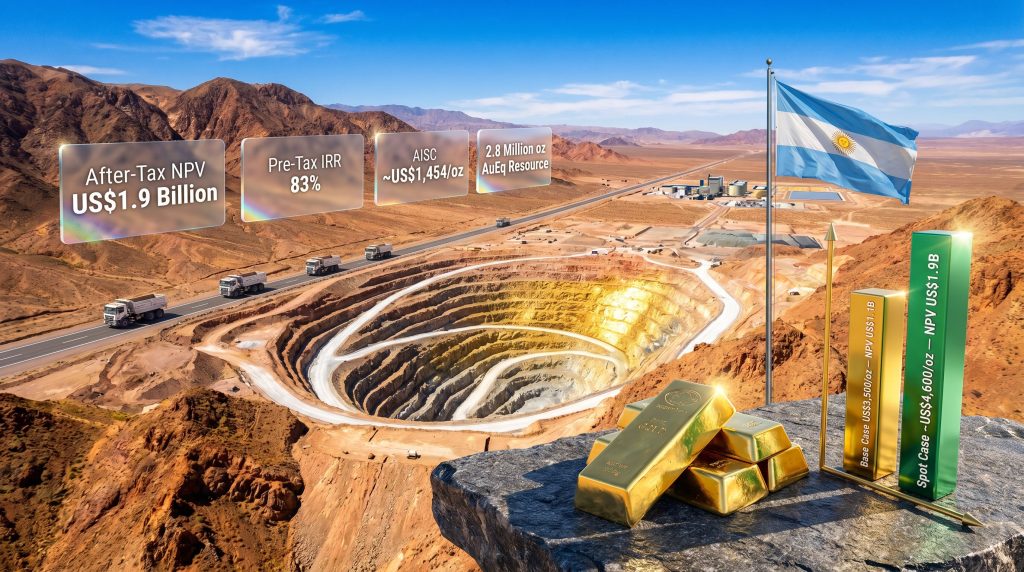
| Financial Metric | Base Case (US$3,500/oz) | Spot Price Case (~US$4,600/oz) |
|---|---|---|
| After-Tax NPV | US$1.1 billion | US$1.9 billion |
| Pre-Tax IRR | 45% | 83% |
| Payback Period | 2.25 years | 1.25 years |
| Startup Capital Required | US$232 million | US$232 million |
| Mine Life | 14 years | 14 years |
| Total Production | 1.8 million oz | 1.8 million oz |
The dual gold price scenario structure of this PFS is analytically important. Using a conservative US$3,500 per ounce base case, the project still generates an after-tax NPV of US$1.1 billion with a pre-tax IRR of 45% and a payback period of 2.25 years. These are genuinely compelling metrics by any standard measure of junior gold project economics.
At the spot price environment prevailing at the time of publication, approximately US$4,500 to US$4,600 per ounce, those metrics transform dramatically. The after-tax NPV rises to US$1.9 billion, the IRR expands to 83%, and the payback compresses to just 1.25 years. The gap between these two scenarios illustrates the extraordinary operating leverage that high-margin gold projects carry in elevated price environments. Consequently, the current gold price outlook is particularly favourable for projects with this level of margin sensitivity.
Production Profile and Cash Flow Sequencing
The production schedule envisioned by the PFS follows a logical ramp-up structure:
- Years 1 and 2: Production of approximately 105,000 ounces per year as the operation ramps up
- Years 3 through 14: Steady-state production averaging 135,000 ounces per year
- Total life-of-mine production: 1.8 million ounces of gold equivalent
The processing configuration underpinning this profile is a hybrid system combining a conventional 1.5 million tonne per year flotation plant with an 8 million tonne per year heap leach circuit, both fed from a single open pit. This configuration represents a notable evolution from the 2023 scoping study and introduces important operational flexibility. The flotation circuit captures high-grade sulphide ore efficiently, while the heap leach handles lower-grade oxide and transitional material that would otherwise be uneconomic to process through the flotation plant alone.
AISC Analysis: The Margin Story
The reported all-in sustaining cost (AISC) of approximately US$1,454 per ounce of gold equivalent during the toll milling startup phase positions Hualilan comfortably in the lower half of the global gold cost curve. With spot prices hovering near US$4,500 per ounce, the implied operating margin approaches US$3,000 per ounce, representing one of the widest per-ounce margins available in the junior gold development universe at current prices. Indeed, the relationship between gold and mining equities highlights why such margins are attracting significant institutional attention.
It is worth noting that AISC figures at the PFS stage carry inherent uncertainty and should not be treated as guaranteed outcomes. Cost estimates at this level of study typically carry accuracy ranges of plus or minus 25%, and actual costs will depend heavily on contractor pricing, Argentine peso dynamics, and energy costs at the time of production.
The Resource Base: Grade, Scale, and Exploration Optionality
Understanding why the toll milling startup approach is viable at Hualilan requires appreciating the grade profile of the underlying resource. Hualilan hosts a total mineral resource of approximately 2.8 million ounces of gold equivalent, anchored by a high-grade core of 1.6 million ounces at 5.0 grams per tonne gold equivalent.
That 5.0 g/t AuEq grade is the critical enabler of the entire low-cost startup strategy. High-grade ore generates more revenue per tonne mined and hauled, which is precisely what makes the economics of a 165-kilometre trucking operation viable. A lower-grade deposit would require processing far more tonnes to generate equivalent revenue, rapidly eroding the economics of toll milling at this distance.
Grade Context: Why 5.0 g/t AuEq Matters
For context, the global average grade for open-pit gold operations sits well below 2.0 g/t. At 5.0 g/t, Hualilan's high-grade core places it among the more compelling open-pit grade profiles in the global junior development pipeline. This grade concentration also means the starter pit can be designed to target the highest-value material first, maximising early cash flow generation and reducing the time required to recover the initial capital investment.
The broader 2.8 million ounce resource base provides the foundation for the 14-year mine life modelled in the PFS, while the wider Hualilan tenement package offers exploration upside that has not yet been fully captured in the current resource estimate. Resource growth drilling, funded in part by the recently announced capital raise, will test whether the known mineralisation extends beyond its current boundaries.
Capital Structure: The A$85 Million Placement and What It Signals
Challenger Gold has announced an A$85 million private placement structured around approximately 708 million new fully paid ordinary shares at an issue price of A$0.12 per share, with binding commitments already received for the full placement.
The lead investor commitment of A$10 million from the incoming chairperson-elect and other cornerstone investors carries meaningful signalling value. Senior mining executives committing personal capital alongside institutional investors is a credibility indicator that the institutional market typically reads as meaningful alignment of interests.
How the Capital Will Be Deployed
| Use of Funds | Purpose |
|---|---|
| Resource Growth Drilling | Testing the broader Hualilan tenement package beyond the current resource |
| Definitive Feasibility Study | Advancing Hualilan toward a construction decision |
| Working Capital | Supporting toll milling startup operations |
An earlier A$33.9 million equity raise had already been completed prior to this placement, with proceeds directed toward the toll milling commencement phase. This pre-funded working capital position means the startup operation does not depend on debt financing during its initial phase, removing a significant source of execution risk that has derailed numerous junior gold projects in recent years.
Leadership Quality as a Project De-Risking Mechanism
The incoming chairperson-elect brings a career track record that includes founding one of the most successful mid-tier gold companies of the past two decades and subsequently building a second major gold platform. The incoming COO brings more than 25 years of progressive technical and operational experience across South American and North American gold operations, including senior leadership roles at two established gold producers.
In the junior mining sector, management quality is not merely a soft factor. It directly affects the probability of successful project execution, the ability to attract institutional capital, and the credibility of feasibility study assumptions with independent technical reviewers.
The next major ASX story will hit our subscribers first
Economic and Social Footprint: Quantifying Hualilan's Broader Impact
| Impact Category | Projected Value |
|---|---|
| Direct Employment Created | 900 new jobs |
| Provincial Royalties | At least US$287 million |
| Argentine Corporate Taxes and Export Duties | US$542 million |
| Life-of-Mine EBITDA (Scoping Study Estimate) | US$738 million |
The combined fiscal contribution of US$829 million in royalties, taxes, and export duties across the mine's life represents a meaningful contribution to both San Juan Province and the Argentine national government. For a project in a jurisdiction where government revenue from the extractive sector is politically significant, this scale of fiscal contribution typically provides an additional layer of social licence support.
The 900 direct jobs figure is also noteworthy in the context of a region where large-scale formal employment opportunities in the resources sector have been limited for nearly two decades. As Panorama Minero reports, Hualilan has now entered its productive stage, with the first doré pour anticipated in the near term.
Key Risks Every Investor Should Evaluate
Toll Milling Phase Risks
- Third-party processing dependency: Availability, scheduling priority, and throughput capacity at Casposo are outside Challenger Gold's direct operational control
- Haulage cost variability: Fuel price movements, road conditions, and contractor pricing over a 165-kilometre route introduce ongoing cost uncertainty
- Grade reconciliation risk: The relationship between the resource model grade and actual recovered grade from mined ore will only be confirmed through production
Development Transition Risks
- The US$232 million capital requirement for the full standalone development is substantial relative to the company's current market capitalisation and will require significant additional financing
- Permitting timelines for transitioning from starter operations to full-scale mining in Argentina can be unpredictable
- A material decline from current gold price levels would compress project economics significantly, particularly given the sensitivity illustrated by the dual-scenario PFS
Macroeconomic and Geopolitical Risks
Argentina's history of currency controls, export duty modifications, and fiscal policy shifts represents a genuine ongoing risk for any mining operation in the country. The PFS models include export duty obligations, but the interaction between future Argentine policy settings and project economics under different gold price scenarios deserves careful scenario analysis by prospective investors.
Disclaimer: This article is for informational purposes only and does not constitute financial advice. The Hualilan project remains a development-stage asset, and all forward-looking statements, financial projections, and resource estimates are subject to material risks and uncertainties. Investors should conduct their own due diligence and consult a qualified financial adviser before making investment decisions.
Frequently Asked Questions: Hualilan Gold Project Low-Cost Startup
What makes the Hualilan gold project low-cost startup different from conventional gold mine development?
The Hualilan gold project low-cost startup strategy relies on ore trucking to an existing third-party processing facility rather than constructing a standalone plant. This reduces the initial capital requirement to approximately US$4.2 million in capex plus US$4.7 million in working capital, compared to the US$232 million required for the full standalone development. The approach leverages a sealed highway connection to the Casposo processing plant approximately 165 kilometres away, enabling cash flow generation within months of mining commencement.
What is the current production status of Hualilan?
Ore shipments from Ullum to the Casposo plant have commenced. A first doré pour is anticipated in the near term. The project has been described as the first new gold mine in San Juan Province in approximately 17 years.
What is the total mineral resource at Hualilan?
Hualilan hosts a total mineral resource of approximately 2.8 million ounces of gold equivalent, anchored by a high-grade core of 1.6 million ounces at 5.0 grams per tonne gold equivalent.
How does the 2026 PFS compare to the 2023 scoping study?
The PFS introduces a hybrid processing configuration combining a 1.5 million tonne per year flotation plant with an 8 million tonne per year heap leach circuit, an expanded production profile, a 14-year mine life, and substantially improved NPV and IRR metrics reflecting both the updated project design and the elevated gold price environment.
What is the AISC during the toll milling phase?
The reported AISC during the toll milling startup phase is approximately US$1,454 per ounce of gold equivalent, positioning the project with significant operating margin relative to current gold prices near US$4,500 per ounce. Note that this figure carries the inherent estimation uncertainty typical of PFS-stage cost modelling.
Staged Development as a Value Creation Framework
Perhaps the most instructive aspect of the Hualilan story for the broader junior gold development sector is the clarity of its staged development logic. Each phase is designed not merely to advance the project, but to de-risk the next stage while creating discrete value inflection points:
- Stage 1: Toll milling startup generates early cash flow with minimal capital at risk, validates the ore body in production, and builds operational credibility
- Stage 2: Cash flow and capital raise proceeds fund the definitive feasibility study, which locks in the engineering and cost basis for a construction decision
- Stage 3: The full standalone operation at 1.5 Mtpa flotation plus 8 Mtpa heap leach reaches steady-state production of approximately 135,000 ounces per year across a 12-year remaining mine life
At a time when gold prices are providing exceptional leverage to development-stage assets, the projects most likely to convert that leverage into genuine shareholder value are those with credible pathways to production, capital-efficient startup strategies, and management teams capable of navigating complex jurisdictions. Whether the Hualilan gold project low-cost startup ultimately delivers on its potential will depend on execution quality, Argentine policy stability, and gold price sustainability, but the structural logic of the development approach is among the more compelling in the current junior gold universe.
Want to Track the Next Major ASX Gold Discovery Before the Market Moves?
Discovery Alert's proprietary Discovery IQ model scans ASX announcements in real time, instantly identifying high-potential mineral discoveries across gold and 30-plus other commodities — turning complex data into actionable insights for investors at every level. Explore how historic discoveries have generated exceptional returns on Discovery Alert's dedicated discoveries page, then begin your 14-day free trial to secure your market-leading edge.