August 14, 2026
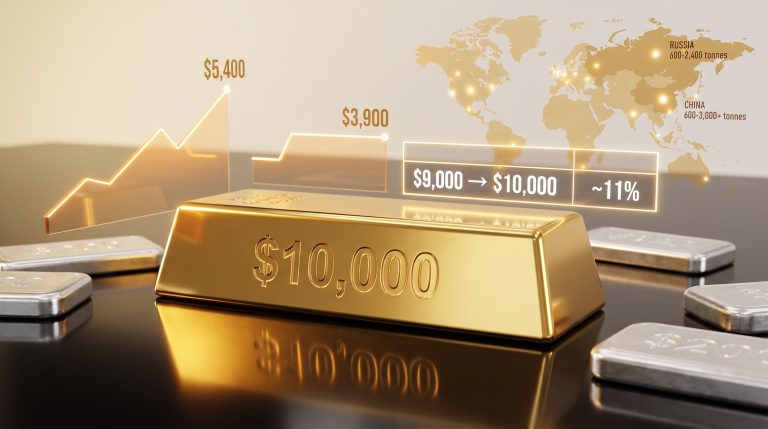
The Hidden Architecture of Gold's Price Rally: Why Official-Sector Demand Has Changed Everything
For most of financial history, gold prices responded to a familiar set of variables: inflation expectations, real interest rates, the strength of the US dollar, and the ebb and flow of retail investor sentiment. Professional analysts built models around these inputs, calibrated their forecasts accordingly, and largely agreed on the framework. That consensus has now been fundamentally disrupted by the Goldman central bank gold buying forecast, which has forced a wholesale reassessment of how official-sector demand shapes price dynamics.
Understanding why this matters requires examining not just the volume of buying, but the nature of the buyers themselves. Central banks are not traders. They do not respond to short-term price signals, they do not have quarterly performance targets, and they do not exit positions when sentiment shifts. They operate on policy mandates measured in decades, and once gold is absorbed into official reserves, it rarely returns to the market.
When big ASX news breaks, our subscribers know first
Why Central Bank Gold Demand Has Become the Most Important Price Driver in 2026
The Structural Shift Away From Dollar-Denominated Reserves
The transformation in reserve management philosophy did not happen overnight. It traces back through years of geopolitical friction, the gradual recognition among emerging-market economies that dollar-denominated assets carry sovereign risk as well as financial risk, and the increasing use of financial sanctions as a geopolitical instrument.
The 2022 freezing of Russian foreign exchange reserves accelerated what had already been a developing trend. For reserve managers across Asia, the Middle East, and Eastern Europe, that event functioned as a stress test demonstrating that dollar-denominated reserves could theoretically be rendered inaccessible by political decision. Physical gold held domestically carries no such counterparty risk. It cannot be frozen, sanctioned, or devalued by a foreign government's monetary policy.
This recognition has driven a systematic reallocation of reserves that shows no signs of reversal. Furthermore, central banks influencing gold markets remain structurally underweight relative to their developed-market counterparts. Advanced economies typically hold between 60% and 80% of their reserves in gold by value, while many major emerging economies hold less than 10%, creating what Goldman Sachs characterises as a substantial structural runway for continued accumulation.
How Official-Sector Buying Differs From Retail and Institutional Demand
The distinction between central bank demand and other forms of gold buying is not merely quantitative but qualitative. Consider how different buyer categories respond to the same market conditions:
| Demand Category | Price Sensitivity | Investment Horizon | Reversibility |
|---|---|---|---|
| Central Banks | Very Low | Multi-decade | Very Low |
| Gold ETFs | High | Short-to-medium term | High |
| Jewellery Consumers | Moderate | Long (cultural holding) | Low |
| Speculative Traders | Very High | Days to months | Very High |
ETF investors typically reduce holdings when real interest rates rise, since higher yields increase the opportunity cost of holding a non-yielding asset. Jewellery demand fluctuates with consumer income cycles and cultural events. Speculative positioning responds to momentum and macro signals. Central banks, however, respond to none of these triggers in the same way.
Official-sector gold accumulation functions less like an investment and more like the construction of financial infrastructure. Once built, it is not dismantled for tactical reasons.
This behavioural difference transforms central bank demand from a flow variable into something closer to a structural constant, removing metal from available supply on a near-permanent basis and establishing a price floor that purely financial demand cannot replicate.
What Does the Goldman Central Bank Gold Buying Forecast Actually Say?
Revised Nowcast: From 29 Tonnes to 50 Tonnes Per Month
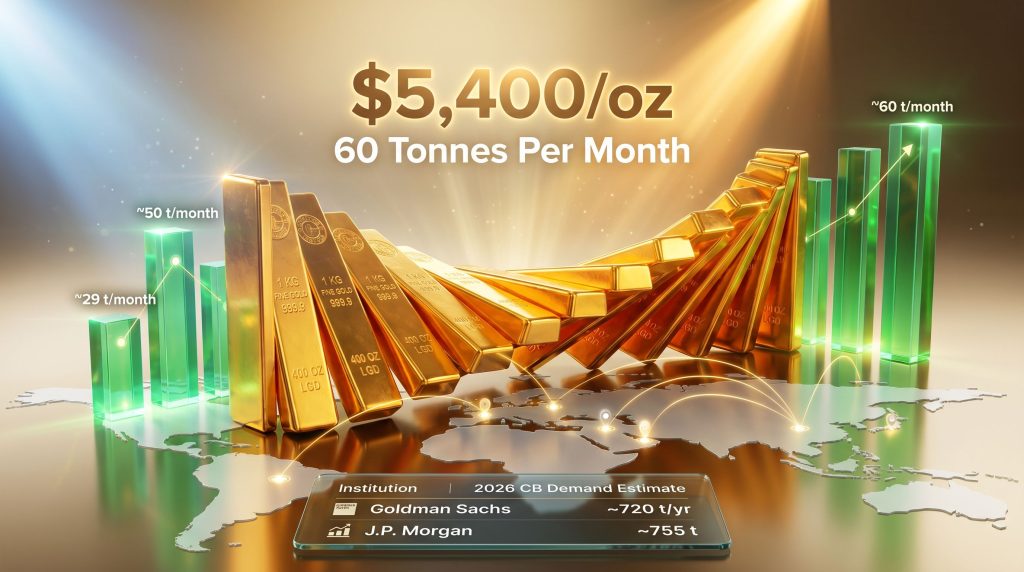
In May 2026, Goldman Sachs released a significant revision to its central bank gold demand model. The bank's nowcast of monthly central bank purchases on a 12-month moving average basis for March 2026 was raised to approximately 50 tonnes per month, up from a prior estimate of 29 tonnes per month. This represents an upward revision of more than 72%, a correction of extraordinary magnitude for a model that had been functioning as a key input for gold price forecasts across the investment research community.
The revision was not driven by new buying activity but by the identification of a structural gap in the data the model had been consuming. Goldman determined that its previous methodology had been systematically underestimating sovereign demand since August 2025, when UK trade data began failing to fully reflect gold leaving London's vault network.
The 60-Tonne-Per-Month Baseline: Goldman's 2026 Forecast
Looking forward, Goldman Sachs projects that central banks will average approximately 60 tonnes of gold purchases per month through 2026. On an annualised basis, this implies roughly 720 tonnes of official-sector demand for the full year, a figure broadly consistent with the World Gold Council's independently reported data showing 244 tonnes of central bank purchases in Q1 2026 alone.
Goldman characterises any near-term softness in monthly buying as seasonal variation rather than a structural reversal. The bank's position is that the underlying demand impulse remains intact, supported by ongoing reserve diversification strategies and the continuation of the geopolitical dynamics that have been driving sovereign gold accumulation.
The $5,400/oz Price Target: Key Assumptions and Risks
Goldman's end-2026 gold price target sits at $5,400 per troy ounce, representing a substantial premium to mid-2026 spot levels. The two primary drivers embedded in this target are sustained central bank gold demand and anticipated reductions in the US Federal Reserve's benchmark interest rate, which would reduce the opportunity cost of holding gold and likely weaken the US dollar.
| Metric | Prior Estimate | Revised Estimate |
|---|---|---|
| Monthly CB purchases (nowcast, March 2026) | ~29 t/month | ~50 t/month |
| Monthly CB purchases (2026 full-year forecast) | Not stated | ~60 t/month |
| Goldman end-2026 gold price target | Previously stated | $5,400/oz |
| World Gold Council Q1 2026 CB purchases | N/A | 244 tonnes |
Goldman did explicitly flag a near-term risk: gold could face downward price pressure during episodes of acute market stress if investors move to liquidate liquid assets to raise cash. This is a well-documented pattern in which even the gold safe-haven role experiences temporary selling during broad market dislocations as investors cover margin requirements elsewhere.
How Did Goldman's Model Miss the Signal, and Why Does It Matter?
The London Vault Data Gap: A Methodological Blind Spot
The mechanics of the data failure are instructive. London remains the world's primary over-the-counter gold trading and storage hub, with the Bank of England's vaults and a network of commercial bullion vaults holding the majority of the world's investment-grade gold. When gold moves out of these vaults for physical delivery to sovereign buyers, that movement is typically captured in UK trade export statistics.
From August 2025 onward, those trade statistics began failing to fully reflect actual outflows. The precise reason for this measurement gap requires further disclosure from UK statistical authorities, but the effect was clear: a meaningful volume of sovereign gold transfers was occurring entirely outside the visibility of the standard data frameworks that most gold market analysts rely upon.
When a major financial institution's demand model undershoots reality by more than 70% on a monthly basis, the implications extend well beyond that institution's own forecasting accuracy. The entire analytical infrastructure built on publicly reported trade flows must be reassessed.
Unrecorded Sovereign Buying: A Persistent Market Feature
The London vault data gap is a specific instance of a broader, longer-standing phenomenon in the gold market: the systematic underreporting of sovereign gold transactions. Several central banks, particularly in emerging markets, have historically disclosed reserve changes with significant delays, sometimes reporting acquisitions months or even years after the physical metal was transferred.
This practice has multiple motivations. Premature disclosure of large-scale buying programmes can move market prices against the accumulating institution. Some countries maintain strategic ambiguity around their reserve composition for geopolitical reasons. Others simply face bureaucratic delays in the formal reporting process to institutions such as the IMF.
The consequence for analysts is important: if the reported data systematically understates actual demand, then price models calibrated to reported figures will consistently underestimate the structural support for gold prices. Goldman's revised methodology attempts to bridge this gap through alternative data signals, including London vault flow analysis, but the revision itself confirms how wide the gap can become.
Which Central Banks Are Driving Demand, and Are They Still Underweight Gold?
Emerging-Market Central Banks: The Primary Accumulation Engine
The geographic distribution of central bank gold demand is neither uniform nor static. Emerging-market institutions have been by far the most active accumulators, driven by the convergence of three factors: relatively low existing gold allocations, growing economic weight seeking proportional reserve representation, and heightened sensitivity to geopolitical risks associated with dollar-denominated reserve concentration.
Across Asia, particularly in China and several Southeast Asian economies, reserve managers have been building gold positions against a backdrop of managed currency policies and deliberate diversification away from US Treasury exposure. In the Middle East, sovereign wealth management frameworks have incorporated increased gold allocations as a hedge against oil price volatility and regional instability. In addition, Eastern European central banks have been motivated significantly by proximity to the conflict in Ukraine and the demonstration effect of Western financial sanctions.
Goldman's assessment that these institutions remain structurally underweight gold relative to developed-market peers is supported by basic arithmetic. If major emerging-market central banks were to raise their gold allocation from current levels to even half the proportion held by the US Federal Reserve or the Bundesbank, the cumulative demand would represent several years of global mine production. Consequently, the central bank trends driving this accumulation appear far from exhausted.
How Major Institutions' Forecasts Compare
| Institution | 2026 CB Demand Estimate | Key Driver Cited |
|---|---|---|
| Goldman Sachs | Reserve diversification + data revision | |
| J.P. Morgan | ~755 t (full year) | Sustained structural demand |
| World Gold Council | 244 t in Q1 2026 alone | Geopolitics + inflation hedging |
The convergence between Goldman's revised forecast and J.P. Morgan's independent estimate is noteworthy. Two major financial institutions, using different methodologies, are arriving at broadly similar conclusions about the scale of official-sector demand. This convergence strengthens the case that the revised estimates are reflecting genuine underlying demand rather than modelling artefacts. For further context, J.P. Morgan's gold price analysis outlines additional structural factors supporting elevated price projections.
What Is the Relationship Between Central Bank Buying and the Gold Price Outlook?
How Sovereign Demand Functions as a Price Floor Mechanism
The mechanics through which central bank demand supports gold prices operate differently from speculative or investment demand. When hedge funds accumulate gold positions, they create demand that is inherently reversible. A change in macro outlook, a risk-off event, or a shift in relative value calculations can trigger rapid liquidation.
Central bank accumulation works differently. When the People's Bank of China adds gold to its official reserves, or when the National Bank of Poland increases its bullion holdings, that metal is effectively removed from the tradeable float. It does not return to the market in response to price signals, and the accumulated stock becomes a permanent reduction in the supply available to other market participants.
Over time, this creates what analysts describe as a structural price floor: a level below which the sheer volume of sovereign demand would prevent sustained price declines. Unlike technical support levels that can be broken by momentum, the price floor created by persistent non-price-sensitive buying has a fundamentally different character.
The Federal Reserve Variable: A Secondary Amplifier
Goldman's price target explicitly incorporates anticipated Federal Reserve rate reductions as a secondary driver. The relationship between real interest rates and gold prices is well established: lower real rates reduce the opportunity cost of holding a non-yielding asset, typically weakening the US dollar and making dollar-priced gold cheaper for foreign buyers simultaneously.
The significance of framing rate cuts as a secondary rather than primary driver reflects how substantially the gold market's pricing dynamics have shifted. In previous cycles, Federal Reserve policy was the dominant variable. Today, however, Goldman's model suggests that central bank structural demand carries greater weight, with monetary policy functioning as an amplifier of existing demand rather than the primary catalyst.
Geopolitical Risk Premium: A New Structural Component
Beyond the mechanics of supply and demand, gold now appears to be pricing in a persistent geopolitical risk premium that did not exist in the same form a decade ago. This premium reflects the market's assessment of the probability of further financial system fragmentation, additional use of reserve weaponisation as a geopolitical tool, and the long-term development of alternative settlement systems that reduce dollar centrality.
Goldman's own survey-based research indicates continued strong underlying interest in gold from both official institutions and private investors, with geopolitical uncertainty cited as a reinforcing factor for demand across both categories.
The next major ASX story will hit our subscribers first
Is the Central Bank Gold Buying Trend a Short-Term Spike or a Decade-Long Structural Shift?
Evidence for a Multi-Year Accumulation Cycle
The acceleration in central bank gold buying that began in earnest after 2022 represents a departure from the patterns that defined the post-Bretton Woods era. For decades following the collapse of the gold standard, central banks across the developed world were net sellers of gold, treating their legacy holdings as an underperforming asset. The Washington Agreement on Gold, signed in 1999, was specifically designed to coordinate and limit the pace of European central bank gold sales to prevent market disruption from excessive supply.
The current environment is the structural inverse of that era. Central banks are now net buyers at a scale and consistency that has no historical precedent in the modern financial system. Goldman's framing of the Goldman central bank gold buying forecast as driven by reserve diversification mandates rather than return-seeking behaviour suggests the cycle has institutional staying power that purely investment-driven trends lack.
Risks That Could Moderate Official-Sector Accumulation
Intellectual honesty requires acknowledging the scenarios under which central bank buying could slow or reverse:
- A sharp and sustained appreciation of the US dollar could reduce the relative attractiveness of gold for non-dollar reserve managers
- A significant reduction in geopolitical tensions, particularly a resolution of the Ukraine conflict and a normalisation of US-China financial relations, could reduce the sanctions-hedging motivation
- Gold price volatility itself could prompt some reserve managers to pause accumulation if internal risk frameworks flag excessive concentration
- An acute global liquidity crisis could see some institutions liquidate gold alongside other assets to meet domestic funding needs, a risk Goldman explicitly acknowledged in its May 2026 note
None of these scenarios appear imminent based on current conditions, but they represent legitimate counterarguments to a purely linear extrapolation of the current trend.
What Historical Reserve Diversification Cycles Reveal
Previous episodes of major reserve system transitions offer partial but imperfect guidance. The post-Bretton Woods period saw significant reallocation of global reserves, but that transition was driven primarily by the formal dissolution of a fixed exchange rate system. The current cycle is distinguished by its voluntary, strategically motivated character: central banks are choosing to accumulate gold in the absence of any formal system requirement to do so.
This voluntary nature actually makes the trend more durable, not less. It reflects genuine institutional conviction rather than compliance with a systemic rule that could be changed by international agreement.
Frequently Asked Questions: Goldman Sachs Central Bank Gold Buying Forecast
What is Goldman Sachs' forecast for central bank gold buying in 2026?
Goldman Sachs projects that central banks will purchase approximately 60 tonnes of gold per month on average through 2026, underpinned by ongoing reserve diversification and persistent geopolitical uncertainty.
Why did Goldman Sachs revise its central bank gold demand estimate upward?
Goldman revised its nowcast from approximately 29 tonnes to 50 tonnes per month after identifying gaps in UK trade data that had been failing to capture gold outflows from London vaults since August 2025, pointing to significant unrecorded sovereign purchasing activity that its earlier methodology had not accounted for.
What is Goldman Sachs' gold price target for end-2026?
Goldman Sachs has set a gold price target of $5,400 per troy ounce for the end of 2026, with sustained central bank demand and expected Federal Reserve interest rate reductions identified as the two primary supporting factors.
How does Goldman Sachs' forecast compare to J.P. Morgan's outlook?
J.P. Morgan estimates approximately 755 tonnes of central bank gold purchases for full-year 2026, while Goldman's 60 t/month projection implies an annualised rate of approximately 720 tonnes. Both institutions regard official-sector demand as structurally elevated, even if slightly below the record pace recorded in 2022.
Are central banks likely to continue buying gold beyond 2026?
Goldman Sachs does not anticipate a near-term reversal in central bank accumulation, citing the persistent structural underweight positioning of emerging-market central banks relative to developed-market peers and the continuation of the geopolitical and reserve diversification dynamics that have been driving demand.
What risks could interrupt the central bank gold buying trend?
Goldman has specifically flagged the possibility of near-term gold price pressure if investors liquidate liquid assets during market stress events. Broader structural risks include a significant reversal in geopolitical tensions, sharp US dollar appreciation, or a fundamental shift in emerging-market reserve policy priorities.
Key Takeaways: What the Goldman Forecast Means for the Gold Market
The implications of the Goldman central bank gold buying forecast extend well beyond the specific price target attached to it. They collectively point toward a fundamental reassessment of how the gold market should be modelled and understood:
- Central bank gold demand has been materially underestimated by consensus models, with Goldman's revised nowcast exceeding its prior estimate by more than 72%
- The 60 t/month forecast for 2026 reflects a sustained, policy-driven accumulation pace with institutional characteristics that make it substantially more durable than investment or speculative demand
- Goldman's $5,400/oz end-2026 price target is explicitly anchored to official-sector demand as the primary fundamental support, with monetary policy serving as an amplifying factor rather than the primary driver
- Emerging-market central banks remain structurally underweight gold relative to developed-market counterparts, creating a multi-year demand runway independent of short-term price or rate dynamics
- The London vault data gap confirms that actual sovereign buying may consistently exceed reported figures, meaning standard analytical frameworks built on public trade data are likely to continue underestimating true demand
- The convergence between Goldman and J.P. Morgan's independent estimates provides cross-institutional validation that the revised demand picture reflects genuine market conditions rather than a single-institution modelling anomaly
Disclaimer: This article is intended for informational purposes only and does not constitute financial advice. Gold price forecasts, including those referenced from Goldman Sachs and J.P. Morgan, are forward-looking projections subject to significant uncertainty. Past performance of gold as an asset class is not indicative of future results. Readers should consult qualified financial advisers before making investment decisions. Forecasts cited reflect analyst estimates as of May 2026 and may be subject to revision.
Want to Capitalise on the Next Major ASX Mineral Discovery Before the Market Catches On?
Discovery Alert's proprietary Discovery IQ model scans ASX announcements in real time, delivering instant alerts on significant mineral discoveries and turning complex data into actionable opportunities — just as it has done for historic discoveries like those made by De Grey Mining and WA1 Resources. Start your 14-day free trial today and explore Discovery Alert's dedicated discoveries page to see how major mineral discoveries have generated substantial market returns.