June 15, 2026
The Hidden Mechanics Behind Gold Mining's Most Powerful Earnings Engine
Most investors understand that rising gold prices benefit gold miners. What far fewer appreciate is the precise mathematical relationship between price appreciation and free cash flow generation at a mid-tier producer operating with a fixed cost base. When the gap between the gold price received and all-in sustaining costs widens rapidly, the resulting free cash flow expansion is not linear. It is exponential. This is the fundamental dynamic that makes the Harmony Gold third quarter results for the nine months to March 31, 2026, so analytically compelling.
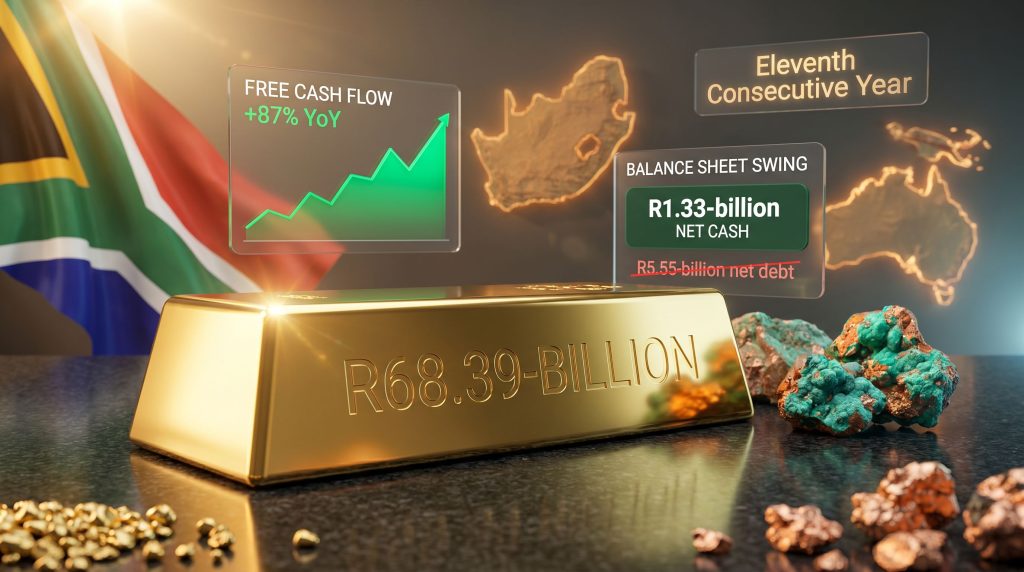
The numbers tell a story that goes well beyond simple revenue growth. A 39% increase in the average gold price received translated into an 87% year-on-year increase in free cash flow at the operational level, and a balance sheet that swung from a net debt position of R5.55-billion ($335-million) to a net cash position of R1.33-billion ($78-million) within a single quarter. Understanding why that happens requires a closer look at how gold mining economics actually work.
When big ASX news breaks, our subscribers know first
Understanding Gold Mining's Operational Leverage: Why Price Beats Volume
In conventional industries, a 39% revenue uplift might produce a roughly proportional improvement in profit. Gold mining operates differently. Once a mine's fixed cost base, infrastructure, labour, and capital commitments are established, incremental gold price gains flow almost entirely to the margin. This concept, known as operational leverage, is the defining characteristic of high-quality gold producers in structurally elevated price environments. Understanding the gold price and mining equities relationship is therefore essential before evaluating any producer's results.
Harmony's cost structure illustrates this clearly. All-in sustaining costs (AISC) for gold assets rose 14% to R1.17-million per kilogram ($2,133/oz) from R1.03-million per kilogram ($1,765/oz) in the prior comparable period. Meanwhile, the average gold price received climbed 39% to R2.02-million per kilogram ($3,691/oz), up from R1.45-million per kilogram ($2,497/oz). The resulting margin expansion was substantial:
| Variable | Prior Period | Current Period | Change |
|---|---|---|---|
| Average gold price received | R1.45m/kg ($2,497/oz) | R2.02m/kg ($3,691/oz) | +39% |
| AISC (gold assets) | R1.03m/kg ($1,765/oz) | R1.17m/kg ($2,133/oz) | +14% |
| Price-to-cost premium | R420,000/kg | R850,000/kg | +102% |
| Free cash flow (operational) | Base period | Current period | +87% YoY |
The key figure in this table is the price-to-cost premium, which effectively doubled. This is precisely why free cash flow growth outpaced revenue growth by such a wide margin, and why the company's balance sheet transformation was achievable within a single quarter rather than across multiple reporting periods.
Analytical note: When gold price appreciation outpaces AISC growth by a factor exceeding 2.5 times, the resulting operational leverage tends to produce non-linear free cash flow outcomes. Harmony's current results reflect exactly this dynamic, with price outpacing costs by approximately 2.8 times.
Nine-Month Performance: Reading the Key Metrics Correctly
A surface-level reading of Harmony's nine-month results might flag a 3% decline in gold production to 33,393 kg (approximately 1.07-million ounces) as a concern. A more informed interpretation recognises that this decline was fully anticipated and built into the company's internal planning assumptions from the start of the financial year. Gold production rose 5% from the prior quarter, with both recoveries and processed grades normalising in line with management's expectations.
The underground recovered grade of 5.85 g/t for the nine-month period exceeded guidance thresholds, which is a particularly important data point for technically minded investors. Recovered grade refers to the actual concentration of gold extracted from ore after processing losses are accounted for, as distinct from the reserve grade or the head grade at the point of mining. Consistently beating recovered grade guidance indicates strong grade control practices underground, effective mill recoveries, and the absence of significant dilution from waste rock contamination. Indeed, why grade is king in evaluating any gold operation cannot be overstated.
The broader nine-month financial picture is equally compelling:
- Gold and copper revenue rose 34% year-on-year to R68.39-billion ($4.02-billion)
- The net cash position of R1.33-billion ($78-million) reflects a R6.88-billion ($413-million) improvement within a single quarter
- Free cash flow at the operational level grew 87% year-on-year
- Cost inflation, measured by AISC growth of 14%, remained well below the rate of gold price appreciation
Which Mines Drove the Quarter's Operational Improvement?
Three operations were identified as standout performers during the quarter, each contributing meaningfully to the sequential production recovery.
Mponeng Mine
Mponeng Mine (South Africa) is one of the deepest gold mines on the planet, operating at depths exceeding 3.8 kilometres below surface in some sections. At these depths, ore grades tend to be higher than shallower reef systems, but the operational complexity, heat management requirements, and logistical challenges are proportionally greater. Mponeng's consistent performance at these depths reflects both the quality of the orebody and the maturity of Harmony's ultra-deep mining practices.
Tshepong North
Tshepong North (South Africa) contributed through disciplined grade control, which is particularly noteworthy given that Tshepong North targets the Basal Reef and associated reef packages, which can be geologically complex with variable grades across strike. Maintaining grade consistency in such environments requires meticulous blast design and careful development sequencing.
Hidden Valley
Hidden Valley (Papua New Guinea) provided geographic and geological diversification to the group's output profile. As an open-pit gold-silver operation at higher elevation in PNG's Morobe Province, it operates on an entirely different geological system to the deep Witwatersrand reefs in South Africa, consequently offering a natural hedge against jurisdiction-specific operational disruptions.
Eleven Consecutive Years of Guidance Delivery: What Does This Actually Signal?
Guidance delivery in the mining sector is far from routine. A combination of geological variability, equipment availability, rainfall disruptions, labour dynamics, and regulatory factors means that many producers routinely miss their published targets. A track record spanning eleven consecutive years of meeting production, cost, and grade guidance simultaneously is exceptionally rare within the global gold mining peer group.
This consistency has several practical implications for investors:
- Geological model accuracy: Consistently meeting grade guidance over more than a decade suggests that Harmony's geological models reliably predict the quality of ore to be mined, reducing the risk of negative production surprises.
- Operational planning discipline: Eleven years of guidance delivery reflects a planning culture that builds achievable targets rather than aspirational ones, reducing the credibility discount that often applies to junior and mid-tier producers.
- Reserve replacement quality: Management noted that ongoing quality mineral reserve replacement is supporting the production pipeline, which is significant because a mine delivering to guidance while simultaneously replacing its reserves is in a genuinely sustainable operational position.
- Cost management culture: The controlled AISC trajectory, combined with minimal disruption from oil and diesel price movements, suggests robust hedging and procurement strategies at the operational level.
The Moab Khotsong Transition and the Zaaiplaats Extension: A Strategic Depth Play
One of the lesser-understood elements within the Harmony Gold third quarter results is the deliberate production step-down at the Moab Khotsong mine. Moab Khotsong has historically ranked among the highest-grade gold operations in South Africa, targeting the Vaal Reef and Carbon Leader Reef at depth. The mine is now entering a planned five-year period of lower production as Harmony advances the Zaaiplaats extension project.
The Zaaiplaats extension is not a remedial response to geological depletion. It is a strategic investment in the next production horizon below the existing mine infrastructure. In deep-level hard rock mining, extending a shaft system to access deeper reef packages is enormously capital-intensive and operationally disruptive. The fact that Harmony chose to absorb this production headwind across the broader portfolio, rather than delay the development, reflects management's confidence in the quality of the Zaaiplaats orebody and the long-term economics of the extension.
The CSA copper mine in Australia was acquired specifically to offset this transitional volume reduction. CSA targets high-grade copper mineralisation and ongoing drilling continues to generate results that reinforce confidence in the scale and quality of the deposit. Mining flexibility at CSA remains constrained but is improving as a coherent mining sequence is re-established, and a ventilation upgrade project is on schedule to support long-term throughput targets. Furthermore, the broader copper market trends support the strategic rationale for this acquisition.
The next major ASX story will hit our subscribers first
The Dual-Commodity Strategy: Gold and Copper as Complementary Assets
Harmony's strategic objective of establishing approximately 100,000 tonnes per year of copper production alongside its high-margin gold operations represents a deliberate portfolio repositioning rather than a diversification of convenience. Copper and gold share certain geological associations, particularly in porphyry and skarn deposit types, but they respond to very different macroeconomic drivers.
Gold typically outperforms in environments of monetary uncertainty, currency debasement, and geopolitical stress. Copper, by contrast, is a primary indicator of industrial activity and infrastructure investment cycles. Holding meaningful exposure to both commodities provides a natural hedge against the scenario where gold prices moderate as economic conditions stabilise, while copper demand accelerates on the back of electrification and infrastructure spending trends. For context on the gold price outlook and how it shapes producer strategy, the current environment remains constructive for high-margin operators.
The 24-month execution window cited by management for key growth projects is therefore critical. If CSA's operational flexibility improves on schedule and the Zaaiplaats extension proceeds without material delays, Harmony will emerge from this transitional period with a larger, more diversified, and higher-margin production base than it currently operates.
Shareholder Return Framework: Understanding the Dividend Mechanics
Harmony's revised dividend policy introduces a structured but variable return mechanism that directly links payouts to cash generation performance. Investors exploring different gold mining stock types will find this policy structure particularly relevant when comparing producers at different stages of the value chain:
| Dividend Component | Allocation | Condition |
|---|---|---|
| Base dividend | 30% of net free cash | Standard entitlement |
| Upside dividend | Up to 20% of net free cash | Net debt to EBITDA threshold |
| Maximum combined return | 50% of net free cash | Board discretion and leverage |
The record interim dividend of R3.38-billion ($204-million), equivalent to 530 cents per share ($0.32/share), paid on April 28, 2026, demonstrates the policy in practice. The upside dividend component is particularly well-designed from an investor perspective, because it automatically increases returns when the balance sheet is strong and reduces them when leverage rises, creating a self-regulating mechanism that protects financial flexibility across different points in the commodity cycle. Investors can review full financial disclosures on Harmony's investor relations page for additional detail on the dividend framework.
Risk Factors That Demand Monitoring
No analysis of Harmony Gold third quarter results would be complete without a frank assessment of the risks that could erode the current positive momentum.
- Gold price dependency: The 87% free cash flow growth was overwhelmingly price-driven rather than volume-driven. If gold prices retrace materially from current levels, the same operational leverage that amplified gains will work in reverse.
- AISC trajectory: A 14% cost increase, while currently dwarfed by price appreciation, reflects real underlying pressures including labour costs, electricity pricing in South Africa, and consumables inflation. Any acceleration of this trend warrants scrutiny.
- Deep-level safety and seismicity: Operating at depths exceeding 3 kilometres in South Africa's Witwatersrand gold fields exposes operations to seismic events, which can result in production stoppages, damage to infrastructure, and, critically, safety incidents that carry both human and financial costs.
- PNG weather and geotechnical exposure: Historical surface disruptions at operations in the Vaal River region and at Hidden Valley in PNG highlight the ongoing sensitivity of certain assets to rainfall-related events and slope stability considerations in high-rainfall tropical environments. Indeed, third quarter output was notably impacted by excessive rainfall, underscoring this risk.
- CSA integration timeline risk: Copper production targets are contingent on the CSA mine reaching full operational flexibility within the projected timeframe. Any delays to ventilation or sequencing improvements could push back the copper growth profile.
This article contains forward-looking analysis and financial projections. All figures cited are sourced from Harmony Gold's published operational update for the nine months to March 31, 2026. Readers should conduct independent due diligence before making investment decisions. Past financial performance and guidance delivery are not guarantees of future results.
For additional context on Harmony Gold's operational and financial disclosures, readers can refer to investor relations materials published via the JSE (HAR) and NYSE (HMY) listings, as well as industry coverage available through Mining Weekly at miningweekly.com.
Want to Capture the Next Major ASX Gold Discovery Before the Market Does?
Discovery Alert's proprietary Discovery IQ model scans ASX announcements in real time, instantly identifying high-potential mineral discoveries across gold and 30+ other commodities — turning complex data into actionable opportunities for investors at every experience level. Explore historic discoveries and the substantial returns they generated, then begin your 14-day free trial to position yourself ahead of the broader market.