
August 23, 2026
Economic Forces Reshaping African Gold Production Hierarchies
Resource extraction dynamics across Sub-Saharan Africa demonstrate how geological endowments intersect with policy frameworks to create competitive advantages in global commodity markets. The continent's precious metals sector operates within complex economic systems where production capacity reflects not merely natural abundance but institutional effectiveness in mobilising both formal and informal mining activities.
Contemporary mineral economics reveal that nations capable of integrating diverse operational scales whilst maintaining regulatory coherence achieve superior resource utilisation rates. Furthermore, this integration becomes particularly pronounced when governments implement frameworks that channel previously unregulated activities into formal economic streams, transforming potential revenue leakage into measurable fiscal contributions.
Global supply chain dynamics increasingly favour jurisdictions that can provide production consistency whilst adapting to price volatility. In addition, resource-dependent economies that successfully balance immediate revenue optimisation with long-term investment attractiveness demonstrate resilience during commodity super-cycles, positioning themselves as preferred partners within international mining investment portfolios.
When big ASX news breaks, our subscribers know first
Geological Advantages and Policy Convergence in West African Mining
Ghana's emergence as Africa's premier gold producer reflects a convergence of geological advantages and strategic policy reforms that have fundamentally reshaped continental mining hierarchies. The Ghana gold production increase demonstrates how the country's auriferous deposits, concentrated within the Birimian greenstone belts, provide exceptional resource density that supports sustained extraction across multiple operational scales.
Production Performance Metrics (2025):
| Indicator | Volume | Global Position |
|---|---|---|
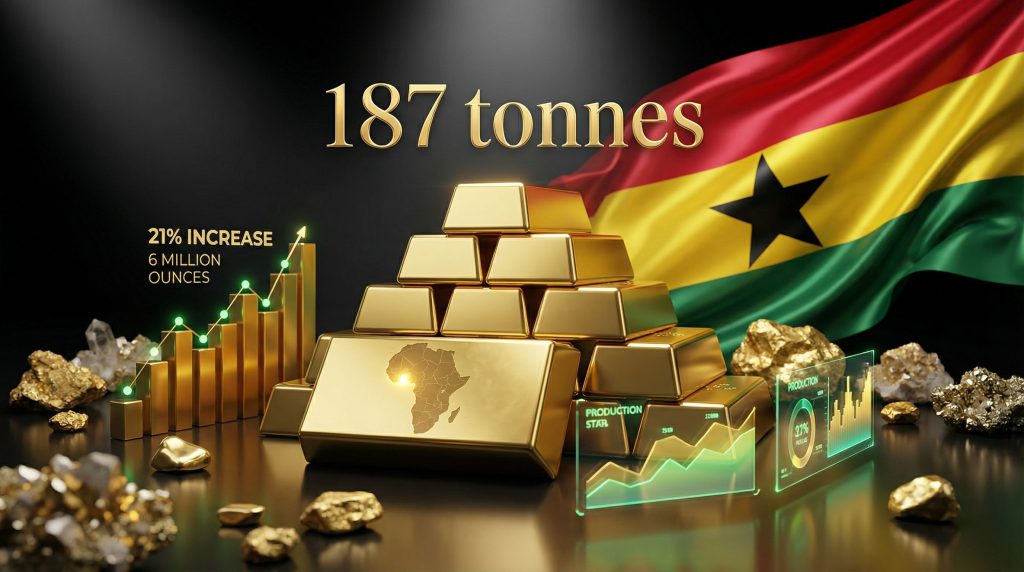
| Total Output | 187 tonnes (6.0 million ounces) | Approaching 5th globally |
| Continental Ranking | 1st in Africa | Surpassing South Africa |
| Year-over-Year Growth | 21% increase | Outpacing regional competitors |
| Market Share (Africa) | 35% estimated | Dominant continental position |
The geological foundation supporting this production expansion demonstrates how mineral endowments translate into economic advantage when combined with effective resource management. Ghana's greenstone belt formations contain higher-grade ore bodies distributed across accessible depths, enabling both surface and underground extraction methodologies.
According to industry analysis, rising gold prices create economic incentives for expanded extraction across operational tiers, justifying previously uneconomic extraction activities whilst encouraging exploration and development investments.
This price-production relationship illustrates how commodity cycles influence national mining strategies, with Ghana's diversified operational base providing resilience during market fluctuations. Consequently, the country's ability to maintain production growth during elevated price environments demonstrates operational flexibility that distinguishes it from single-scale mining jurisdictions.
Reserve Base Sustainability and Exploration Dynamics
Ghana's production trajectory depends critically on reserve replacement rates and exploration success metrics. For instance, current extraction levels require continuous discovery and development of new deposits to maintain output sustainability beyond the medium term.
Key Sustainability Factors:
• Reserve-to-production ratios averaging 15-20 years across major operations
• Exploration budgets increasing proportionally with gold's price surge
• Discovery rates maintaining pace with depletion at mature operations
• Technology adoption improving recovery rates from existing deposits
The interplay between resource depletion and new project development creates ongoing capital allocation requirements that influence Ghana's long-term competitive position within African mining markets.
Artisanal Mining Formalisation as Economic Transformation
The integration of artisanal and small-scale mining (ASM) into Ghana's formal economy represents a fundamental restructuring of the country's gold production architecture. This transformation has elevated ASM from peripheral activity to the dominant production segment, accounting for over 50% of national output in 2025.
ASM Sector Evolution (2024-2025):
| Performance Metric | 2024 | 2025 | Growth Rate |
|---|---|---|---|
| ASM Production | 2.4 million oz | 3.1 million oz | +29% |
| Share of Total Output | 42% | 52% | +10 percentage points |
| Formal Employment | 850,000 | 1M+ | +18% |
| Export Channel Share | 35% | 45% | +10 percentage points |
The Ghana Gold Board's formalisation framework demonstrates how regulatory innovation can capture previously unaccounted production whilst improving environmental compliance standards. However, this institutional approach addresses the dual challenges of revenue optimisation and operational legitimacy.
Formalisation Benefits:
• Revenue capture from previously informal channels
• Environmental monitoring through regulated operations
• Technology transfer to improve extraction efficiency
• Financial inclusion for ASM operators through banking integration
• Export facilitation reducing smuggling incentives
The 29% year-on-year growth in ASM production significantly outpaces large-scale mining's steady-state performance, indicating that formalisation creates powerful economic incentives for informal operators to enter regulated markets.
Employment and Socioeconomic Impact Analysis
The ASM sector's expansion to over one million direct employees creates substantial socioeconomic impacts across rural Ghana. Furthermore, this employment growth provides income diversification for agricultural communities whilst reducing urban migration pressures.
The sector's ability to absorb labour during economic transitions demonstrates its role as a social safety net, particularly during agricultural off-seasons or crop failures.
Labour productivity improvements through formalisation training programmes enhance individual operator earnings whilst increasing overall sector efficiency. In addition, these improvements create positive feedback loops that encourage continued formal sector participation.
Industrial Mining Operations and Production Stability
Large-scale mining operations provide the production consistency that balances ASM sector volatility, maintaining steady output of 2.9 million ounces whilst new project development offsets declining grades at mature operations.
Industrial Mining Characteristics:
• Predictable production schedules enabling forward planning
• Capital-intensive infrastructure supporting long-term operations
• Technology integration maximising extraction efficiency
• Environmental compliance meeting international standards
• Export certainty through established commercial channels
Industry reports indicate that the ramp-up at new mines such as Newmont Gold Corporation's Ahafo North is offsetting declining grades at other mines in the country.
Newmont's Ahafo North project exemplifies how capital allocation toward higher-grade ore bodies maintains industrial production levels despite resource depletion elsewhere. Consequently, this replacement mechanism ensures large-scale mining continues contributing approximately 48% of total national output.
Technology Integration and Operational Efficiency
Modern extraction technologies employed in large-scale operations achieve higher recovery rates whilst reducing environmental impacts. These technological advantages create operational moats that differentiate industrial mining from ASM capabilities.
Technology Applications:
• Automated processing systems improving ore recovery
• Environmental monitoring systems ensuring compliance
• Predictive maintenance reducing operational downtime
• Remote operations capabilities enhancing worker safety
The technology gap between industrial and artisanal operations creates opportunities for knowledge transfer programmes that could enhance overall sector efficiency whilst maintaining operational differentiation.
Global Price Dynamics and Production Incentives
Gold price movements create powerful incentive structures that influence production decisions across all operational scales. Current prices of $5,067/oz (as of February 20, 2026) following December 2025 record-high gold prices demonstrate how commodity super-cycles drive production optimisation behaviours.
Price Environment Analysis:
| Factor | Current Status | Production Impact |
|---|---|---|
| Gold Price | $5,067/oz | High production incentives |
| Price Pattern | Consolidation phase | Stable planning environment |
| Interest Rates | Cuts expected June 2026 | Supportive for higher prices |
| USD Strength | Near-term headwind | Marginal price pressure |
Industry analysis indicates that the rising price of gold is incentivising greater production but also leading governments to seek a larger share of the profits.
This price-policy feedback loop demonstrates how commodity appreciation creates fiscal opportunities for resource-rich governments whilst potentially constraining future investment if tax burdens become excessive.
Price Elasticity and Market Response Mechanisms
The relationship between gold prices and Ghanaian production demonstrates significant price elasticity, particularly within the ASM sector where marginal operators enter and exit based on economic viability thresholds.
Market Response Channels:
• ASM participation rates increasing with price appreciation
• Marginal ore bodies becoming economically viable
• Exploration budgets expanding during high-price periods
• Technology adoption accelerating to capture price premiums
The 21% production increase during elevated price environments suggests supply elasticity coefficients above unity, indicating Ghana's mining sector responds aggressively to price signals compared to mature mining jurisdictions.
Fiscal Policy Evolution and Investment Climate
Ghana's consideration of dynamic royalty structures reflects broader trends toward optimising resource taxation during commodity favourable cycles. The proposed shift from flat levies to price-responsive rates (5-12%) aims to capture greater economic rents whilst maintaining investment attractiveness.
Proposed Fiscal Framework:
| Current System | Proposed System | Revenue Impact |
|---|---|---|
| Flat royalty rate | 5-12% sliding scale | Variable government income |
| Fixed cost structure | Price-responsive mechanism | Enhanced rent capture |
| Predictable taxation | Dynamic rate adjustments | Investment uncertainty |
The Ghanaian government is considering legislation to lift the gold royalty payment from a flat levy to a range of 5% to 12% depending on the price, which has disappointed large mining companies.
To offset increased royalty burdens, Ghana's Finance Minister has proposed reducing alternative mining levies by two percentage points, demonstrating attempts to balance revenue optimisation with investment retention. However, this relationship with trade war gold impact creates additional complexity for policy makers.
Investment Climate Implications
Mining companies' concerns about royalty increases highlight the tension between government revenue maximisation and private sector investment incentives. The challenge lies in maintaining Ghana's competitive position within global mining investment markets.
Investment Considerations:
• Project economics sensitivity to tax rate changes
• Capital allocation decisions influenced by fiscal certainty
• Long-term planning affected by policy volatility
• International competitiveness relative to other African jurisdictions
The downside of higher tax levels is that they often disincentivise investment and longer-term production, which will drag government income down.
This dynamic illustrates the complexity of resource taxation where short-term revenue gains must be balanced against long-term production capacity maintenance.
The next major ASX story will hit our subscribers first
Continental Mining Leadership and Regional Integration
Ghana's ascension to Africa's top gold producer position reflects successful resource sector development that other African nations seek to replicate. The Ghana gold production increase has resulted in 187-tonne annual production significantly exceeding South Africa's declining output, cementing continental leadership.
African Gold Production Hierarchy (2025):
-
Ghana: 187 tonnes (continental leader)
-
South Africa: Production declining from historical peaks
-
Mali: Significant but lower than Ghanaian output
-
Burkina Faso: Regional player with growth potential
-
Tanzania: Emerging producer with expansion plans
Ghana may soon overtake the US and be the fifth-largest producing country of gold globally.
This continental leadership creates opportunities for regional value chain development, from equipment manufacturing to specialised financial services supporting mining operations across West Africa.
Regional Economic Spillover Effects
Ghana's mining sector success generates positive externalities that benefit neighbouring economies through increased demand for support services and cross-border trade facilitation.
Regional Integration Opportunities:
• Equipment and services demand benefiting regional suppliers
• Financial sector development supporting mining operations
• Infrastructure development facilitating cross-border commerce
• Knowledge transfer accelerating regional mining development
• Labour mobility creating employment across national boundaries
These spillover effects position Ghana as a regional mining hub that can drive broader economic integration initiatives across the West African Economic and Monetary Union.
Environmental Challenges and Sustainability Constraints
Illegal mining activities, locally known as "galamsey," pose significant environmental and regulatory challenges that could constrain long-term sector sustainability. Environmental degradation from unregulated mining threatens both ecological systems and Ghana's international mining reputation.
Environmental Risk Assessment:
• Water contamination from mercury use in informal operations
• Agricultural land degradation affecting food security
• Forest ecosystem destruction in mining areas
• Regulatory enforcement capacity limitations
• International compliance pressures increasing
The challenge of balancing economic development with environmental protection requires coordinated policy responses that address both immediate environmental damage and long-term sustainability requirements.
Regulatory Enforcement and Compliance
Effective environmental management demands enhanced regulatory enforcement capabilities combined with economic incentives that encourage compliance across all operational scales.
Sustainability Framework Requirements:
• Environmental monitoring systems across all operations
• Rehabilitation bonds ensuring post-mining land restoration
• Technology transfer for environmentally sound practices
• Community engagement in environmental stewardship
• International certification maintaining export market access
The integration of environmental compliance with economic incentives creates pathways for sustainable mining development that maintain Ghana's competitive advantages whilst addressing ecological concerns.
Future Production Trajectories and Strategic Positioning
Ghana's projection of 6.5 million ounces for 2026 suggests continued growth momentum, though achieving these targets requires addressing policy uncertainties and operational challenges that could constrain expansion. Furthermore, the gold price forecast indicates favourable market conditions for continued Ghana gold production increase.
Growth Sustainability Factors:
• New project pipeline development and commissioning
• Technology adoption improving extraction efficiency
• Environmental framework development ensuring compliance
• Fiscal policy stability maintaining investment attractiveness
• Infrastructure development supporting increased production
The sector's continued development requires strategic planning that maximises current opportunities whilst building foundations for long-term economic resilience and diversification beyond mineral dependence.
Economic Diversification Strategies
Ghana's mining success provides a foundation for broader economic development through strategic revenue allocation toward productive capacity building in non-extractive sectors.
Diversification Opportunities:
• Mining services sector development leveraging expertise
• Financial sector specialisation in commodity financing
• Technology innovation centres supporting mining technology
• Value-added processing capabilities reducing commodity dependence
• Education and training institutions building human capital
The transition from resource extraction to knowledge-based economic activities represents the ultimate sustainability strategy for Ghana's mining-dependent regions.
Investment Uncertainties and Operational Risk Management
Recent policy decisions, including state intervention in mining operations, create operational uncertainties that affect investor confidence and long-term capital allocation decisions within Ghana's mining sector.
Risk Management Considerations:
• Policy predictability ensuring consistent regulatory frameworks
• Contract sanctity maintaining international investment standards
• Dispute resolution mechanisms protecting investor rights
• Operational continuity planning for regulatory changes
• International arbitration access maintaining confidence
These factors significantly influence Ghana's ability to attract the continued mining investments necessary for sustained production growth and technological advancement.
The balance between national resource sovereignty and international investment requirements creates ongoing tensions that require careful management to maintain Ghana's position as Africa's premier gold producer whilst ensuring long-term sector sustainability and economic development.
Ready to Capitalise on the Next Major Mineral Discovery?
Discovery Alert instantly alerts investors to significant ASX mineral discoveries using its proprietary Discovery IQ model, turning complex mineral data into actionable insights. Understand why historic discoveries can generate substantial returns and begin your 14-day free trial today to position yourself ahead of the market.