May 18, 2026
The Hidden Cost of Regulatory Ambiguity in Mining-Dependent Economies
Every dollar allocated to a mining project in a developing economy carries a price that goes beyond geology, metallurgy, and extraction cost. It carries a political premium, a sovereign discount, and a governance tax that sophisticated capital allocators price into every feasibility model before a single drill hole is sunk. When that governance premium rises sharply, capital does not argue or negotiate. It simply relocates.
Ghana is confronting precisely this dynamic. As Africa's leading gold producer, it occupies a position of significant strategic and commercial weight in global commodity markets. Yet a convergence of lease revocations, stalled renewal negotiations, and competing domestic policy agendas is generating the kind of tenure uncertainty that institutional investors treat as a hard stop rather than a manageable variable. The consequences of Ghana mining lease uncertainties, if unaddressed, extend well beyond the companies directly affected.
When big ASX news breaks, our subscribers know first
Why Security of Tenure Is the Non-Negotiable Foundation of Mining Investment
In the extractive industries, the concept of security of tenure refers to the legally enforceable assurance that a mining company's right to access, develop, and extract minerals within a licensed area will be honoured for the agreed duration of the lease, and that any renewal process will follow transparent, predictable criteria. It is not an abstract legal nicety. It is the foundational condition that makes the entire capital structure of a mining project viable.
The financial logic is straightforward. Large-scale gold mining operations require capital commitments that span decades. Pre-production expenditures alone on a major greenfield project can easily exceed $1 billion before a single ounce of gold is recovered. Debt financiers underwriting such commitments require stable tenure as collateral security. Equity markets price tenure risk into the discount rate applied to future cash flows. Ratings agencies incorporate it into sovereign and corporate credit assessments.
Furthermore, what makes Ghana mining lease uncertainties particularly damaging at present is the compounding effect of perceived instability. Even before any formal policy change is enacted, the mere visibility of stalled negotiations, unexplained revocations, and domestic advocacy for lease reallocation is enough to trigger upward adjustments in country risk premiums. Capital allocation decisions for projects that might not enter production for five to ten years are being made today, based on signals about governance quality being transmitted right now.
The Three Active Fault Lines in Ghana's Mining Lease Environment
Lease Revocations and the Adamus Resources Case
Ghana's Minerals Commission, which serves as the primary regulatory body for lease administration under the country's Minerals and Mining Act, initiated revocation proceedings against leases held by local miner Adamus Resources, citing alleged irregularities in how those leases were obtained. The specifics of the legal basis for revocation remain opaque to the broader market, and that opacity is itself part of the problem.
Under Ghanaian mining law, revocation can be triggered by a range of administrative breaches, but the line between legally mandated revocation and discretionary administrative action is one that international investors scrutinise carefully. When enforcement actions lack detailed public justification, the industry cannot distinguish between legitimate regulatory correction and selective enforcement, a distinction that matters enormously for due diligence and risk assessment.
The Adamus situation has elevated awareness within the investment community about the degree to which lease security in Ghana can be subject to administrative discretion. Consequently, that awareness is feeding directly into country risk assessments for the broader sector. These geopolitical mining risks are increasingly difficult for investors to ignore.
The Tarkwa Mine: A Stalled Renewal With Global Implications
| Metric | Detail |
|---|---|
| Mine Location | Tarkwa, Western Region, Ghana |
| 2025 Gold Production | ~427,000 ounces |
| Current Lease Expiry | 2027 |
| Renewal Status | Stalled, no confirmed timeline |
| Operator | Gold Fields (South Africa) |
| Sector Significance | One of Ghana's highest-volume producing assets |
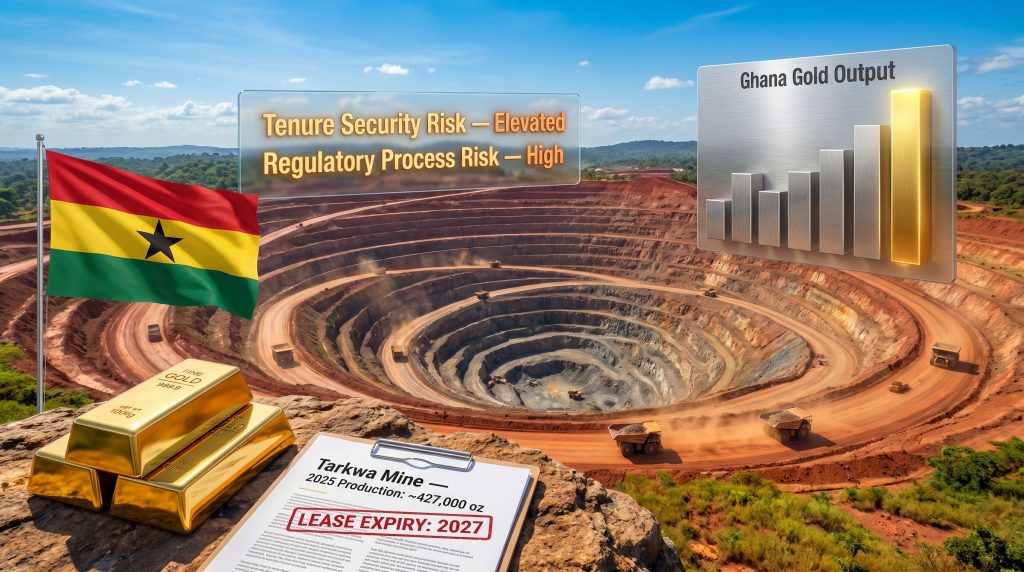
The Tarkwa mine, operated by South Africa's Gold Fields, produced approximately 427,000 ounces of gold in 2025, positioning it among the most productive gold operations on the African continent. Its lease expires in 2027, yet formal renewal negotiations have stalled. According to Kenneth Ashigbey, CEO of the Ghana Chamber of Mines, attempts to advance renewal talks have failed to gain traction, with company representatives unable to secure meaningful engagement with relevant officials.
This is not a minor procedural delay. For a producing asset of Tarkwa's scale, lease uncertainty within a two-year window creates immediate consequences:
- Reserve reporting constraints: Mining companies cannot book reserves beyond the life of their legally recognised tenure. A lease expiring in 2027 with no renewal pathway compresses reportable reserves, which directly affects equity valuation.
- Capital reinvestment freeze: Operators are unlikely to commit sustaining capital or expansion expenditure to an asset whose legal future is uncertain. This accelerates the physical decline of the operation.
- Debt refinancing complications: Project finance facilities tied to Tarkwa's production profile require tenure certainty as a condition of covenant compliance.
- Workforce and contractor instability: Uncertainty at the operational level filters down to labour and supply chain relationships, increasing employee attrition risk at the skilled-technical level.
Industry sources familiar with the situation have noted that the company operating Tarkwa is deeply concerned by the uncertainty generated after multiple attempts to engage officials produced no substantive progress. The volume contribution of Tarkwa to Ghana's national gold output makes this a systemic issue, not just a bilateral commercial matter.
The Damang Precedent and Its Policy Signalling Effect
In a decision that has become the reference point for all subsequent debate about Ghana mining lease uncertainties, the government declined to renew Gold Fields' lease for its smaller Damang mine, a property that the company had indicated could be divested, and instead reallocated the licence to domestic contractor Engineers & Planners (E&P).
On its face, this could be interpreted as an isolated decision about an asset already earmarked for divestment. The analytical community, however, is reading it as something more deliberate: a policy signal that Ghana intends to use lease expiry as a mechanism for shifting operational control of mineral assets from foreign operators to domestic entities.
The critical distinction that investors are drawing is between divestment-ready assets (where reallocation carries limited operational risk) and core high-volume producing assets (where the same logic applied to Tarkwa would represent a fundamentally different risk category). A 427,000-ounce-per-year operation is not analogous to an asset already being prepared for sale. Treating them through the same policy lens introduces operational complexity and production risk that the Ghanaian state may not be positioned to absorb. According to Mining Weekly, the Chamber of Mines has been vocal in raising these precise concerns with government authorities.
Resource Nationalism in Context: The Africa-Wide Trend and Ghana's Specific Exposure
Ghana's situation is not occurring in a vacuum. Across Sub-Saharan Africa, governments that have historically been net recipients of foreign mining capital are recalibrating the terms of resource extraction in response to elevated commodity prices and rising domestic political pressure. Zimbabwe has imposed mandatory local processing requirements. Tanzania renegotiated royalty frameworks under the 2017 Natural Wealth and Resources Acts. Guinea restructured major bauxite contracts following changes in government.
The economic logic is coherent. When gold trades at historically elevated levels, as it has through 2025 and into 2026, the fiscal mathematics of royalty and tax arrangements signed during lower price environments look increasingly unfavourable to host governments. The political pressure to capture a larger share of the windfall is real and democratically legitimate. In fact, the gold price record highs of recent years have intensified this pressure considerably.
However, the tension lies in the mechanism through which revenue capture is pursued. There is a meaningful difference between:
- Renegotiating fiscal terms (royalty rates, corporate tax structures, local procurement requirements) within an existing, secure tenure framework
- Redirecting operational leases to domestic entities, which introduces production risk and signals that existing contractual arrangements are contingent on ongoing political favour
The first approach is practised with reasonable success in Chile, Botswana, and increasingly in Western Australia's Indigenous land use agreement frameworks. The second approach tends to produce the investment flight outcomes observed in Venezuela and Zimbabwe during their more aggressive nationalisation phases.
The Institutional Divide: IEA Arguments Versus Chamber of Mines Realities
The Accra-based Institute for Economic Affairs has publicly argued that the Tarkwa lease should not be renewed for its current operator and should instead be reallocated to Ghanaian-controlled entities. The intellectual foundation of this position rests on post-colonial resource sovereignty theory, domestic value retention, and the desire to internalise royalty flows, employment income, and operational profits within the Ghanaian economy.
These objectives are economically rational in principle. The challenge lies in the gap between the policy's theoretical appeal and its operational feasibility. Running a 427,000-ounce-per-year open-pit gold operation requires:
- Deep institutional knowledge of large-scale open-pit mining methodology
- Access to multi-hundred-million-dollar capital facilities for sustaining investment
- Technical expertise in ore processing, tailings management, and environmental compliance at industrial scale
- International marketing relationships for refined gold offtake
The Ghana Chamber of Mines has been unambiguous in its assessment. Kenneth Ashigbey has publicly stated that proposals to redirect major operating leases to domestic entities would fundamentally damage the security of tenure that the entire mining industry's development depends upon. This is not a defence of foreign corporate interests as an end in itself. It is a warning grounded in the observable behaviour of capital markets when tenure security degrades.
The Chamber's position reflects a well-documented pattern: jurisdictions that have undermined tenure frameworks, even with genuine revenue-capture motivations, have consistently experienced contractions in exploration investment that reduce the productive pipeline for subsequent decades. The damage is often invisible in the near term and catastrophic in the medium term.
Investor Risk Framework: Mapping the Capital Allocation Consequences
| Risk Category | Nature of Risk | Current Severity |
|---|---|---|
| Tenure Security Risk | Lease revocation or non-renewal without transparent legal basis | Elevated |
| Regulatory Process Risk | Delays, inaccessible officials, opaque timelines | High |
| Policy Consistency Risk | Divergence between investment frameworks and actual decisions | Moderate-High |
| Sovereign Discretion Risk | Government capacity to override contractual arrangements | Moderate |
| Operational Continuity Risk | Production disruption stemming from lease uncertainty | Latent but material |
For capital allocators with exposure to Ghana-listed or Ghana-dependent mining equities, the risk dimensions above translate into specific portfolio considerations. The broader commodity price impact on company valuations makes this assessment even more consequential:
- Reserve life discounting: When lease uncertainty compresses reportable reserve life, price-to-net-asset-value (P/NAV) multiples contract. Investors should model NAV scenarios under both renewal and non-renewal assumptions.
- ESG governance scoring: Institutional funds increasingly use governance risk as a portfolio screening criterion. Regulatory opacity and arbitrary lease administration lower Ghana's governance score in ESG-linked investment mandates.
- Bilateral investment treaty optionality: Gold Fields, as a South African operator, may have recourse through South Africa-Ghana bilateral investment frameworks if lease-related decisions constitute an effective expropriation. This creates an asymmetric legal risk for the Ghanaian state that policymakers should factor into their calculus.
- Cost of capital escalation: Every upward revision to a country risk premium increases the discount rate applied to future cash flows from Ghanaian operations, mechanically reducing asset valuations and the attractiveness of new project commitments.
The next major ASX story will hit our subscribers first
The Fiscal Paradox: Undermining Revenue at the Peak of the Cycle
There is a profound irony embedded in the timing of Ghana's current policy direction. The gold price outlook remains historically elevated through 2025 and into 2026, creating the most favourable revenue environment Ghana's mining sector has experienced in a generation. At precisely the moment when maximising production continuity and attracting incremental investment would yield the greatest fiscal return, policy uncertainty is creating the conditions for capital withdrawal.
Mining's relationship with commodity cycles creates a structural asymmetry that policymakers frequently underestimate. The exploration investments made today, under current governance conditions, determine production volumes five to fifteen years from now. A deterred exploration dollar in 2026 does not simply delay a project by one year. It may eliminate it entirely, or redirect it to Côte d'Ivoire, Senegal, or Mali, jurisdictions actively competing for the same capital pool.
Ghana's gold sector contributes meaningfully to the country's export earnings, government revenue, and regional employment. Any sustained decline in production capacity caused by investment deterrence would flow directly into the country's balance of payments position and its ability to service external debt obligations. The fiscal dependency runs deeper than the royalty line in the government's budget. It permeates infrastructure maintenance, regional employment, and the broader economic multiplier effects generated by operating mines in the Western Region.
In addition, the downstream implications extend to critical minerals demand frameworks, where stable producing jurisdictions are increasingly prioritised by energy transition investors over those with uncertain regulatory environments.
What a Credible Policy Resolution Requires
Resolving Ghana mining lease uncertainties does not require Ghana to abandon its legitimate interest in capturing greater value from its mineral wealth. It requires a separation between the fiscal terms of mineral extraction and the tenure security of extraction rights. These are distinct instruments, and conflating them has been the source of the current crisis.
A credible stabilisation framework would involve:
- Immediate resumption of formal, documented renewal dialogue between the Minerals Commission and Gold Fields regarding the Tarkwa lease, with a publicly disclosed timeline for resolution
- Publication of a clear government statement outlining the criteria and process for lease renewal assessments across all major producing assets
- Legislative clarification of the distinction between administrative revocation (for genuine regulatory breaches) and policy-driven non-renewal, with separate procedural frameworks for each
- Establishment of an independent mining tenure review panel to provide a structured escalation pathway for disputed lease decisions
- Engagement with bilateral investment treaty counterparts to clarify the government's legal obligations and avoid inadvertent arbitration triggers
Ghana's status as Africa's premier gold producer has been built over decades on a foundation of relative regulatory credibility. That credibility is an asset with real economic value, even if it does not appear on any government balance sheet. As mining.com reports, protecting it is not a concession to foreign capital. It is an investment in the long-term productive capacity of the Ghanaian economy itself.
This article is intended for informational purposes only and does not constitute financial or investment advice. All forecasts, scenarios, and analytical assessments represent the views of the author based on publicly available information and are subject to significant uncertainty. Readers should conduct independent research before making any investment decisions.
Want to Track ASX Mineral Discoveries Before the Broader Market Does?
Discovery Alert's proprietary Discovery IQ model delivers real-time alerts on significant ASX mineral discoveries, cutting through complex mineral data to provide actionable insights for investors at every level — explore the historic returns major discoveries have generated and begin your 14-day free trial to position yourself ahead of the market.