
June 6, 2026
The Quiet Scramble Reshaping Africa's Critical Minerals Map
Across the global mining industry, a structural shift is underway that rarely makes front-page news but is reshaping investment flows, corporate strategy, and geopolitical alliances simultaneously. Western nations and Asian manufacturing economies are competing to lock in long-term supply agreements for a narrow group of minerals that sit at the intersection of consumer electronics, defence systems, and the energy transition. Tantalum and lithium occupy two of the most contested positions on that list, and the countries that host economically viable, responsibly governed deposits of both commodities are attracting a level of strategic attention that would have seemed improbable a decade ago.
Namibia has quietly emerged as one of the most compelling jurisdictions within this global realignment. Its combination of political stability, transparent mineral governance, and geologically rich pegmatite systems in the south of the country has created a convergence of factors that increasingly differentiate it from peer African resource nations. Against this backdrop, the Kazera Namibian tantalum lithium project — known as African Tantalum, or Aftan — is drawing sustained commercial attention from a range of international parties, while simultaneously navigating a complex legal dispute that has tested the company's structural protections and ultimately reinforced its ownership position.
When big ASX news breaks, our subscribers know first
Why Namibia's Pegmatite Belt Commands Strategic Attention
The Geopolitical Logic Behind Critical Minerals Investment in Southern Africa
The global tantalum market is structurally concentrated in ways that create persistent supply chain anxiety for downstream manufacturers. Approximately 60% of the world's mined tantalum originates from the Democratic Republic of Congo and Rwanda, regions that carry ongoing concerns around conflict mineral compliance under legislation such as the Dodd-Frank Act Section 1502 and the EU Conflict Minerals Regulation. This DRC supply disruption risk has created a measurable premium for responsibly sourced tantalum from jurisdictions with clean governance records, with industry observers noting pricing differentials of approximately 15–20% for ethically certified material compared to unverified supply sources.
Lithium's supply chain dynamics carry a different but equally significant set of concerns, with processing capacity concentrated in China representing a strategic vulnerability for Western battery manufacturers seeking to comply with domestic content requirements under programmes such as the US Inflation Reduction Act. The combination of these two supply chain pressures creates an unusual opportunity for African jurisdictions that can offer both commodities from a single, well-governed project.
Namibia's positioning within this landscape is strengthened by several structural factors. The country's mineral governance framework includes a publicly accessible mining title registry that reduces the risk of overlapping claims, a transparent royalty regime, and a track record of large-scale international mining operations adhering to rigorous environmental standards. The Langer Heinrich uranium mine and the Husab uranium mine — one of the world's largest uranium operations — both demonstrate Namibia's capacity to host institutional-grade mining projects within demanding arid environments.
The Geological Case for Southern Namibia's Pegmatite Systems
The pegmatite belt hosting the Aftan project formed during the Neoproterozoic Damara Orogeny approximately 550 million years ago, when magmatic differentiation processes created exceptionally mineralised lithium-caesium-tantalum (LCT) pegmatite bodies cutting through the granitic gneisses of the Namaqua-Natal Metamorphic Province. This geological heritage is significant because LCT pegmatites represent the primary global source of both spodumene-hosted lithium and tantalite-columbite tantalum mineralisation, meaning the Aftan licence area's dual-commodity profile is a function of its fundamental geology rather than coincidence.
A critical and often underappreciated characteristic of these pegmatite systems is their internal zonation. Individual bodies typically exhibit albite-rich cores hosting spodumene and lepidolite, surrounded by intermediate zones containing tantalite and columbite, with outer transitional zones featuring beryl and tourmaline. This zonation pattern means that drilling targeting tantalum mineralisation may simultaneously intersect lithium-bearing zones at different depths, creating cost efficiencies in resource delineation that single-commodity projects cannot replicate.
Regional magnetic and radiometric surveys of southern Namibia suggest a continuous mineralised corridor extending over 250 kilometres along the eastern margin of the Namaqua-Natal Province. This implies that the Aftan licence area represents a segment of a much larger prospective system rather than an isolated mineralised occurrence, which fundamentally changes the risk-reward calculus for any incoming development partner.
The Aftan Project: Understanding the Asset Beyond the Headlines
Resource Geometry, Grade Profile, and the Unexplored Majority
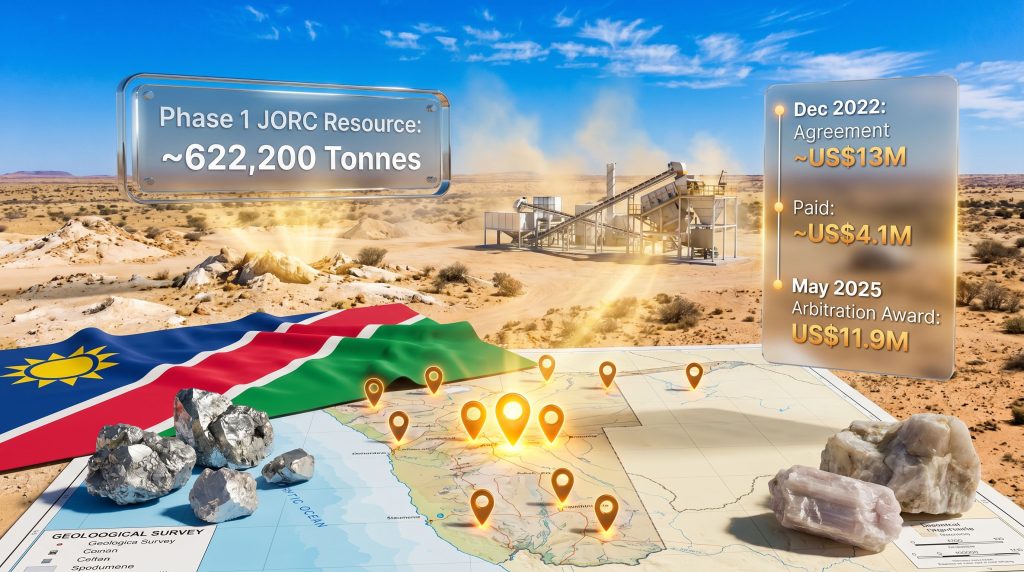
The Aftan project encompasses a licence area in southeastern Namibia containing at least 13 identified mineralised pegmatites. The JORC-compliant Phase 1 resource estimate covers approximately 622,200 tonnes of combined tantalum and lithium mineralisation, with previous pilot operations demonstrating that gravity and magnetic separation techniques can produce tantalum concentrate grading between 28% and 32% Ta₂O₅ — a specification that meets requirements for capacitor-grade material used in consumer electronics and aerospace applications.
What makes the resource geometry particularly compelling from an investor perspective is the concentration of all modern technical work on just three of the 13 known pegmatites. Diamond drilling on these three bodies has confirmed mineralisation continuity to depths exceeding 150 metres, but the remaining ten pegmatites have received minimal modern exploration investment despite showing strong surface expressions and geochemical anomalies broadly consistent with the mineralised bodies already drilled.
| Feature | Detail |
|---|---|
| Project Name | African Tantalum (Aftan) |
| Location | Southeastern Namibia |
| Known Pegmatites | At least 13 identified |
| Pegmatites with Modern Resource Work | 3 of 13 |
| Phase 1 JORC Resource | ~622,200 tonnes combined mineralisation |
| Primary Commodities | Tantalum, Lithium |
| Prior Processing Method | Gravity and magnetic separation |
| Tantalum Concentrate Grade | 28–32% Ta₂O₅ (pilot operations) |
"The concentration of all modern drilling and resource estimation across only three of at least thirteen identified pegmatites means that the project's true resource ceiling remains substantially undetermined. For any incoming development partner, this represents optionality that is not yet reflected in the current JORC estimate."
Geological modelling across the full licence area suggests the total in-situ resource potential could be multiples of the current Phase 1 estimate if exploration confirms comparable mineralisation grades across the undrilled pegmatite bodies. Furthermore, this unexplored majority is arguably the project's most strategically significant characteristic, as it transforms Aftan from a defined, bounded resource into a district-scale exploration platform with production-grade assets already in the base case.
Tantalum's Role in Advanced Manufacturing and Why Grade Matters
Tantalum's industrial importance is frequently misunderstood outside specialist circles. The metal's primary application is in tantalum electrolytic capacitors, which are used in smartphones, laptops, medical devices, and avionics because of their superior volumetric efficiency, reliability at extreme temperatures, and long service life compared to ceramic alternatives. The global tantalum capacitor market was valued at approximately US$4.2 billion in 2024 and is projected to grow at a compound annual rate of 5.8% through 2030.
Grade and mineralogy interact in complex ways in tantalum production. The rare tantalum minerals wodginite and ixiolite — identified through spectral analysis of drill core from southern Namibia's pegmatite systems — are particularly valued for high-performance capacitor applications due to their superior dielectric properties compared to standard tantalite. The presence of these minerals in a deposit can translate to a product quality premium that materially enhances project economics beyond what the headline grade alone would suggest. For context, proactive investors have highlighted how ongoing drilling in the region continues to intersect both lithium and tantalum, reinforcing the district-scale potential.
The Dry Beneficiation Breakthrough: What It Means in Practice
Water Scarcity as a Project-Level Risk in Arid Mining Environments
Namibia ranks among the world's most arid countries, with annual average rainfall below 250 millimetres across most of the south of the country, and periods of extended drought that have historically constrained water-intensive industrial operations. For a tantalum and lithium processing facility, conventional wet processing routes create a fundamental tension with the operating environment: they require substantial volumes of water for ore slurrying, classification, and tailings management — precisely the inputs that are most scarce and logistically costly in a desert-adjacent location.
Water infrastructure for mining operations in southern Namibia typically involves either long-distance pipeline supply from the Orange River system or establishment of on-site water storage and recycling facilities. Both represent material capital expenditure items that can fundamentally alter project economics before a single tonne of ore is processed. The environmental regulatory framework also imposes increasingly stringent requirements on mine water management and discharge, adding compliance cost layers to an already challenging water logistics problem.
How Dry Beneficiation Changes the Economic Equation
Recent technical analysis commissioned by Kazera has identified potential dry beneficiation processing routes that may be applicable to the Aftan mineralisation. This finding carries significant implications because it suggests a potential pathway to commercial production that does not depend on solving the water access challenge, effectively removing one of the most capital-intensive risk items from the project development stack.
Dry beneficiation encompasses a family of separation techniques that use physical and electrical property differences between minerals rather than water as the separation medium. The primary methods applicable to tantalum-lithium pegmatite processing include:
- Air classification: Separates particles by density and size using controlled airflow, effective for removing fine waste material from coarser mineralised fractions
- Electrostatic separation: Exploits differences in electrical conductivity between minerals, particularly effective for separating tantalite from silicate gangue minerals
- Dry magnetic separation: Uses high-intensity magnetic fields to separate paramagnetic tantalum and iron-bearing minerals from non-magnetic lithium silicates
- Sensor-based ore sorting: Applies X-ray transmission or near-infrared spectroscopy to identify and eject waste rock before fine processing, reducing feed volume and energy consumption
| Factor | Wet Processing (Conventional) | Dry Beneficiation (Potential) |
|---|---|---|
| Water Dependency | High | Minimal |
| Environmental Footprint | Elevated in arid zones | Reduced |
| Infrastructure Requirements | Pipeline, tailings dams, water storage | Air-based separation systems |
| Capital Efficiency | Lower due to infrastructure cost | Potentially higher |
| Namibia Suitability | Challenging | Well-suited |
| Regulatory Risk | Higher under Namibian water law | Lower |
The Kazera board has confirmed that this potential dry processing capability could prove particularly relevant given the arid operating environment and may offer both environmental and economic advantages in relation to any future development pathway. Metallurgical testwork has demonstrated that the Aftan mineralisation responds to both conventional wet processing and potential dry beneficiation approaches, with tantalum recovery rates consistently exceeding 75% across multiple test scenarios, providing confidence that the dry route is a technically grounded possibility warranting further validation.
"Dry beneficiation refers to mineral processing techniques that separate valuable minerals from waste material without water, using methods including air classification, electrostatic separation, and dry magnetic separation. In arid environments where water access is limited or costly, these approaches can fundamentally alter the capital and operating cost profile of an otherwise viable mineral asset."
Third-Party Interest and Strategic Partnership Pathways
Who Is Circling the Aftan Project and Why
Kazera has confirmed receipt of multiple expressions of interest and held active discussions with a range of parties that bring different strategic orientations to their engagement with the project. The categories of interested parties, as reported by Mining Weekly on 18 May 2026, span a broad spectrum of the critical minerals value chain:
- Critical minerals exploration and development specialists seeking early-stage project exposure in established jurisdictions
- Downstream tantalum and lithium processing operators looking to secure feed material for existing or planned processing facilities
- Critical minerals supply chain participants seeking to establish traceable, ethically certified tantalum supply to meet conflict mineral compliance obligations
- Mine development and operational companies with the technical capability and balance sheet strength to take a project from feasibility to production
The breadth of this interest is strategically significant. It suggests that the Aftan project is attracting attention from parties with fundamentally different investment theses — ranging from resource consolidation plays to vertical integration strategies — which creates a competitive dynamic that strengthens Kazera's negotiating position when evaluating transaction structures. Indeed, the critical minerals demand surge globally has only sharpened the appetite for assets with dual-commodity exposure in politically stable jurisdictions.
Evaluating the Structural Options: What Each Pathway Offers
Kazera has stated its focus is on identifying the right long-term route to create value for shareholders while supporting future operational activity, job creation, and economic participation within Namibia. This framing, which explicitly links shareholder returns to community and national development outcomes, reflects the ESG expectations that institutional investors and development finance institutions increasingly impose on African critical minerals projects as a condition of engagement.
The principal structural pathways under evaluation include:
- Full or partial project sale to a technically capable and financially robust partner, delivering immediate liquidity to Kazera while potentially retaining a royalty interest
- Joint venture or farm-in arrangement in which a partner funds exploration and development expenditure in exchange for an equity interest, preserving Kazera's ongoing participation in project upside
- Operational partnership enabling project development without material dilution to existing shareholders, structured around service or development agreements
- Phased development model that sequences tantalum concentrate production as Phase 1 to generate near-term cash flow while funding progressive lithium resource delineation as Phase 2
The phased model carries particular strategic logic. Tantalum processing is relatively well understood, requires lower capital intensity than lithium processing, and addresses an established end market with documented demand. Using tantalum cash flow to fund lithium exploration and development allows the project to self-fund its most capital-intensive future phase while reducing the risk that lithium price volatility undermines the overall project economics before the deposit is fully delineated.
The Hebei Dispute: Legal Mechanics and What the Outcome Means
Reconstructing the Transaction and Its Breakdown
The legal dispute at the centre of Kazera's Aftan situation began with a transaction announced in December 2022, under which Hebei Xinjian Construction agreed to acquire the Aftan project for approximately US$13 million plus a 2.5% life-of-mine royalty on both lithium and tantalum sales. The royalty component is noteworthy because it reflects an expectation — embedded in the original deal structure — that lithium production would eventually generate material revenue alongside the established tantalum stream. Further background on this Aftan ownership update is publicly available via the London Stock Exchange.
| Event | Detail |
|---|---|
| December 2022 | Transaction agreed: ~US$13 million plus 2.5% life-of-mine royalty |
| Post-Agreement | Hebei pays ~US$4.1 million; defaults on remaining consideration |
| May 2025 | Binding arbitration award: US$11.9 million plus interest and costs |
| Post-Award | Hebei initiates Namibia High Court review of arbitration process |
| Current Status | High Court judgment pending; Kazera retains legal title to Aftan shares |
Hebei's partial payment of approximately US$4.1 million followed by default on the remaining consideration created an unresolved financial exposure that Kazera pursued through binding arbitration. The May 2025 arbitration award of US$11.9 million plus interest and costs represents a significant vindication of Kazera's contractual position, though the subsequent High Court proceedings introduced a layer of legal uncertainty that has influenced the timing of third-party partnership discussions.
Why the Legal Title Structure Matters More Than the Arbitration Award
The most consequential element of Kazera's legal position is not the arbitration award itself but the security structure embedded in the original transaction documents. Under the terms agreed in December 2022, Kazera retained legal title to the issued shares in Aftan as security pending receipt of the full consideration from Hebei. Because Hebei defaulted before completing payment, this security mechanism has remained operative, meaning that legal ownership of the Aftan project has never passed to Hebei regardless of how much was paid.
This structural protection distinguishes the Kazera situation from scenarios where a buyer takes possession of an asset and disputes arise over payment obligations after transfer. Kazera's legal title retention means that the Aftan project remains unambiguously within its asset base irrespective of the High Court proceedings outcome.
"Hebei's legal proceedings in Namibia's High Court challenge elements of the arbitration process rather than the core finding that Hebei breached its contractual obligations. This distinction is legally significant: the substantive determination of breach is not being contested, only procedural aspects of how the award was reached."
Kazera has confirmed it holds legal advice supporting its position, and the company has characterised its stance as one of confident patience rather than defensive vulnerability. The practical implication for potential development partners is that the asset's ownership is not in genuine dispute, which removes a potential dealbreaker that might otherwise discourage engagement.
The next major ASX story will hit our subscribers first
Kazera's Strategic Framework: Capital Efficiency and Shareholder Value
Governance Structure and the Board's Active Role
As part of its ongoing strategic review of the asset base, Kazera has implemented a governance approach in which individual directors have been assigned active roles across key strategic priorities. This structure is designed to accelerate decision-making and maintain direct board-level accountability for outcomes, rather than delegating critical commercial negotiations to management layers that may lack the authority or relationships to move quickly.
The board's clearly articulated preference for partner-funded development pathways reflects a pragmatic assessment of the capital intensity of mine development relative to the company's current market position. Mine development from resource to first production typically requires capital across multiple orders of magnitude that junior-listed companies cannot access through equity markets without either extreme dilution or shareholder fatigue — both of which destroy the very value the company is trying to create.
The Investor Psychology of Undervalued Critical Minerals Assets
Junior critical minerals companies with quality assets in stable jurisdictions face a persistent valuation challenge: the market often prices in legal uncertainty and development timeline risk at a discount that exceeds the actual probability-weighted impact of those risks. This creates an asymmetric situation for informed investors who can independently assess the underlying asset quality, legal title security, and commercial interest.
For the Aftan project specifically, the combination of factors currently in play creates a scenario where the market may be applying a discount to a project that:
- Retains clear legal title regardless of the Hebei dispute outcome
- Has received confirmed expressions of interest from multiple credible counterparties
- Possesses a technically validated dry beneficiation pathway that could materially reduce development costs
- Hosts a resource that covers only three of at least 13 known mineralised pegmatites
- Sits within a jurisdiction with growing strategic appeal for ESG-aligned institutional investors
The arbitration award of US$11.9 million plus interest and costs, if enforced, would itself represent a material financial recovery relative to typical junior company market capitalisations, providing an additional value dimension that is separate from the underlying project fundamentals. In addition, the broader context of critical minerals and energy security continues to underpin long-term institutional interest in projects such as Aftan.
Three Development Scenarios and What Each Requires
Scenario Mapping: From Partnership to Prolonged Uncertainty
The Aftan project's trajectory over the next 24 to 36 months will be shaped primarily by two variables: the outcome of the Hebei High Court proceedings and the progression of partnership discussions. Mapping these variables against plausible outcomes generates three distinct scenarios for investors and industry observers to consider.
Scenario 1: Strategic Partnership Secured
A technically capable partner acquires an interest in Aftan, funding exploration across the full pegmatite system and validating the dry beneficiation processing route at pilot scale. Phase 1 tantalum concentrate production commences within approximately three to four years, with lithium resource delineation progressing concurrently. Kazera retains a royalty or equity interest that provides ongoing exposure to the project's long-term upside, with the 2.5% life-of-mine royalty structure from the original Hebei transaction providing a useful precedent for how such an interest might be structured.
Scenario 2: Legal Resolution Enables Full Asset Monetisation
The Hebei High Court challenge fails, enabling Kazera to enforce the US$11.9 million arbitration award. The resulting capital recovery provides financial optionality to negotiate from a position of strength — either funding a full project sale at a higher valuation, entering a more favourable joint venture arrangement, or self-funding initial exploration work to de-risk the broader pegmatite system before transacting.
Scenario 3: Legal Uncertainty Delays but Does Not Derail Development
High Court proceedings extend into 2027, creating headline uncertainty that constrains some potential partners' appetite for engagement. However, Kazera's legal title retention means the project remains accessible and the technical work programme continues to progress. Third-party interest is maintained, and a transaction is ultimately concluded once the legal overhang is resolved.
Macro Demand Drivers That Strengthen the Long-Term Thesis
Regardless of which near-term scenario unfolds, the long-term demand drivers underpinning the Kazera Namibian tantalum lithium project's value proposition continue to strengthen. The global tantalum capacitor market is projected to grow at approximately 5.8% annually through 2030, driven by increasing component density requirements in 5G infrastructure, electric vehicles, satellite communications, and medical devices. Lithium demand trajectories linked to electric vehicle battery production and grid-scale energy storage continue to attract substantial investment in resource development across multiple continents.
Furthermore, direct lithium extraction technologies are improving the economics of lithium development globally, creating additional tailwinds for projects with proven lithium mineralisation. Meanwhile, China's critical minerals strategy of tightening export controls on processed materials continues to incentivise Western governments and manufacturers to secure upstream supply from non-Chinese jurisdictions — precisely the dynamic that elevates Namibia's strategic relevance.
Namibia's growing profile as a preferred critical minerals jurisdiction, combined with the Aftan project's dual-commodity nature, positions the asset at the intersection of multiple long-term demand curves. For investors and development partners conducting fundamental analysis, the question is not whether these demand drivers are real but whether the near-term legal and partnership uncertainties justify the current pricing of the opportunity.
Disclaimer: This article contains forward-looking statements, scenario projections, and analytical commentary that should not be construed as financial advice. The scenarios described are illustrative frameworks rather than predictions. Investors should conduct their own due diligence and seek independent financial and legal advice before making any investment decisions related to Kazera Global or the Aftan project. All figures cited are sourced from publicly available company announcements and industry data as of May 2026.
Want to Stay Ahead of the Next Major Critical Minerals Discovery on the ASX?
Discovery Alert's proprietary Discovery IQ model scans ASX announcements in real time, instantly identifying high-potential mineral discoveries across tantalum, lithium, and more than 30 other commodities — converting complex data into clear, actionable investment opportunities for both short-term traders and long-term investors. Explore how historic discoveries have generated substantial returns on Discovery Alert's dedicated discoveries page, and begin your 14-day free trial today to position yourself ahead of the broader market.