May 16, 2026
The Quiet Risk That Reshapes Billion-Dollar Decisions
Long before a single ounce of gold is poured, mining companies must answer one foundational question: will the rights they acquire today still be valid when the mine reaches peak production a decade from now? In capital-intensive resource extraction, where initial development costs routinely exceed a billion dollars and payback horizons stretch across two to three decades, the stability of tenure frameworks is not a bureaucratic formality.
It is the variable that determines whether a jurisdiction attracts world-class investment or quietly loses it to competitors with clearer rules. Ghana mining lease uncertainties now sit at the centre of precisely this debate, making the country a critical test case for how African resource governance evolves in the years ahead.
Ghana now finds itself at precisely this inflection point. As Africa's top gold producer, it commands geological credibility and an established mining tradition. However, a series of lease revocations, stalled renewal negotiations, and policy proposals favouring domestic reallocation of major producing assets are collectively generating the kind of uncertainty that causes international capital to pause, reassess, and, in some cases, redirect.
Understanding how Ghana arrived here, and what it means for the broader trajectory of African mining finance trends, requires looking beyond individual licence decisions to the structural forces reshaping the relationship between resource-rich governments and the global mining capital that funds extraction.
When big ASX news breaks, our subscribers know first
Why Security of Tenure Has Become the Central Fault Line in Ghana's Mining Sector
What Security of Tenure Actually Means in Practice
Security of tenure in mining refers to the legally enforceable certainty that an operator can continue exploring, developing, and producing from a licensed area for the agreed duration of its licence, free from arbitrary revocation, sudden non-renewal, or administrative interference that falls outside established legal procedures. It is, in essence, the operating system upon which all other investment calculations run.
Without it, feasibility studies become unreliable, project financing becomes prohibitively expensive or unavailable, and the internal rate of return assumptions that justify capital allocation collapse. Lenders providing debt financing for mining projects routinely require tenure security as a prerequisite. Equity investors apply sovereign risk premiums that are directly sensitive to perceived licence stability. When tenure frameworks weaken, both forms of capital become more expensive and harder to access.
The structural tension this creates is well understood across the African mining landscape. Governments seek maximum revenue capture from resources that are finite and that belong, in constitutional and sovereign terms, to the state. Investors seek legal certainty sufficient to justify committing capital that will only be recovered over the long term. These interests are not inherently incompatible, but when policy signals become ambiguous or enforcement becomes discretionary, the equilibrium breaks down.
The Resource Nationalism Wave and Ghana's Position Within It
Ghana's current policy environment reflects a continent-wide shift toward more assertive resource governance. Across sub-Saharan Africa, governments from Zambia to Guinea have revised royalty structures, imposed local content requirements, introduced windfall taxes, and in some cases reassigned mining rights in response to surging commodity prices and domestic political pressures demanding a larger share of mineral wealth.
This trend is not inherently destructive to investment. Many jurisdictions have successfully implemented local participation frameworks while maintaining investor confidence by doing so through transparent, predictable, and legally grounded processes. The critical differentiator is not whether a government pursues resource nationalism, but how it is designed and communicated.
Ghana's challenge is that several recent policy actions have been interpreted by international capital as lacking the procedural clarity that would make them acceptable, even to investors broadly supportive of local participation goals. The distinction matters enormously, because perception drives capital allocation decisions long before formal policy is enacted.
The Strategic Importance of Ghana's Gold Mining Sector
Production Scale, Export Revenue, and Economic Relevance
Ghana holds the distinction of being Africa's largest gold producer, a position it reclaimed from South Africa in 2019 and has maintained through continued investment in large-scale mechanised operations. Gold dominates the country's export earnings, contributing a significant share of foreign exchange inflows that underpin the stability of the Ghanaian cedi and the government's capacity to service external debt obligations.
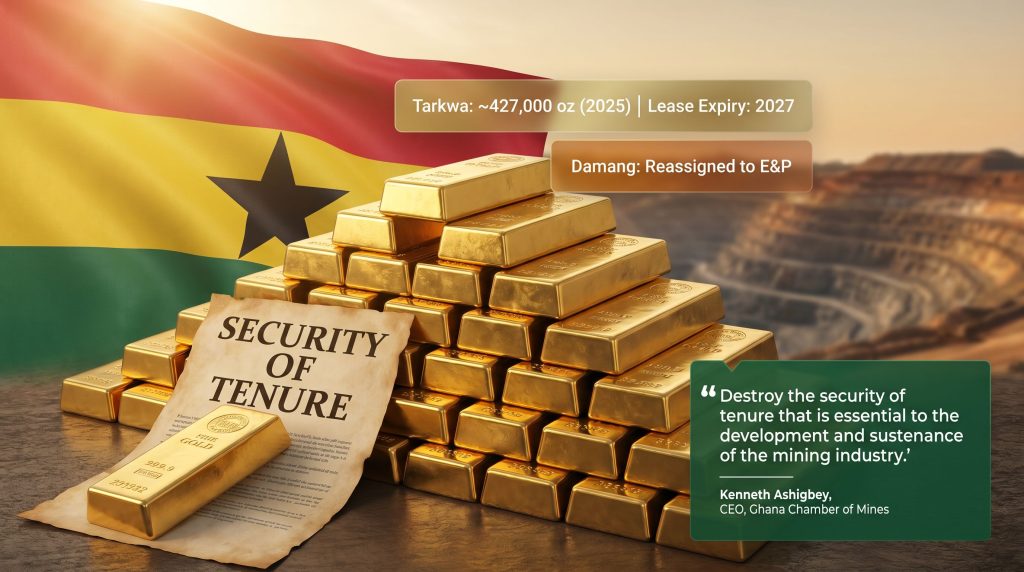
The Tarkwa mine, operated by South African major Gold Fields, stands as one of the country's cornerstone producing assets. In 2025, Tarkwa produced approximately 427,000 ounces of gold, a volume that represents a substantial contribution to both Ghana's national production figures and Gold Fields' global output portfolio. The mine supports thousands of direct and indirect jobs across the Western Region and generates significant royalty and tax revenues for the state.
The combination of production scale, employment generation, and foreign exchange contribution makes Tarkwa's tenure situation far more consequential than a typical licence renewal dispute. Its outcome will function as a policy signal read by every major mining investor evaluating Ghana exposure.
| Metric | Detail |
|---|---|
| Ghana's gold producer ranking in Africa | Number one |
| Tarkwa annual gold output (2025) | Approximately 427,000 ounces |
| Tarkwa lease expiry | 2027 |
| Damang lease outcome | Awarded to local contractor Engineers & Planners (E&P) |
Why Large-Scale Licences Anchor Ghana's Macroeconomic Position
Large-scale mining licences in Ghana are not simply commercial arrangements between a government and a company. They function as anchor points for broader economic activity: they attract supplier industries, underpin local banking activity, support infrastructure development, and generate the foreign exchange that allows Ghana to maintain import capacity and debt servicing. When tenure uncertainty clouds the future of major assets like Tarkwa, the macroeconomic implications extend well beyond the balance sheet of a single operator.
This is the economic reality that gives the current policy debate its urgency. Ghana is not debating the fate of a marginal asset. It is debating the future of one of the country's most consequential foreign exchange generators at a time when global gold prices are elevated and the opportunity to maximise revenue from operating mines is historically significant. Furthermore, the commodity price impact of elevated gold values makes the timing of any policy misstep especially costly.
What Is Driving Ghana Mining Lease Uncertainties in 2026?
Three Converging Forces Creating Investor Concern
The current environment of Ghana mining lease uncertainties is not the product of a single policy decision. It reflects three distinct but interconnected developments that have compounded to create a broader atmosphere of unpredictability.
Force 1: Lease Revocations Linked to Alleged Regulatory Breaches
The revocation of selected mining leases held by local operator Adamus Resources over alleged illegalities introduced an unsettling precedent into Ghana's mining sector. What made this development particularly notable was that it demonstrated even domestically held leases are not immune from sudden cancellation. For international operators who had previously viewed the revocation risk as primarily a political tool targeting foreign capital, this was a recalibrating signal.
The precedent effect of a single revocation can be disproportionately large relative to the specific asset involved. Risk assessment models applied by mining companies and their insurers update probability estimates for revocation across entire portfolios whenever a new precedent is established. In Ghana's case, the Adamus revocations, regardless of their specific legal merits, contributed materially to a perception that tenure security in the country is no longer unconditional.
Force 2: Stalled Renewal Negotiations for a Major Producing Asset
The Tarkwa mine lease expires in 2027, creating a hard deadline that is now less than two years away. According to reporting by Reuters, efforts to advance renewal discussions have stalled, with mining executives reportedly unable to secure meetings with government officials to progress negotiations. A senior industry figure, speaking to Reuters on condition of anonymity given the sensitivity of the situation, indicated that the company operating Tarkwa was concerned about the absence of progress, noting that the mine's contribution to national gold output makes its tenure situation a matter of significant consequence.
The stalling of renewal talks is not merely an administrative inconvenience. Mining companies operate on capital planning cycles that extend five to ten years into the future. Investment decisions for Tarkwa's next phase of development, whether in equipment replacement, pit expansion, or processing upgrades, cannot responsibly be made without clarity on the asset's post-2027 status. Every quarter of delay in renewal discussions translates directly into deferred capital expenditure and reduced operational confidence.
Force 3: The Damang Reassignment as a Policy Signal
When Ghana declined to renew Gold Fields' lease for the Damang mine and instead awarded operating rights to local contractor Engineers & Planners (E&P), the decision was interpreted by the international mining investment community as something more significant than a single commercial outcome. Damang was a smaller asset that Gold Fields had previously indicated it might consider divesting, which made the government's decision to reassign rather than renew a deliberate statement of policy direction.
The critical analytical distinction here is between a commercially motivated divestment and a state-directed reassignment. In the former case, capital flows to wherever the seller and buyer agree value is maximised. In the latter, operational control is redirected by government decision to a locally connected operator, regardless of that operator's capital base, technical capability, or track record in large-scale mining. International investors watching the Damang outcome asked a straightforward question: if this can happen to Damang, why not Tarkwa?
How Ghana's Localisation Push Conflicts With Long-Term Investment Stability
The IEA Proposal and the Industry's Response
The Institute for Economic Affairs, an Accra-based research and policy organisation, publicly proposed that Ghana should decline to renew the Tarkwa mine lease for its current operator and instead allocate the asset to local management. The proposal reflects a strand of economic thinking that argues Ghana's most productive mineral assets should, over time, transition to domestic control as part of a broader strategy of resource sovereignty and local value capture.
The Ghana Chamber of Mines responded with unusual directness. Kenneth Ashigbey, the Chamber's chief executive, warned publicly that implementing such proposals would cause severe harm to the fundamental investment principles upon which Ghana's mining sector has been built. The Chamber's position is that whatever the merits of increased local participation as a long-term policy goal, achieving it by reassigning the licences of operating producers creates a precedent that makes Ghana's investment environment structurally less attractive to the international capital that funds mine development.
This is not simply a debate between foreign corporate interests and domestic policy aspirations. It is a question of sequencing and mechanism. There are ways to increase local participation in mining that preserve investor confidence, and there are ways that destroy it. The distinction lies in whether the process is transparent, predictable, legally grounded, and commercially rational.
When Policy Debate Becomes a Market Signal
One dimension of this situation that receives insufficient attention is the role of public policy discourse itself as a risk signal. When a credible national research institution publicly advocates for the reassignment of a major producing asset, and when that proposal receives meaningful public attention, it enters the risk models of every mining investor with Ghana exposure regardless of whether the proposal is ever implemented.
Options markets, project financing terms, and equity valuations all respond to perceived probability distributions of future outcomes. A proposal that shifts the estimated probability of lease reassignment from near-zero to even a modest figure can materially affect the cost of capital for Ghana-based mining projects. Consequently, this is one mechanism through which policy debate, even debate that leads to no formal action, can cause real economic harm to a jurisdiction's investment competitiveness.
Is Ghana's Mining Lease Risk Isolated to Gold?
The Ewoyaa Lithium Project as a Parallel Case Study
The answer to whether Ghana's tenure risk is confined to gold is clearly no. The Ewoyaa lithium project, one of West Africa's most strategically significant critical minerals assets, has experienced extended permitting delays, renegotiated royalty structures, and community compensation backlogs. Approximately 1,500 farming households were left in extended uncertainty during the approval process, unable to plan their agricultural activities or understand their compensation entitlements.
The Ewoyaa experience is analytically important because it demonstrates that Ghana's tenure and permitting challenges are not sector-specific. They reflect broader characteristics of the regulatory environment that affect any resource project requiring state approvals, licence renewals, or community engagement processes.
Comparing Lease Risk Across Ghana's Resource Sectors
| Sector | Key Asset | Tenure Issue | Community or Economic Impact |
|---|---|---|---|
| Gold | Tarkwa | Renewal stalled, expiry 2027 | Major forex and employment risk |
| Gold | Damang | Lease reassigned to local operator E&P | Operational transition uncertainty |
| Gold | Adamus Resources leases | Revoked over alleged illegalities | Investor confidence erosion |
| Lithium | Ewoyaa Project | Delayed approvals, royalty renegotiation | Approximately 1,500 farming households in limbo |
The pattern across these cases suggests the issue is systemic rather than asset-specific. When lease risk manifests consistently across different commodities, different operators, and different stages of the project lifecycle, it signals structural characteristics of the regulatory environment rather than isolated enforcement actions.
The next major ASX story will hit our subscribers first
What Are the Real Investment Risks of Ghana Mining Lease Uncertainties?
Risk Category 1: Capital Allocation Deferral
The most immediate and quantifiable consequence of tenure uncertainty is the deferral of capital expenditure. Mining companies facing genuine doubt about whether their operating licences will be renewed do not invest in expanding production, modernising equipment, or funding exploration programmes that would only generate returns well beyond the current licence term.
For Ghana, this creates a compounding problem. If Tarkwa's uncertainty persists through 2026 and into 2027, the mine's operator cannot responsibly commit to the reinvestment programmes that sustain production levels and extend the operational life of the asset. Lower reinvestment leads to production decline, which reduces royalty and tax revenues to the state, which undermines the very economic goals that motivated the localisation push in the first place.
Risk Category 2: Sovereign Risk Premium Repricing
When tenure insecurity becomes systemic rather than isolated, international capital markets reprice the sovereign risk premium attached to Ghana-domiciled mining assets. This repricing affects not just the specific assets facing lease uncertainty, but the entire universe of Ghana mining investments, including assets with no immediate tenure concerns.
A higher sovereign risk premium means higher required returns, which means lower asset valuations, more expensive project financing, and less competitive offtake terms. For junior mining companies with Ghana assets seeking to raise equity capital or secure debt financing, a repriced sovereign risk premium can be the difference between a project that advances and one that stalls indefinitely.
Risk Category 3: Competitive Disadvantage Within the African Mining Landscape
Ghana does not compete for mining capital in isolation. Every dollar directed to a Ghanaian mining project is a dollar that is not going to Côte d'Ivoire, Burkina Faso, Senegal, or any of the other West African jurisdictions that offer comparable geological prospectivity with potentially clearer regulatory frameworks. The broader geopolitical mining landscape across the continent means that capital can and does relocate rapidly when regulatory signals shift.
At a moment when elevated global gold prices are expanding exploration budgets and incentivising new mine development across the continent, Ghana's tenure uncertainty represents an opportunity cost that is difficult to quantify precisely but straightforward to understand directionally. Capital follows clarity.
The competitive dynamic is particularly acute for exploration-stage assets, where the gap between available jurisdictions is wide and the marginal cost of redirecting programmes is low. Senior producers with existing infrastructure in Ghana may absorb short-term uncertainty. Explorers and developers with no existing commitments will simply choose elsewhere.
How Should Ghana Balance Local Participation Goals With Investor Confidence?
Policy Frameworks That Preserve Both Objectives
The fundamental challenge Ghana faces is not a binary choice between resource nationalism and investor protection. Other African mining jurisdictions have demonstrated that both objectives can be advanced simultaneously when policy is designed with precision and communicated with transparency.
Several mechanisms have proven effective in comparable contexts:
-
Transparent, time-bound renewal processes with clearly published criteria, enabling investors to understand the standards against which renewal applications will be assessed, eliminating the uncertainty created by opaque discretionary decision-making
-
Structured equity participation requirements that require a defined percentage of project ownership to be held by Ghanaian entities without displacing the operating company's management control or threatening its licence security
-
Community benefit agreements negotiated as a condition of licence renewal rather than as a basis for reassignment, aligning community interests with operational continuity rather than against it
-
Progressive local content frameworks that increase domestic participation in supply chains, employment, and services over defined timelines without threatening the tenure security of the primary licence holder
The Case for Institutional Clarity
Perhaps the most actionable near-term step Ghana could take to reduce investor uncertainty without compromising its resource sovereignty agenda is to establish a formal, publicly available process for licence renewal. This process should include defined timelines for government response, published assessment criteria, and an accessible appeals mechanism.
This kind of institutional clarity costs relatively little to implement but can yield significant dividends in terms of investor confidence and sovereign risk premium compression. Furthermore, a well-defined framework would complement Ghana's broader critical minerals strategy considerations, as international partners evaluating long-term supply agreements require regulatory predictability as a baseline condition. The absence of such a framework is, in many respects, more damaging than any specific policy position, because it leaves investors unable to plan with any confidence regardless of their appetite for Ghana exposure.
Frequently Asked Questions: Ghana Mining Lease Uncertainties
What does security of tenure mean in mining?
Security of tenure is the legal certainty that a mining company can continue operating within its licensed area for the agreed duration of its licence without facing arbitrary revocation, non-renewal, or administrative interference outside established legal procedures. It is the foundational requirement for attracting long-term mining investment.
Why is the Tarkwa mine lease renewal so significant for Ghana?
Tarkwa produced approximately 427,000 ounces of gold in 2025, making it one of Ghana's highest-output operating mines. Its lease expires in 2027, and without renewal progress, the uncertainty threatens both continued investment in the asset and Ghana's position as a reliable destination for large-scale mining capital.
What happened with the Damang mine lease?
Ghana declined to renew the Damang mine lease for its previous operator, Gold Fields, and instead awarded it to local contractor Engineers & Planners (E&P). The decision has been interpreted by the international mining investment community as a signal of increasing government preference for domestic operational control of producing assets.
Does tenure uncertainty in Ghana extend beyond gold mining?
Yes. The Ewoyaa lithium project experienced significant permitting delays, royalty renegotiations, and community compensation backlogs affecting approximately 1,500 farming households, demonstrating that Ghana's tenure and regulatory challenges are not confined to the gold sector.
What is the Ghana Chamber of Mines' position on lease reassignment?
The Chamber of Mines has strongly opposed proposals to redirect major producing leases to local operators, with CEO Kenneth Ashigbey warning publicly that such actions would undermine the investment confidence essential to sustaining Ghana's mining industry, as reported by Reuters via Kitco News.
How does lease uncertainty practically affect mining investment decisions?
Tenure uncertainty causes mining companies to defer capital expenditure, suspend expansion planning, delay exploration programmes, and in some cases redirect investment entirely to jurisdictions with clearer regulatory frameworks. This reduces the host country's medium-term production output and the associated tax and royalty revenues the government sought to maximise through its resource nationalism agenda.
Key Takeaways
Ghana mining lease uncertainties have moved from being a background investment consideration to an active risk factor that is reshaping capital allocation decisions at a moment when elevated gold prices create historically significant revenue opportunities. Several conclusions emerge from this analysis:
-
Ghana's tenure challenge is structural rather than isolated, manifesting across multiple assets, operators, and commodity sectors in ways that suggest systemic regulatory characteristics rather than specific enforcement actions
-
The Tarkwa renewal stalemate represents the most consequential near-term test of Ghana's mining investment credibility, given the asset's scale, its contribution to national production, and its role as a reference point for how major licences are treated
-
Policy proposals advocating for lease reassignment, even when motivated by legitimate resource sovereignty objectives, carry market signal effects that can damage investor confidence independent of whether they are formally adopted
-
The resolution of Ghana's lease uncertainty debate will serve as a reference point for how other African commodity producers approach the balance between resource nationalism and investment attraction, making it a case study of continental significance
-
Jurisdictions that successfully balance these objectives through transparent, rules-based processes will attract the capital that Ghana risks losing if the current uncertainty persists through the critical 2026-2027 window
This article is intended for informational purposes only and does not constitute investment advice. Forward-looking statements and projections regarding policy outcomes, investment flows, and mining sector developments involve inherent uncertainty and should not be relied upon as predictions of future events.
Want to Stay Ahead of Significant ASX Mineral Discoveries Before the Broader Market Reacts?
While Ghana's lease uncertainties highlight how quickly regulatory shifts can reshape mining investment landscapes, Discovery Alert's proprietary Discovery IQ model delivers real-time alerts on significant ASX mineral discoveries — instantly turning complex mineral data into actionable opportunities for both traders and long-term investors. Explore historic discoveries and the returns they generated, then begin your 14-day free trial to ensure you're positioned ahead of the market when the next major discovery is announced.