August 6, 2026
The Superannuation Supercycle: Why Global Miners Are Eyeing Australia's Capital Markets
Few capital market dynamics are reshaping global mining finance as quietly, yet as profoundly, as the compounding scale of Australia's superannuation system. With mandatory employer contributions channelling roughly 11% of wages into long-duration managed funds, Australia has constructed one of the most formidable institutional investment ecosystems on earth. The current pool sits at approximately A$4.3 trillion, and independent projections suggest that figure will swell to around A$12.4 trillion by 2045. For a global mining conglomerate seeking patient, commodity-literate capital, that trajectory is essentially impossible to ignore.
It is within this context that the planned Glencore ASX listing begins to make complete strategic sense, not as a capital raising exercise, but as a calculated move to embed one of the world's most diversified commodity groups into the institutional architecture of Australian investing.
When big ASX news breaks, our subscribers know first
What the Glencore ASX Listing Actually Involves
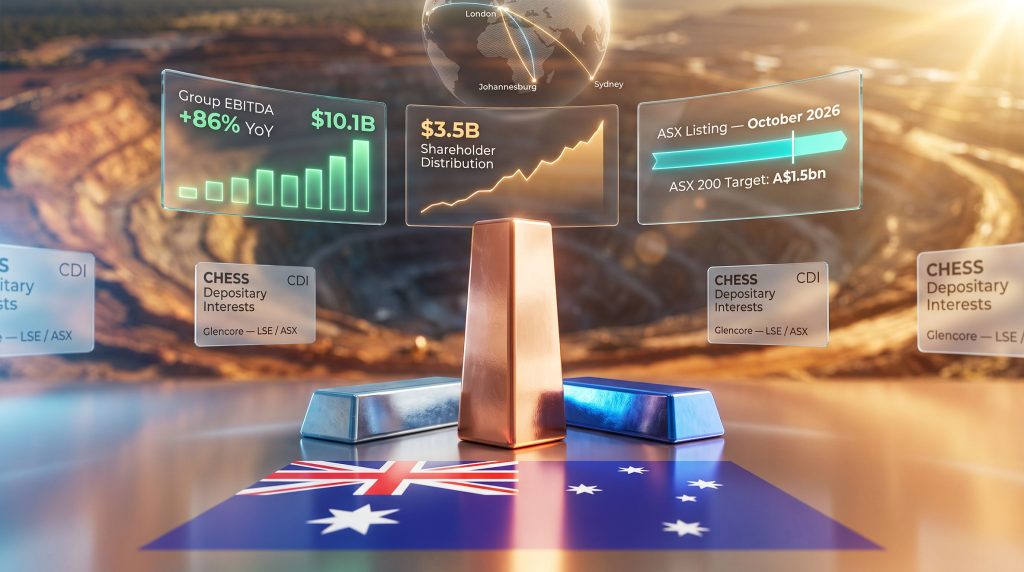
The mechanics of this transaction are deliberately straightforward. Glencore, whose primary listing resides on the London Stock Exchange (LSE) with a secondary listing on the Johannesburg Stock Exchange (JSE), is targeting an October 2026 admission to the Australian Securities Exchange via CHESS Depositary Interests (CDIs). No new shares will be issued. No existing shares will be transferred. The listing is structured as a low-friction market access exercise designed to give Australian investors a locally settled, AUD-denominated pathway into Glencore's existing share register.
Understanding the CDI Structure
For investors unfamiliar with the mechanics, CDIs are instruments that represent an economic interest in an underlying foreign-listed share. They are settled through the CHESS settlement system, Australia's domestic clearing and settlement infrastructure, meaning Australian investors can buy and sell exposure to Glencore in Australian dollars through their standard brokerage accounts.
Crucially, CDI holders retain the same economic entitlements as ordinary shareholders, including:
- Dividend distributions (converted to AUD)
- Voting rights on shareholder resolutions
- Access to capital return events (buybacks, special payments)
- Corporate action participation
The depositary layer that sits between the CDI and the underlying London-listed share is operationally transparent to the end investor in most circumstances.
How Secondary Listings Compare to Primary Listings
| Feature | Primary Listing | Secondary Listing (CDI) |
|---|---|---|
| Capital Raising | Common | Not required |
| Regulatory Compliance | Full ASX disclosure | Home exchange remains primary |
| Index Eligibility | Immediate | Subject to ownership thresholds |
| Share Register Impact | Direct | Depositary layer (CDIs) |
| Execution Cost | High | Relatively low |
Why Australia Was Chosen Over Other Exchanges
Glencore's decision to pursue an ASX secondary listing rather than targeting another major exchange, such as the New York Stock Exchange (which the company evaluated as recently as August 2025 before abandoning those plans), reflects a convergence of specific structural factors unique to the Australian market. Management has publicly described the primary motivation as reverse inquiry, meaning the decision was not driven by top-down strategic ambition alone, but by direct demand signals from Australian institutional investors already seeking Glencore exposure through more operationally cumbersome offshore routes.
Three reinforcing dynamics appear to underpin the choice:
- Superannuation growth trajectory: The mathematical scale of Australia's pension system creates a growing and captive pool of long-duration capital that needs to be deployed into assets matching funds' risk and return mandates.
- Mining sector consolidation: A wave of mergers, acquisitions, and delistings across the ASX mining sector has reduced the number of large-cap, diversified resource vehicles available to institutional investors. Glencore's arrival would partially fill that gap.
- Index inclusion mathematics: Unlike other major exchanges, the ASX's index inclusion thresholds are low enough relative to Glencore's market capitalisation that achieving benchmark status within a defined timeframe is realistically achievable.
Glencore's CEO Gary Nagle stated publicly that Australia was selected over competing exchanges specifically because the mathematical pathway to index inclusion was the most direct, reflecting the company's view that index-driven demand, not initial listing activity, is where the long-term value of the exercise resides. (Source: MiningMX, August 2026)
The Index Inclusion Mechanics That Matter Most
For sophisticated investors, the listing date itself is largely incidental. The value inflection points are the ASX 200 index and ASX 100 inclusion milestones, which trigger a categorically different type of demand.
How Index Inclusion Creates Non-Discretionary Buying
Once Glencore crosses the ownership threshold that qualifies it for ASX 200 inclusion, passive funds and ETFs benchmarked to that index are obligated to hold the stock. This demand is non-discretionary, meaning fund managers tracking the index must acquire Glencore CDIs regardless of their individual fundamental view on the company.
This structural buying mechanism can reduce the available free float on the Australian line, consequently creating upward price pressure that benefits existing holders. It also improves liquidity by compressing bid-ask spreads and deepening the order book.
Inclusion Thresholds and Timelines
| Milestone | Required Australian Investor Holdings | Management Target |
|---|---|---|
| ASX Listing (CDI admission) | No minimum | October 2026 |
| ASX 200 Inclusion | Approximately A$1.5 billion | ~12 months post-listing |
| ASX 100 Inclusion | Approximately A$5.5 billion | Medium-term |
Management has publicly indicated that ASX 100 inclusion, not merely ASX 200 inclusion, is the ultimate target. This is a meaningfully more ambitious goal, requiring roughly 3.7 times the Australian investor holdings needed for ASX 200 entry.
The South African Precedent: A Data Point Worth Understanding
One of the less widely discussed aspects of this listing strategy is the analytical framework Glencore's management is using to calibrate expectations. The JSE secondary listing provides a directly comparable case study. South African investors currently hold approximately 8% of Glencore's total share register, representing close to A$10 billion in market capitalisation terms. This was achieved organically over time in a market characterised by deep familiarity with diversified mining companies and a similar institutional investor structure to Australia's.
Management has explicitly drawn the parallel, noting there is no structural reason why Australian investor participation could not reach or exceed South African levels over time. If that scenario were to materialise, it would place Glencore's Australian-line holdings well above the ASX 100 inclusion threshold of A$5.5 billion, potentially driving the company into one of the ASX's most closely tracked benchmark indices.
The JSE comparison is particularly instructive because South Africa's listed mining universe is also highly concentrated, and South African pension funds, like their Australian counterparts, are mandated to diversify across sectors. The structural parallel gives management's confidence in the Australian uptake thesis a credible empirical foundation.
Half-Year Financial Results: The Numbers Behind the Confidence
The timing of the Glencore ASX listing announcement was not incidental. It was released alongside interim financial results for the six months ended June 2026 that demonstrated the kind of financial momentum that makes a new listing announcement credible rather than aspirational.
Key Financial Highlights
| Metric | H1 2026 Result | Year-on-Year Change |
|---|---|---|
| Group EBITDA | $10.1 billion | +86% |
| Industrial Assets EBITDA | $6.5 billion | +75% |
| Marketing Division EBITDA | $3.3 billion | More than doubled |
| Total Shareholder Distribution | $3.5 billion | N/A |
| Special Interim Cash Payment | ~$1 billion | N/A |
| Share Buyback Programme | $500 million | N/A |
| Per-Share Top-Up Payment | 8.5 US cents | N/A |
| Net Debt | $10.2 billion | Reduced by $1 billion |
The marketing division's contribution is particularly noteworthy. At $3.3 billion, it represented approximately one-third of total group EBITDA, more than doubling year-on-year. This performance warrants specific examination because it reflects a structural feature of Glencore's business model that has no close equivalent among ASX-listed mining peers.
What Drives the Marketing Division
Glencore's marketing operations function as a physical commodity trading platform, generating returns from price volatility and supply dislocations rather than production volumes. This is mechanically distinct from a conventional mining company, where revenue is largely a function of tonnes produced multiplied by spot price.
The H1 2026 environment was exceptionally favourable for this business model. Middle East conflict created severe disruptions to shipping through the Strait of Hormuz, removing approximately 10 million barrels per day of oil supply from the market at peak disruption. Brent crude prices surged 15% in the immediate escalation period and subsequently reached $120 per barrel, generating extreme volatility across oil, refined petroleum products, LNG, and freight markets.
For Glencore's marketing desk, which physically holds and trades commodity inventories across geographies, such conditions create outsized arbitrage and basis-trading opportunities that a pure-play mining company cannot access. This counter-cyclical characteristic relative to supply shocks is an underappreciated feature of Glencore's earnings profile.
The next major ASX story will hit our subscribers first
Glencore's Commodity Mix: What Australian Investors Would Be Buying
Beyond the financial results, the commodity exposure embedded in a Glencore CDI position is substantively different from what is currently available in the ASX large-cap mining universe. Furthermore, the broader context of mining capital markets reinforces why diversified commodity access is increasingly valued by institutional allocators.
Comparative Snapshot: Major Miners with ASX Exposure
| Company | Primary Exchange | Key Commodities | Integrated Trading Division |
|---|---|---|---|
| BHP | ASX / LSE (dual primary) | Iron ore, copper, coal | No |
| Rio Tinto | ASX / LSE (dual primary) | Iron ore, aluminium, copper | No |
| South32 | ASX (primary) | Aluminium, manganese, copper | No |
| Glencore | LSE (primary), ASX targeting Oct 2026 | Copper, cobalt, zinc, coal, oil marketing | Yes |
Several commodities within Glencore's portfolio are notably underrepresented in the current ASX large-cap mining universe:
- Cobalt: Glencore is the world's largest cobalt producer, predominantly sourced from its Congolese operations. Cobalt remains a critical input for lithium-ion battery cathodes, with no direct ASX-listed equivalent at scale.
- Zinc: A commodity with meaningful exposure to infrastructure spending cycles, largely absent from ASX index-eligible miners.
- Integrated oil marketing: No ASX-listed mining company offers exposure to physical oil trading returns.
This commodity mix provides Australian superannuation funds with a diversification vector into energy transition metals and physical commodity trading that is genuinely difficult to replicate through existing ASX-listed vehicles.
The M&A Question: Rio Tinto and the Scrip Currency Argument
Any analysis of the Glencore ASX listing would be incomplete without addressing the M&A speculation that emerged alongside the announcement. Banking analysis cited by Reuters at the time suggested that an ASX-listed scrip could simplify the mechanics of large-scale transactions involving Australian-listed mining companies, with the implication being a potential path back to discussions with Rio Tinto.
The two companies formally terminated merger discussions on 5 February 2026, with Glencore's position being that any transaction structured around a change of control, including proposals to appoint an incoming board chair and CEO, would require a meaningful control premium that was not reflected in Rio Tinto's offer terms. In addition, understanding the broader Rio Tinto delisting impact on ASX investors provides useful context for why the appetite for large diversified miners on the exchange remains elevated.
However, Glencore's CEO has explicitly pushed back on the scrip-currency interpretation of the ASX listing, stating publicly that the listing does not materially change the company's M&A positioning. Whether the ASX presence ultimately creates optionality for future deal structures remains a speculative question, and investors should treat analyst commentary on this point as exploratory rather than indicative of any confirmed strategic intent.
Key Takeaways for Australian Investors
The Glencore ASX listing represents something more nuanced than a conventional new listing event. Understanding what it is and what it is not helps frame the investment case accurately:
- The listing involves no capital raising and no dilution of existing shareholders.
- The real value events are index inclusion milestones, not the admission date itself.
- Glencore offers Australian investors access to cobalt, zinc, and integrated physical commodity trading exposure unavailable through existing ASX-listed peers.
- The South African register analogy provides a credible, data-backed framework for assessing potential Australian uptake levels.
- The marketing division's earnings volatility is a feature, not a bug, but investors should understand it performs best during periods of geopolitical or supply-side stress, making Glencore's earnings profile more variable than a pure-play producer.
- The Rio Tinto merger question remains unresolved and speculative; no confirmed M&A intention has been disclosed.
Disclaimer: This article is intended for informational purposes only and does not constitute financial advice. Past financial performance, index inclusion projections, and management targets discussed herein involve forward-looking statements subject to material risks and uncertainties. Readers should conduct independent research and consult a qualified financial adviser before making investment decisions.
Frequently Asked Questions: Glencore ASX Listing
What is the Glencore ASX listing date?
Glencore is targeting October 2026 for its secondary listing on the Australian Securities Exchange via CHESS Depositary Interests.
Will Glencore raise capital through the ASX listing?
No. The listing does not involve a capital raising or the transfer of existing shares. It is structured as a low-cost market access exercise.
What are CDIs and how do Australian investors access them?
CDIs are instruments representing an economic interest in an underlying foreign-listed share, settled through Australia's CHESS system. They allow Australian investors to buy and sell Glencore exposure in AUD through standard brokerage accounts.
When could Glencore achieve ASX 200 inclusion?
Management has indicated ASX 200 inclusion is achievable within approximately 12 months of listing, subject to Australian investors accumulating at least A$1.5 billion in Glencore shares.
What differentiates Glencore from existing ASX-listed miners?
Glencore's integrated physical commodity marketing division, combined with meaningful cobalt and zinc exposure, provides a commodity mix that has no direct equivalent among current ASX large-cap mining companies.
Why did Glencore choose the ASX over other exchanges?
Management cited strong demand from Australian institutional investors, the mathematical pathway to index inclusion, and the scale and mining literacy of Australia's superannuation-driven institutional investment community.
Want to Stay Ahead of the Next Major ASX Mineral Discovery?
While institutional capital flows into large-cap vehicles like Glencore, the most transformative returns in Australian mining have historically emerged from significant new mineral discoveries — and Discovery Alert's proprietary Discovery IQ model delivers real-time alerts the moment these opportunities hit the ASX, giving subscribers an immediate edge over the broader market. Explore Discovery Alert's dedicated discoveries page to understand the historic returns major mineral discoveries have generated, and begin your 14-day free trial to position yourself ahead of the next significant find.