
August 26, 2026
Global energy markets are experiencing unprecedented volatility as geopolitical tensions reshape fundamental supply-demand dynamics across multiple commodity sectors. When energy infrastructure becomes compromised, the resulting price dislocations create asymmetric opportunities for companies positioned to capitalise on market inefficiencies. This phenomenon extends beyond simple supply shortages, encompassing complex arbitrage possibilities, transportation bottlenecks, and fuel switching mechanisms that can dramatically alter corporate earnings profiles within compressed timeframes. Glencore poised to benefit from Newcastle coal price surge represents one such opportunity where diversified commodity producers can leverage their operational flexibility.
The interconnected nature of modern energy systems means disruptions in one fuel type cascade through alternative energy sources, creating ripple effects that sophisticated market participants can exploit through strategic positioning and operational flexibility. Furthermore, these dynamics have emerged once again as Middle Eastern energy strategies threaten critical energy chokepoints, triggering significant price premiums in coal markets and highlighting the strategic advantages held by diversified commodity traders with global logistics capabilities.
Understanding the Current Energy Market Disruption Driving Coal Price Volatility
Geopolitical Tensions Reshape Global LNG Supply Chains
The Strait of Hormuz represents one of the world's most critical energy transit corridors, handling approximately 25% of seaborne oil shipments and 20% of global LNG flows according to maritime trade analysis. When geopolitical tensions escalate in this region, the immediate impact extends far beyond local markets, creating supply chain disruptions that reverberate across global energy systems.
Recent conflicts involving Iran have highlighted the vulnerability of LNG infrastructure, particularly affecting Qatar's massive Ras Laffan facility, which represents a substantial portion of global LNG export capacity. The potential for extended facility downtime creates immediate concerns for utilities and power generators who have increasingly relied on natural gas for baseload electricity generation.
The geographic concentration of LNG production facilities means that disruptions in key exporting regions cannot be easily compensated through alternative supply sources. Unlike crude oil, which benefits from extensive pipeline networks and diverse production locations, LNG requires specialised liquefaction facilities and dedicated shipping infrastructure that cannot be rapidly substituted when primary sources face operational challenges.
The Economics Behind Gas-to-Coal Switching in Power Generation
Fuel switching in power generation operates according to specific economic thresholds that utilities continuously monitor as part of their operational optimisation strategies. When natural gas price trends shift dramatically upward relative to coal prices, utilities with dual-fuel capability can transition their generation mix to maintain cost-effective electricity production.
The switching decision involves multiple technical and economic considerations beyond simple fuel cost comparisons. Power plants must evaluate:
• Generation efficiency differentials between natural gas combined cycle units and coal-fired facilities
• Emissions compliance costs associated with increased coal utilisation
• Inventory management requirements for maintaining adequate coal stockpiles
• Operational flexibility constraints limiting rapid capacity transitions
• Contract structure limitations that may restrict fuel switching decisions
European utilities possess approximately 25-35 million tonnes of annual switching potential, while Japanese facilities can accommodate 8-12 million tonnes of additional coal demand during extended gas supply disruptions. However, these switching capabilities face infrastructure constraints that prevent immediate activation, typically requiring 4-8 week implementation timelines for full capacity utilisation.
When big ASX news breaks, our subscribers know first
What Makes Newcastle Coal Prices a Global Energy Benchmark?
Newcastle's Role as Asia-Pacific Pricing Hub
Newcastle's emergence as the primary coal pricing reference for the Asia-Pacific region reflects decades of infrastructure development, quality standardisation, and market liquidity accumulation that established it as the most reliable price discovery mechanism for thermal coal transactions. The port's strategic location enables efficient access to major Asian electricity markets while maintaining consistent quality specifications that facilitate standardised trading.
The Newcastle benchmark specifically references coal with energy content ranging from 5,500 to 6,000 kilocalories per kilogram, ash content below 12%, and sulphur content meeting environmental compliance standards across multiple jurisdictions. These specifications ensure that Newcastle-priced coal can be directly substituted across diverse power generation facilities without requiring complex quality adjustments.
Trading volumes at Newcastle consistently exceed other regional coal markets, providing sufficient liquidity to support both physical transactions and financial hedging activities. Consequently, the combination of reliable supply, consistent quality, and active trading participation creates the market depth necessary for accurate price discovery that reflects genuine supply-demand fundamentals rather than artificial price manipulation.
Current Price Dynamics Versus Historical Patterns
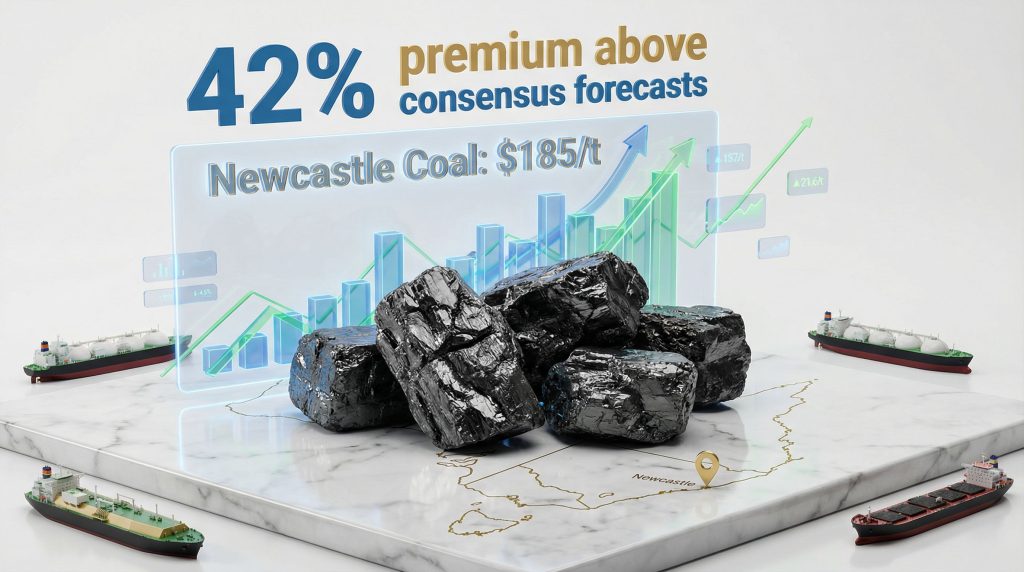
Newcastle coal prices have surged to levels representing a 42% premium above consensus forecasts, reaching sustained levels above $165 per tonne since late February 2026. This pricing trajectory differs significantly from historical patterns where coal price volatility typically correlated with seasonal demand variations or gradual supply adjustments.
The current price environment reflects acute supply-demand imbalances triggered by LNG market disruptions rather than fundamental coal market dynamics. Unlike the 2022 energy crisis, which involved simultaneous supply shocks across multiple energy commodities including Russian coal export restrictions and Australian weather-related production disruptions, the current situation concentrates primarily on LNG infrastructure limitations.
| Price Period | Newcastle Coal ($/tonne) | Premium vs. Consensus | Primary Driver |
|---|---|---|---|
| Pre-February 2026 | ~$115-125 | Baseline | Normal market conditions |
| March 2026 | $165+ | 42% | LNG supply disruption |
| Base scenario | $185 | 60%+ | Extended disruption |
| Stress scenario | $185-245 | 100%+ | Prolonged conflict |
Forward curve analysis indicates that market participants expect price normalisation within 3-6 months assuming geopolitical tensions resolve and LNG infrastructure restoration proceeds without additional complications. However, the steep backwardation in coal futures suggests significant uncertainty regarding conflict duration and infrastructure repair timelines.
How Energy Market Disruptions Create Asymmetric Benefits for Diversified Miners
Natural Hedging Strategies in Volatile Energy Markets
Glencore's position as a diversified commodity producer and trader creates natural hedging mechanisms that become particularly valuable during energy market volatility. When LNG supply disruptions drive coal prices higher, the company benefits from increased thermal coal revenues while simultaneously capturing trading margins from geographic price dislocations and cargo routing optimisation.
The natural hedging concept operates through portfolio effects where commodity price correlations shift during market stress periods. While Glencore maintains exposure to energy-intensive mining operations that face higher input costs during energy price spikes, this negative exposure is more than offset by beneficial exposure through thermal coal production and energy trading activities.
Bloomberg Intelligence projects that Glencore's 2026 earnings could increase by 14% year-on-year to reach $20 billion in prolonged conflict scenarios, reflecting the asymmetric benefit structure inherent in diversified commodity portfolios during energy market disruptions. This earnings uplift compares to approximately $17.5 billion in normalised market conditions, representing significant outperformance relative to pure-play mining operations.
Trading Desk Capabilities Versus Pure-Play Mining Operations
Glencore's integrated trading operations provide competitive advantages that become magnified during market disruptions when geographic price dislocations create arbitrage opportunities. The trading desk can capture value through several mechanisms unavailable to traditional mining companies:
• Geographic arbitrage exploiting price differentials between supply origins and demand centres
• Temporal arbitrage optimising inventory positions across different delivery periods
• Quality arbitrage matching specific coal grades to regional demand requirements
• Transportation optimisation leveraging logistics networks to minimise freight costs
• Risk management hedging operational exposures while maintaining beneficial price exposure
During the 2022 energy crisis, Glencore's marketing earnings doubled compared to normalised levels, demonstrating the scalability of trading operations during periods of elevated market volatility. The trading desk's ability to navigate supply chain disruptions and capture margins from price dislocations represents a sustainable competitive advantage that pure-play miners cannot replicate.
Competitive Positioning Analysis Across Mining Majors
Traditional mining companies face asymmetric disadvantages during energy market disruptions, experiencing the negative impact of higher input costs without corresponding revenue benefits. Companies like Whitehaven, Peabody, Yancoal, and New Hope operate primarily in metallurgical coal markets that do not benefit directly from gas-to-coal switching dynamics.
The "short energy" exposure of pure-play miners manifests through multiple operational channels:
• Diesel fuel costs for mining equipment and transportation
• Electricity consumption for processing and beneficiation activities
• Natural gas usage in certain metallurgical processes
• Transportation costs affected by energy price volatility
• Contract coal supplies required for power generation at mine sites
Geographic diversification provides additional competitive advantages for integrated operations. For instance, Glencore poised to benefit from Newcastle coal price surge showcases how global footprint enables cargo routing flexibility when specific export terminals face congestion or transportation constraints, while regional miners remain dependent on fixed logistics infrastructure that may experience bottlenecks during periods of elevated demand.
Quantifying the Scale of Global Gas-to-Coal Switching Potential
Regional Switching Capacity Assessment
Gas-to-coal switching potential varies significantly across regions based on existing infrastructure, regulatory frameworks, and operational constraints. However, commodity market volatility affects these calculations as Bloomberg Intelligence estimates that practical switching capacity could accommodate between 40-60 million tonnes of additional coal demand across Europe, Japan, South Korea, and Taiwan during extended LNG supply disruptions.
| Region | Switching Potential (MT) | Key Constraints | Implementation Timeline |
|---|---|---|---|
| Europe | 25-35 | Emissions policy, capacity limits | 4-8 weeks |
| Japan | 8-12 | Contract structures, operational limits | 6-10 weeks |
| South Korea | 4-6 | Environmental regulations | 3-6 weeks |
| Taiwan | 3-5 | Inventory levels, logistics | 4-7 weeks |
| Total | 40-60 | Multiple factors | 3-10 weeks |
European switching capacity faces the greatest constraints due to progressive coal plant retirements and emissions policy restrictions that limit operational flexibility. Many facilities maintain dual-fuel capability primarily for emergency backup rather than extended commercial operation, creating technical limitations on sustained switching duration.
Japanese utilities operate under long-term LNG contract structures that include take-or-pay provisions, creating economic incentives to maintain gas consumption even when coal offers cost advantages. However, force majeure provisions in supply agreements may provide contractual flexibility during documented supply disruptions.
Supply Response Mechanisms in High-Calorific Coal Markets
The seaborne thermal coal market encompasses approximately one billion tonnes of annual trade, with high-calorific coal representing less than 400 million tonnes of this total volume. Gas-to-coal switching demand concentrates specifically in high-calorific coal grades, creating disproportionate tightening in this market segment relative to overall coal supply availability.
Australian export capacity operates at high utilisation rates, limiting immediate supply response capabilities without significant infrastructure modifications or productivity improvements. Colombian and South African operations provide some supply flexibility, but transportation bottlenecks at Richards Bay and other export terminals constrain rapid capacity expansion.
Freight rate volatility represents an additional supply response constraint, with Capesize vessel rates experiencing significant increases during periods of elevated coal demand. Transportation costs can represent 15-25% of delivered coal prices, meaning freight market dynamics significantly impact the economics of coal switching decisions for utilities.
Why Trading Operations Thrive During Energy Market Dislocations
Arbitrage Opportunities in Fragmented Energy Markets
Energy market disruptions create geographic and temporal price dislocations that experienced trading operations can exploit through sophisticated arbitrage strategies. When LNG supply chains face disruption, regional energy markets become temporarily fragmented, creating price differentials that exceed normal transportation and logistics costs.
Glencore's trading desk thrives on these "war premium" conditions, capturing margins as thermal coal, oil, and gas prices decouple from fundamental supply-demand relationships. The trading operation leverages its vast logistics network to reroute energy cargoes and navigate rising freight volatility, extracting margins that pure-play mining peers cannot access.
During market stress periods, normal price convergence mechanisms become impaired due to:
• Infrastructure constraints limiting cargo routing flexibility
• Contract rigidities preventing rapid supply source substitution
• Inventory limitations constraining buffer stock utilisation
• Information asymmetries creating temporary pricing inefficiencies
• Risk premium adjustments reflecting uncertainty about disruption duration
Historical Performance During Previous Energy Crises
The 2022 energy crisis, triggered by the Russian invasion of Ukraine, provides a valuable precedent for understanding how integrated trading operations perform during energy market disruptions. However, this context also demonstrates how trade war impacts compound energy market stress, as Glencore's marketing earnings doubled compared to normalised levels during that period.
The company's ability to navigate supply chain disruptions while maintaining operational flexibility enabled premium capture that exceeded initial market expectations. Trading desk performance during 2022 likely reached the top of Glencore's long-term guidance range of $2.3-3.5 billion in marketing earnings, suggesting potential for similar outperformance during current market conditions.
Current market dynamics, while not yet comparable in scale to 2022 conditions, exhibit similar characteristics that favour integrated trading operations. Geographic price dislocations, freight market volatility, and contract flexibility constraints create opportunities for sophisticated market participants with operational capabilities spanning multiple commodity markets.
Scenario Analysis: Duration and Magnitude of Price Support
Base Case: Short-Term Disruption (1-2 Months)
Bloomberg Intelligence's base case scenario assumes LNG infrastructure restoration within 1-2 months, with Newcastle coal prices potentially reaching $185 per tonne during peak disruption periods. This scenario reflects limited but meaningful gas-to-coal switching across European and Asian utilities, creating temporary demand uplift in high-calorific coal markets.
Under base case assumptions, coal price premiums would begin retracing once LNG supply restoration becomes visible and utilities gain confidence in natural gas availability. Nevertheless, infrastructure repair timelines often experience delays due to technical complexities and ongoing security concerns in conflict zones.
The base case scenario would generate significant but temporary earnings benefits for thermal coal producers, with price premiums potentially adding $60-70 per tonne above normalised levels. For major producers, this translates to substantial quarterly earnings uplift concentrated in thermal coal operations and trading activities.
Extended Stress Scenario: Prolonged Conflict (3+ Months)
Extended conflict scenarios envision Newcastle prices reaching $185-245 per tonne with potential for up to 90 million tonnes of additional coal demand from fuel switching across multiple regions. This scenario assumes progressive escalation of switching activities as utilities exhaust LNG inventory buffers and activate contingency fuel supply arrangements.
Prolonged disruption creates cumulative effects that amplify initial price pressures:
• Inventory depletion forcing utilities into spot coal markets
• Contract negotiations favouring coal suppliers with available capacity
• Infrastructure utilisation approaching maximum sustainable levels
• Secondary effects as coal shortages create competition among users
• Policy responses potentially relaxing emissions restrictions temporarily
In stress scenarios, Bloomberg Intelligence projects that Glencore's earnings could reach $20 billion, representing the upper end of potential performance during energy market disruptions. This earnings level reflects maximum utilisation of thermal coal assets combined with optimal trading desk performance capturing geographic arbitrage opportunities.
The next major ASX story will hit our subscribers first
Investment Implications for Energy-Exposed Mining Companies
Earnings Sensitivity Analysis
The 14% year-on-year earnings increase projection reaching $20 billion in revenue potential during stress scenarios demonstrates the significant financial impact of energy market disruptions on diversified commodity producers. This earnings sensitivity reflects the asymmetric exposure profile created by natural hedging mechanisms and trading capabilities.
Earnings sensitivity to coal price changes operates through multiple channels for integrated producers:
• Direct production exposure through thermal coal mining operations
• Trading margin capture from geographic price dislocations
• Logistics optimisation reducing transportation costs during market stress
• Contract optimisation negotiating favourable terms during supply shortages
• Risk management hedging negative exposures while maintaining beneficial positions
Normalised earnings expectations for Glencore typically range between $15-17 billion annually, suggesting that energy market disruptions could provide 15-30% earnings uplift depending on disruption magnitude and duration. This performance differential highlights the strategic value of diversified commodity portfolios during market stress periods.
Strategic Positioning Versus Industry Peers
Thermal coal exposure provides defensive characteristics during energy transitions, contradicting conventional wisdom that coal assets represent stranded value in decarbonising energy systems. When renewable energy sources cannot immediately replace baseload generation and natural gas faces supply constraints, coal maintains strategic importance for grid stability.
Additionally, OPEC production impact affects broader energy market dynamics. Metallurgical coal operations demonstrate limited correlation with energy market disruptions, as steelmaking processes cannot easily substitute alternative fuel sources. Companies with primary exposure to metallurgical coal markets experience energy cost inflation without corresponding revenue benefits during gas and oil price spikes.
Geographic diversification across multiple export terminals provides operational flexibility that becomes particularly valuable during infrastructure bottlenecks. Glencore poised to benefit from Newcastle coal price surge demonstrates how access to Newcastle, Queensland, Colombian, and South African coal operations enables cargo routing optimisation when specific terminals face capacity constraints or transportation disruptions.
Long-Term Structural Changes in Global Energy Markets
Policy Constraints on Future Coal Capacity
European coal plant retirement schedules continue progressing despite temporary supply disruptions, creating long-term structural limitations on gas-to-coal switching potential. Many facilities maintain emergency backup capability rather than commercial operational status, constraining extended switching capacity over multi-year timeframes.
Asian utility investment patterns increasingly favour renewable energy and battery storage systems for baseload capacity expansion, though coal plants retain importance for grid stability during transition periods. Environmental regulations create operational constraints on coal plant activation, requiring emissions compliance procedures that limit rapid switching implementation.
The regulatory framework surrounding coal utilisation continues tightening across major consuming regions, suggesting that current switching capacity may represent peak levels rather than sustainable long-term demand patterns. Policy makers balance energy security concerns against climate commitments, creating complex regulatory environments for coal operations.
Supply Chain Resilience Lessons for Energy Security
Recent energy market disruptions highlight the importance of fuel diversification strategies for utilities and power system operators. Over-reliance on single fuel sources creates vulnerability to supply chain disruptions that can compromise grid reliability and economic stability.
Strategic inventory management becomes critical for maintaining operational flexibility during supply disruptions. Utilities with adequate coal stockpiles can implement switching strategies more rapidly than facilities dependent on just-in-time fuel delivery systems that lack buffer inventory capacity.
Infrastructure investment requirements for maintaining dual-fuel capability represent ongoing costs that utilities must balance against energy security benefits. The economic value of switching flexibility becomes apparent during supply disruptions but requires sustained investment during normal market conditions to maintain operational readiness.
Energy Market Volatility as Competitive Advantage
Key Takeaways for Investors
Portfolio positioning during energy transitions requires understanding the complex relationships between different energy commodities and the operational capabilities that enable companies to benefit from market volatility. Diversified commodity producers with integrated trading operations possess structural advantages that become magnified during supply disruptions.
Trading capabilities represent sustainable value creation drivers for companies with global logistics networks and market expertise. The ability to capture arbitrage opportunities and optimise cargo routing decisions provides consistent earning potential that supplements traditional mining operations.
Geographic and operational diversification importance extends beyond risk mitigation to encompass active value creation during market stress periods. Companies with flexible operational footprints can optimise production and logistics decisions in response to changing market conditions.
Monitoring Indicators for Sustained Price Support
LNG infrastructure restoration timelines provide the primary catalyst for coal price normalisation, making geopolitical developments and facility repair progress critical monitoring variables for investors. Qatar's Ras Laffan facility status represents a key indicator given its substantial contribution to global LNG export capacity.
Utility inventory levels and switching decisions create real-time demand indicators that reflect actual fuel switching implementation rather than theoretical capacity estimates. European and Asian utility fuel procurement patterns provide leading indicators of switching demand sustainability.
Furthermore, coal industry experts have noted that "the current market dynamics represent a fundamental shift in energy security priorities" across major consuming regions. Geopolitical stability metrics in key energy corridors affect long-term supply chain reliability assessments and infrastructure investment decisions. The Strait of Hormuz remains a critical chokepoint whose operational status influences global energy market dynamics and commodity price formation.
Moreover, industry analysts highlight that "war-driven LNG constraints have created unexpected opportunities for thermal coal producers to capitalise on fuel switching dynamics", emphasising how Glencore poised to benefit from Newcastle coal price surge represents broader structural advantages for diversified commodity companies during energy market disruptions.
Disclaimer: This analysis contains forward-looking statements and projections that involve assumptions about future market conditions, geopolitical developments, and corporate performance. Coal and energy commodity prices are highly volatile and subject to numerous factors beyond company control. Investors should conduct independent research and consider their risk tolerance before making investment decisions. Past performance does not guarantee future results, and actual outcomes may differ materially from projections presented in this analysis.
Looking to Capitalise on Energy Market Volatility?
Discovery Alert's proprietary Discovery IQ model delivers real-time alerts on significant ASX mineral discoveries, instantly empowering subscribers to identify actionable opportunities ahead of the broader market during periods of energy sector disruption. Begin your 14-day free trial today and secure your market-leading advantage in capitalising on commodity market volatility.