
July 26, 2026
Global battery supply chains face unprecedented uncertainty as strategic mineral governance evolves across resource-rich nations. The Democratic Republic of Congo's implementation of cobalt export quotas represents a fundamental shift from market-driven commodity flows to government-controlled resource allocation. This transformation demonstrates how the glencore cobalt congo quota system affects multinational corporations and downstream manufacturers navigating complex regulatory frameworks whilst managing supply chain resilience.
Furthermore, battery manufacturers worldwide now confront a new reality where government policy decisions carry equal weight to geological resource availability in determining material costs and supply security. The DRC's quota system exemplifies resource nationalism, where strategic commodities become instruments of economic statecraft rather than purely commercial products traded on global markets.
Understanding Congo's Cobalt Export Quota Architecture
The Democratic Republic of Congo launched its structured cobalt export framework on October 16, 2024, replacing months of complete export restrictions with a controlled allocation system. This regulatory architecture establishes specific tonnage limits whilst requiring comprehensive compliance protocols from mining companies seeking to export cobalt concentrate and finished products.
In addition, the DRC cobalt export ban had previously created significant supply disruptions before the quota system implementation. The transition from complete prohibition to managed allocation demonstrates the government's sophisticated approach to resource control and revenue optimisation.
Regulatory Framework Implementation
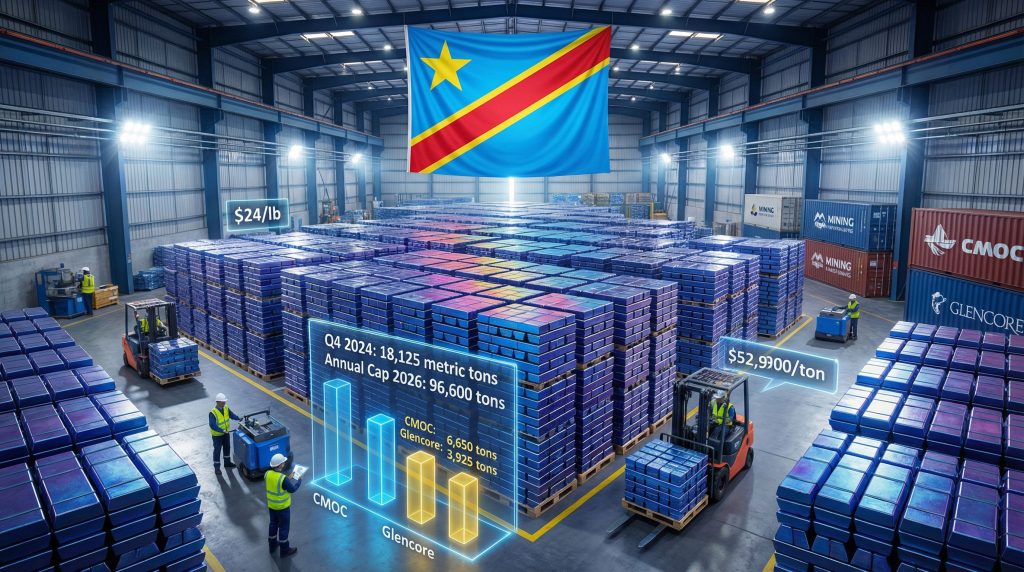
The quota system operates through the Autorité de Régulation de la Chaîne de Valeur des Minerais (ARECOMS), which oversees all cobalt export activities. The fourth quarter 2024 allocation totaled 18,125 metric tons, distributed among major producers based on undisclosed government criteria. Beginning in 2026, annual export volumes will face a hard cap of 96,600 metric tons, representing a significant reduction from historical export levels.
ARECOMS retains 10% of all allocations for strategic reserves, ensuring government control over emergency supply releases or domestic processing requirements. This mechanism provides the regulatory authority with discretionary power to influence global cobalt markets through strategic reserve deployment.
Compliance Requirements and Operational Procedures
Mining companies must navigate a multi-step approval process before any cobalt shipment can leave Congolese ports. However, the complexity of these requirements creates substantial operational challenges for international operators:
• Government notification before batch preparation begins
• Laboratory testing for quality certification and volume verification
• Royalty calculation based on certified quantities and current market prices
• 48-hour payment window for 10% royalty fees
• Cargo movement authorisation following proof of payment
Consequently, the system creates significant cash flow pressures for mining operators, who must maintain substantial liquid reserves to meet rapid payment deadlines. A typical 500-ton cobalt shipment valued at current market prices of $52,900 per ton would require approximately $2.6 million in royalty payments within the specified 48-hour window.
Quota Distribution for Q4 2024:
| Company | Allocation (Metric Tons) | Percentage Share |
|---|---|---|
| CMOC (China) | 6,650 | 36.7% |
| Glencore | 3,925 | 21.7% |
| Other Producers | 7,550 | 41.6% |
| Total | 18,125 | 100% |
When big ASX news breaks, our subscribers know first
Strategic Motivations Behind Export Restrictions
The DRC government implemented cobalt export restrictions following a dramatic price collapse that reached nine-year lows of approximately $10 per pound in February 2024. This pricing environment severely reduced government revenues from mining royalties and export taxes, prompting officials to seek alternative mechanisms for revenue optimisation and market influence.
For instance, global cobalt mining production patterns had created oversupply conditions that depressed prices throughout 2023 and early 2024. The government's strategic intervention represents a sophisticated response to market dynamics rather than arbitrary policy-making.
Revenue Enhancement Through Supply Control
Government sources indicate the export ban and subsequent quota system succeeded in driving cobalt prices from $10 per pound to current levels of $24 per pound, representing a 140% price appreciation. This artificial scarcity creation demonstrates how supply-side interventions can generate substantial revenue increases for resource-controlling governments.
The policy shift reflects sophisticated understanding of global supply chain dependencies. With Congo controlling over 70% of global cobalt production from an estimated 280,000 metric tons annually, government officials recognised their ability to influence international prices through strategic export management.
Value Addition and Domestic Processing Objectives
Beyond immediate revenue considerations, the quota system supports longer-term industrialisation goals. By constraining raw material exports, the government creates incentives for international companies to invest in domestic processing facilities, potentially capturing higher-value manufacturing activities within Congolese borders.
Mining industry sources suggest this approach mirrors successful precedents in other critical mineral sectors, particularly Indonesia's nickel processing requirements, which attracted billions in foreign investment for domestic smelting and refining capacity. Similarly, companies pursuing cobalt blue expansion projects now must consider downstream processing capabilities as part of their strategic planning.
Global Supply Chain Disruption Analysis
Congo's cobalt quota system creates structural supply constraints that reverberate throughout global battery manufacturing networks. The country's dominant market position means policy decisions in Kinshasa directly impact production schedules for electric vehicle manufacturers worldwide.
The critical minerals surge in global demand has made supply security a paramount concern for battery manufacturers. However, the quota system introduces unprecedented regulatory uncertainty into previously market-driven commodity flows.
Market Concentration Risk Assessment
The DRC's 70% share of global mined cobalt production creates extraordinary geographic concentration risk compared to other critical minerals. This dependency becomes particularly acute given the limited timeframe for developing alternative supply sources, as cobalt mining projects typically require 5-7 years from discovery to production.
Current global cobalt production of approximately 280,000 metric tons implies DRC annual output near 196,000 tons. The 96,600-ton export cap beginning in 2026 represents roughly 49% of estimated national production, indicating substantial volumes will require domestic processing or remain unmined.
Price Volatility and Investment Implications
Cobalt price movements demonstrate the system's immediate market impact:
• February 2024: $10/lb (nine-year low)
• December 2025: $24/lb ($52,900/ton)
• Price appreciation: 140% from trough to current levels
• Market disruption period: 10 months from ban to quota implementation
These price movements create cascading effects throughout battery supply chains. Industry analysts estimate cobalt represents 5-10% of total battery costs, which comprise 30-40% of electric vehicle manufacturing expenses. A 140% cobalt price increase translates to approximately 2-5% higher EV costs, assuming manufacturers cannot absorb the additional expenses.
"Battery manufacturers typically maintain 60-90 days of cobalt inventory. The multi-month delays between quota announcement and actual shipments force companies to either increase expensive inventory carrying costs or reduce production schedules to match actual supply availability," according to industry analysts.
Operational Challenges for Mining Companies
The quota system implementation has created significant operational uncertainties for companies seeking to export cobalt from Congo. Industry representatives have formally requested government clarification on procedural requirements and compliance standards, as reported by Reuters on Glencore's pilot shipment.
Procedural Ambiguity and Regulatory Risk
Mining industry sources cite several specific concerns regarding the new export framework:
Quality Standards Uncertainty: No publicly available specifications define acceptable cobalt purity levels or testing methodologies for export approval. Companies must navigate undisclosed quality requirements that could result in shipment rejections after substantial preparation investments.
Discretionary Approval Authority: Government officials retain undefined discretion in final export approvals, creating uncertainty even after companies complete all specified compliance requirements. This regulatory unpredictability complicates long-term production planning and customer commitment schedules.
Payment Timing Confusion: Conflicting information exists regarding whether the 10% royalty represents a prepayment before quality determination or payment after testing completion. Government sources indicated royalty payment occurs after quality determination, contradicting earlier communications suggesting prepayment requirements.
Cash Flow and Financial Risk Management
The 48-hour royalty payment deadline creates substantial financial management challenges for mining operators. Companies must maintain significant liquidity reserves to meet rapid payment obligations whilst managing uncertain approval timelines.
Example Financial Impact Calculation:
• 1,000-ton cobalt shipment at $52,900/ton = $52.9 million value
• 10% royalty requirement = $5.29 million
• Payment deadline: 48 hours from notification
• Required liquidity buffer for multiple simultaneous shipments: $10-15 million monthly
For companies operating multiple mining complexes with staggered export schedules, the cumulative cash flow requirements could strain operational budgets and require dedicated credit facilities for royalty payments.
Major Producer Quota Allocations and Strategic Positioning
The government's quota distribution reveals strategic preferences and reflects existing production capacities among major cobalt producers operating in Congo. Furthermore, the allocation decisions demonstrate how the glencore cobalt congo quota system prioritises established relationships and operational capabilities.
Chinese Company Dominance in Allocations
China Molybdenum Company (CMOC) received the largest individual allocation of 6,650 tons for Q4 2024, representing 36.7% of total available quotas. CMOC operates the Tenke Fungurume Mining complex, one of Congo's largest cobalt-producing facilities, and has initiated export procedures following Glencore's pilot shipment validation.
CMOC's substantial allocation reflects both its production capacity and strategic relationship with Congolese government officials. The company had previously advocated for complete lifting of the export ban rather than quota implementation, suggesting initial resistance to the controlled allocation approach.
Western Mining Company Adaptation Strategies
Glencore secured a 3,925-ton allocation, representing 21.7% of Q4 quotas. As the first company to complete a pilot export under the new system, Glencore has validated operational procedures and demonstrated compliance with government requirements. The company operates both Mutanda and Katanga mining complexes in Congo and had previously supported quota-based systems over complete export restrictions.
Glencore's pilot shipment, completed in the first week of December 2025, provides a procedural template for other mining companies navigating the new regulatory framework. Industry sources suggest successful completion of this initial export will streamline subsequent shipment approvals, as detailed by Mining Technology's coverage.
Smaller Producer Allocation Distribution
The remaining 7,550 tons (41.6% of Q4 quotas) are distributed among various smaller producers and joint ventures operating in Congo. This allocation structure maintains market participation for multiple companies whilst concentrating control among the largest industrial operators.
Long-Term Market Evolution and Policy Trajectory
The quota system represents a permanent structural change rather than temporary market intervention. Government officials have indicated the annual 96,600-ton export cap beginning in 2026 will remain stable, forcing global cobalt markets to adapt to constrained supply availability.
Annual Export Cap Implementation Strategy
Beginning January 2026, Congo will enforce a fixed annual export limit of 96,600 metric tons, representing approximately 34% reduction from historical export volumes. This cap creates permanent supply scarcity designed to maintain elevated cobalt prices and maximise government revenue extraction.
The policy structure mirrors successful resource management models in petroleum markets, where producing nations coordinate supply levels to influence global pricing. However, Congo's unilateral approach differs from multilateral coordination mechanisms typically employed in oil markets.
Industry Adaptation and Investment Response
Mining companies are developing various strategies to adapt to the new regulatory environment. In addition, the constrained supply environment creates opportunities for innovation and alternative approaches:
Domestic Processing Investment: Several companies are evaluating cobalt processing facility construction within Congo to capture higher-value manufacturing activities whilst reducing dependence on raw material exports.
Alternative Source Development: Battery manufacturers are accelerating investment in cobalt mining projects outside Congo, particularly in Australia, Philippines, and Papua New Guinea, despite higher production costs compared to Congolese operations.
Technology Innovation Acceleration: The constrained supply environment is driving research into cobalt-reduced battery chemistries and battery recycling breakthrough technologies to reduce dependence on primary mining sources.
Timeline of Implementation Milestones:
| Date | Event | Market Impact |
|---|---|---|
| February 2024 | Complete export ban implemented | Cobalt prices begin rising from $10/lb |
| October 16, 2024 | Quota system launched | Limited export resumption authorised |
| December 2025 | Glencore pilot shipment completed | Operational procedures validated |
| January 2026 | Annual export cap enforcement | Long-term supply constraint begins |
The next major ASX story will hit our subscribers first
Resource Nationalism and Critical Mineral Governance Trends
Congo's cobalt quota system establishes important precedents for critical mineral governance across resource-rich developing nations. The policy demonstrates how governments can leverage strategic mineral deposits to influence global supply chains and capture greater economic value from natural resource endowments.
Regional Coordination Potential
Other African nations with significant critical mineral deposits are closely monitoring Congo's approach for potential replication. Countries with substantial lithium, rare earth, or nickel resources may implement similar export control mechanisms to maximise revenue and encourage domestic value addition.
The success of Congo's quota system in driving price appreciation whilst maintaining international market access could encourage broader adoption of managed export strategies across the continent. Regional coordination among multiple producing countries could amplify market influence and revenue optimisation potential.
Global Supply Chain Restructuring Imperatives
The quota system forces fundamental reassessment of critical mineral supply chain strategies among consuming nations and multinational corporations. Traditional approaches emphasising cost optimisation must now incorporate geopolitical risk management and supply security considerations.
Key Strategic Adaptations Include:
• Geographic Diversification: Reducing dependence on single-country sources through multi-region sourcing strategies
• Strategic Inventory Management: Increasing buffer stock levels to manage supply disruption risks
• Technology Innovation Investment: Accelerating development of alternative materials and recycling capabilities
• Diplomatic Engagement: Strengthening government-to-government relationships to ensure supply access
The Congo quota system demonstrates how resource-controlling nations can effectively exercise market power in critical mineral sectors, fundamentally altering the balance of influence between producing and consuming countries in global commodity markets.
Market Psychology and Investment Strategy Implications
The implementation of Congo's cobalt quota system reveals important insights about market psychology and strategic positioning in critical mineral investments. The government's ability to drive 140% price appreciation through supply restrictions demonstrates the power dynamics inherent in geographically concentrated resource markets.
Investor Sentiment and Risk Assessment
Cobalt markets now operate under permanent supply uncertainty, requiring investors to incorporate geopolitical risk premiums into valuation models. Traditional commodity analysis focusing on geological reserves and production costs must expand to include regulatory risk, government policy stability, and diplomatic relationship factors.
Consequently, the success of Congo's price manipulation strategy may encourage similar approaches in other critical mineral markets, creating systematic risks across the entire battery supply chain. Investors must now evaluate not just resource quality and production economics, but also government intentions and policy predictability when assessing mining investments.
Strategic Positioning for Market Participants
Mining Companies: Operators must balance production optimisation with regulatory compliance, potentially sacrificing efficiency for policy alignment. Companies with strong government relationships and local processing capabilities may command valuation premiums over pure extraction businesses.
Battery Manufacturers: Supply chain diversification becomes a competitive necessity rather than optional risk management. Companies with secured alternative sourcing arrangements or advanced recycling capabilities gain strategic advantages over competitors dependent on Congolese cobalt.
Technology Investors: The artificial scarcity created by quota systems accelerates returns for cobalt-alternative technologies and recycling innovations. Investment opportunities in lithium iron phosphate batteries, solid-state technologies, and urban mining operations benefit from sustained high cobalt prices.
Through strategic resource control, Congo has fundamentally altered global cobalt market dynamics, creating lasting implications for supply chain management, investment strategy, and technology development across the critical minerals sector. The glencore cobalt congo quota system represents a new model of resource governance that prioritises sovereign economic interests over traditional free-market commodity trading principles.
Looking for the Next Strategic Mineral Opportunity?
Discovery Alert's proprietary Discovery IQ model delivers real-time alerts on significant ASX mineral discoveries, instantly empowering subscribers to identify actionable opportunities ahead of the broader market. Begin your 30-day free trial today and secure your market-leading advantage.