
July 23, 2026
The Hidden Mechanics Behind LME Lead Market Movements
Base metal markets have long operated in ways that confound casual observers. Exchange inventory data, widely assumed to reflect the pulse of real industrial demand, can tell a story far removed from what is actually happening at the factory floor. Nowhere is this more apparent than in the lead market, where Glencore LME lead withdrawals and related warehouse manoeuvres create a complex web of signals that frequently diverge from genuine consumption trends.
The recent surge in LME lead stocks to levels not seen since 1970 offers a compelling case study in how large commodity traders can shape apparent market conditions through logistical and financial manoeuvres rather than shifts in end-user demand. Understanding these mechanics is essential for any investor or analyst tracking the lead market in 2026.
When big ASX news breaks, our subscribers know first
Understanding LME Warrant Cancellations and What They Actually Signal
The Mechanics of LME Warrant Cancellations Explained
An LME warrant is a title document conferring legal ownership over a specific quantity of metal held inside an LME-approved warehouse. When an owner decides to remove that metal from the exchange system, they cancel the warrant, which registers the intention to withdraw. This cancellation appears in daily LME stock reports and is closely watched by market participants as an indicator of tightening supply.
However, warrant cancellation and physical delivery to an end-user are two distinct events. Metal can be cancelled off the exchange system and subsequently re-delivered into another LME warehouse, transferred to an off-warrant facility, or used to satisfy a financial arrangement without ever reaching a manufacturer or battery producer.
Key Data Snapshot: LME Lead Stock Movements
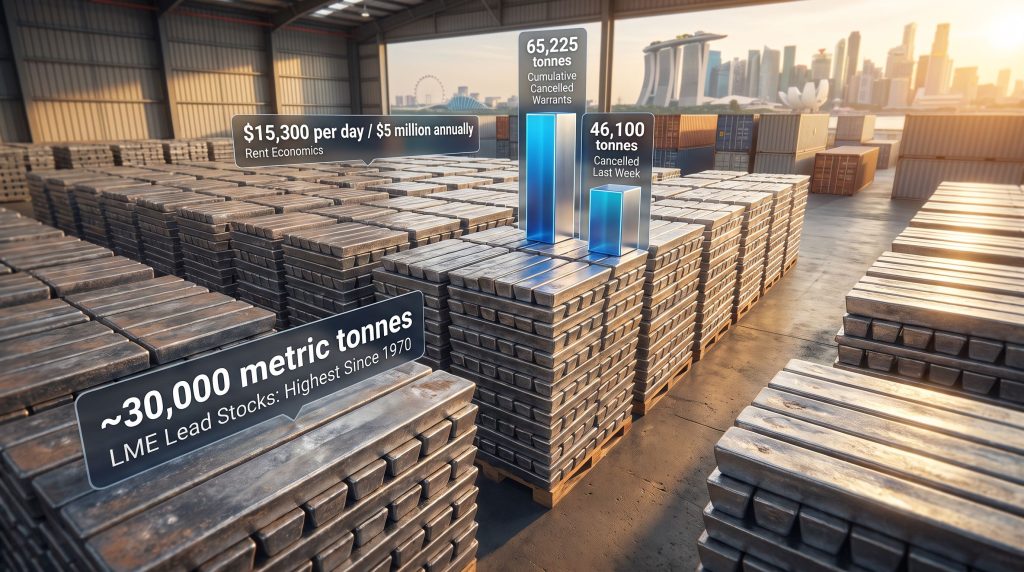
The following table captures the scale of recent activity in LME lead markets, illustrating how concentrated and significant the current round of Glencore LME lead withdrawals has become:
| Metric | Volume |
|---|---|
| Glencore planned withdrawal | ~30,000 metric tonnes |
| Total warrants cancelled (prior week) | 46,100 tonnes |
| Cumulative cancelled warrants | 65,225 tonnes |
| Share of total LME lead stocks cancelled | ~14% |
| Cancelled stock located in Singapore | ~98% (all but 1,725 tonnes) |
| Trafigura's prior Singapore delivery | 160,000+ tonnes |
| LME lead stock level context | Highest since 1970 |
Fellow trader Hartree Partners also cancelled lead warrants during the same period, though the precise volume was not publicly disclosed. The combined scale of cancellations, approaching 65,000 tonnes in cumulative terms, represents a meaningful portion of the total exchange stock and has generated significant market attention. Furthermore, LME trading volumes across base metals have been on a notable upward trajectory heading into this period, amplifying the market impact of concentrated activity in lead.
Why Warrant Cancellations Are Not the Same as Physical Demand
When large volumes of LME warrants are cancelled, market participants often interpret the move as a signal of rising physical demand. However, when metal is simply being repositioned between warehouses or transferred for rent arrangements, the apparent demand signal may not reflect genuine end-user consumption. This distinction is critical for analysts and investors tracking lead market fundamentals.
This transparency gap represents one of the more underappreciated risks in base metal price benchmarking. The LME relies on visible stock data to help market participants price the metal, yet those stock figures can be influenced through entirely legal financial transactions that have nothing to do with industrial consumption. In addition, base metal pricing delays can further distort how quickly these signals are properly interpreted and acted upon.
Why Singapore Has Become the Epicentre of Global LME Lead Activity
The Strategic Economics of Singapore as a Warehousing Hub
Singapore's emergence as the dominant location for LME lead stocks is not accidental. It reflects a deliberate convergence of cost economics, logistics, and financial strategy. Approximately 98% of all recently cancelled LME lead warrants are held in Singapore, a concentration that speaks volumes about the financial appeal of warehousing metal in this jurisdiction.
The daily LME rent rate for lead storage in Singapore sits at $0.51 per tonne. At that rate, storing 30,000 tonnes generates approximately $15,300 per day, which compounds to more than $5 million annually. For a large commodity trader managing positions across multiple metals, these passive income streams are financially significant.
How Logistical Friction Creates a Natural Lock-In Effect
What makes Singapore particularly attractive for rent deal structures is the high cost of actually removing metal from the city-state's warehouses. Warrant cancellation fees, loading charges, and international shipping costs to major consumer markets create a substantial economic barrier to withdrawal. This friction is not incidental. It is, in effect, a structural feature that protects the revenue stream for both the warehouse operator and the delivering trader.
The practical consequence is that metal delivered into Singapore LME warehouses tends to stay there for extended periods, generating consistent rental income long after the initial delivery is complete. This creates a form of annuity-like revenue from what is essentially idle industrial metal.
What Is a Lead Rent Deal and How Do Traders Profit From It?
Defining the Rent Deal Structure in Commodity Markets
A rent deal is a financial arrangement where a commodity trader delivers metal into an exchange warehouse, then transfers ownership to another party while retaining a share of the ongoing storage rental income. The delivering trader does not need to maintain a balance sheet position in the metal itself. Instead, they receive a portion of the rent paid by the new owner for as long as that metal remains in storage.
The longer the metal stays, the longer the income stream flows. This creates a powerful incentive to deliver metal into locations where withdrawal is prohibitively expensive or logistically inconvenient, thereby extending the earning period.
Key Mechanics of a Rent Deal
- Trader delivers metal into an LME-approved warehouse.
- Ownership is transferred to a second party, often through a financial intermediary.
- The delivering trader negotiates a rent sharing arrangement with the warehouse.
- The new owner pays daily storage fees, a portion of which flows back to the original delivering party.
- Both parties benefit as long as withdrawal remains economically unattractive.
Comparing Rent Deal Incentives: Singapore vs. Other LME Locations
| Factor | Singapore | European LME Locations |
|---|---|---|
| Daily rent rate (lead) | $0.51/tonne | Variable, often lower |
| Shipping friction to consumers | High | Lower for European buyers |
| Historical withdrawal rate | Low | Higher |
| Suitability for rent deals | Very high | Moderate |
| Concentration of cancelled warrants | ~98% of total | Minimal |
Industry sources have noted that it would be unusual for major commodity trading giants like Glencore or Hartree Partners to pursue rent deal structures, suggesting the withdrawn metal may instead be destined for physical customers or alternative warehousing arrangements. The ambiguity itself is a defining feature of how opaque these transactions remain even to informed market observers.
How LME Lead Stocks Reached Their Highest Level Since 1970
Tracing the Inventory Surge
The surge in LME lead inventories to 1970-level highs did not materialise gradually. Trafigura's delivery of more than 160,000 tonnes of lead into Singapore warehouses across two consecutive days earlier in July 2026 was the primary catalyst. This single delivery event fundamentally altered the visible supply picture, creating an instant statistical glut within the exchange system.
To contextualise the scale, 160,000 tonnes represents a volume sufficient to satisfy several months of lead consumption across major industrial markets. When this quantity appears overnight in exchange warehouse data, it sends a dramatic signal that is almost impossible to reconcile with genuine demand dynamics in the short term.
Historical Context: What 1970-Level Stocks Tell Us
Lead inventories at their highest since 1970 place today's market at a historically anomalous position. In the early 1970s, global battery demand was a fraction of its current scale, automotive production was just beginning its modern expansion, and industrial lead consumption patterns were structurally different. Reaching comparable inventory levels in today's environment suggests a significant disconnection between exchange stocks and real consumption.
Exchange inventory data is only a reliable demand signal when the metal stored genuinely represents industrial surplus. When large volumes are delivered for financial rather than operational reasons, historical stock comparisons can be deeply misleading.
What Role Do Glencore's Operations Play in Lead Market Dynamics?
Glencore's Strategic Position Across the Lead Value Chain
Glencore occupies an unusually powerful position in the global lead market, operating simultaneously as a miner, smelter, and physical commodity trader. This vertical integration means the company can influence lead market balances at multiple points simultaneously, from mine gate to exchange warehouse. Consequently, decisions made at the trading level can reverberate across the entire supply chain in ways that are not immediately visible to external observers.
| Strategic Action | Market Impact |
|---|---|
| Warehouse warrant cancellations | Short-term inventory signal distortion |
| Smelter operational reviews | Medium-term supply tightening signals |
| Announced production volume cuts | Structural price support mechanism |
| Physical customer supply arrangements | Direct demand fulfilment, price neutral |
The Portovesme smelting complex in Sardinia has historically been a reference point for European lead and zinc supply. Operational decisions made at facilities like Portovesme carry weight across the physical market because they directly affect the volume of refined lead entering the European supply chain. When smelter reviews are announced at major facilities, spot prices and term contract pricing can shift materially even before any physical changes occur.
The next major ASX story will hit our subscribers first
Lead Prices, Spreads, and the Battery Sector's Role as Demand Anchor
How LME Cash-to-Three-Month Spreads React to Cancellations
One of the most immediate market responses to large-scale warrant cancellations is movement in the LME cash-to-three-month spread, known as the contango or backwardation position. When significant volumes are cancelled and the market interprets the move as genuine demand, the spread tightens as near-term supply appears constrained relative to forward months.
However, when the cancellation proves to be a repositioning rather than a genuine withdrawal, spreads frequently revert. This pattern creates short-term trading opportunities but also introduces noise into what should be a clean price discovery mechanism.
The Battery Sector as the Dominant Demand Driver
Lead-acid batteries account for the overwhelming majority of global lead consumption, estimated at around 80% of total demand by volume. While lithium-ion batteries dominate discussions about the energy transition, lead-acid technology remains deeply embedded across several industries:
- Automotive starter batteries for internal combustion and hybrid vehicles.
- Industrial uninterruptible power supply systems.
- Telecommunications backup power infrastructure.
- Renewable energy storage in off-grid applications.
- Materials handling equipment including forklifts and warehouse vehicles.
This structural demand base provides a reasonably stable floor for lead consumption, even during periods of elevated exchange inventory. The battery sector's consistent offtake means that genuine physical tightness, when it does arrive, tends to manifest quickly in price.
Scenario Analysis: Three Possible Outcomes From the Current Inventory Cycle
Scenario A: Physical Delivery to End-Users
If the metal withdrawn through Glencore LME lead withdrawals and related cancellations reaches genuine battery manufacturers or industrial consumers, visible LME stocks decline meaningfully, spreads tighten, and spot prices receive upward support. This is the bullish interpretation and the one that market participants hoping for price recovery would favour.
Scenario B: Warehouse-to-Warehouse Repositioning
Metal exits the LME system temporarily before re-entering at another approved location. The visible stock decline is transitory, and any price reaction based on the initial signal subsequently reverses. This scenario produces volatility without lasting directional impact.
Scenario C: Extended Rent Deal Arrangement
Metal remains within the warehouse ecosystem under new ownership, generating passive income for the original delivering party while leaving broader market balances largely unchanged. Prices stabilise but without meaningful upward catalyst.
How Should Investors and Analysts Interpret LME Warehouse Data?
The Limitations of Using Exchange Inventory as a Demand Proxy
Treating LME stock levels as a direct proxy for industrial demand is one of the most common analytical errors in base metal markets. Several layers of distortion exist between what exchange data shows and what is actually happening in the physical economy:
- On-warrant stocks represent metal available for delivery against LME contracts, but availability does not equal demand.
- Cancelled warrants signal withdrawal intent, not consumption.
- Off-warrant stocks held in non-LME facilities are entirely invisible to exchange reporting systems.
- Geographical concentration of stocks, such as the current Singapore dominance, can make global inventory figures appear more accessible than they actually are.
Key Metrics to Watch Beyond Headline Stock Levels
Sophisticated analysts tracking the lead market should look beyond headline inventory figures and focus on:
- The rate of change in cancelled warrants relative to total on-warrant stocks.
- The geographical distribution of both on-warrant and recently cancelled metal.
- LME cash-to-three-month spread direction and velocity.
- Premium or discount levels in physical lead markets relative to LME benchmarks.
- Smelter utilisation rates and refined lead production data from major producing regions.
- Battery manufacturer inventory cycles and procurement activity.
Furthermore, a broader review of metals and mining analysis can provide valuable context for how similar inventory cycles have played out historically across other base metals.
Understanding the Singapore Concentration Risk
With approximately 98% of all recently cancelled LME lead warrants concentrated in a single city-state, the global lead market faces an unusual geographical risk. If genuine physical consumers are not located near Singapore, the metal's theoretical availability does not translate into practical accessibility.
The cost of shipping lead from Singapore to European or North American battery manufacturers can be substantial enough to effectively strand the metal from a pricing perspective, creating regional tightness even when global exchange stocks appear ample. For this reason, commodity market hedging strategies need to account for these geographical nuances when assessing true supply accessibility. According to Glencore's own materials, the company operates an integrated zinc and lead business that spans mining, smelting, and marketing activities globally, underscoring the scale at which these warehouse decisions are made.
Frequently Asked Questions: Glencore LME Lead Withdrawals
What is Glencore planning to withdraw from LME warehouses?
Glencore has signalled plans to withdraw approximately 30,000 metric tonnes of lead from LME-approved warehouses, according to industry sources. The company declined to comment publicly on the reasons or intended destination for the metal.
Why are LME lead stocks at their highest level since 1970?
Trafigura's delivery of more than 160,000 tonnes of lead into Singapore warehouses across two consecutive trading days in early July 2026 was the primary driver, creating an immediate and dramatic increase in visible LME inventory that took stocks to historically elevated levels.
What is the difference between a warrant cancellation and a physical withdrawal?
A warrant cancellation is the first step in a withdrawal process, signalling the owner's intention to remove metal from the exchange system. Physical withdrawal involves the actual movement of metal from the warehouse. Cancelled warrants do not always result in metal reaching end-users; it may be redelivered elsewhere or retained within the warehouse system under different financial arrangements.
What is a rent deal in commodity trading?
A rent deal is an arrangement where a trader delivers metal into an exchange warehouse, transfers ownership to another party, and retains a share of the ongoing storage rental income. The delivering party earns passive income without maintaining ownership of the underlying metal.
Does a large warrant cancellation always mean lead prices will rise?
Not necessarily. If the cancellation reflects genuine end-user demand, prices typically receive upward support. However, if the metal is simply being repositioned or transferred into a financial arrangement, any initial price reaction may prove temporary. Context, trader identity, and destination geography are all important interpretive factors.
Key Takeaways: What This Episode Reveals About Modern Commodity Market Mechanics
The current episode involving Glencore LME lead withdrawals, Hartree Partners' parallel cancellations, and the preceding Trafigura delivery serves as a masterclass in the complexity of modern exchange-based commodity markets. Several structural realities emerge from a careful examination of these events:
- Physical and financial lead markets are increasingly difficult to separate using publicly available exchange data alone.
- Warehouse rent economics can generate meaningful passive income streams that incentivise large-scale deliveries disconnected from industrial demand.
- Geographical concentration of exchange stocks creates accessibility gaps that can produce regional price dynamics even when global inventory appears abundant.
- Market sentiment around warrant cancellations is frequently shaped by the identity of the cancelling party rather than the underlying economic rationale.
- Transparent analysis of lead market conditions requires layering multiple data sources beyond headline LME stock figures.
Disclaimer: This article is intended for informational and educational purposes only. It does not constitute financial advice or a recommendation to buy or sell any financial instrument. All figures, data points, and scenario analyses are drawn from publicly reported information and should be independently verified before being used as the basis for investment decisions. Commodity markets are inherently volatile and subject to rapid change. Readers should consult a qualified financial adviser before making any investment decisions related to commodity markets.
Want to Stay Ahead of Significant ASX Mineral Discoveries Before the Broader Market Reacts?
While base metal market mechanics can obscure genuine investment signals, Discovery Alert's proprietary Discovery IQ model cuts through the noise by delivering real-time alerts on significant ASX mineral discoveries directly to subscribers — explore the historic returns major discoveries have generated or start your 14-day free trial today to position yourself ahead of the market.