July 28, 2026
When Mining Majors Trim Junior Positions, the Market Should Pay Attention
Institutional behaviour in the junior mining sector rarely happens in isolation. When a diversified commodity giant adjusts its equity exposure in a smaller developer, the decision carries layers of meaning that extend well beyond a single transaction. Glencore Canada reduces Osisko shareholding to 11.9% — and that single headline encapsulates capital allocation decisions reflecting commodity cycle positioning, balance sheet priorities, and a nuanced read of project risk that retail investors seldom access directly. Understanding how to decode these signals is one of the more underappreciated skills in resource investing.
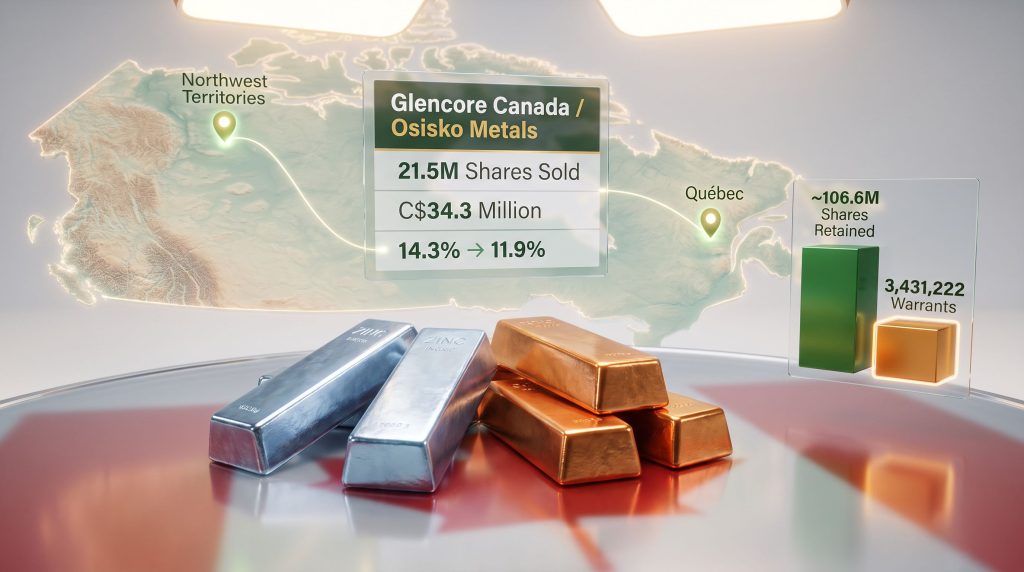
Against that backdrop, the recent disclosure that Glencore Canada Corporation has reduced its shareholding in Osisko Metals from approximately 14.3% to 11.9% through the sale of 21.5 million common shares for proceeds of C$34.3 million deserves careful analysis. This is not simply a line item in a regulatory filing. It is a data point inside a much larger story about base metals, project development risk, and how the world's largest commodity trading and mining companies manage optionality in volatile markets.
When big ASX news breaks, our subscribers know first
Breaking Down the Transaction: Numbers That Define the Move
The mechanics of this divestment are straightforward, but the details reward scrutiny. Glencore Canada entered into a private agreement with a third-party buyer, bypassing open market sales in favour of a negotiated transaction. Settlement is expected on July 29, 2026, and the pricing implies a per-share value that represents a meaningful realisation on the original position accumulated through a combination of strategic agreements and equity conversions.
The table below captures the before-and-after structure of Glencore Canada's position in Osisko Metals:
| Metric | Pre-Sale Position | Post-Sale Position |
|---|---|---|
| Common Shares Held | ~128 million | ~106.6 million |
| Warrants Held | 3,431,222 | 3,431,222 |
| Ownership (Non-Diluted) | ~14.3% | ~11.9% |
| Shares Sold | — | 21.5 million |
| Transaction Value | — | C$34.3 million |
| Settlement Date | — | July 29, 2026 |
Several details in this table are worth dwelling on. First, the warrant position remains entirely unchanged. Glencore Canada retains 3,431,222 common share purchase warrants, instruments that preserve the right to acquire additional shares at a predetermined price at a future date. This is not a passive legacy holding. Warrants are deliberate instruments, and retaining them while selling direct equity is a classic expression of optionality management. It signals reduced near-term conviction without full strategic withdrawal.
Second, the use of a private placement agreement rather than an on-market sale is significant for liquidity reasons. Block trades conducted off-exchange avoid the price depression that can accompany large open-market sell orders, particularly in smaller-cap mining stocks where daily trading volumes may not comfortably absorb tens of millions of shares without meaningful slippage. Furthermore, Osisko Metals' announcement of the conversion confirms that the debenture-to-equity pathway was central to how Glencore Canada originally built this position.
From Strategic Partner to Portfolio Investor: The Glencore-Osisko Relationship in Context
The relationship between Glencore and Osisko Metals did not begin as a conventional equity investment. Its origins trace back to 2023, when Osisko acquired the Gaspé Copper project in Québec directly from Glencore. That transaction fundamentally restructured Glencore's role from asset owner to equity holder, giving the mining major a meaningful stake in the vehicle now responsible for advancing a project it had previously controlled.
This type of relationship is more common in the mining sector than it might appear. When a major divests an exploration or development-stage asset to a junior, retaining equity in that junior is a way of preserving exposure to upside without carrying the operational and capital burden of development on its own balance sheet. The junior takes on the development risk; the major retains optionality through its shareholding.
Over time, however, the nature of that relationship can evolve. As Osisko has progressed its project pipeline and as Glencore's own capital priorities have shifted across its global portfolio, the strategic rationale for maintaining a 14%+ direct equity position may have diminished relative to the capital value it represents. The partial divestment reflects this natural maturation of the relationship. Consequently, the junior mining risks associated with holding concentrated development-stage positions are a key driver of why majors periodically rebalance — understanding junior mining risks provides essential context here.
Glencore Canada has stated that it holds the Osisko position for investment purposes and will continue assessing the company's business performance, financial condition, and market outlook, adjusting its position in either direction as circumstances evolve.
What Osisko Metals Actually Owns: Pine Point and Gaspé Unpacked
To understand why any institutional investor maintains exposure to Osisko Metals at all, it is worth examining what the company holds in its project portfolio.
Pine Point and Gaspé Copper represent two distinct but complementary development opportunities:
-
Pine Point is located in Canada's Northwest Territories and was historically one of the country's most significant zinc and lead producers. The original mine operated for decades before closure in 1988, leaving behind substantial infrastructure and a well-defined geological footprint. The project hosts a large-tonnage zinc-lead resource with the potential for bulk open-pit mining methods, meaning relatively low strip ratios and favourable unit economics if brought back into production.
-
Gaspé Copper sits in Québec's Gaspésie region and represents a large-scale copper porphyry system. Porphyry deposits are geologically significant because of their scale. While individual grades may be modest compared to high-grade underground copper mines, the sheer tonnage of porphyry systems means that they can underpin decades-long mine lives at production scales that justify major capital investment. Gaspé was mined by Noranda from the 1950s through to 1999, and the historical production record confirms the deposit's metallurgical characteristics and processing pathway. In addition, those assessing this as a major copper system will recognise parallels in how porphyry-scale deposits attract and retain institutional attention.
Past-producing mines carry a distinct investment thesis compared to greenfield discoveries. They come with documented resource estimates, known metallurgy, existing infrastructure corridors, and established community and regulatory relationships. The primary risk is not geological uncertainty but rather the capital intensity of recommissioning and the commodity price environment at the time of final investment decisions.
Both projects sit within Canadian jurisdictions that have demonstrated track records for mining permitting, though the Northwest Territories and Québec each carry their own regulatory and community engagement requirements that developers must navigate carefully.
The Critical Minerals Demand Thesis Underpinning Both Projects
Copper and zinc occupy different positions in the critical minerals narrative, but both face structural demand tailwinds over the coming decades. The broader critical minerals demand outlook reinforces why institutional investors continue to anchor positions in developers holding large-scale base metals assets.
Why Copper Demand Continues to Rise
Copper is at the centre of electrification. Every electric vehicle contains roughly two to four times the copper of a conventional internal combustion engine vehicle, and grid infrastructure upgrades required to support the energy transition demand enormous volumes of the metal. According to the International Energy Agency, clean energy technologies already account for a significant and growing share of total copper consumption, a share that is projected to expand substantially through 2040. Furthermore, the copper supply crunch is creating conditions in which past-producing large-scale assets are increasingly strategic — the dynamics behind this copper supply crunch help explain why Glencore retains meaningful exposure even after trimming.
Zinc's Diversified Demand Channels
Zinc, while less celebrated in the energy transition narrative, serves critical functions across multiple demand channels:
- Galvanisation of steel used in construction, automotive bodies, and infrastructure remains the largest single use category for zinc globally.
- Zinc-air battery chemistry is attracting renewed research interest as a lower-cost alternative to lithium-ion for stationary energy storage applications, potentially opening a new demand vector.
- Zinc oxide plays a role in rubber manufacturing, pharmaceuticals, and a range of industrial processes, providing demand diversification beyond its primary construction-linked applications.
The supply side for both metals is constrained by a decade-long underinvestment in new mine development, a pattern that accelerated after the commodity price downturn of 2014 to 2016. New large-scale copper and zinc discoveries capable of supporting major mine development are rare, making the redevelopment of proven past-producing deposits like Pine Point and Gaspé a commercially rational response to the supply gap.
Reading Institutional Share Movements as Market Signals
One of the less-discussed dimensions of strategic shareholder behaviour in junior mining is what it communicates to the broader market. The framework below illustrates how different actions by a major shareholder are typically interpreted:
| Shareholder Action | Typical Signal | Market Interpretation |
|---|---|---|
| Stake increase via open market | High conviction | Project or commodity cycle acceleration |
| Warrant exercise | Forward commitment | Locking in future exposure at current pricing |
| Stake maintenance | Neutral monitoring | Watchful; no directional call |
| Partial divestment via private agreement | Capital recycling | Harvesting returns while retaining optionality |
| Full exit | Strategic disengagement | Project concerns or complete capital reallocation |
Glencore Canada's action falls clearly into the partial divestment category — a capital recycling exercise. Critically, the retention of warrants positions this as a sophisticated risk management decision rather than a vote of no confidence. An investor fully exiting a position does not hold onto derivative instruments that preserve future re-entry rights.
The next major ASX story will hit our subscribers first
Canadian Securities Disclosure: Why the 11.9% Threshold Matters Legally
Under Canadian securities regulations, specifically the early warning reporting system governed by National Instrument 62-104, shareholders who own 10% or more of a reporting issuer's securities are required to file early warning reports when their holdings change by 2% or more in either direction. Falling from approximately 14.3% to 11.9% represents a change that triggers these disclosure obligations, which is why the transaction entered the public record through the regulatory filing process.
This disclosure framework serves an important market function. It ensures that significant movements in the ownership of public companies are visible to all market participants simultaneously, preventing information asymmetries that could disadvantage smaller investors. For observers of the Osisko Metals story, this regulatory mechanism is the primary reason the transaction became publicly known at all.
It is also worth noting that remaining above the 10% threshold means Glencore Canada continues to carry early warning reporting obligations. Any further material change in its position, whether an increase or decrease, will require additional public disclosure, providing investors with ongoing visibility into the major's evolving conviction. Glencore Canada's share sale disclosure as reported by The Globe and Mail confirms the regulatory process was followed precisely as required.
Three Structural Themes for Base Metals Investors in 2026
Stepping back from the specific transaction, three broader themes emerge that are relevant to anyone tracking base metals development companies and the institutions that invest in them:
-
Capital recycling at the major level is accelerating. As commodity cycles mature and major miners face competing capital demands across their global portfolios, managing junior equity exposures becomes an active rather than passive exercise. Investors in junior developers need to understand the equity overhang that major shareholders represent and how sensitive the share register is to changes in institutional conviction. Understanding the available capital raising options is equally important when evaluating how juniors fund their next development phase.
-
Warrants as strategic tools are underappreciated. When large investors retain warrant positions while selling direct equity, they are expressing a view that the current share price adequately compensates for near-term risk, but that longer-dated upside remains valid. This asymmetric positioning is a sophisticated risk management technique that retail investors can study and apply within their own frameworks.
-
Past-producing mine redevelopment is attracting and retaining institutional interest. The fact that a company of Glencore's scale remains a double-digit shareholder in Osisko Metals even after a partial divestment confirms that the Pine Point and Gaspé projects remain credible development candidates in the eyes of one of the most informed commodity investors in the world.
Frequently Asked Questions
How Many Shares Did Glencore Canada Sell?
Glencore Canada sold 21.5 million common shares of Osisko Metals through a privately negotiated agreement with a third-party buyer, generating proceeds of approximately C$34.3 million.
What Is Glencore Canada's Ownership in Osisko Metals After the Sale?
Following settlement, Glencore Canada holds approximately 106.6 million common shares, representing 11.9% of Osisko Metals' issued and outstanding common shares on a non-diluted basis. However, this figure remains subject to any further disclosures triggered by subsequent position changes.
Does Glencore Canada Still Hold Warrants?
Yes. The 3,431,222 common share purchase warrants held by Glencore Canada were not included in the divestment and remain intact, preserving future optionality in the company.
What Are Osisko Metals' Core Assets?
Osisko Metals holds two past-producing base metals projects: the Pine Point zinc-lead project in the Northwest Territories and the Gaspé Copper porphyry project in Québec, both targeted for redevelopment into operating mines.
Why Did Glencore Use a Private Agreement Rather Than Selling on Market?
Private placement agreements for large share parcels avoid the price impact of open-market block sales, protect the seller from adverse price movement during the transaction process, and allow for negotiated terms including settlement dates that suit both parties.
Disclaimer: This article is intended for informational and educational purposes only and does not constitute financial or investment advice. Statements regarding commodity demand forecasts, project development timelines, and market signals involve inherent uncertainty. Readers should conduct their own due diligence and consult a qualified financial adviser before making investment decisions. Further context on global base metals developments is available through Mining Weekly at miningweekly.com.
Want To Catch The Next Major Base Metals Discovery Before The Market Does?
Discovery Alert's proprietary Discovery IQ model scans ASX announcements in real time, instantly identifying significant mineral discoveries across copper, zinc, and more than 30 other commodities — giving subscribers an actionable edge the moment opportunities emerge. Explore historic discoveries and the exceptional returns they generated, then begin your 14-day free trial at Discovery Alert to position yourself ahead of the broader market.