July 28, 2026
When Coal Markets Defy the Transition Narrative
The global energy transition has dominated investment headlines for years, yet thermal coal markets continue to reward producers who execute with discipline. Across Asian power grids, the gap between politically driven energy timelines and the physical reality of baseload generation requirements remains stubbornly wide. For Australian coal producers with established export infrastructure and diversified asset bases, this divergence creates a pricing environment that periodically surprises even seasoned commodity analysts.
Understanding how a company like Whitehaven Coal navigates this environment requires more than tracking spot prices. It demands a close reading of operational execution, cost management under inflationary pressure, and the strategic logic behind major asset acquisitions. Furthermore, ongoing coal supply challenges across seaborne markets add another layer of complexity. FY2026 provided a revealing case study across all three dimensions.
When big ASX news breaks, our subscribers know first
Whitehaven Coal Output and Sales Guidance: How FY2026 Stacked Up
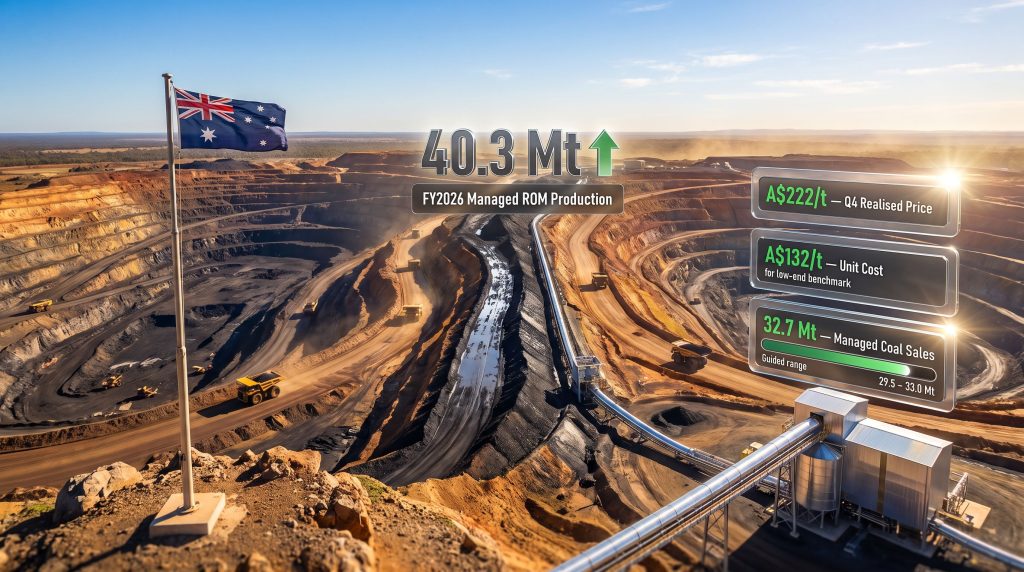
Whitehaven's full-year result for the period ended June 30, 2026, delivered managed run-of-mine (ROM) coal production of 40.3 million tonnes, representing a 3% year-on-year increase and a landing point near the top of the guided range of 37.0 to 41.0 million tonnes. Managed coal sales reached 32.7 million tonnes, an 8% rise on the prior year, sitting comfortably within the forecast band of 29.5 to 33.0 million tonnes.
The following table provides a structured view of guidance versus outcomes across the key operational metrics:
| Metric | FY2026 Guidance Range | FY2026 Reported Outcome | Position Within Range |
|---|---|---|---|
| Managed ROM Production | 37.0 to 41.0 Mt | 40.3 Mt | Near top end |
| Managed Coal Sales | 29.5 to 33.0 Mt | 32.7 Mt | Within range |
| Unit Cost per Tonne | Towards low end | ~A$132/t | Low end |
| Q4 Realised Price | N/A | A$222/t | Up from A$189/t (pcp) |
| Q4 Managed Production | Consensus ~10.7 Mt | 10.7 Mt | Matched consensus |
Delivering near-top-of-guidance production outcomes in consecutive financial years is not a coincidence. It reflects a management team that has tightened operational planning cycles, particularly as the Queensland integration added significant complexity to the portfolio. The full details of quarterly performance are available in Whitehaven's June 2025 quarterly report, which provides granular breakdowns of production by region and asset.
Whitehaven has now achieved near-top-of-guidance production in back-to-back years, a consistency signal that institutional investors typically reward through reduced forecast risk discounts on the stock.
Understanding Run-of-Mine Production as an Investor Metric
What ROM Production Actually Measures
Run-of-mine coal refers to the raw material extracted directly from the mine before it undergoes any processing or beneficiation. It is a primary throughput metric, capturing the volume of material moved through the extraction process before washing, screening, or blending occurs. For investors, ROM production guidance is a leading indicator of a company's operational capacity utilisation and mining rate.
- Managed production encompasses all assets under the company's operational control, including joint venture interests where Whitehaven holds a management role
- Equity production differs by attributing only the ownership-weighted share of output, making it a more conservative but arguably more meaningful figure for per-share earnings analysis
- The distinction matters when comparing companies of varying ownership structures across the Australian coal sector
How FY2026 Guidance Compared to the Prior Year
| Period | ROM Production Guidance | Actual Outcome | Sales Guidance | Actual Sales |
|---|---|---|---|---|
| FY2025 | 35.0 to 39.5 Mt | ~39.1 Mt | 28.0 to 31.5 Mt | ~30.2 Mt |
| FY2026 | 37.0 to 41.0 Mt | 40.3 Mt | 29.5 to 33.0 Mt | 32.7 Mt |
The upward trajectory across both production and sales metrics, combined with top-end delivery in both years, reinforces the view that the Queensland assets are integrating faster than initially modelled by many external analysts. For context on pricing dynamics, a recent metallurgical coal price update highlights how coking and thermal coal valuations have been evolving across the region.
Queensland vs. New South Wales: A Tale of Two Operating Regions
Queensland's Rebound After Weather Disruption
The Blackwater and Daunia mines, acquired from BHP Group in early 2024 as part of a US$4.1-billion transaction, were the primary driver of Whitehaven's Q4 FY2026 production uplift. Queensland output surged 41% sequentially in the final quarter, recovering from weather-related curtailment that had compressed the prior period's numbers. Whitehaven's Blackwater strategy has been instrumental in positioning the Queensland assets as a cornerstone of long-term Asian supply relationships.
This kind of weather sensitivity is a structural feature of open-cut coal mining in Queensland's Bowen Basin, where tropical rainfall events can temporarily halt truck-and-shovel operations and delay coal train loadings. What matters to long-term investors is not the disruption itself but the speed and completeness of the recovery response, and the Q4 rebound suggests Whitehaven's operational teams are managing the Queensland assets with growing confidence.
New South Wales Portfolio: Stability with Short-Term Headwinds
The NSW operations, anchored by Maules Creek, Narrabri, and Gunnedah, delivered a 1.6% year-on-year increase in quarterly production. However, Q4 NSW output declined 8% quarter-on-quarter, attributable to tougher mining conditions rather than any structural deterioration in the asset base.
| Region | Q4 QoQ Change | YoY Trend | Primary Driver |
|---|---|---|---|
| Queensland (Blackwater, Daunia) | +41% | Recovery trajectory | Post-weather rebound |
| New South Wales (Maules Creek, Narrabri, Gunnedah) | -8% | +1.6% YoY | Challenging mining conditions |
Mining conditions in underground and open-cut operations alike can be affected by geological variability, including changes in coal seam depth, overlying stratum hardness, and spontaneous combustion risk in certain seam types. The Gunnedah Basin, where Narrabri and Maules Creek are located, contains high-quality semi-soft coking and thermal coal seams, but seam geometry complexity can periodically slow advance rates. These are transient rather than permanent constraints in most cases.
Cost Performance: A$132 Per Tonne and the Discipline Behind It
Achieving the Low End of Cost Guidance in an Inflationary Environment
Full-year unit costs tracking at approximately A$132 per tonne (roughly US$92.29 per tonne at prevailing exchange rates) represents a meaningful achievement given the cost pressures facing Australian mining operations in recent years. Diesel, the single largest variable cost for open-cut coal mining operations, has remained elevated due to supply chain disruptions linked to geopolitical instability in the Middle East. Indeed, the broader oil price rally impact has had tangible consequences for Australian mining cost structures throughout this period.
Large open-cut operations like Blackwater consume diesel at enormous scale across fleets of haul trucks, excavators, and ancillary equipment. Even modest per-litre price movements can translate into tens of millions of dollars in annual cost variation across a portfolio of this size. Whitehaven's ability to contain unit costs despite this headwind points to two factors:
- Annualised savings programme execution delivering within the A$60-million to A$80-million target band
- Operational efficiency gains as the Queensland assets are standardised under Whitehaven's management systems
Containing unit costs at the low end of guidance, while simultaneously absorbing a major acquisition and elevated diesel prices, is a combination that benchmarks favourably against Australian coal sector peers.
Why the Savings Programme Matters Beyond the Number
A structured savings programme of this scale, running across a recently expanded portfolio, signals more than cost consciousness. It suggests that integration synergies are being captured methodically, whether through procurement consolidation, maintenance scheduling alignment, or workforce productivity improvements. For a company that doubled its managed production base through the BHP Queensland acquisition, achieving savings within the guided band in the first full year of consolidated operations is a credibility-building outcome.
Asian Thermal Coal Demand: The Pricing Backdrop Behind A$222 Per Tonne
Q4 Realised Pricing and What Drove It
The Q4 FY2026 average realised price of A$222 per tonne represented a 17.5% increase from the A$189 per tonne achieved in the same quarter of FY2025. This improvement was not driven solely by contract structures. It reflects a genuine tightening in Asian seaborne thermal coal demand linked to disruptions in liquefied natural gas supply. In addition, LNG supply constraints have reinforced the substitution case for thermal coal across several key Asian markets.
When LNG supply is constrained, gas-fired power generators across Japan, South Korea, Taiwan, and parts of Southeast Asia face fuel switching decisions. In markets where coal-fired capacity remains available and operational, thermal coal becomes the logical short-term substitute. This dynamic pushes spot coal procurement activity higher and can lift contract pricing for Australian exporters with established supply relationships.
The LNG-Coal Substitution Mechanism
The substitution relationship between LNG and thermal coal in Asian power markets is more nuanced than it appears:
- LNG supply disruptions create immediate fuel cost spikes for gas-dependent generators
- Coal-fired plants that maintain operational readiness capture incremental dispatch volume
- Increased coal dispatch lifts short-term procurement demand, tightening spot market availability
- This can flow through to improved realised pricing for exporters, particularly those supplying high-calorific-value product
Australian thermal coal, particularly from the Hunter Valley and Bowen Basin, commands a quality premium in Asian markets due to its relatively high energy content and low sulphur characteristics, both important parameters for utility buyers operating under emissions intensity constraints.
Structural Demand Considerations
Japan, South Korea, and several Southeast Asian economies continue to depend on thermal coal for a significant share of baseload power. Despite policy commitments to renewable energy expansion, the pace of coal phase-out has been slower than many transition scenarios projected. Consequently, this creates a durable demand floor for Australian product through at least the mid-2030s based on current generation fleet retirement timelines.
The next major ASX story will hit our subscribers first
The BHP Acquisition: Production Scale and What Comes Next
From Single-Basin to Dual-Basin: The Strategic Transformation
The acquisition of Blackwater and Daunia from BHP Group in early 2024 fundamentally repositioned Whitehaven Coal output and sales guidance expectations on a permanent basis. Prior to the transaction, the company operated exclusively within New South Wales, with an annual managed ROM output profile in the 20 to 22 million tonne range.
| Period | Approximate Annual Managed ROM Output | Asset Base |
|---|---|---|
| Pre-Acquisition (FY2023) | ~20 to 22 Mt | NSW only |
| FY2025 Actual | ~39.1 Mt | NSW + Queensland (partial year) |
| FY2026 Actual | 40.3 Mt | NSW + Queensland (full year) |
FY2026 represents the first complete financial year of consolidated Queensland production under Whitehaven's management. The fact that the company delivered near-top-of-guidance output in this first full year suggests operational integration has progressed ahead of the more conservative scenarios that some market observers modelled at the time of the transaction.
Importantly, Blackwater is one of the largest operating open-cut coal mines in Australia by production volume, with established rail and port logistics connecting to the Hay Point and Dalrymple Bay coal terminals. Securing access to this infrastructure was arguably as strategically significant as the coal reserves themselves. Further detail on the broader business structure can be found via Whitehaven's corporate overview.
Key Variables Investors Should Monitor in FY2027
Whitehaven's FY2026 performance establishes a strong operational baseline, but several variables will determine whether FY2027 continues the upward trajectory:
- Weather risk in Queensland: Bowen Basin open-cut operations remain exposed to tropical rainfall disruption, and the pace of recovery from any future curtailment will be a key test of operational resilience
- Diesel and consumables pricing: Continued geopolitical instability affecting global oil markets will influence unit cost trajectories in ways that are difficult to hedge completely
- Asian thermal coal demand sustainability: As LNG supply disruptions potentially normalise, the substitution-driven demand uplift may moderate, placing downward pressure on realised pricing
- AUD/USD exchange rate movements: A stronger Australian dollar reduces the AUD-equivalent value of USD-denominated coal sales, directly affecting reported revenue and cost competitiveness
- FY2027 guidance width: Whether management narrows or widens the production range in its next guidance issuance will signal internal confidence in Queensland operational consistency
Disclaimer: This article contains forward-looking analysis and market observations that involve inherent uncertainty. Nothing in this article constitutes financial advice. Investors should conduct independent research and consult qualified financial advisers before making investment decisions related to Whitehaven Coal or any other company.
Frequently Asked Questions: Whitehaven Coal Output and Sales Guidance
What was Whitehaven Coal's FY2026 production guidance range?
Whitehaven guided for managed run-of-mine coal production of 37.0 million to 41.0 million tonnes for the financial year ended June 30, 2026.
Did Whitehaven Coal meet its FY2026 sales guidance?
Yes. Managed coal sales of 32.7 million tonnes fell within the guided range of 29.5 million to 33.0 million tonnes, an 8% increase on the prior year.
What were Whitehaven's unit costs for FY2026?
Full-year unit costs were expected at approximately A$132 per tonne, placing the company at the low end of its cost guidance range after delivering savings within its A$60-million to A$80-million annualised target.
Which mines drove Queensland's production recovery in Q4 FY2026?
The Blackwater and Daunia mines, acquired from BHP Group for US$4.1 billion in early 2024, delivered a 41% sequential production increase in Q4 FY2026 following weather-related disruption in the prior quarter.
What was Whitehaven's Q4 FY2026 realised coal price?
The company achieved an average realised price of A$222 per tonne in Q4 FY2026, up from A$189 per tonne in the prior corresponding quarter, supported by stronger Asian thermal coal demand partly driven by LNG supply disruptions.
How does FY2026 output compare to FY2025?
FY2026 managed ROM production of 40.3 Mt was approximately 3% higher than the prior year and continued the upward production trajectory that followed the Queensland asset integration. Readers seeking broader sector context may find value in resources published by Mining Weekly, which covers Australian and international commodity developments across multiple sectors.
Want to Track the Next Major ASX Mineral Discovery Before the Market Moves?
Discovery Alert's proprietary Discovery IQ model delivers real-time alerts on significant ASX mineral discoveries, turning complex data across more than 30 commodities into clear, actionable insights for both traders and long-term investors — explore historic discovery returns on Discovery Alert's dedicated discoveries page to see what early positioning can mean, and begin a 14-day free trial at Discovery Alert to secure your market-leading edge.