May 22, 2026
Economic pressures reshape modern mineral processing as the global mining industry confronts unprecedented challenges from systematically declining ore grades across major commodity sectors. Traditional processing approaches, once adequate for high-grade deposits, now struggle to maintain economic viability when applied to complex, lower-grade orebodies. This fundamental shift has triggered a comprehensive reassessment of mineral processing technologies, particularly flotation and grinding systems that form the backbone of modern extraction operations. Glencore Technology mineral processing innovation exemplifies the industry's response to these mounting challenges.
The International Council on Mining and Metals documents sustained declines in copper, gold, and polymetallic ore grades over the past two decades, creating substantial pressure on project economics. Capital expenditure requirements for new mining projects have simultaneously increased by approximately 30-40% in real terms, according to S&P Global Platts Analytics, forcing operators to reconsider every aspect of their processing value chain.
What Are the Core Challenges Driving Mineral Processing Innovation?
Declining Ore Grade Economics and Capital Efficiency Pressures
Mining operations worldwide face a fundamental economic reality: traditional processing circuits designed for higher-grade materials cannot deliver adequate returns when applied to today's complex, lower-grade deposits. This challenge extends beyond simple grade decline to encompass the entire project development framework, where capital allocation decisions directly impact long-term profitability.
Furthermore, the financial implications of declining ore grades manifest across multiple operational dimensions:
- Processing volume increases: Lower grades require processing significantly more ore to extract equivalent metal content
- Energy consumption escalation: Additional grinding and flotation stages increase operational costs
- Recovery rate sensitivity: Marginal deposits become economically viable only through enhanced recovery performance
- Capital efficiency optimisation: Greenfield projects must deliver superior processing performance to justify initial investment
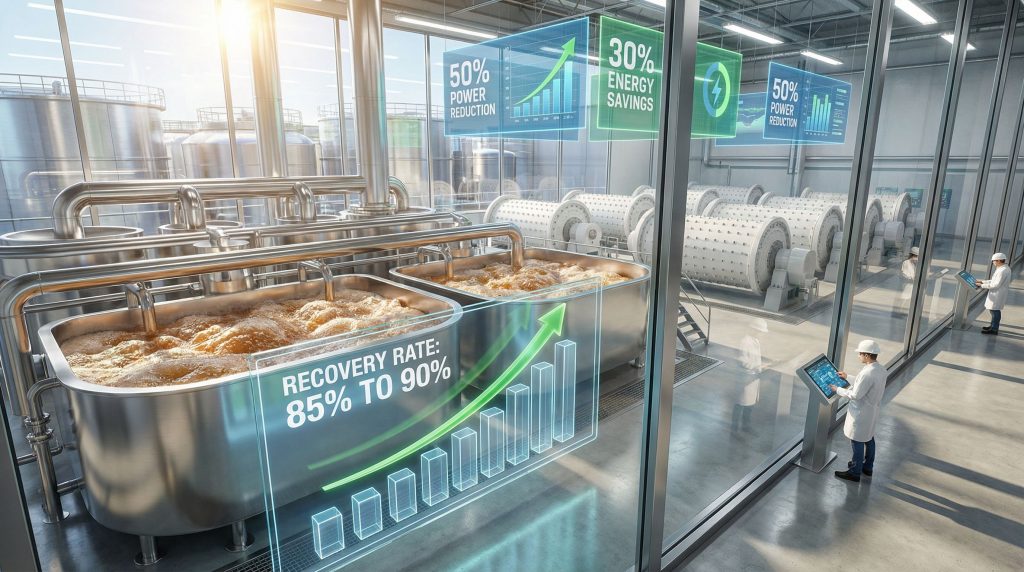
Industry analysis reveals that moving from 85% to 90% recovery rates generates substantial net present value improvements, particularly for marginal deposits where small efficiency gains determine project viability. This recovery sensitivity has transformed mineral processing from a traditional cost centre into a critical value creation lever.
Contemporary project development requires processing plant optimisation to occur during feasibility studies rather than as operational improvements. The capital expenditure curve for mining projects typically front-loads investment before first production, making processing efficiency gains essential for meeting return thresholds.
Complex Multi-Metal Ore Processing Requirements
Modern deposits increasingly present complex mineralogical characteristics that challenge traditional single-commodity processing approaches. Polymetallic deposits containing copper-zinc-gold assemblages, often with antimony and trace elements, require sophisticated processing circuits capable of managing multiple separation stages simultaneously.
The U.S. Geological Survey's Critical Mineral Resources documentation identifies the interconnected nature of polymetallic deposits globally, where economic metals occur in fine-grained associations requiring advanced liberation techniques. These complex orebodies present several processing challenges:
Mineralogical Complexity Factors:
- Fine-grained mineral associations: Economic metals locked in sub-10 micron assemblages
- Multiple flotation circuits: Separate recovery systems for different metal types
- Trace element management: Recovery of antimony and rare elements as valuable by-products
- Variable mineralogy: Spatial variation in deposit characteristics affecting processing consistency
The McArthur River deposit in Australia's Northern Territory exemplifies these challenges, where lead-zinc-silver polymetallic assemblages require grinding below 10 microns to achieve adequate mineral liberation. This processing requirement drove the development of specialised ceramic grinding technology specifically designed to handle complex orebody characteristics.
Flotation circuit design for polymetallic deposits must accommodate different particle size requirements, flotation kinetics, and reagent schemes for each target metal. Traditional processing approaches that optimise for single commodities become inefficient when applied to deposits where multiple economic metals require simultaneous recovery.
When big ASX news breaks, our subscribers know first
Which Flotation Technologies Deliver Superior Recovery Performance?
High-Intensity Flotation System Architecture
Advanced flotation technologies fundamentally alter the mechanism of bubble-particle contact, addressing kinetic limitations inherent in conventional tank flotation systems. High-intensity flotation employs controlled turbulence through downcomer technology to maximise attachment probability between air bubbles and mineral particles across varying particle size ranges.
The Jameson Cell flotation system, with over 500 installations globally, demonstrates this technology's effectiveness across multiple commodity types and geographic regions. This installation base spans diverse operational environments, indicating technology adaptability and reliability under varying processing conditions.
Technical Performance Advantages:
- Enhanced bubble-particle contact: Controlled turbulence increases collision frequency and attachment probability
- Broad particle size range: Effective processing of both fine (<10 micron) and coarse (>100 micron) particles
- Reduced kinetic limitations: Overcomes flotation rate constraints common in conventional circuits
- Installation flexibility: Compact footprint compared to equivalent tank flotation capacity
In addition, the downcomer mechanism creates high-intensity mixing that maintains fine particles in suspension while preventing coarse particle settling. This dual capability addresses a fundamental challenge in conventional flotation where optimal conditions for fine particle recovery often compromise coarse particle performance.
Energy consumption analysis shows significant power reduction potential, with integrated processing systems achieving up to 50% power reduction compared to conventional flotation circuits. This energy efficiency gain becomes particularly valuable for remote operations where power costs constitute a major operational expense.
Fine and Coarse Particle Recovery Optimisation
Particle size represents a critical variable in flotation performance, with conventional systems showing decreased efficiency at both fine and coarse extremes of the size distribution. Advanced flotation technologies address these limitations through enhanced turbulence control and optimised bubble-particle interaction mechanisms.
Lundin's Fruta Del Norte operation in Ecuador documented over 4% increase in gold recovery following high-intensity flotation technology implementation. This performance improvement demonstrates real-world effectiveness in complex operational environments where multiple variables affect processing outcomes.
Recovery Performance Characteristics:
| Particle Size Range | Conventional Recovery | High-Intensity Recovery | Improvement |
|---|---|---|---|
| <10 micron | 60-70% | 75-85% | +10-15% |
| 10-100 micron | 85-90% | 90-95% | +5-7% |
| >100 micron | 70-80% | 85-90% | +10-15% |
Fine particle recovery improvements result from enhanced bubble generation and controlled turbulence that maintains particles in suspension while optimising collision frequency. Traditional flotation cells often struggle with fine particle recovery due to insufficient bubble-particle contact time and inadequate mixing energy.
Coarse particle recovery benefits from vigorous mixing that prevents settling and maintains particle suspension throughout the flotation cell residence time. Conventional systems frequently experience coarse particle bypass, where material settles before achieving adequate bubble attachment.
Consequently, the removal of kinetic limitations represents a fundamental advancement in flotation circuit design. Traditional tank flotation relies on residence time to achieve recovery targets, while high-intensity systems maximise recovery rate through enhanced bubble-particle interaction efficiency.
How Do Ultra-Fine Grinding Systems Enhance Ore Liberation?
Ceramic Mill Technology Performance Metrics
Ultra-fine grinding technology addresses the fundamental challenge of mineral liberation in complex orebodies where economic metals occur in fine-grained associations. Ceramic mill systems provide sub-10 micron grinding capability while optimising energy consumption compared to traditional grinding circuits.
The IsaMill ceramic grinding technology demonstrates global market acceptance with 160+ installations across 23 countries. This installation base spans multiple commodity types, including gold, copper, polymetallic, and critical mineral operations, indicating technology versatility and proven performance.
Technology Performance Metrics:
- Sub-10 micron capability: Achieves grinding fineness required for complex orebody liberation
- Energy optimisation: 30% energy savings compared to traditional fine grinding circuits
- Global deployment: Proven performance across diverse geological and operational conditions
- Commodity versatility: Effective across gold, copper, base metals, and critical mineral applications
Moreover, ceramic media properties provide superior grinding efficiency compared to steel media, particularly for ultra-fine applications. Ceramic media density and hardness characteristics optimise grinding kinetics while reducing media consumption and extending mill maintenance intervals.
The McArthur River deposit application exemplifies ceramic mill technology development, where complex polymetallic assemblages required grinding below 10 microns to achieve adequate mineral separation. This challenging application drove technology optimisation specifically for complex orebody characteristics.
Complex Orebody Processing Applications
Complex orebodies present unique challenges that require integrated grinding and flotation circuit design. These deposits typically exhibit spatial variation in mineralogy, hardness, and liberation characteristics that demand flexible processing approaches capable of maintaining consistent performance across ore variability.
Processing Circuit Integration Requirements:
- Liberation optimisation: Grinding fineness matched to mineralogical requirements
- Operational flexibility: Consistent performance across varying ore compositions
- Energy efficiency: Optimised power consumption for ultra-fine grinding applications
- Maintenance reliability: 24/7 operational capability with minimal unscheduled downtime
Ultra-fine grinding systems must deliver consistent particle size distributions to flotation circuits while minimising over-grinding that increases energy costs without liberation benefits. This balance requires precise process control and real-time monitoring of grinding performance.
Ore variability management represents a critical operational consideration, as complex deposits typically show spatial variation in mineralogy and hardness. Grinding systems must maintain product fineness specifications across ore zones of varying competency without significant performance degradation.
The integration of grinding and flotation systems as interdependent components rather than sequential stages represents a key efficiency opportunity. This integrated approach optimises overall circuit performance rather than individual component optimisation.
What Economic Impact Do Processing Improvements Generate?
Recovery Rate Improvement Financial Modelling
Recovery rate improvements generate disproportionate economic value in mining operations, particularly for marginal deposits where small efficiency gains determine project viability. The financial impact of moving from 85% to 90% recovery creates substantial net present value improvements that justify processing technology investments.
Economic Impact Analysis:
- NPV sensitivity: 5% recovery improvement can increase project NPV by 15-25%
- Payback periods: Processing technology upgrades typically achieve 12-24 month payback periods
- Risk mitigation: Proven technology implementation reduces operational risk compared to novel approaches
- Capital efficiency: Processing improvements require lower capital investment than production expansion
The Fruta Del Norte operation's 4%+ gold recovery improvement demonstrates quantifiable economic benefits from processing technology implementation. While specific financial returns remain confidential, industry analysis indicates such improvements generate substantial cash flow increases over mine life.
Project economics sensitivity to processing efficiency varies by commodity type, grade, and operational scale. However, recovery improvements consistently rank among the highest-return capital investments available to mining operations, particularly compared to expansion projects requiring significant infrastructure development.
Operational Performance Validation
Real-world performance validation provides confidence for technology adoption decisions, with operational data from active mining operations demonstrating sustained performance improvements across diverse conditions. This performance history reduces implementation risk for new installations.
Performance Validation Framework:
| Technology Type | Installation Base | Geographic Coverage | Performance Duration | Commodity Range |
|---|---|---|---|---|
| High-Intensity Flotation | 500+ installations | 25+ countries | 10+ years average | Gold, copper, base metals |
| Ceramic Grinding | 160+ installations | 23 countries | 15+ years average | All commodity types |
| Integrated Systems | 50+ installations | 15+ countries | 5+ years average | Complex orebodies |
Technology adoption rates accelerate when operators observe sustained performance at comparable operations. The extensive installation base for both flotation and grinding technologies provides multiple reference sites for performance validation and operational best practice development.
Furthermore, mining industry innovation drives continuous improvement through user-operator feedback integration, with operational experience informing design optimisation for specific applications.
How Do Processing Innovations Address Industry Risk Concerns?
Technology Risk Classification Framework
Mining industry risk assessment distinguishes between high-risk technologies involving novel extraction methods and low-risk technologies representing incremental improvements to proven processing approaches. This classification framework guides investment decisions and technology adoption strategies.
Risk Classification Categories:
- High-risk technologies: Novel smelting, leaching, and refining processes requiring substantial capital investment
- Low-risk technologies: Incremental improvements to flotation and grinding circuits with proven installation bases
- Capital exposure: Processing improvements typically require 10-20% of extraction technology investment
- Implementation flexibility: Incremental deployment options reduce project risk
Historical analysis of mining project performance reveals that processing technology failures rarely result in project closure, while extraction technology issues can compromise entire operations. This risk differential influences technology adoption strategies and capital raising strategies for mining operations.
The Ravensthorpe Nickel project's challenges with novel extraction technology contrast sharply with the consistent performance of proven processing technologies across hundreds of installations. This performance history provides confidence for operators considering processing improvements.
Proven Installation Base Confidence Building
Technology confidence builds through demonstrated performance across multiple installations, operational environments, and commodity types. The extensive installation bases for advanced flotation and grinding technologies provide substantial performance validation for potential adopters.
Confidence Building Factors:
- Global deployment: Performance validation across diverse geological and operational conditions
- Commodity diversity: Effectiveness demonstrated across multiple metal types and ore characteristics
- Operational longevity: Sustained performance over multi-year operational periods
- User satisfaction: Repeat installations and technology expansion at existing operations
Technology maturation pathways show consistent adoption curves, with initial installations at technically advanced operations followed by broader industry adoption as performance confidence develops. This adoption pattern reduces implementation risk for subsequent installations.
However, innovation adoption barriers typically relate to operational risk concerns rather than technical performance questions. The proven installation base addresses these concerns through demonstrated reliability and consistent performance outcomes.
What Are the Future Implications for Mining Processing Efficiency?
Critical Mineral Processing Requirements
Critical mineral extraction presents unique processing challenges that require specialised techniques for strategic mineral recovery. These materials often occur in complex associations requiring advanced processing capabilities to achieve economic recovery rates while maintaining environmental compliance.
Processing technology adaptation for emerging commodity demands reflects changing market requirements for materials essential to renewable mining solutions and technology applications. These commodities frequently present processing challenges distinct from traditional base metals and precious metals.
Critical Mineral Processing Challenges:
- Complex mineralogy: Strategic minerals often occur in fine associations with gangue minerals
- Environmental compliance: Strict processing requirements for environmentally sensitive materials
- Supply chain security: Domestic processing capability development for strategic independence
- Technical expertise: Specialised processing knowledge for novel mineral types
Advanced processing technologies provide the flexibility required for critical mineral applications, where traditional processing approaches often prove inadequate. The ability to achieve sub-10 micron liberation and optimise flotation kinetics becomes essential for these challenging applications.
Industry Transformation Pathways
The mining industry's transformation toward processing efficiency reflects broader trends in operational optimisation and capital efficiency. Processing plant optimisation represents an immediate value creation opportunity compared to expansion projects requiring significant infrastructure development.
Integration opportunities with existing mining operations provide pathways for technology adoption without major operational disruption. Incremental implementation strategies allow operators to validate performance before committing to full-scale upgrades.
Transformation Elements:
- Processing focus shift: From extraction-centric to processing-optimised operations
- Technology integration: Combined grinding and flotation system optimisation
- Operational flexibility: Adaptive processing for varying ore characteristics
- Performance monitoring: Real-time optimisation and predictive maintenance capabilities
In addition, data-driven mining operations incorporate technology scaling considerations that accommodate different project sizes, from large-scale operations requiring multiple processing lines to smaller operations needing compact, efficient systems.
Innovation adoption acceleration requires addressing both technical and commercial barriers. Technical barriers relate to operational integration, while commercial barriers involve capital allocation and return justification. Successful technology adoption addresses both considerations simultaneously.
The next major ASX story will hit our subscribers first
Frequently Asked Questions About Advanced Mineral Processing
How significant are recovery improvements in project economics?
Recovery rate improvements deliver immediate economic value through increased metal production from existing ore processing. A 5% recovery improvement typically increases project net present value by 15-25%, depending on commodity prices and operational scale. These improvements often provide the highest return on investment available to mining operations.
Threshold recovery improvements required for project viability vary by ore grade and commodity type. However, marginal deposits frequently become economically viable through processing improvements that would otherwise require significant production expansion to achieve equivalent returns.
What are the implementation timelines for processing upgrades?
Technology deployment phases typically follow 12-18 month implementation schedules for major processing upgrades. Initial phases involve metallurgical testwork and circuit design, followed by equipment installation and commissioning. Performance validation periods extend 3-6 months beyond commissioning to optimise operational parameters.
Integration complexity with existing operations affects implementation timelines, with brownfield installations requiring coordination with ongoing production schedules. Furthermore, AI in mining innovation enhances implementation efficiency through predictive maintenance and process optimisation.
How do advanced processing technologies compare globally?
International technology adoption rates vary by region, with technically advanced mining jurisdictions leading early adoption followed by broader global implementation. Performance benchmarking across different mining jurisdictions demonstrates consistent technology effectiveness across diverse operational environments.
Technology transfer considerations include local engineering support, spare parts availability, and technical training requirements. Successful global deployment requires comprehensive support infrastructure to maintain operational performance standards, as demonstrated by Glencore's innovation solutions across multiple jurisdictions.
Processing technology innovations represent the most immediate pathway to unlocking additional value from existing mineral resources. As ore grades continue declining and deposit complexity increases, advanced flotation and grinding technologies provide proven solutions for maintaining operational profitability. The extensive global installation base for these technologies demonstrates sustained performance across diverse applications, reducing implementation risk while delivering quantifiable economic benefits. Glencore Technology mineral processing innovation continues advancing industry capabilities through proven, low-risk approaches that optimise recovery performance while maintaining operational reliability.
Are You Positioned to Capitalise on Tomorrow's Processing Technology Breakthroughs?
Advanced mineral processing innovations are transforming how companies unlock value from complex orebodies, but identifying which ASX-listed companies will successfully implement these technologies requires real-time market intelligence. Discovery Alert's proprietary Discovery IQ model monitors significant mineral discoveries and technological breakthroughs across Australian markets, ensuring subscribers stay informed about processing innovations that could drive substantial returns. Begin your 14-day free trial today to secure your market-leading advantage in identifying tomorrow's processing technology winners.