August 14, 2026
Urbanization trends and industrial modernisation continue reshaping global material consumption patterns across diverse economic sectors. As populations concentrate in metropolitan areas and manufacturing processes advance toward greater precision, materials engineering solutions must address increasingly complex structural, thermal, and aesthetic requirements. Among lightweight metals, aluminium's unique combination of formability, strength-to-weight performance, and corrosion resistance positions it as a critical input across multiple industrial applications. Furthermore, these evolving demands directly influence global aluminium extrusion consumption patterns worldwide.
The sophisticated manufacturing processes that transform primary aluminium into precisely engineered profiles serve construction, transportation, electronics, and industrial equipment sectors through customised cross-sectional designs. In addition, these extrusion technologies enable complex geometries that traditional forming methods cannot achieve, creating opportunities for innovative architectural solutions, vehicle lightweighting initiatives, and thermal management systems. Moreover, our comprehensive tariff impact analysis reveals how trade policies significantly influence regional consumption patterns.
What Drives the 35+ Million Tonne Global Aluminium Extrusion Market?
Current Market Scale and Growth Trajectories
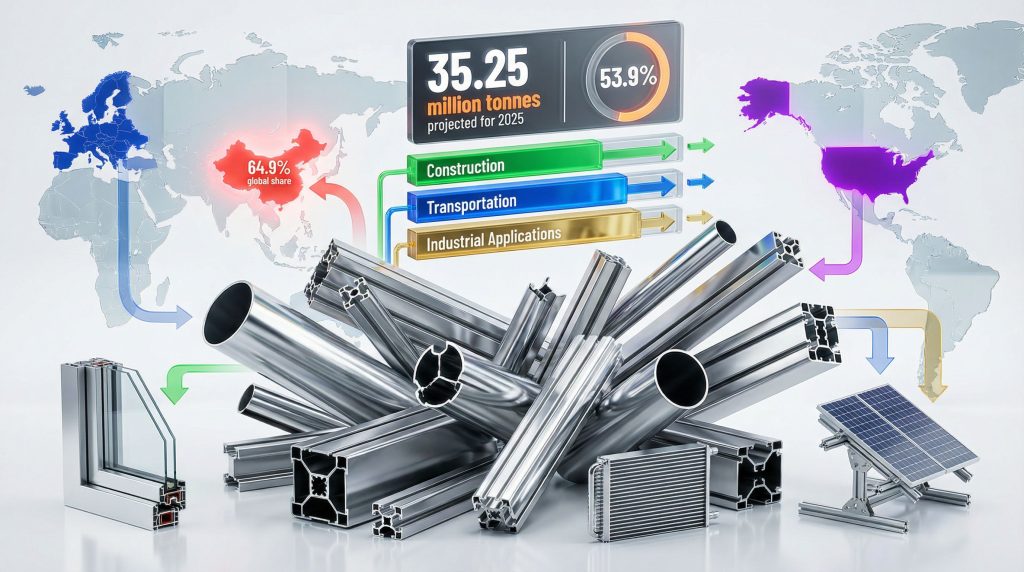
Global aluminium extrusion consumption reached 34.27 million tonnes in 2024, with projected expansion to 35.25 million tonnes in 2025, representing approximately 2.9% year-over-year growth. Forward projections indicate continued momentum, with consumption anticipated to reach 36.14 million tonnes by 2026, though growth rates are expected to moderate to 2.5% as market maturity influences demand patterns.
This multi-year trajectory reflects steady industrial demand across diverse end-use applications, though regional variations suggest different underlying economic drivers affecting consumption patterns. However, the gradual deceleration from 2025 to 2026 may indicate market saturation in developed economies while potentially masking higher growth rates in emerging markets with expanding infrastructure requirements.
Sectoral Consumption Analysis Across Key Industries
Table: Global Aluminium Extrusion Consumption by Application Sector
| Sector | 2024 Volume (MT) | 2025 Projected (MT) | Market Share (%) | Growth Rate (%) |
|---|---|---|---|---|
| Construction | 18.57 | 18.98 | 53.9% | 2.2% |
| Transportation | 6.31 | 6.53 | 18.5% | 3.5% |
| Industrial Applications | 3.86 | 3.98 | 11.3% | 3.1% |
| Electrical & Electronics | 2.42 | 2.48 | 7.0% | 2.5% |
| Consumer Durables | 1.81 | 1.84 | 5.2% | 1.7% |
| Other Applications | 1.30 | 1.44 | 4.1% | 10.8% |
Construction applications dominate global aluminium extrusion consumption with 18.98 million tonnes projected for 2025, maintaining over 53% market share. This sector's prominence stems from aluminium's inherent material properties that align with modern building requirements: lightweight characteristics that reduce structural loading, corrosion resistance extending service life, and fire safety performance meeting stringent building codes.
Transportation represents the second-largest consumption category at 6.53 million tonnes, exhibiting the strongest growth rate at 3.5% annually. This acceleration reflects automotive industry electrification trends, where aluminium extrusions serve critical functions in battery housings, thermal management systems, and structural components that enable vehicle lightweighting objectives. Consequently, these developments align closely with the broader green transition impact observed across industries.
Industrial applications demonstrate consistent expansion at 3.1% growth, reaching 3.98 million tonnes consumption. This category encompasses heat sinks for thermal management, enclosures for sensitive equipment, and automation components where precision tolerances and dimensional stability are essential for operational performance.
Technology Integration and Material Performance Characteristics
The extrusion process transforms heated aluminium billets through precision dies, creating complex cross-sectional profiles with exceptional dimensional accuracy. This manufacturing capability enables customisation for specific application requirements, from structural members requiring high strength-to-weight ratios to thermal management components demanding optimised heat transfer characteristics.
Recent technological advancements in alloy development enhance performance characteristics across applications. 6xxx series alloys (aluminium-magnesium compositions) provide excellent formability and moderate strength for architectural applications, while specialised formulations address specific requirements in transportation and electronics sectors.
Surface treatment technologies further expand application possibilities through enhanced durability and aesthetic properties. Anodisation processes create protective oxide layers that improve corrosion resistance, while powder coating systems enable diverse colour and texture options for architectural applications.
When big ASX news breaks, our subscribers know first
Which Regional Markets Dominate Global Aluminium Extrusion Consumption?
China's Market Leadership and Production Dynamics
China maintains overwhelming dominance in global aluminium extrusion consumption, accounting for 22.87 million tonnes in 2025, representing approximately 65% of global demand. This consumption level reflects the country's massive construction sector, expanding transportation infrastructure, and extensive manufacturing base requiring aluminium components.
Chinese production capacity exceeds 23.5 million tonnes annually, creating a structural surplus that positions the country as a net exporter with approximately 1.1 million tonnes of net exports in 2025. Furthermore, import levels remain minimal at 98,070 tonnes, indicating comprehensive domestic supply chain capabilities across diverse product specifications.
The emphasis on "green billet" production utilising renewable energy and post-consumer scrap aligns with carbon neutrality objectives while strengthening competitive positioning in markets increasingly influenced by carbon-related trade policies. This sustainability focus may provide strategic advantages as global supply chains evolve toward lower-carbon procurement requirements.
Asia-Pacific Regional Supply-Demand Imbalances
Across the broader Asia-Pacific region excluding China, consumption reached 3.31 million tonnes in 2025, representing substantial growth from 3.16 million tonnes in 2024. However, regional production capacity remains insufficient to meet domestic requirements, creating persistent import dependency.
Key import volumes by nation include:
• Vietnam: 168,008 tonnes
• India: 166,295 tonnes
• Malaysia: 111,890 tonnes
• Turkey: 117,921 tonnes
• Australia: 92,317 tonnes
• Japan: 38,624 tonnes
• Indonesia: 33,402 tonnes
These import figures collectively represent over 750,000 tonnes across major regional economies, demonstrating substantial reliance on external suppliers, predominantly Chinese exporters. Regional production facilities include Hindalco's operations at Renukoot and Alupuram (combined 115,000 tonnes capacity) and LB Aluminium Berhad's 4,300-tonne press in Malaysia, but these remain insufficient for regional demand.
European Market Capacity Constraints
European global aluminium extrusion consumption reached 3.49 million tonnes in 2025, representing modest 2.58% growth from previous year levels. Despite advanced manufacturing capabilities and technological expertise, regional production capacity of approximately 2.2 million tonnes falls significantly short of consumption requirements.
Major European producers include Hydro Extrusions with 1.4 million tonnes global capacity and Constellium operating 800,000 tonnes capacity. However, import dependency remains substantial, with the European Union importing 775,049 tonnes and the United Kingdom importing an additional 123,540 tonnes in 2025. Consequently, these patterns directly relate to broader US tariff effects on global trade dynamics.
Recent capacity expansion initiatives include EAS Aluminium's 35,000 square metre facility commissioned in 2025, targeting over 20,000 tonnes capacity with focus on energy efficiency and export capabilities. This expansion represents strategic investment in addressing regional supply-demand imbalances.
North American Market Development
North American consumption reached 2.93 million tonnes in 2025, with projections indicating growth to 3.0 million tonnes by 2026. The United States imported 581,366 tonnes of extrusion products, indicating significant import reliance despite domestic production facilities.
Strategic investment in domestic capacity includes MAGNA Aluminum Profile's fully electric extrusion facility in Quebec, representing technological advancement and regional supply chain strengthening. This facility targets 6xxx alloys commonly utilised in transportation and structural applications.
Kaiser Aluminum Corporation operates 10 extrusion and drawing facilities across North America, with automotive extrusion shipments reaching 101.4 million pounds in 2024, generating USD 119.7 million in conversion revenue. For the first nine months of 2025, conversion revenue increased to USD 211 million, indicating robust demand growth.
How Do Supply Chain Dynamics Affect Regional Markets?
Production Capacity Distribution and Import Dependencies
Table: Regional Supply-Demand Analysis (2025 Projections)
| Region | Consumption (MT) | Production Capacity (MT) | Import Dependency | Primary Suppliers |
|---|---|---|---|---|
| China | 22.87 | 23.5+ | Net Exporter | Domestic |
| Europe | 3.49 | 2.2 (estimated) | High | China, Regional |
| North America | 2.93 | 1.8 (estimated) | Moderate | China, Mexico |
| Rest of Asia-Pacific | 3.31 | 1.5 (estimated) | Very High | China |
| Middle East & Africa | 1.75 | 1.2 (estimated) | Low | Regional, China |
Geographic concentration of production capacity in China creates both opportunities and vulnerabilities across global supply chains. Chinese production represents approximately 60-65% of global capacity, with export availability stabilising global markets while potentially constraining price realisation for producers in other regions.
European and Asia-Pacific markets demonstrate the highest import dependencies, with consumption significantly exceeding regional production capabilities. This structural imbalance creates market opportunities for capacity expansion while exposing importing regions to supply chain disruption risks.
Strategic Investment Patterns and Technology Adoption
Recent investment activity demonstrates industry-wide adoption of advanced automation and energy efficiency technologies. MAGNA Aluminum's electric extrusion facility in Quebec represents North America's first fully electric installation, targeting enhanced environmental performance and operational efficiency.
The USD 500 million ALUPCO-Asia Aluminum hub development in Riyadh spans 1.5 million square metres with phased capacity deployment: 100,000 tonnes within 30 months in Phase One, targeting total capacity of 200,000 tonnes annually. This facility emphasises construction profiles, modular housing, and solar frame applications while incorporating advanced automation systems.
European capacity expansion includes EAS Aluminium's 35,000 square metre facility utilising Presezzi technology, targeting energy efficiency optimisation and export market development. These investments demonstrate strategic positioning for regional supply chain strengthening.
Transportation and Logistics Considerations
Global aluminium extrusion consumption patterns create complex transportation logistics requirements, with substantial tonnages moving from Chinese production centres to consuming regions across Asia-Pacific, Europe, and North America. Ocean freight availability and pricing significantly influence regional market dynamics and competitive positioning.
Quality specification compliance across international supply chains requires sophisticated quality control systems and standardisation protocols. Different regional markets maintain varying technical standards and certification requirements, creating complexity for global suppliers serving multiple markets simultaneously.
Inventory management strategies must balance demand volatility with transportation lead times, particularly for importing regions dependent on Chinese supply. Economic order quantities and safety stock levels significantly influence working capital requirements and supply chain resilience.
What Are the Primary End-Use Applications Driving Demand?
Construction Sector Applications and Performance Requirements
Construction applications consume over 18.98 million tonnes annually, representing 53.9% of global demand. Primary applications include façades, window systems, curtain walls, and structural components where aluminium's unique combination of properties addresses modern building requirements.
Key performance advantages include:
• Lightweight properties: Reducing overall structural loading
• Corrosion resistance: Extending service life in diverse climates
• Fire safety performance: Meeting stringent building codes
• Thermal characteristics: Supporting energy-efficient building design
• Formability: Enabling complex architectural geometries
Energy efficiency mandates and green building standards drive increasing adoption of aluminium extrusion systems. LEED certification requirements and similar sustainability frameworks favour materials with favourable life-cycle environmental profiles, including recyclability at end-of-service life.
Transportation Industry Electrification Impact
Transportation sector consumption reached 6.53 million tonnes in 2025, exhibiting 3.5% annual growth driven primarily by automotive industry electrification initiatives. Electric vehicle applications include battery housings requiring precise thermal management, structural components enabling vehicle lightweighting, and charging infrastructure components.
Traditional automotive applications encompass body panels, chassis components, and heat exchangers where weight reduction directly improves fuel efficiency and performance characteristics. Aerospace applications utilise specialised high-strength extrusions for structural elements and interior fittings requiring exceptional strength-to-weight ratios.
Commercial transportation including rail and marine applications increasingly adopt aluminium extrusions for weight reduction benefits and corrosion resistance in challenging operating environments.
Industrial and Electronics Sector Requirements
Industrial applications consume 3.98 million tonnes annually across diverse equipment categories. Heat sinks for thermal management represent a significant application where aluminium's thermal conductivity properties enable efficient heat dissipation in power electronics and LED lighting systems.
Electronics sector applications include:
• Computer components: Chassis and heat management systems
• LED lighting: Thermal management and optical components
• Telecommunications infrastructure: Equipment enclosures and antenna systems
• Solar energy systems: Mounting structures and frame assemblies
Consumer durables applications at 1.84 million tonnes encompass appliances, furniture, and recreational equipment where aesthetic properties combine with functional performance requirements.
How Do Market Forces Shape Future Consumption Patterns?
Sustainability and Environmental Considerations
Carbon footprint reduction initiatives across industries increasingly influence material selection decisions. Aluminium's recyclability advantages position it favourably as circular economy principles gain prominence in procurement strategies. Recycled content requirements in building codes and corporate sustainability commitments drive demand for post-consumer recycled aluminium products.
Green building standards including LEED certification impacts create specification preferences for materials with favourable environmental profiles. Energy efficiency mandates in building performance regulations favour lightweight, thermally efficient building envelope systems utilising aluminium extrusions.
Life-cycle assessment methodologies increasingly evaluate materials based on total environmental impact from production through end-of-life recycling, favouring materials with established recycling infrastructure and high recycling rates.
Technology and Innovation Drivers
Alloy development continues enhancing strength-to-weight ratios and specialised performance characteristics. Surface treatment innovations improve durability and aesthetic properties while reducing maintenance requirements over service life. These advancements reflect broader industry innovation trends reshaping materials technology.
Manufacturing process improvements include:
• Precision extrusion techniques: Enhanced dimensional accuracy
• Advanced die design: Complex geometry capabilities
• Automation integration: Improved quality consistency
• Energy efficiency: Reduced production environmental impact
Digital integration enables smart building applications where aluminium extrusion systems incorporate sensors, wiring channels, and connectivity features supporting building automation and energy management systems.
Economic and Policy Influences
Trade relationships and tariff policies significantly influence global aluminium extrusion consumption patterns and regional competitiveness. Infrastructure spending programmes by governments create demand surges that ripple through supply chains and influence capacity utilisation rates across producing regions.
Urbanization trends in developing economies drive construction sector demand growth, while population density increases in metropolitan areas favour high-performance building envelope systems utilising aluminium extrusions. For instance, Australia's tariff strategy demonstrates how nations address these evolving trade dynamics.
Industrial policy considerations regarding strategic materials may influence regional capacity development and supply chain localisation initiatives, particularly in markets seeking reduced import dependency for critical materials.
What Regional Growth Opportunities Exist Through 2026?
Emerging Market Development Potential
Middle Eastern markets demonstrate 2.29% CAGR with substantial local capacity building initiatives. The USD 500 million ALUPCO-Asia Aluminum hub in Riyadh represents strategic investment in regional supply chain development, targeting 200,000 tonnes annual capacity across construction profiles, modular housing, and solar frame applications.
South American growth at 2.22% CAGR reflects industrial development and infrastructure expansion across the region. While modest in absolute scale, consistent growth patterns indicate market development opportunities for both domestic production and import supply chains.
African infrastructure development supports construction sector demand growth, though market fragmentation and logistics challenges influence supply chain strategies. Regional production capacity development may address import dependency while serving continental market expansion.
Southeast Asian manufacturing expansion in electronics and automotive sectors drives demand growth beyond current production capacity, maintaining import dependency while creating opportunities for foreign direct investment in regional capacity.
Developed Market Evolution
North American reshoring trends favour supply chain localisation, potentially reducing import dependency through domestic capacity expansion. The MAGNA Aluminum electric extrusion facility represents technological advancement and strategic positioning for regional supply chain strengthening.
European green transition initiatives create demand for renewable energy infrastructure components, including solar mounting systems and wind turbine components utilising specialised aluminium extrusions. Energy efficiency retrofits and building renovation programmes support sustained construction sector demand.
Japanese technological advancement in precision applications drives demand for high-specification extrusions in electronics, automotive, and industrial equipment sectors. Australian resource sector development creates demand for specialised applications in mining and energy project infrastructure.
The next major ASX story will hit our subscribers first
How Should Industry Stakeholders Position for Market Evolution?
Strategic Considerations for Market Participants
Capacity planning optimisation requires balancing regional demand-supply dynamics with transportation economics and quality specification requirements. Over-concentration in single regions creates supply chain vulnerabilities, while excessive distribution may compromise economies of scale benefits.
Technology investment priorities should emphasise automation and efficiency improvements that enhance competitiveness while addressing sustainability requirements. Green production methodologies may provide strategic advantages as carbon-related trade policies evolve globally.
Market diversification strategies across end-use sectors provide risk management benefits, reducing exposure to sector-specific economic cycles. Construction sector dominance creates both stability and concentration risk that balanced portfolio approaches may address.
Supply Chain Risk Management Framework
Geographic concentration risks require evaluation given Chinese production dominance and export dependency across multiple importing regions. Alternative supply source development may provide resilience benefits, though potentially at higher cost structures.
Transportation logistics optimisation becomes increasingly critical as global aluminium extrusion consumption grows and shipping costs influence competitiveness. Long-term logistics partnerships and alternative transportation modes may provide stability in volatile freight markets.
Quality standards compliance across diverse regional markets requires sophisticated quality management systems and certification capabilities. Specification harmonisation efforts may reduce complexity while maintaining regional customisation requirements.
Inventory optimisation strategies must balance demand volatility management with working capital efficiency, particularly for importing regions managing extended supply chain lead times and seasonal demand variations.
Disclaimer: Market projections and growth forecasts are based on current industry analysis and are subject to economic, technological, and regulatory changes that may affect actual outcomes. Readers should conduct independent research and analysis for investment or business decisions.
Ready to Capitalise on the Next Major Aluminium Discovery?
Discovery Alert's proprietary Discovery IQ model delivers real-time alerts on significant ASX mineral discoveries, including critical aluminium opportunities that could benefit from the 35+ million tonne global extrusion market. Subscribers gain immediate access to actionable insights on major discoveries with proven potential for substantial returns, positioning themselves ahead of broader market awareness.