August 8, 2026
Understanding the Strategic Shift in Global Aluminium Manufacturing
The global materials landscape faces unprecedented disruption as traditional supply chains undergo fundamental restructuring. While China has dominated aluminium production for over two decades, achieving 61% of global output, structural constraints and geopolitical tensions are forcing the emergence of alternative production centers worldwide. This transformation represents more than cyclical market adjustment; it signals a permanent realignment of industrial capacity that will define metal markets for the next generation.
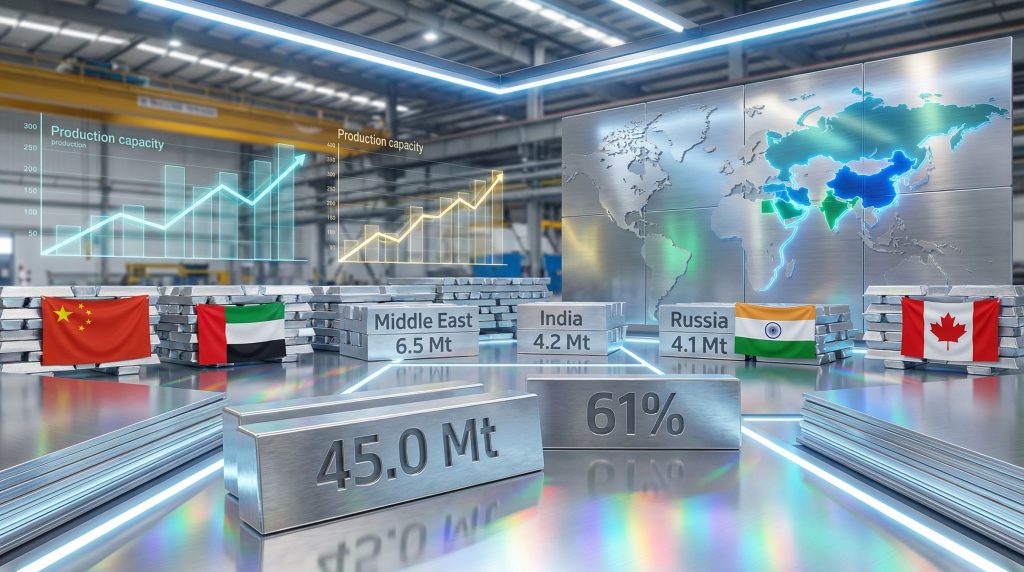
Global primary aluminium production reached 73.8 million tonnes in 2025, with China's self-imposed ceiling of 45 million tonnes creating persistent supply gaps. Unlike historical commodity cycles where spare capacity provided market elasticity, virtually all major producers now operate at maximum utilization rates, eliminating traditional buffer mechanisms. This constraint coincides with projected global consumption growth to 119.5 million tonnes by 2030, intensifying pressure on alternative production regions to scale operations rapidly.
Global Production Capacity Distribution (2025)
| Region | Annual Capacity (Mt) | Market Share | Strategic Position |
|---|---|---|---|
| China | 45.0 | 61% | Self-imposed ceiling reached |
| Middle East (GCC) | 6.45 | 8.7% | Energy-advantaged expansion |
| India | 4.2 | 5.7% | Raw material integration |
| Russia | 3.9 | 5.3% | Sanctions-redirected output |
| Canada (Quebec) | 3.3 | 4.5% | Low-carbon positioning |
| UAE | 2.7 | 3.7% | Strategic acquisitions |
| Bahrain | 1.6 | 2.2% | Technology upgrades |
| Australia | 1.5 | 2.0% | Stable operations |
| Norway | 1.3 | 1.8% | Renewable energy focus |
The rise of global aluminium hubs outside China reflects convergent pressures including environmental regulations limiting coal-powered smelting, trade tensions affecting export markets, and strategic resource nationalism across multiple economies. Furthermore, these tariffs impact investment decisions across regional markets. These factors have created structural advantages for regions with renewable energy access, integrated supply chains, and favorable regulatory environments.
When big ASX news breaks, our subscribers know first
What Economic Forces Drive Aluminium Hub Development Beyond China?
Energy Cost Arbitrage as Primary Location Determinant
Aluminium smelting's extraordinary energy intensity fundamentally shapes global production geography. The Hall-Héroult electrolytic reduction process requires approximately 12,000-15,000 kilowatt-hours per tonne of aluminium produced, making electricity costs the dominant operational variable. A differential of merely 1-2 cents per kilowatt-hour translates to $120-240 per tonne competitive advantage, sufficient to determine project viability across international markets.
This energy dependency has created persistent advantages for regions with abundant renewable resources:
- Hydroelectric regions: Quebec, Norway, and Russia leverage renewable baseload power for substantial cost advantages
- Natural gas hubs: Middle Eastern producers utilize abundant gas supplies, though recent shortages demonstrate supply vulnerability
- Solar integration projects: Australia and India incorporate renewable mandates into new capacity development
Carbon Intensity Differentiation Driving Premium Markets
Low-carbon aluminium production has evolved from niche environmental positioning to mainstream competitive differentiator. Premium pricing mechanisms now reward products meeting stringent environmental standards, particularly as the European Union's Carbon Border Adjustment Mechanism creates economic incentives for low-emission supply chains.
Carbon Intensity Benchmarks:
- Quebec renewable energy production: ≤4 tonnes CO2 equivalent per tonne aluminium
- Russian hydropower operations: ≤4 tonnes CO2 equivalent per tonne aluminium
- Standard coal-intensive production: 10-12+ tonnes CO2 equivalent per tonne aluminium
This differentiation has enabled premium product positioning for producers with renewable energy access while creating regulatory barriers for high-emission facilities seeking Western market access. In addition, companies leveraging green metals leadership strategies capture premium valuations in environmental markets.
Capacity Utilization Constraints Eliminating Market Flexibility
The global aluminium sector operates under unprecedented capacity constraints, with major producers achieving near-100% utilization rates. This operational reality eliminates traditional market mechanisms where spare capacity could respond to demand fluctuations or supply disruptions. The March 2026 closure of South Africa's Mozal smelter, eliminating 580,000 tonnes annually, exemplifies how individual facility shutdowns create immediate global supply pressures.
Combined primary and secondary aluminium supply totaled 116 million tonnes in 2025, comprising:
- Primary aluminium: 73.8 million tonnes (63.6%)
- Secondary (recycled) aluminium: 42.2 million tonnes (36.4%)
The growing secondary proportion reflects both economic incentives and environmental regulations driving recycling investment, particularly in developed markets with established scrap collection infrastructure.
Which Regions Are Establishing Themselves as Major Aluminium Production Hubs?
India: Integrated Raw Material Advantage Through Odisha Development
India's emergence as a major aluminium hub centers on Odisha state's exceptional resource endowment and strategic industrial planning. The state controls 1.5 billion tonnes of metallurgical-grade bauxite reserves while accounting for 54% of India's total smelting capacity through integrated operations spanning mining, refining, and smelting.
Current Odisha Industrial Capacity:
- Aluminium smelting: 2.7 million tonnes annually across three major producers
- Alumina refining: Combined 5+ million tonnes per year capacity
- Projected 2030 output: >6 million tonnes aluminium, >8 million tonnes alumina
Major expansion commitments include:
- Nalco expansion: Additional 500,000 tonnes capacity by 2030
- Vedanta integrated development: $11 billion investment in 6 million tonne alumina refinery plus 3 million tonne aluminium smelter
- Infrastructure development: Angul Aluminium Park creation for downstream industry clustering
This vertical integration strategy provides cost advantages through eliminated transportation expenses, supply chain control, and operational coordination across the value chain. Odisha's port connectivity enables efficient export access while abundant coal reserves support competitive power generation.
Middle East: Strategic Energy Utilization and Geographic Positioning
Gulf Cooperation Council countries have leveraged abundant natural gas resources and strategic geographic positioning to establish significant global market presence. Combined GCC production reached 6.45 million tonnes in 2024, representing approximately 20% of ex-China global supply. However, the region faces energy transition challenges similar to other resource-dependent economies.
UAE Production Leadership:
- Emirates Global Aluminium: 2.7 million tonnes annual capacity
- Strategic market focus: 60% export to Asian markets (Japan, South Korea)
- Expansion strategy: Mergers and acquisitions plus renewable energy integration
- US operations: Spectro Alloys acquisition adding 55,000 tonnes secondary capacity
Bahrain's Specialized Positioning:
- Alba operations: 1.6 million tonnes annual capacity
- Technology advancement: Smelting efficiency improvements and green product development
- Brand positioning: Eternal low-carbon aluminium utilizing recycling and carbon offsets
However, 2026 production cuts at major facilities due to gas shortages demonstrate vulnerability in this energy-dependent strategy. The outbreak of regional conflicts has further highlighted operational risks affecting facility security and shipping access through critical maritime routes.
Quebec: Renewable Energy Advantage and Low-Carbon Market Access
Quebec has established itself as North America's dominant aluminium producer through strategic utilization of abundant hydroelectric resources. The province supplies 90% of Canadian aluminium production with 3.2 million tonnes annual capacity, all powered by 100% renewable energy.
Major Production Facilities:
- Alouette smelter: 634,000 tonnes annually (40% Rio Tinto ownership)
- Bécancour facility: 462,000 tonnes (Alcoa-Rio Tinto joint venture)
- Rio Tinto integrated operations: Multiple facilities totaling ~1.5 million tonnes
Quebec's competitive positioning derives from multiple advantages:
- Energy profile: Complete renewable electricity supply ensuring <4 tonnes CO2/tonne carbon intensity
- Product differentiation: Rio Tinto's "Renewal" brand offering certified low-carbon aluminium
- Market access flexibility: Export diversification responding to US tariff pressures
Trade data demonstrates strategic market pivoting, with European export share increasing to 18% from 0.2% as US imports declined 26% to 2.33 million tonnes in 2025. This geographical diversification protects against single-market dependency while capturing premium pricing in carbon-conscious European markets.
Russia: Hydropower Advantages Constrained by Geopolitical Isolation
Russia produces 3.9 million tonnes annually using >90% hydroelectric power, creating one of the lowest carbon intensity profiles globally. Rusal's operations demonstrate the technical feasibility of large-scale renewable energy utilization for competitive aluminium production. According to recent industry analysis, the rise of global aluminium hubs is accelerating outside traditional production centres.
However, Western sanctions implemented following the Ukraine conflict have eliminated traditional market access:
- Market restrictions: US and UK sanctions plus London Metal Exchange bans on post-April 2024 production
- Geographic redirection: Russian output now flows exclusively to Asian markets, primarily China
- Product positioning: Despite low-carbon credentials, geopolitical constraints override environmental advantages
This situation illustrates how political factors can neutralize economic and environmental competitive advantages in globally integrated commodity markets.
How Do Geopolitical Factors Influence Aluminium Hub Development?
Sanctions Impact on Traditional Supply Relationships
Western sanctions targeting Russian aluminium exports have fundamentally restructured global trade flows, creating both constraints and opportunities across regional markets. The elimination of 3.9 million tonnes from Western markets has forced supply chain restructuring while opening market share for alternative producers. These tariffs economic implications extend beyond immediate trade relationships.
Market Redistribution Effects:
- Russian output diverted from Europe and North America to Asian consumption
- Increased European dependence on Canadian and Middle Eastern suppliers
- Premium pricing for sanctions-compliant supply sources
- Long-term supply agreement renegotiation across Western markets
Regional Security Considerations Affecting Operational Continuity
The outbreak of conflicts affecting Middle Eastern production facilities has highlighted vulnerability in regions accounting for significant global capacity. Reports of attacks on Emirates Global Aluminium's Al Taweelah facility and Alba's Bahrain operations demonstrate how regional security risks translate to immediate supply concerns.
The closure of shipping routes through the Strait of Hormuz would affect approximately 8-9% of global aluminium supply, illustrating the strategic importance of geographic diversification in global supply chains. However, market analysts note that fragile aluminium markets remain vulnerable to geopolitical disruptions.
Policy Framework Evolution Driving Location Advantages
Trade policy developments continue reshaping optimal production locations through:
- Tariff structures: US aluminum tariffs affecting Canadian trade relationships and market access
- Carbon border adjustments: EU CBAM implementation creating advantages for low-emission producers
- Strategic resource policies: Export restrictions and domestic processing requirements in resource-rich nations
These policy frameworks create persistent competitive advantages for producers meeting environmental standards while constraining high-emission facilities regardless of cost competitiveness.
What Investment Strategies Are Driving Hub Development?
Brownfield Expansion Versus Greenfield Development Economics
Investment strategies in the rise of global aluminium hubs outside China reflect careful evaluation of capital efficiency and market positioning requirements. Brownfield expansion typically requires 30-50% of greenfield equivalent investment while providing faster capacity deployment and reduced execution risk. Moreover, these developments align with broader industry evolution trends across resource sectors.
Brownfield Optimization Focus:
- Technology retrofits improving efficiency and environmental compliance
- Capacity debottlenecking utilizing existing infrastructure
- Integrated recycling capability additions capturing circular economy trends
- Power supply agreement renegotiation for renewable energy access
Greenfield Strategic Positioning:
- Advanced smelting technology implementation from project inception
- Integrated value chain development optimizing transportation and processing costs
- Renewable energy infrastructure coordination for long-term competitive advantage
- Market proximity optimization reducing logistics costs and delivery times
Public-Private Partnership Models Facilitating Development
Government industrial policies increasingly support aluminium hub development through coordinated infrastructure investment and regulatory support:
- Industrial park development: Integrated infrastructure reducing individual project costs
- Power supply coordination: Long-term renewable energy agreements providing cost certainty
- Transportation infrastructure: Port and rail connectivity supporting efficient logistics
- Research and development funding: Technology advancement supporting competitive positioning
The Kentucky aluminium development exemplifies this approach, with federal support including up to $500 million Department of Energy funding for low-emission smelter demonstration projects.
Long-Term Power Supply Agreements as Strategic Foundation
Successful hub development requires securing long-term electricity supply agreements providing both cost competitiveness and carbon compliance. These agreements typically span 15-25 years and include provisions for renewable energy access, price escalation mechanisms, and supply reliability guarantees.
Critical Agreement Components:
- Fixed or indexed pricing providing cost certainty for investment planning
- Renewable energy certification enabling premium product positioning
- Supply reliability guarantees minimizing operational disruption risks
- Expansion capability accommodating future capacity growth
How Are Environmental Regulations Shaping Production Location Decisions?
Carbon Border Adjustment Mechanism Implementation Creating Competitive Differentiation
The European Union's Carbon Border Adjustment Mechanism represents the most significant environmental regulation affecting global aluminium trade relationships. Implementation creates direct economic incentives favoring low-emission producers while imposing costs on high-carbon suppliers.
Strategic Market Implications:
- Premium pricing opportunities for renewable energy-powered facilities
- Market access barriers for coal-intensive production
- Investment incentives driving clean technology adoption
- Supply chain restructuring toward environmentally compliant sources
Canadian and Norwegian producers benefit directly from this regulatory framework through existing renewable energy infrastructure, while coal-dependent facilities face competitive disadvantages regardless of production costs.
Renewable Energy Integration Requirements Driving Technology Investment
Regional Renewable Energy Adoption Patterns:
- Nordic countries: Hydroelectric power utilization providing consistent low-carbon supply
- Middle Eastern projects: Solar and nuclear power partnerships reducing natural gas dependency
- Australian developments: Solar energy integration supporting domestic consumption growth
- North American initiatives: Hydroelectric and nuclear baseload power ensuring supply reliability
These technology investments require substantial capital commitment but provide long-term competitive advantages through reduced operational costs and environmental compliance.
The next major ASX story will hit our subscribers first
What Market Dynamics Will Determine Future Hub Success?
Demand Growth Projections Driving Capacity Requirements
Global aluminium consumption growth to 119.5 million tonnes by 2030 reflects expanding applications across multiple sectors:
Primary Growth Drivers:
- Electric vehicle adoption: 40% higher aluminium content per vehicle compared to conventional automobiles
- Renewable energy infrastructure: Solar panel frames, wind turbine components, and grid infrastructure
- Sustainable packaging applications: Aluminum substitution for less recyclable materials
- Construction sector growth: Urbanization in developing markets driving structural demand
This demand trajectory requires approximately 5.7 million tonnes additional annual capacity by 2030, highlighting the strategic importance of hub development outside China's constrained production ceiling.
Supply Chain Resilience Requirements Influencing Location Decisions
Critical Success Factors for Hub Development:
- Geographic diversification: Multiple production regions minimizing single-point-of-failure risks
- Integrated recycling capabilities: Circular economy compliance supporting sustainable positioning
- Advanced logistics infrastructure: Efficient transportation networks enabling global market access
- Technology partnerships: Continuous efficiency improvements maintaining competitive positioning
The rise of global aluminium hubs outside China reflects recognition that supply chain resilience requires distributed production networks rather than concentrated capacity in individual regions or countries.
Technology Leadership Driving Competitive Differentiation
Advanced smelting technologies and recycling capabilities increasingly determine market positioning success. Investment in next-generation production methods provides multiple competitive advantages:
- Efficiency improvements: Reduced energy consumption lowering operational costs
- Environmental performance: Lower emission profiles enabling premium market access
- Product quality: Enhanced specifications meeting specialized application requirements
- Operational flexibility: Improved capacity utilization and maintenance scheduling
Companies investing in technology leadership position themselves for sustained competitive advantage as environmental regulations intensify and customer specifications become more demanding.
Future Outlook: Strategic Positioning for Global Competitiveness
The evolution of global aluminium production centers outside China represents a fundamental shift toward more distributed, sustainable, and technologically advanced manufacturing networks. Success in this transformed landscape requires strategic positioning across multiple dimensions including energy security, environmental compliance, technological capability, and market proximity.
Emerging Hub Characteristics:
- Energy independence: Long-term renewable energy partnerships providing cost and environmental advantages
- Technology leadership: Advanced smelting and recycling capabilities enabling premium positioning
- Market access optimization: Strategic geographic positioning for key consumption centers
- Environmental differentiation: Low-carbon production certification capturing regulatory compliance value
The rise of global aluminium hubs outside China suggests a future where production becomes increasingly specialized and differentiated, with regions competing on distinct value propositions rather than solely cost advantages. This evolution reflects broader industrial trends toward supply chain resilience, environmental sustainability, and technological advancement.
Investment Implications:
Investment in emerging aluminium hubs requires careful evaluation of long-term competitive positioning rather than current cost structures. Regions with renewable energy access, integrated supply chains, and favorable regulatory environments are positioned for sustained growth as global markets prioritize environmental compliance and supply chain security.
The transformation of global aluminium production geography represents one component of broader industrial restructuring affecting multiple commodity sectors. Understanding these dynamics provides insight into future competitive positioning as traditional production centers face constraints while emerging regions capture market share through strategic advantages.
Please note: This analysis contains forward-looking projections and market assessments that involve inherent uncertainties. Investment decisions should incorporate comprehensive due diligence and professional consultation appropriate to specific circumstances and risk tolerance.
Want to Stay Ahead of Global Commodity Market Shifts?
Discovery Alert's proprietary Discovery IQ model delivers instant notifications on significant ASX mineral discoveries, helping investors capitalise on commodity market transformations as they unfold. With global aluminium production centres shifting and new mining opportunities emerging, Discovery Alert ensures you're positioned to identify actionable investment prospects ahead of the broader market—start your 14-day free trial today.