
July 25, 2026
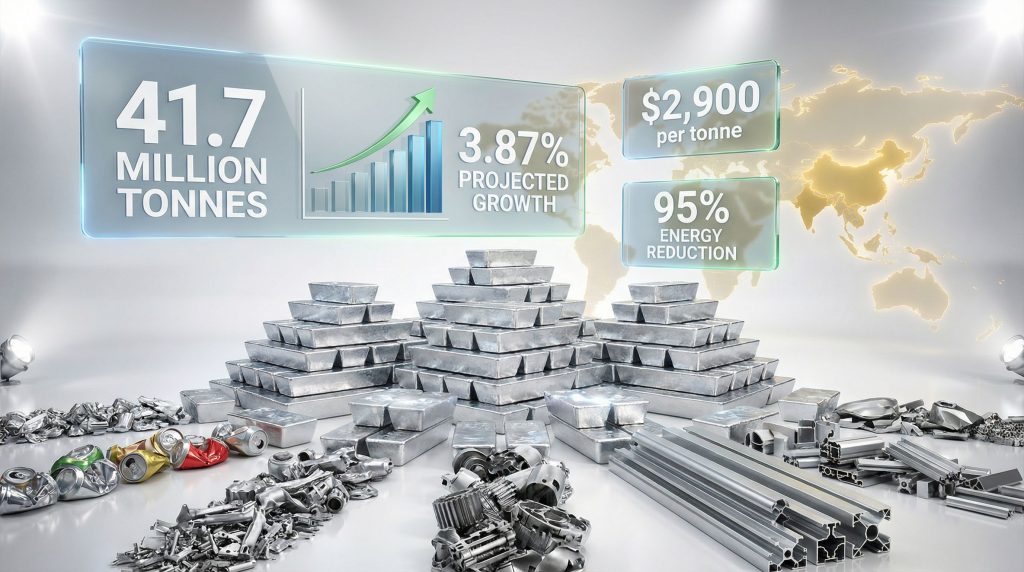
The global aluminium scrap tracker reveals a complex secondary materials market that has evolved far beyond supplementary status to become critical infrastructure supporting worldwide aluminium consumption. With recycled aluminium production reaching 41.7 million tonnes in 2024, these materials now represent essential supply chain components rather than mere environmental alternatives. Furthermore, this substantial volume demonstrates how recycling has transformed from marginal market participation into foundational infrastructure supporting global manufacturing requirements.
The evolution of secondary aluminium from supplementary material to foundational infrastructure reflects fundamental shifts in global manufacturing requirements, environmental regulations, and energy cost structures. Understanding these market dynamics requires analysis of production capacity limitations, regional consumption patterns, and technological innovations driving processing efficiency improvements across different scrap grades and quality specifications.
Understanding Secondary Aluminium's Market Infrastructure Role
Defining the 41.7 Million Tonne Foundation Layer
Global recycled aluminium production reached 41.7 million tonnes in 2024, representing a substantial portion of worldwide aluminium consumption totaling 100.8 million tonnes. This secondary production volume demonstrates how recycled materials have evolved beyond marginal market participation to become structural components of global supply chains.
The energy efficiency advantages of recycled aluminium processing create compelling economics compared to primary production pathways. Secondary aluminium processing requires approximately 95% less energy than conventional smelting operations, making it attractive both from cost optimisation and carbon reduction perspectives. Consequently, this dramatic energy differential translates into significant operational advantages for manufacturers seeking to reduce both production costs and environmental footprints.
Low-carbon aluminium production totaled 55.2 million tonnes in 2024, with recycled sources contributing 41.7 million tonnes of this total. The remaining 13.5 million tonnes originated from low-carbon primary production routes, highlighting recycled aluminium's dominance in sustainable aluminium supply chains. This distribution pattern reflects the practical reality that recycling represents the most accessible pathway for manufacturers implementing decarbonisation benefits.
Primary vs Secondary Production Capacity Constraints Analysis
China's approach to its 45 million tonne primary aluminium capacity ceiling illustrates the constraints affecting global supply dynamics. This self-imposed limitation, combined with speculation that primary production may have already exceeded this threshold in 2025, creates supply uncertainty that elevates secondary aluminium's strategic importance within global markets.
European smelting operations have experienced significant disruption, with over 800,000 tonnes of capacity taken offline since the 2022 energy crisis. These capacity reductions stem from energy cost competitiveness issues rather than demand weakness, creating permanent shifts in regional production geography that increase reliance on recycled aluminium sources.
The convergence of Chinese capacity constraints and European energy-related shutdowns creates supply gaps that traditional primary production expansion cannot readily fill. In addition, this supply limitation environment positions recycled aluminium as a necessity rather than an environmental preference, fundamentally altering market dynamics and pricing structures across regional markets.
When big ASX news breaks, our subscribers know first
What Drives the 3.87% Projected Growth in Recycled Aluminium Demand?
Structural Market Deficit Scenarios for 2026
Global aluminium markets face projected deficits ranging from 180,000 to 510,000 tonnes in 2026, with Mozambique facility closure risks playing a significant role in supply constraint scenarios. This wide deficit range reflects uncertainty surrounding production capacity availability and the potential impacts of facility closures on global supply chains.
The deficit projections occur despite primary aluminium production increases from 72.7 million tonnes in 2024 to 73.9 million tonnes in 2025, with forecasts reaching 75.3 million tonnes by 2026. However, this apparent growth masks underlying capacity constraints that limit further expansion, particularly in regions where energy costs or regulatory restrictions prevent additional smelting capacity deployment.
Market deficit scenarios emphasise the global aluminium scrap tracker's role as a pressure valve within global supply systems. For instance, the 3.87% projected growth in recycled aluminium demand reflects both increasing consumption requirements and the practical necessity of substituting secondary materials for unavailable primary production capacity.
China's Secondary Aluminium Production Scaling Patterns
China's domestic secondary aluminium consumption reached 12.79 million tonnes in 2024, with projections indicating growth to 13.35 million tonnes in 2025, representing a 5.1% year-over-year increase. This consumption growth occurs within a broader pattern showing a 13% compound annual growth rate projected between 2020 and 2025.
Chinese secondary aluminium output demonstrates remarkable scaling, expanding from 8.98 million tonnes in 2015 to 15.84 million tonnes in 2024. This represents approximately 76% growth over nine years, indicating sustained investment in recycling infrastructure and processing capacity expansion across the country.
The difference between China's 15.84 million tonnes output and 12.79 million tonnes domestic consumption suggests approximately 3 million tonnes of export capacity. Consequently, this positions China as a significant supplier to global recycled aluminium markets, providing flexibility for regional supply balancing during periods of production disruption elsewhere.
Regional Market Dynamics and Price Discovery Mechanisms
Asia-Pacific Market Leadership Analysis
The Asia-Pacific region commands 56.9% of global recycled aluminium market share, reflecting concentrated industrial demand and established processing infrastructure. This regional dominance stems from manufacturing sector concentration, urbanisation-driven scrap generation, and strategic emphasis on supply chain self-reliance.
Regional quality grade preferences favour wrought aluminium and Used Beverage Can (UBC) specifications, indicating sophisticated end-use applications requiring higher material specifications. Furthermore, this preference pattern creates differentiated pricing structures within regional markets, with premium grades commanding higher values than casting-quality materials.
Urban mining initiatives across Asia-Pacific markets represent systematic approaches to material recovery from end-of-life products and infrastructure. These programmes generate consistent scrap supplies while reducing dependence on imported materials, supporting regional self-reliance strategies in critical material supply chains.
North American and European Supply Chain Disruptions
United States import surcharge implementations create 10-15% price impacts on recycled aluminium flows, affecting cross-border trade patterns and regional price discovery mechanisms. The implementation of us steel aluminum tariffs alters competitive dynamics between domestic recycling operations and international scrap suppliers.
Southeast Asian e-waste processing restrictions eliminate significant scrap supply sources, creating upstream disruptions that affect global material availability. These policy changes force material flows toward alternative processing regions, potentially increasing transportation costs and supply chain complexity.
London Metal Exchange inventory depletion patterns reflect broader supply tightness across global aluminium markets. Reduced warehouse stocks limit market participants' ability to manage supply disruptions through inventory drawdowns, increasing reliance on continuous production flows from both primary and secondary sources.
Industrial End-Use Applications Driving Scrap Demand
Automotive Sector Lightweighting Requirements
Automotive manufacturers increasingly implement closed-loop recycling systems to secure consistent aluminium supplies while meeting sustainability targets. These systems create direct material flows from vehicle end-of-life processing back to manufacturing operations, reducing dependence on spot market scrap procurement.
Alloy specification challenges in automotive recycling require sophisticated contamination management and sorting technologies to maintain material quality standards. Advanced processing systems enable higher recovery rates of specification-grade aluminium suitable for critical vehicle components including body panels and structural elements.
Future mobility transition scenarios project increased aluminium content per vehicle, particularly in electric vehicle architectures where weight reduction provides direct performance benefits. This trend creates sustained demand growth for high-quality recycled aluminium meeting automotive specification requirements.
Construction and Infrastructure Aluminium Recycling Flows
Building sector end-of-life product recovery systems generate substantial old scrap volumes as infrastructure reaches replacement cycles. Construction aluminium recycling typically involves longer material cycles compared to packaging or automotive applications, creating predictable but delayed scrap generation patterns.
Old scrap versus new scrap utilisation patterns differ significantly across construction applications, with new scrap from manufacturing processes offering higher purity levels. However, old scrap provides volume scale, whilst construction projects increasingly specify recycled content requirements, creating dedicated demand streams for secondary aluminium products.
Urban development aluminium intensity correlations show increasing material usage in high-density construction projects, creating concentrated scrap generation zones. These patterns support efficient collection and processing operations, enabling economies of scale in recycling infrastructure development.
Technology and Processing Innovation Impact Assessment
Advanced Sorting Technology Integration
Laser-induced breakdown spectroscopy systems achieve 98%+ precision in alloy identification and contamination detection, enabling higher-value material recovery from mixed scrap streams. These precision sorting capabilities allow processors to segregate materials into specific grade categories that command premium pricing in end-use markets.
Contamination reduction methodologies incorporate both mechanical and sensor-based separation techniques to remove non-aluminium materials and incompatible alloy compositions. Advanced processing facilities achieve contamination levels below 0.1% for critical elements, ensuring recycled materials meet stringent specification requirements.
Alloy heterogeneity management solutions enable processors to blend different scrap sources whilst maintaining consistent output chemistry. These capabilities reduce the quality penalties traditionally associated with mixed scrap processing, expanding the range of scrap sources suitable for high-value applications through industry innovation trends.
Energy Efficiency Optimisation in Secondary Processing
Comparative energy consumption analysis demonstrates that recycled aluminium processing requires substantially less energy input than primary smelting operations. However, energy efficiency varies significantly based on processing method, with induction furnace systems achieving different efficiency levels compared to reverberatory furnace operations.
Carbon footprint reduction quantification extends beyond direct energy consumption to include transportation, collection, and preprocessing activities. Lifecycle assessments show recycled aluminium's carbon intensity remains substantially lower than primary production even when including complete supply chain impacts.
Renewable energy integration in recycling operations provides opportunities for further carbon footprint reduction whilst potentially improving operational cost structures. Solar and wind power installations at processing facilities can offset grid electricity consumption, particularly during periods of high renewable generation.
Market Intelligence and Price Tracking Infrastructure
Real-Time Price Discovery Mechanisms
Current pricing benchmarks around $2,900 per tonne represent average levels across different aluminium scrap grades. However, significant variation exists based on material specification, contamination levels, and regional supply-demand dynamics. Price discovery mechanisms incorporate both spot market transactions and longer-term contract arrangements.
Grade-specific price movements reflect differentiated demand patterns across end-use applications, with wrought aluminium specifications commanding premiums over casting-grade materials. Volatility patterns vary by grade, with higher-specification materials showing greater price sensitivity to supply disruptions and tariff-driven market impacts.
Regional price differentials reflect transportation costs, local supply-demand balances, and trade policy impacts including tariffs and import restrictions. These differentials create arbitrage opportunities for traders whilst indicating supply chain inefficiencies that technology and logistics improvements may address.
Supply Chain Monitoring and Forecasting Systems
Inventory tracking methodologies across global facilities provide market participants with visibility into material availability and potential supply constraints. Digital tracking systems enable real-time monitoring of scrap collection rates, processing capacity utilisation, and finished product inventory levels.
Logistics disruption impact assessment incorporates weather patterns, geopolitical factors, and infrastructure limitations that affect material movement efficiency. Supply chain resilience planning requires understanding these disruption sources and implementing alternative routing and sourcing strategies.
Market intelligence platforms aggregate data from multiple sources to provide industry participants with comprehensive views of supply-demand dynamics, pricing trends, and emerging market developments. Accordingly, these systems support strategic decision-making for both suppliers and consumers of recycled aluminium products.
The next major ASX story will hit our subscribers first
Investment and Strategic Planning Implications
Market Size Growth Projections Through 2030-2034
| Timeframe | Market Value | Growth Rate | Key Drivers |
|---|---|---|---|
| 2030 Recycling Market | +$4.88B growth | 10.8% CAGR | APAC expansion, technology adoption |
| 2034 Overall Scrap Market | $91.49B total | 6.1% CAGR | Old scrap recovery, construction demand |
Growth projections through 2030-2034 indicate sustained expansion driven by technological advancement, infrastructure investment, and regulatory support for circular economy initiatives. The 10.8% CAGR projected for recycling markets reflects both volume growth and value enhancement through improved processing capabilities.
Asia-Pacific region expansion represents the largest growth opportunity, supported by urbanisation trends, manufacturing sector development, and policy emphasis on material self-sufficiency. Investment in processing technology and collection infrastructure supports sustained market development across the region.
Strategic Risk Assessment for Market Participants
Trade policy volatility creates uncertainty for international scrap flows, with tariff implementations and policy changes affecting supply chain economics and competitive positioning. Market participants require flexible sourcing strategies to manage policy-driven disruptions.
Geopolitical supply chain resilience requirements emphasise diversified sourcing and processing capacity across multiple regions. Concentration risks in specific countries or regions create vulnerabilities that strategic planning must address through supply base diversification.
Technology investment priorities focus on processing efficiency, material recovery rates, and product quality consistency. Consequently, competitive positioning increasingly depends on technological capabilities that enable higher-value material recovery from diverse scrap sources.
Future Market Evolution and Sustainability Integration
Decarbonisation Pathway Dependencies
Secondary aluminium's role in industrial emission reduction targets becomes increasingly critical as manufacturers implement net-zero commitments. The 95% energy reduction compared to primary production positions recycled aluminium as essential infrastructure for achieving decarbonisation objectives.
Circular economy integration across manufacturing sectors requires coordinated approaches to product design, material recovery, and processing capability development. Success depends on collaboration between original equipment manufacturers, recyclers, and policy makers to optimise material flows.
Regulatory framework evolution supports recycling infrastructure development through extended producer responsibility programmes, recycled content requirements, and carbon pricing mechanisms. These policy tools create economic incentives for investment in recycling capacity and technology advancement.
Long-Term Supply Security Considerations
Resource availability projections for scrap feedstock depend on product lifecycle patterns, urbanisation trends, and material intensity in various applications. Understanding these supply patterns enables strategic planning for processing capacity development and technology investment priorities.
Quality maintenance challenges in recycling cycles require ongoing technology development to manage contamination accumulation and alloy degradation over multiple recycling iterations. Furthermore, advanced processing techniques enable extended material lifecycle utilisation whilst maintaining specification compliance.
Innovation requirements for sustained market growth include both processing technology advancement and supply chain optimisation solutions. Digital technologies, automated sorting systems, and energy efficiency improvements represent key development areas supporting long-term market evolution through global aluminium scrap tracker systems and comprehensive international recycling data initiatives.
This analysis is provided for informational purposes only and should not be considered as investment advice. Market projections and forecasts involve uncertainties and actual results may vary significantly from estimates. Readers should conduct their own research and consult qualified professionals before making investment decisions.
Are You Missing Out on ASX Mineral Discovery Opportunities?
Discovery Alert's proprietary Discovery IQ model delivers instant notifications on significant ASX mineral discoveries, transforming complex geological data into actionable investment insights for both short-term traders and long-term investors. Explore how major mineral discoveries have historically generated substantial returns and begin your 14-day free trial today to position yourself ahead of the market.