
July 24, 2026
Global aviation fuel markets face unprecedented disruption as supply chain vulnerabilities expose the fundamental fragilities within refined product distribution networks. The iran conflict global jet fuel price spike demonstrates how specialized jet fuel production, combined with concentrated export routes and lean inventory management systems, creates amplification effects during geopolitical crises that extend far beyond simple commodity price volatility. Understanding these structural weaknesses reveals why certain refined products experience disproportionate market impacts compared to crude oil or other petroleum derivatives.
How Are Geopolitical Tensions Reshaping Global Aviation Fuel Markets?
The Strategic Chokepoint Crisis
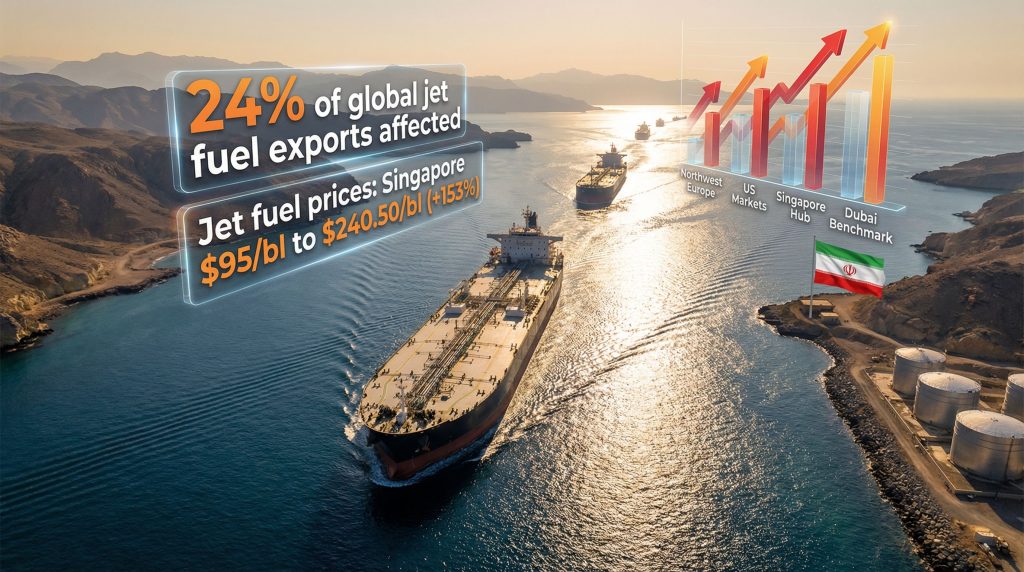
The closure of the Strait of Hormuz represents more than a regional disruption—it constitutes a systematic breakdown of global energy distribution networks. Prior to current tensions, approximately 24 percent of worldwide jet fuel exports transited through this narrow waterway, creating a single-point-of-failure that affects aviation fuel availability across multiple continents.
Global jet fuel production operates within tight constraints that distinguish it from other refined products. Total worldwide production reaches approximately 8 million barrels per day, with only 1.8 million barrels per day entering international export markets. This relatively small export volume means that disruptions to major transit routes can eliminate substantial portions of globally available supply.
Since early March 2026, global jet fuel exports have contracted by more than 60 percent to fewer than 700,000 barrels per day. This reduction represents one of the most severe supply contractions in modern commodity markets, exceeding disruptions experienced during previous energy crises.
Market Structure Vulnerabilities Exposed
The fundamental challenge facing jet fuel markets stems from production yield limitations inherent in crude oil refining processes. While refineries extract 19-20 gallons of gasoline and 11-13 gallons of diesel from each barrel of crude oil, jet fuel yields reach only 3-4 gallons per barrel. This disproportionate yield creates inherent supply constraints that cannot be easily overcome through operational adjustments.
According to Kpler analytics data from March 2025, international crude oil production averaged 83 million barrels per day, supporting 26.7 million barrels per day of gasoline production and 30 million barrels per day of diesel production. In contrast, jet-kerosene production reached just under 8 million barrels per day, highlighting the structural limitations affecting aviation fuel availability.
These yield constraints become particularly problematic during supply disruptions because refineries cannot quickly redirect production capacity from other products to jet fuel. The technical specifications and processing requirements for aviation fuel create bottlenecks that persist even when crude oil remains available.
Critical Dependency Ratios Across Major Aviation Markets
Regional vulnerability patterns reveal significant disparities in supply security across global markets. European markets depend on Middle East Gulf sources for more than 50 percent of jet fuel imports, creating exposure levels that exceed those of most other energy commodities.
The concentration risk becomes evident when examining specific supply routes and regional dependencies:
- Asian markets: Singapore refineries reducing utilization from 85% to 60%
- European hubs: ARA inventory levels declining 8% year-over-year
- North American markets: West Coast facilities facing 17% capacity reduction
These dependency ratios indicate that certain regions face substantially greater exposure to supply disruptions than others, with geographic proximity to affected transit routes serving as a primary vulnerability factor. Furthermore, the iran conflict global jet fuel price spike highlights how these regional vulnerabilities translate into immediate market pressures.
When big ASX news breaks, our subscribers know first
What Price Scenarios Are Aviation Markets Currently Experiencing?
Regional Price Divergence Patterns
Current market dynamics reveal unprecedented price escalation across all major aviation fuel trading hubs, with regional variations reflecting different degrees of supply security and alternative sourcing capabilities.
| Market Region | Pre-Conflict Baseline | Current Peak Levels | Percentage Surge |
|---|---|---|---|
| Northwest Europe | $800/t | $1,600/t | 100% |
| US Markets | $107/bl | $167.75/bl | 57% |
| Singapore Hub | $95/bl | $240.50/bl | 153% |
| Dubai Benchmark | $75/bl | $150/bl | 100% |
The Singapore market experienced the most severe price surge, with jet fuel prices climbing 153 percent to peak at $240.50 per barrel on March 4, 2026. This extreme volatility reflects Singapore's position as a major refining hub dependent on steady Middle Eastern crude feedstock flows.
Northwest Europe markets witnessed prices doubling from $800 per metric ton to exceed $1,600 per metric ton, reaching levels equivalent to $210 per barrel. These price levels match previous highs established during the 2022 Ukraine energy crisis, indicating comparable market stress conditions.
United States markets showed relatively moderate increases, with average jet fuel prices rising 57 percent to peak at $167.75 per barrel on March 13, 2026. This comparatively restrained price movement reflects greater domestic production capacity and diversified import sources.
Crude Oil Transmission Mechanisms
The foundation for refined product price movements stems from crude oil market reactions, which establish cost floors for all downstream petroleum products. WTI crude oil increased $29.19 per barrel (43.6 percent) to $96.21 per barrel, reaching its highest level since July 2022 after peaking at $98.71 per barrel.
North Sea Dated crude climbed $31.85 per barrel, representing a 45 percent increase, surpassing $100 per barrel for the first time since November 2022. This benchmark serves as the primary pricing reference for European crude purchases and refined product valuations.
Dubai crude oil more than doubled to exceed $150 per barrel, surpassing the previous 2008 record high by 7 percent and establishing historically unprecedented price levels. This extreme price movement reflects the direct impact of regional supply disruptions on benchmark crude pricing.
The divergence between crude oil price increases (43-45 percent) and jet fuel price increases (57-153 percent) demonstrates market recognition of aviation fuel's uniquely constrained supply situation compared to other refined products. Moreover, these developments occur alongside broader concerns about an oil price rally driven by geopolitical tensions.
Which Supply Chain Adaptations Are Emerging Across Global Markets?
Asian Refining Sector Response Strategies
Asian refineries are implementing immediate operational adjustments to address crude supply disruptions and anticipated feedstock shortages. These modifications represent strategic responses rather than temporary maintenance adjustments.
Singapore Refinery Utilization Changes:
- Run rates reduced from 85% to 60% utilization
- 25 percentage point decline in operational intensity
- Response to Middle Eastern crude supply disruptions
Japanese Refinery Operational Adjustments:
- 10% run cuts implemented across facilities
- End-March gasoline cargo cancellations
- Private confirmation of production reductions
Chinese Export Contraction Patterns:
Chinese refiners had planned to increase jet fuel exports by 40,000 barrels per day during March 2026, targeting 650,000 barrels per day total capacity. However, preliminary data from Vortexa analytics indicates only 155,000 barrels per day was loaded in the first week of March, representing a 495,000 barrels per day shortfall against expansion targets.
State-owned Chinese refiners source up to 50 percent of crude purchases from Middle Eastern suppliers, leaving major exporters like Sinopec and PetroChina directly exposed to regional supply disruptions. This dependency creates operational constraints that extend beyond immediate production adjustments and contribute to ongoing oil prices stagnation concerns.
European Import Substitution Challenges
European markets face particular vulnerability due to historical refining capacity reductions and increasing import dependence. ARA hub inventory levels show an 8 percent year-over-year decline as of March 11, 2026, representing early indicators of more significant tightening expected by April 2026.
European Refinery Maintenance Schedules:
- Maintenance programs proceeding despite margin opportunities
- Service provider contracts already finalised
- Cancellation costs potentially exceeding margin gains
Import Route Disruptions:
- Vessels carrying European fuel redirected to Asian markets
- Middle East Gulf supplies over 50% of European imports
- Alternative sourcing options increasingly constrained
European refiners are maintaining scheduled spring maintenance programs despite surge in refined product crack spreads, indicating long-term planning constraints that limit ability to capitalise on short-term margin opportunities.
North American Market Restructuring
North American markets face unique challenges stemming from recent refinery capacity reductions and import dependency patterns. The US West Coast experiences particular vulnerability following shutdown of two major refineries representing 17 percent of California's crude processing capacity.
Recent Capacity Reductions:
- Phillips 66: Ceased 139,000 b/d Los Angeles refining complex production
- Valero: Idling process units at 150,000 b/d Benicia refinery
- Combined impact: 289,000 b/d offline capacity
Import Dependency Patterns:
- South Korea supplies 85% of total US jet fuel imports
- 87% of West Coast imports sourced from South Korean refineries
- Regional jet prices reached 44-month highs following South Korean export restrictions
South Korean implementation of mandatory caps on refined petroleum product exports, limiting shipments to 2025 monthly levels, indicates minimal flexibility to supplement US West Coast supply after refinery shutdowns. These developments intersect with broader tariff economic implications affecting international trade patterns.
How Are Airlines Implementing Crisis Management Strategies?
Immediate Operational Adjustments
Airlines are implementing comprehensive operational modifications to address both fuel cost increases and supply availability concerns. These adjustments extend beyond typical cost management strategies to encompass route planning and capacity utilisation decisions.
Route Optimisation Protocols:
- Middle East airspace avoidance procedures
- Flight path extensions increasing fuel consumption
- Alternative routing through longer corridor systems
Capacity Management Responses:
- Flight cancellation programs affecting major carriers
- Air New Zealand: 1,100 flights cancelled affecting 44,000 passengers
- Schedule adjustments prioritising high-yield routes
Fuel Procurement Strategies:
- Extended hedging programs to manage price volatility
- Supply contract renegotiations with fuel suppliers
- Strategic inventory accumulation where storage permits
Airlines face particular challenges because jet fuel represents approximately 20-25 percent of total operating costs, meaning price increases translate directly into profitability impacts that cannot be easily absorbed through operational efficiencies.
Financial Risk Mitigation Approaches
Carrier financial responses involve multiple mechanisms to address both immediate cost pressures and longer-term uncertainty about fuel availability and pricing.
Hedging Strategy Limitations:
- Traditional crack spread hedging becomes less effective during extreme volatility
- Limited availability of hedging instruments for extended forward periods
- Basis risk increases when physical and financial markets diverge
Fare Adjustment Mechanisms:
- Cathay Pacific: Doubling fuel surcharges on international routes
- Dynamic pricing adjustments based on fuel cost transmission
- Route-specific surcharge implementation reflecting regional price variations
Profit Margin Compression Scenarios:
Airlines anticipate sustained margin pressure extending into 2026, with fuel cost increases outpacing ability to implement compensatory fare increases in competitive markets. According to a recent Australian economic impact analysis, these cost pressures particularly affect regional aviation markets.
Airlines cannot immediately pass through fuel cost increases due to advance booking patterns and competitive constraints, creating a lag effect that amplifies financial impact during rapid price escalation periods.
What Long-Term Market Structure Changes Are Anticipated?
Refining Capacity Investment Scenarios
The current crisis accelerates existing trends toward refining capacity expansion in regions with greater supply security. US production forecasts indicate increases of 4.5 percent to 1.83 million barrels per day following recent investments to boost jet fuel capacity.
Energy Information Administration Projections:
- 2026 jet fuel price forecast: Raised 37% to $2.67/USG
- US production capacity: Increased 4.5% to 1.83mn b/d
- Investment catalyst: Stronger margin expectations
These capacity additions reflect recognition that jet fuel margins may remain elevated compared to historical averages, providing investment incentives for refinery modifications and expansions.
Alternative Supply Development:
- Nigeria Dangote refinery: 650,000 b/d capacity utilisation potential
- US Gulf Coast: Export redirection from Latin America to domestic markets
- India Reliance complications: Russian crude exposure affecting European buyers
Strategic Reserve Utilisation Considerations
Governments are evaluating strategic petroleum reserve policies in light of refined product supply vulnerabilities revealed by current disruptions. Traditional crude oil reserves provide limited immediate relief for refined product shortages.
Policy Framework Evolution:
- Strategic refined product reserve establishment
- International coordination protocols for emergency supply sharing
- Private sector inventory requirement modifications
Regional Diversification Initiatives:
- Supply chain resilience improvements through geographic distribution
- Alternative transit route development reducing chokepoint dependency
- Refining capacity incentives in strategic locations
These developments highlight broader energy export challenges facing resource-dependent economies in an increasingly volatile global environment.
Which Regional Markets Face Greatest Vulnerability?
European Supply Security Assessment
European markets demonstrate the highest vulnerability to sustained supply disruptions due to import dependency and limited alternative sourcing options. Import dependency ratios exceeding 50 percent from affected regions create exposure levels that significantly exceed other major markets.
Vulnerability Factors:
- Import dependency: Over 50% from Middle East Gulf sources
- Refining capacity: Historical reductions increasing import reliance
- Inventory buffers: Current 8% decline trajectory with April tightening expected
Alternative Sourcing Constraints:
- Indian Reliance: European buyers avoiding due to Russian crude concerns
- Nigerian Dangote: Limited additional export capacity availability
- US Gulf Coast: Traditional Latin America export focus
European supply security depends heavily on resolution of transit route disruptions or development of alternative supply sources that currently face capacity or political constraints.
Asia-Pacific Adaptation Mechanisms
Asian markets show varied adaptation capabilities, with some regions implementing successful supply substitution while others face continued constraints.
South Korean Export Policy Impact:
- Mandatory caps limiting exports to 2025 monthly levels
- 85% of US jet fuel imports affected by export restrictions
- Limited flexibility for additional supply to international markets
Chinese Refinery Exposure:
- State-owned refiners: 50% Middle Eastern crude dependency
- Sinochem: Planning cuts at 300,000 b/d Quangzhou refinery
- Rongsheng: 20 percentage point run cuts ahead of schedule
Regional Export Suspension Effects:
- Thailand: Energy ministry halting all oil exports
- China: Regulatory guidance against overseas shipping
- Coordinated defensive posture prioritising domestic energy security
These regional adjustments reflect broader trade war impacts on global commodity flows and supply chain configurations.
The next major ASX story will hit our subscribers first
What Strategic Scenarios Could Reshape Future Market Dynamics?
Escalation vs De-escalation Pathways
Future market evolution depends significantly on geopolitical resolution scenarios, with different outcomes producing vastly different supply chain configurations.
Prolonged Disruption Scenario:
- Sustained 60%+ global export reduction maintenance
- Permanent supply chain diversification requirements
- Regional refining capacity expansion acceleration
- Strategic inventory policy restructuring
Conflict Resolution Scenario:
- Supply normalisation timeline: 3-6 month gradual restoration
- Price normalisation lagging physical supply restoration
- Residual supply chain diversification maintaining higher cost structures
- Long-term market structure changes persisting beyond crisis resolution
Secondary Chokepoint Risk Assessment:
- Suez Canal and Panama Canal alternative routing capacity
- Red Sea transit route security considerations
- Multiple simultaneous chokepoint closure scenarios
Structural Market Evolution Possibilities
Current disruptions may catalyse permanent changes in global aviation fuel market structure extending beyond immediate crisis resolution.
Supply Chain Reconfiguration Trends:
- Geographic diversification: Reduced dependency on single-source regions
- Inventory management: Increased strategic buffer requirements
- Contract structures: Longer-term supply agreements with flexibility provisions
Investment Pattern Shifts:
- Regional refining capacity expansion in secure locations
- Alternative fuel development acceleration for aviation sector
- Infrastructure investments supporting supply chain resilience
Regulatory Framework Evolution:
- Strategic petroleum reserve policy expansion to include refined products
- International energy security coordination mechanisms
- Private sector inventory requirement modifications
Investment and Policy Response Frameworks
Government intervention mechanisms are evolving to address vulnerabilities revealed by current supply disruptions, with implications extending across multiple policy domains.
Energy Security Policy Development:
- Strategic refined product reserve establishment
- Critical infrastructure protection for refining facilities
- International coordination protocols for emergency supply sharing
Private Sector Capacity Expansion Incentives:
- Tax incentives for jet fuel production capacity additions
- Regulatory streamlining for refinery modification projects
- Strategic location incentives for supply chain diversification
Market Mechanism Improvements:
- Enhanced price transparency and reporting requirements
- Emergency allocation protocols during supply disruptions
- International market integration initiatives reducing regional vulnerabilities
The iran conflict global jet fuel price spike reveals fundamental structural weaknesses in aviation fuel supply chains that require systematic addressing through both private investment and coordinated policy responses to prevent future similar disruptions.
As major airlines face unprecedented operational challenges, recent reports from CNBC indicate that the iran conflict global jet fuel price spike is exacerbating economic disparities across different sectors of the global economy.
Market Analysis Note: The scenarios outlined in this analysis are based on current market conditions as of March 2026 and reflect industry expert assessments. Actual market developments may vary significantly based on geopolitical resolution, weather factors, and unforeseen supply or demand changes. Investors and industry participants should conduct independent analysis and risk assessment before making strategic decisions.
Concerned About Energy Market Volatility Impacting Your Investment Portfolio?
The iran conflict global jet fuel price spike demonstrates how geopolitical disruptions can create exceptional opportunities for investors positioned ahead of market movements. Discovery Alert's proprietary Discovery IQ model delivers real-time alerts on significant ASX mineral discoveries, instantly empowering subscribers to identify actionable opportunities before broader market recognition. Begin your 14-day free trial today and secure your market-leading advantage during these volatile times.