May 22, 2026
Global Battery Markets Face Unprecedented Disruption Through Strategic Resource Realignment
Battery manufacturers worldwide are confronting an evolving landscape where traditional supply dependencies no longer guarantee operational security. The convergence of geopolitical tensions, technological advancement, and energy transition demands has created market conditions requiring fundamental reassessment of material sourcing strategies. These forces are reshaping how companies approach critical mineral procurement, particularly for components essential to lithium-ion battery production, with the Idemitsu natural graphite anode supply chain representing a pivotal development in this sector.
The strategic importance of securing reliable anode material supplies has intensified as electric vehicle adoption accelerates and renewable energy storage deployment expands globally. Furthermore, market participants are increasingly recognizing that diversified supply chains represent competitive advantages rather than operational luxuries, driving investment toward alternative sourcing partnerships and geographic risk distribution models.
When big ASX news breaks, our subscribers know first
How Japan's Battery Supply Chain Vulnerability Drives Strategic Partnerships
Japan's industrial battery sector confronts significant procurement challenges stemming from heavy dependence on imported graphite materials. This vulnerability became particularly evident as global supply chain disruptions highlighted the risks associated with concentrated sourcing from single regions or suppliers.
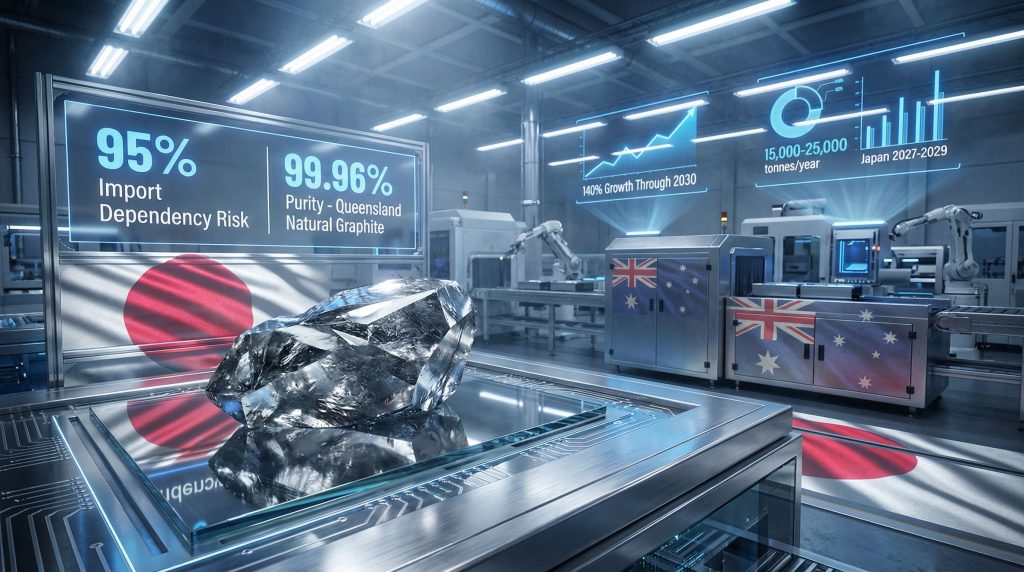
Quantifying Japan's Graphite Import Dependency Risk
The Japanese market relies extensively on imported graphite for battery manufacturing, creating systematic exposure to supply disruptions and price volatility. Industry analysts note that this dependence has prompted strategic initiatives aimed at securing alternative sources through bilateral partnerships and direct investment programs.
The economic implications extend beyond immediate material costs, encompassing potential production delays and market share losses in competitive automotive and energy storage sectors. Consequently, Japanese manufacturers have calculated that supply chain resilience investments today provide insurance against future operational disruptions that could cost significantly more to address reactively.
Key vulnerability factors include:
- Transportation route concentration through specific shipping lanes
- Currency exchange rate fluctuations affecting procurement costs
- Regulatory changes in source countries impacting export availability
- Quality consistency variations among different suppliers
- Lead time extensions during peak demand periods
China's Market Dominance Creates Systemic Risk
China's substantial control over global graphite reserves and processing capabilities creates concentration risk for international battery manufacturers. The country's dominant position in both natural resource extraction and value-added processing stages means that supply chain decisions in China can have cascading effects throughout global battery markets.
Historical precedents demonstrate how export restrictions on critical materials can rapidly impact manufacturing operations in dependent markets. For instance, the 2010-2012 rare earth supply disruptions illustrated how quickly industrial production can be affected when key material flows are interrupted, leading to emergency sourcing initiatives and accelerated alternative supplier development programs.
However, market concentration metrics reveal that diversification strategies require significant lead times and capital investment to establish effective alternative supply channels. Companies pursuing supply security must balance immediate cost considerations against long-term operational resilience objectives.
What Makes Australia-Japan Graphite Partnerships Strategically Superior?
Geographic proximity and established trade relationships position Australia as an attractive alternative source for Japanese battery material requirements. The bilateral partnership model offers distinct advantages over traditional single-supplier arrangements through risk distribution and operational flexibility.
Geographic Advantage in Supply Chain Resilience
Australia-Japan shipping routes provide shorter transit times and reduced geopolitical risk exposure compared to alternative sourcing regions. The established maritime trade infrastructure between these countries supports reliable logistics operations even during periods of global shipping congestion.
Political stability metrics favor long-term partnership development, as both countries maintain consistent regulatory frameworks and established dispute resolution mechanisms. This stability supports multi-year investment planning and capital allocation decisions required for integrated supply chain development.
In addition, the currency relationship between Australian dollars and Japanese yen offers natural hedging opportunities for long-term supply agreements, reducing foreign exchange volatility impacts on material costs.
Resource Quality Benchmarking
Queensland's graphite deposits demonstrate high-grade characteristics suitable for advanced battery applications. The naturally occurring purity levels reduce processing requirements and associated costs compared to lower-grade alternatives that require extensive refinement.
Natural Graphite Quality Comparison
| Source Region | Processing Complexity | Energy Requirements | Yield Efficiency |
|---|---|---|---|
| Queensland | Low | Minimal | High |
| Alternative Sources | High | Extensive | Variable |
| Synthetic Options | Very High | Maximum | Moderate |
The quality advantage translates into operational efficiencies throughout the manufacturing process, from initial processing through final anode production. Higher-grade starting materials typically produce more consistent end products with predictable performance characteristics.
Why Natural Graphite Anodes Are Outpacing Synthetic Alternatives
Battery manufacturers are increasingly favoring natural graphite-based anodes due to superior performance characteristics and production economics. The material properties of natural graphite provide advantages in energy density, charging characteristics, and manufacturing efficiency compared to synthetic alternatives.
Production Cost Economics Favor Natural Materials
Manufacturing cost analysis reveals significant economic advantages for natural graphite processing compared to synthetic production methods. The energy requirements for natural graphite refinement are substantially lower than synthetic graphite manufacturing, reducing both operating costs and carbon footprint implications.
Natural graphite processing typically requires:
- Lower temperature processing stages
- Reduced energy consumption per unit of output
- Shorter production cycle times
- Less complex chemical treatment requirements
- Lower capital equipment investments
Scalability considerations favor natural graphite operations, as resource extraction can expand more readily than synthetic production capacity. Mining operations can increase output through conventional expansion methods, while synthetic facilities require proportional increases in energy infrastructure and chemical processing capabilities.
Performance Specifications Drive Market Preference
Battery performance testing consistently demonstrates advantages for natural graphite anodes in key operational metrics. These materials exhibit superior cycle life characteristics, maintaining capacity retention over extended charge-discharge cycles compared to synthetic alternatives.
Natural graphite anodes demonstrate particular advantages in:
- Energy density optimisation – Higher capacity per unit weight
- Thermal stability – Better performance under temperature variations
- Fast charging capabilities – Superior ion transport characteristics
- Manufacturing consistency – More predictable quality outcomes
- Cost-effectiveness – Lower per-unit production expenses
The combination of performance benefits and economic advantages has driven increasing adoption across automotive and energy storage applications, where both operational efficiency and cost competitiveness are critical success factors.
How Multi-Partner Consortiums Accelerate Market Entry
Complex supply chain development projects benefit from consortium structures that distribute technical, financial, and market risks across multiple specialised participants. The four-company partnership model exemplifies how different organisational capabilities can be integrated to accelerate commercial development timelines.
Risk Distribution Through Strategic Alliances
Multi-partner consortiums enable risk sharing across distinct functional areas: resource access, processing expertise, market knowledge, and financial capacity. This structure reduces individual company exposure while maintaining collective project viability through diversified capabilities and shared investment requirements.
Each consortium member contributes specialised expertise that would be difficult and expensive for individual companies to develop independently. Japanese energy companies provide market access and customer relationships, Australian resource companies contribute geological expertise and extraction capabilities, trading houses offer supply chain management and logistics coordination, while chemical processors provide technical manufacturing knowledge.
The risk distribution model addresses common supply chain development challenges:
- Technical risk – Shared across processing and extraction specialists
- Market risk – Distributed among companies with customer relationships
- Financial risk – Spread across multiple balance sheets and funding sources
- Operational risk – Managed through complementary operational capabilities
- Regulatory risk – Addressed through local market knowledge and compliance expertise
Integrated Value Chain Development Timeline
Commercial development follows systematic phases that leverage each partner's capabilities while maintaining project momentum through parallel workstreams. The Idemitsu natural graphite anode supply chain represents a prime example of this coordinated approach.
Typical Development Sequence:
- Resource Evaluation Phase – Geological assessment and reserve confirmation (6-12 months)
- Facility Planning Phase – Site selection, permitting, and engineering design (12-18 months)
- Construction Phase – Equipment procurement, installation, and commissioning (18-24 months)
- Commercial Ramp-up Phase – Production optimisation and market penetration (24-36 months)
The consortium structure allows overlapping development activities, reducing overall project timelines compared to sequential single-company approaches. Market development can proceed while facility construction continues, and customer qualification processes can begin during equipment commissioning phases.
What Production Capacity Targets Mean for Global Supply
Planned production capacity additions reflect growing demand projections and strategic positioning objectives across regional battery manufacturing hubs. These investments represent responses to identified supply gaps and opportunities for market share capture in expanding battery material markets.
Demand Growth Projections Drive Investment Decisions
Electric vehicle production scaling creates exponential growth in anode material requirements, as battery capacity increases drive proportional material consumption growth. Industry forecasts indicate substantial capacity gaps between current supply capabilities and projected demand levels through 2030.
Energy storage system deployment for renewable energy integration creates additional demand streams beyond automotive applications. Grid-scale battery installations require significant material inputs and represent growing market segments independent of vehicle production trends.
The convergence of these demand drivers supports investment justification for new production capacity, particularly in regions where supply security considerations add strategic value beyond pure economic returns. Moreover, this mining industry evolution reflects broader changes across the sector.
Regional Manufacturing Hub Strategy
Planned Asian Production Capacity Development
| Location | Capacity Target | Development Timeline | Strategic Focus |
|---|---|---|---|
| Japan | Advanced Processing | 2027-2029 | Market Integration |
| Australia | Resource Development | 2026-2028 | Supply Security |
| UAE | Intermediate Processing | 2025-2027 | Geographic Distribution |
The hub strategy recognises that integrated supply chains require multiple processing stages optimally located near resources, markets, or logistical advantages. Japanese facilities focus on advanced processing near end-market customers, while Australian operations concentrate on initial resource preparation and beneficiation activities.
UAE processing facilities provide geographic diversification and access to growing Middle Eastern and African markets. This regional distribution model reduces transportation costs while providing supply chain redundancy through multiple production locations.
The next major ASX story will hit our subscribers first
How Government Support Accelerates Critical Mineral Security
State-level investment in critical mineral supply chains reflects national security considerations beyond commercial market dynamics. Government participation provides capital access, regulatory support, and strategic coordination that private markets alone cannot efficiently deliver.
State Investment Mechanisms and Policy Frameworks
The Japan Organisation for Metals and Energy Security represents direct government involvement in critical material supply chain development. This state-backed entity invested $30 million in UAE graphite processing facilities, demonstrating official commitment to supply diversification objectives.
Government investment mechanisms typically provide:
- Risk capital for early-stage project development
- Political risk mitigation through diplomatic relationships
- Regulatory coordination across multiple jurisdictions
- Long-term strategic planning beyond private investment horizons
- Market coordination among domestic industry participants
These capabilities address market failures where private investment alone cannot achieve optimal outcomes for national economic security objectives. Additionally, government intervention in mining demonstrates how policy frameworks evolve to support strategic industries.
Strategic Stockpiling and Supply Buffer Creation
National stockpiling programmes create demand floors that support supply chain investment decisions while providing emergency reserve capabilities. These buffer systems enable continued industrial production during temporary supply disruptions while alternative sources are activated.
The stockpiling approach addresses supply chain vulnerabilities through systematic inventory management across critical materials. Government coordination ensures adequate reserve levels while avoiding excessive inventory costs or market distortion effects.
Cross-border cooperation on strategic reserves enables burden-sharing among allied nations while maintaining collective supply security. Joint stockpiling initiatives can achieve economies of scale while reducing individual country storage and management costs.
What This Partnership Model Means for Global Battery Markets
The Idemitsu natural graphite anode supply chain development illustrates broader shifts toward supply chain regionalisation and strategic partnership models in critical material markets. These initiatives signal movement away from purely cost-optimised procurement toward resilience-focused sourcing strategies.
Competitive Positioning Against Chinese Suppliers
Alternative supply chain development creates competitive dynamics that extend beyond simple price competition. Quality differentiation, delivery reliability, and customer service capabilities become competitive factors when supply security concerns motivate purchasing decisions.
Market positioning strategies emphasise:
- Supply reliability – Consistent delivery schedules and quality specifications
- Technical support – Application engineering and customer service capabilities
- Flexibility – Customisation and rapid response to changing requirements
- Innovation – Product development and performance improvement initiatives
- Partnership approach – Long-term relationship development rather than transactional sales
These factors create competitive advantages that can support premium pricing where customers value supply security over lowest-cost procurement approaches. Furthermore, US‑China trade tensions continue to reshape global sourcing strategies.
Replication Potential Across Other Critical Minerals
Can the Japan-Australia graphite partnership model be applied to other critical minerals?
The four-partner consortium structure combining resource access, processing expertise, trading capabilities, and market distribution creates a framework applicable to lithium, rare earth elements, nickel, and cobalt supply chain development. Similar risk distribution benefits and accelerated development timelines can be achieved through adapted partnership arrangements tailored to specific material characteristics and market requirements.
Successful replication requires:
- Compatible regulatory frameworks across partner countries
- Complementary technical capabilities among consortium members
- Aligned strategic objectives and investment timelines
- Market demand sufficient to support dedicated supply chain investment
- Resource quality and quantity adequate for commercial-scale development
These conditions exist for multiple critical mineral supply chains, suggesting broader adoption of consortium-based development models in response to supply security concerns and market growth opportunities. The Australian critical minerals reserve strategy supports these collaborative approaches.
Supply Chain Innovation and Technology Integration
Modern supply chain development incorporates advanced technologies and innovative processing methods to optimise efficiency and reduce environmental impact. Digital monitoring systems provide real-time visibility across production stages, enabling proactive quality control and inventory management.
Process optimisation technologies reduce energy consumption and waste generation during graphite refinement. Advanced purification methods achieve higher purity levels with lower environmental impact compared to traditional processing approaches.
Automation integration throughout the supply chain reduces labour requirements while improving consistency and safety outcomes. However, the implementation requires significant capital investment and workforce retraining programmes to ensure successful technology adoption.
Furthermore, blockchain technology enables supply chain traceability and authentication, addressing growing demands for responsible sourcing verification. These systems provide customers with detailed provenance information while supporting regulatory compliance requirements across international markets.
Environmental and Sustainability Considerations
Environmental stewardship represents a critical component of modern supply chain development, particularly for materials supporting clean energy applications. The Idemitsu natural graphite anode supply chain incorporates sustainability principles throughout operational planning and facility design.
Water management systems minimise consumption and ensure responsible discharge practices at processing facilities. Closed-loop systems recycle process water while preventing contamination of surrounding water sources.
Carbon footprint reduction initiatives focus on renewable energy adoption and process efficiency improvements. Natural graphite processing requires less energy than synthetic alternatives, providing inherent environmental advantages that support corporate sustainability objectives.
Land rehabilitation programmes restore mining sites to productive use following resource extraction completion. These initiatives demonstrate long-term environmental responsibility while supporting community relationships in operational regions.
Additionally, critical minerals strategy development increasingly emphasises environmental sustainability alongside supply security objectives.
FAQ: Understanding Natural Graphite Anode Supply Chain Development
Common Questions About Partnership Structures
How do multi-country partnerships manage regulatory compliance?
Multi-jurisdictional partnerships typically establish legal structures in each operating country while maintaining coordination through umbrella agreements and joint management committees. Regulatory compliance is managed through local expertise provided by in-country partners, with legal frameworks designed to address tax, environmental, and operational requirements specific to each jurisdiction.
What are the typical investment timelines for integrated supply chains?
Integrated supply chain development typically requires 4-7 years from initial partnership formation through commercial production. Resource evaluation and feasibility studies occupy the first 12-18 months, followed by permitting and facility design phases lasting 12-24 months, construction and commissioning requiring 18-30 months, and commercial ramp-up extending 12-24 additional months.
How do companies protect intellectual property in joint ventures?
Intellectual property protection in consortium arrangements relies on comprehensive legal agreements defining ownership, usage rights, and confidentiality obligations. Partners typically retain ownership of pre-existing IP while sharing rights to jointly developed technologies through clearly defined licensing arrangements and non-disclosure provisions.
Technical and Commercial Considerations
What quality standards must natural graphite meet for battery applications?
Battery-grade natural graphite requires minimum purity levels exceeding 99.9%, with specific limitations on sulfur, iron, and other metallic impurities. Particle size distribution, surface area characteristics, and crystalline structure must meet precise specifications to ensure consistent electrochemical performance and manufacturing compatibility with existing production equipment.
How do transportation costs affect overall supply chain economics?
Transportation typically represents 8-15% of delivered material costs, varying with shipping distances, handling requirements, and packaging specifications. Bulk shipping methods reduce per-unit costs, while containerised transport offers flexibility and quality protection. Regional processing facilities help optimise transportation economics by reducing shipping volumes and adding value closer to end markets.
What backup supply arrangements ensure production continuity?
Production continuity relies on multiple supply sources, strategic inventory management, and alternative processing capabilities. Effective backup arrangements typically include secondary supplier relationships, emergency stockpiles covering 30-90 days of production requirements, and cross-qualification of materials from different sources to enable rapid supplier substitution when necessary.
Critical minerals processing projects demonstrate how strategic partnerships can accelerate development timelines while distributing associated risks among specialised participants.
Disclaimer: This analysis contains forward-looking projections and market assessments based on current industry conditions and announced development plans. Actual outcomes may vary significantly due to market dynamics, regulatory changes, technological developments, or other factors beyond current predictions. Investment and sourcing decisions should be based on comprehensive due diligence and professional consultation appropriate to specific circumstances.
Looking to Capitalise on Strategic Mineral Supply Chain Developments?
Discovery Alert's proprietary Discovery IQ model delivers real-time notifications on significant ASX mineral discoveries, instantly empowering subscribers to identify actionable opportunities ahead of the broader market. Begin your 14-day free trial today and secure your market-leading advantage in the rapidly evolving critical minerals sector.