May 19, 2026
Global Battery Metal Supply Chains Face Unprecedented Realignment
The global energy transition hinges on a complex web of critical mineral supply chains, where lithium extraction projects increasingly determine the pace of electric vehicle adoption and renewable energy storage deployment. As commodity markets experience extreme volatility and geopolitical tensions reshape resource access patterns, new production sources emerge that fundamentally alter established trade relationships and strategic dependencies.
African mineral-rich nations now find themselves at the center of intensifying competition between Western and Eastern development models. Each approach offers distinct frameworks for risk management, capital deployment, and operational timelines. Furthermore, the Democratic Republic of Congo's emergence as a diversified critical minerals and energy security producer extends beyond its traditional copper and cobalt dominance into territories that could reshape global lithium supply fundamentals.
When big ASX news breaks, our subscribers know first
Strategic Positioning Within Africa's Critical Minerals Corridor
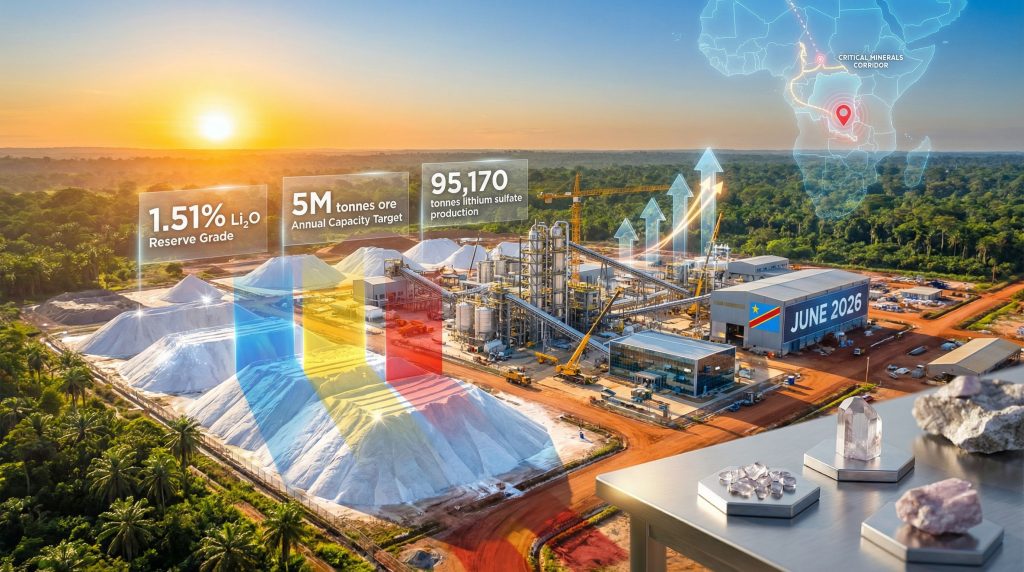
The Manono lithium deposit represents one of the world's largest undeveloped hard-rock lithium resources, positioned strategically within the Democratic Republic of Congo's established mining infrastructure network. With proven reserves graded at 1.51% Li2O, the deposit exceeds global industry averages of approximately 1.2% Li2O while remaining below premium operations like Australia's Greenbushes mine at 2.1% Li2O.
This geographic positioning places the operation within what industry analysts characterise as Africa's critical minerals corridor. The facility leverages existing transportation networks and regional processing capabilities. The 5 million tonnes annual ore capacity target positions Manono as a significant contributor to global lithium supply, particularly as the DRC seeks to diversify beyond its current dominance in cobalt production, which accounts for approximately 60% of global output.
Key Reserve Comparison:
| Deposit | Grade (Li2O %) | Annual Capacity | Processing Method |
|---|---|---|---|
| Manono (DRC) | 1.51% | 5M tonnes ore | Spodumene concentrate |
| Global Average | 1.2% | 3.2M tonnes | Mixed methodologies |
| Greenbushes (Australia) | 2.1% | 8M tonnes | Spodumene concentrate |
The deposit's hard-rock spodumene characteristics require conventional mining infrastructure rather than brine evaporation methods. This necessitates open-pit extraction, ore crushing, and flotation concentration before downstream processing. This methodology provides operational flexibility and potentially higher recovery rates from high-grade ores, though requiring more substantial capital investment compared to brine-based systems.
Integration with Regional Development Strategy
The project's development aligns with broader Chinese investment patterns across African battery metals. Pragmatic operational approaches prioritise revenue generation despite regulatory complexities. This positioning reflects a fundamental shift in how critical minerals projects navigate political risk, with operational advancement proceeding concurrent with legal dispute resolution rather than sequential dependency.
The $1 billion capital deployment for initial phase development demonstrates Chinese willingness to fund large-scale African mining operations. This approach eliminates the need for public co-investment from host governments, creating financing models that accelerate project timelines whilst maintaining state participation through revenue-sharing arrangements.
Production Timeline Significance Amid Market Volatility
The adjusted June 2026 production commencement represents a strategic market entry point during significant commodity price adjustment. Lithium markets have experienced an 86% price collapse from late-2022 peaks, driven by Chinese inventory accumulation and increased domestic output, creating challenging conditions for new project economics.
This timing reflects broader market dynamics where Chinese stockpiling activities and rising domestic production have created oversupply conditions. These conditions continue to pressure prices despite growing long-term demand projections. The late-2022 price peaks saw lithium carbonate reaching approximately $80,000 per tonne before declining substantially throughout 2023-2025.
When Zijin to launch Congo's first lithium output operations commence, market conditions will be markedly different from the peak pricing environment. However, this development aligns with Zijin's 2025 strategy for international expansion and resource diversification.
Market Entry Strategy During Price Weakness
The centralised marketing control by Zijin Mining provides direct exposure to lithium price realisations while eliminating potential conflicts over sales timing or pricing strategies during initial production phases. This structure enables immediate export operations following first production, suggesting pre-arranged offtake agreements or established customer relationships.
The commitment to immediate exports reflects confidence in international market access despite ongoing commodity price weakness. Historical precedent from projects like Australia's Mount Marion operation, which commenced during 2016 price weakness, demonstrates that market entry during downturns can position operations to benefit substantially from subsequent recovery cycles.
Production Ramp-Up Considerations:
• Initial target: 95,170 tonnes annual crude lithium sulfate production
• Processing pathway: Spodumene concentrate to lithium sulfate conversion
• Marketing structure: Centralised sales control including state partner share
• Export logistics: Immediate shipment capabilities following first production
The lack of disclosed specific production volumes or first-year export targets reflects operational flexibility rather than project uncertainty. This allows management to optimise production ramp-up based on real-time market conditions and processing efficiency achievements.
Resource Control Dynamics and Geopolitical Implications
The ownership structure reflects evolving patterns in African mining development, where Chinese operators maintain operational control through 61% equity stakes. This arrangement ensures state participation creates political legitimacy and revenue alignment. This model contrasts sharply with traditional Western mining approaches that emphasise formal dispute resolution before capital deployment.
"The Chinese development approach prioritises operational progress and revenue generation despite legal complexities, whereas Western operators emphasise legal certainty before commencing major capital deployment."
The United States has actively pursued strategies to redirect Congolese lithium supply toward Western markets through short-term contracting mechanisms. This directly challenges established Chinese dominance in African resource access. This competition reflects broader geopolitical realignment where critical minerals and energy security access becomes central to national security considerations.
Contemporary US–China trade strategies increasingly focus on securing alternative supply sources for critical materials. Consequently, African lithium development becomes a focal point for strategic competition between major powers.
Comparative Development Models
The contrast between Chinese and Western approaches manifests clearly in concurrent operations within the same geographic area. While Zijin advances construction and commissioning activities, the US-backed KoBold Metals consortium maintains that construction will not commence until ownership disputes achieve formal resolution.
This fundamental difference in risk tolerance and operational philosophy reflects broader strategic thinking about African mining development. Chinese operators demonstrate willingness to advance operational progress whilst legal disputes proceed through formal channels, accepting potential remediation requirements if arbitration produces adverse outcomes.
Strategic Control Mechanisms:
• Operational control: 61% Zijin ownership with centralised management
• Marketing authority: Complete sales control including state partner production
• Infrastructure provision: State partner supplies power through subsidiary arrangements
• Revenue distribution: Proportional to ownership without capital contribution requirements
Legal Framework Navigation and Arbitration Impact
The ongoing arbitration following permit cancellation and reassignment creates operational complexity that demonstrates divergent approaches to dispute resolution in African mining contexts. The concurrent presence of both AVZ Minerals personnel and Zijin operations at the Manono site reflects the practical challenges of managing disputed territory development.
Recent blasting activities near areas where AVZ maintains staff presence highlight the immediate operational coordination challenges inherent in disputed deposit development. These activities raise safety and procedural concerns whilst demonstrating Zijin's commitment to advancing construction despite ongoing legal proceedings.
As mining companies prepare for more joint ventures to mitigate development risks, the Manono case study illustrates how mining joint ventures can proceed despite complex legal frameworks.
Risk Assessment Framework
Both Cominiere and Zijin maintain that arbitration proceedings do not affect production schedules, with operations remaining compliant with existing legal frameworks. This position reflects management confidence that formal dispute resolution will not require significant operational modifications or timeline adjustments.
The arbitration process creates precedent implications for future African mining disputes, particularly regarding permit cancellation and reassignment procedures. The ultimate resolution may establish clearer frameworks for how state mining authorities can modify concession arrangements whilst maintaining investment security for international operators.
Legal Complexity Factors:
• Permit reassignment: Partial site transfer from AVZ to Manono Lithium joint venture
• Concurrent operations: Multiple parties maintaining site presence during disputes
• Regulatory compliance: Operations proceeding under existing legal frameworks
• Precedent establishment: Outcome implications for broader African mining sector
Infrastructure Development and Operational Readiness
The project's infrastructure foundation centres on power supply arrangements through Cominiere's subsidiary Katamba Mining, providing 44 MW initial capacity with expansion capabilities to 120 MW for broader mining sector and community development. This arrangement demonstrates integration between state mining entities and international operators.
Power supply represents a critical operational constraint for African mining projects, where grid reliability and capacity limitations often determine production sustainability. The dedicated power arrangement through state partnership provides operational security whilst supporting broader regional industrial development objectives.
Processing Technology Implementation
The spodumene concentrate to lithium sulfate processing pathway requires sophisticated chemical conversion capabilities beyond traditional mineral extraction. This downstream processing component adds value creation within the DRC rather than exporting raw materials for processing in established lithium chemical production centres.
The technology implementation reflects Chinese expertise in lithium processing gained through domestic industry development. Integrated supply chains from mining through battery manufacturing provide competitive advantages in African project development.
Infrastructure Components:
• Power generation: 44 MW initial through Katamba Mining partnership
• Processing facilities: Spodumene flotation and chemical conversion capabilities
• Transportation networks: Established regional corridors to export terminals
• Community integration: Power capacity sharing for local development priorities
The next major ASX story will hit our subscribers first
Investment Structure and Financial Framework
The $1 billion project financing demonstrates significant Chinese capital deployment without requiring host government financial contribution. This creates investment models that accelerate African mining development whilst maintaining state revenue participation. Cominiere receives revenue proportional to ownership stakes without capital contribution obligations.
This financing structure reflects Chinese development banking capabilities that support overseas mining investments through integrated industrial policy objectives. The model enables rapid project advancement whilst ensuring state partners benefit from production revenues without assuming construction or operational risks.
This approach contrasts with typical battery metals investment strategies that require multiple funding sources and extended development timelines. Furthermore, Chinese financing models provide operational advantages in challenging regulatory environments.
Revenue Distribution Mechanisms
The centralised marketing arrangement enables Zijin to optimise price realisation timing whilst ensuring proportional revenue distribution to state partners. This structure eliminates potential conflicts over customer relationships, pricing strategies, or export timing that could arise from divided marketing authority.
Revenue sharing according to ownership stakes provides predictable income streams for the Congolese state whilst enabling reinvestment in regional infrastructure and community development projects. The model demonstrates how international mining partnerships can align private investor returns with national development objectives.
Market Dynamics and Competitive Positioning
The production launch occurs during a period of fundamental market restructuring, where Chinese stockpiling activities and increased domestic output create oversupply conditions despite growing long-term demand projections. This timing requires operational flexibility to optimise revenue capture during volatile pricing periods.
Current market conditions reflect the maturation of Chinese domestic lithium production capabilities, reducing import dependency whilst creating export opportunities for overseas Chinese-controlled operations. The Manono project positions Chinese companies to benefit from both domestic market access and international export diversification.
Strategic Market Entry Considerations
The immediate export commitment following first production suggests established customer relationships or offtake arrangements that provide revenue certainty during commodity price volatility. This positioning enables production optimisation based on real-time market conditions rather than inventory accumulation strategies.
The project's market entry during price weakness positions operations to benefit from eventual price recovery whilst establishing supply relationships with international customers seeking supply diversification away from established Australian and Chilean producers.
Long-term Strategic Implications for Global Supply Chains
Zijin's Manono development represents a fundamental shift in global lithium supply chain geography, introducing significant new capacity from African sources during a period of established producer concentration in Australia and South America. This geographic diversification provides supply security benefits whilst creating new geopolitical dependencies.
The project's success could catalyse broader African lithium development, with potential expansion within the Manono complex and replication of development models across regional lithium deposits in Mali, Zimbabwe, and other African producers. This continental development could establish Africa as a major lithium supply region alongside traditional producers.
Supply Chain Diversification Impact
African lithium production reduces global dependency on Australian operations whilst providing Chinese companies with controlled supply sources that integrate with domestic processing and manufacturing capabilities. This vertical integration creates competitive advantages in battery metal supply chains serving electric vehicle and energy storage markets.
The development model demonstrates alternative approaches to African mining that prioritise operational progress over extended legal resolution periods. This potentially accelerates overall African mineral development timelines whilst maintaining appropriate risk management frameworks.
Future Development Scenarios:
• Regional expansion: Additional African lithium projects adopting similar development models
• Processing integration: Downstream chemical processing expansion within the DRC
• Infrastructure development: Regional transportation and power network improvements
• Market diversification: Reduced concentration in established producing regions
What Challenges Does the Manono Project Face?
The primary operational challenges include ongoing legal disputes with AVZ Minerals, complex infrastructure development requirements, and navigating the DRC's evolving regulatory environment. These factors create operational uncertainty that requires flexible management approaches and contingency planning.
Safety coordination between disputed parties operating within the same geographic area presents immediate operational challenges. Recent blasting activities near AVZ personnel locations highlight the complexity of managing concurrent operations during legal proceedings.
How Will This Impact Global Lithium Markets?
Zijin to launch Congo's first lithium output will introduce significant new African supply capacity during a period of price volatility and oversupply conditions. This development could help stabilise markets by diversifying geographic production sources away from Australian and South American dominance.
The project's 5 million tonnes annual ore capacity represents substantial new supply that could influence global pricing dynamics. However, market impact will depend on operational efficiency achievements and the timing of production ramp-up relative to demand recovery.
What Makes Chinese Development Models Different?
Chinese operators demonstrate greater risk tolerance for advancing operations during legal disputes, prioritising revenue generation whilst Western companies typically require formal dispute resolution before major capital deployment. This fundamental difference in operational philosophy creates competitive advantages in challenging regulatory environments.
The integrated financing approach through Chinese development banks enables rapid project advancement without requiring host government capital contribution. This model contrasts with traditional Western mining finance that often requires multiple funding sources and extended due diligence periods.
Transforming Africa's Position in Global Critical Minerals
The launch of Congo's first lithium production through Zijin's Manono project represents far more than a single mining operation – it establishes Africa as a strategic player in global battery metal supply chains that extend beyond traditional copper and cobalt production dominance. The project's advancement despite legal complexities demonstrates alternative development models that prioritise operational progress alongside dispute resolution.
Success at Manono positions the Democratic Republic of Congo as a diversified critical minerals producer whilst validating Chinese development approaches that integrate operational pragmatism with state partnership models. This transformation creates new supply chain geography that reduces global dependency on established producing regions whilst providing Chinese companies with controlled access to African mineral resources.
The broader implications extend throughout global energy transition supply chains, where African lithium production could accelerate electric vehicle adoption and renewable energy storage deployment through increased supply security and geographic diversification. As the project advances toward production, its success may catalyse similar developments across Africa's emerging lithium province, fundamentally reshaping global critical minerals access patterns.
This analysis is based on publicly available information and market research. Mining investments involve significant risks including commodity price volatility, operational challenges, and regulatory uncertainties. Readers should conduct independent research and consult qualified professionals before making investment decisions.
Looking to Capitalise on Critical Minerals Development?
Discovery Alert's proprietary Discovery IQ model delivers real-time alerts on significant ASX mineral discoveries, empowering subscribers to identify actionable opportunities ahead of the broader market. Explore why historic mineral discoveries can generate substantial returns and begin your 14-day free trial today to secure your market-leading advantage.