July 27, 2026
Coal production growth continues shaping the global energy landscape as emerging economies balance energy security needs with industrial development requirements. Furthermore, understanding these production trends necessitates examining the complex interplay between market dynamics, technological advancement, and policy frameworks that influence mining operations worldwide.
Industrial demand patterns in emerging markets create sustained pressure for production expansion, particularly where manufacturing sectors require reliable baseload power generation. Moreover, coal supply challenges and cost competitiveness versus alternative energy sources remain critical decision factors for energy planners. Additionally, grid stability requirements in rapidly industrializing economies often necessitate coal-fired power generation to maintain electrical system reliability during peak demand periods.
What Drives Global Coal Production Growth in 2026?
Fundamental Market Forces Behind Production Expansion
Energy security imperatives continue driving national coal strategies across multiple developing economies, with governments prioritizing domestic resource utilisation over import dependency. In addition, manufacturing sector expansion in Asia-Pacific regions creates sustained industrial demand for coal-based power generation, particularly in steel production, cement manufacturing, and chemical processing industries. These industrial applications require consistent energy supply that many renewable sources cannot yet provide at the scale and reliability needed for continuous operations.
Grid stability considerations significantly influence coal production planning, especially in countries experiencing rapid electrification and industrial development. Furthermore, coal-fired power plants provide essential baseload generation capacity that supports electrical grid stability during periods of variable renewable energy output. This technical requirement ensures continued coal demand even as renewable energy capacity expands, creating a complementary rather than purely competitive relationship between different energy sources.
Cost competitiveness analysis reveals coal's economic advantages in specific regional markets, particularly where transportation infrastructure supports efficient delivery to end users. However, production cost economics have improved through operational efficiency gains, with mining operations implementing advanced extraction techniques and supply chain optimisation strategies. Consequently, these improvements reduce per-unit production costs while maintaining output quality standards required by industrial consumers.
Regional Production Leadership Analysis
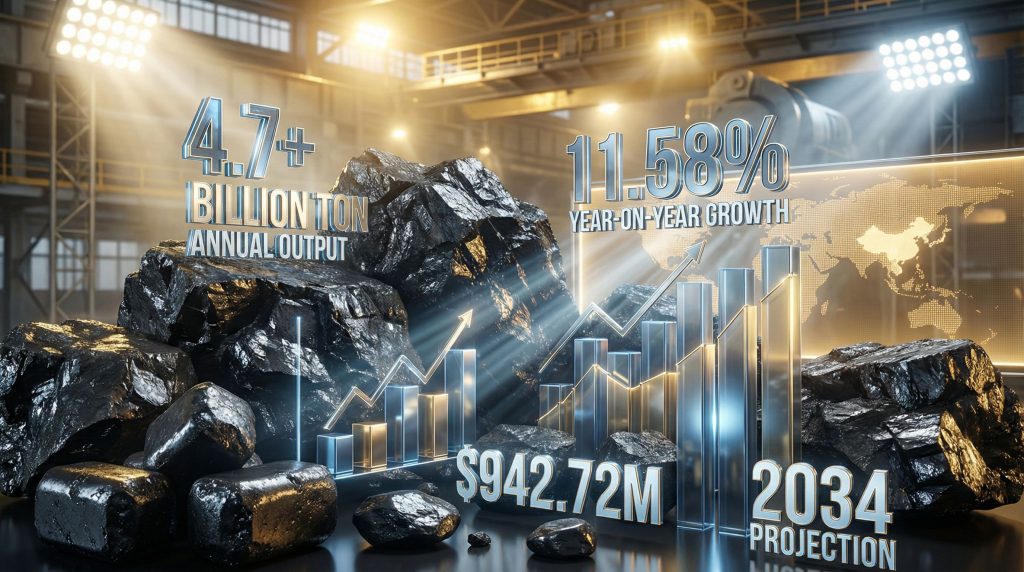
Asia-Pacific markets dominate global coal production growth, with China maintaining annual output levels exceeding 4.7 billion tons through strategic capacity management and technological modernisation. Moreover, Chinese production strategy balances domestic energy security requirements with export market opportunities, utilising advanced geological survey techniques and automated mining equipment to maintain competitive production costs.
India represents a significant growth driver in regional coal production expansion, with captive and commercial mines achieving notable production increases. According to Ministry of Coal data, India's coal production reached 187.16 million tonnes during the financial year 2025-26, representing an 11.58% year-on-year growth rate. Furthermore, monthly production figures demonstrate operational consistency, with February 2026 recording 20.49 million tonnes in combined captive and commercial mine output.
The disparity between production and dispatch rates provides insights into operational efficiency improvements. While production grew by 11.58%, dispatch rates increased by 6.78% to 184.47 million tonnes cumulatively, with February dispatches reaching 17.72 million tonnes. Consequently, this gap suggests either enhanced storage capacity management or improved inventory optimisation strategies supporting sustained coal production growth.
Australia's export-oriented production model continues adapting to changing international demand patterns, with mining operations adjusting output levels to match Asian import requirements. However, Australian export capacity and transportation infrastructure advantages maintain the country's competitive position in seaborne thermal and metallurgical coal markets.
Production Methodology Innovations
Modern coal mining operations increasingly integrate digital mining innovations to improve extraction efficiency and operational safety. Additionally, real-time monitoring systems optimise production workflows by providing continuous data on equipment performance, geological conditions, and output quality metrics. These systems enable predictive maintenance scheduling that reduces operational downtime while extending equipment service life.
Environmental compliance integration has become essential in production planning, with mining operations implementing dust control systems, water management protocols, and land reclamation procedures. Furthermore, these environmental measures, while increasing operational complexity, ensure long-term operational permits and community acceptance necessary for sustained production growth.
Automation adoption in coal mining continues expanding through autonomous vehicle deployment, automated conveyor systems, and remote-controlled extraction equipment. In addition, these technological improvements increase extraction rates per operational shift while enhancing worker safety in underground mining environments. Supply chain optimisation reduces production-to-market timeframes through improved transportation coordination and inventory management systems.
When big ASX news breaks, our subscribers know first
How Are Asian Markets Reshaping Global Coal Production Trends?
China's Production Strategy and Market Impact
China's coal production strategy emphasises energy security through domestic resource development while maintaining export capacity for regional markets. Moreover, strategic capacity additions focus on high-efficiency mining operations that utilise advanced extraction technologies and environmental management systems. Chinese mining companies increasingly implement digitalisation initiatives that improve operational efficiency and reduce production costs per tonne.
Grid stability considerations drive Chinese coal investment decisions, with new production capacity supporting baseload power generation requirements. However, export market positioning remains important, though domestic consumption priorities influence production allocation decisions. Technology integration in Chinese coal operations includes autonomous mining equipment, advanced geological mapping systems, and integrated supply chain management platforms.
Chinese coal quality standards continue improving through selective mining practices and coal preparation technologies. Furthermore, these improvements enhance the competitiveness of Chinese coal in both domestic and export markets, particularly for industrial applications requiring specific calorific value and ash content specifications.
India's Rapid Production Scale-Up
India's coal production growth demonstrates the effectiveness of coordinated policy measures and operational improvements across captive and commercial mining segments. The Ministry of Coal attributes sector performance improvements to strategic policy measures, rigorous monitoring systems, and sustained stakeholder support mechanisms that enhance operational efficiency.
Captive mine operations, developed by industrial consumers for dedicated supply purposes, contribute significantly to overall production growth. In addition, these operations typically focus on specific coal quality requirements for steel production, cement manufacturing, and power generation applications. Commercial mine operations target broader market distribution, supporting diverse industrial and utility customers across different regions.
Monthly production consistency, evidenced by the 20.49 million tonnes achieved in February 2026, indicates operational stability that supports annual growth projections. Furthermore, dispatch efficiency improvements, with monthly rates of 17.72 million tonnes, demonstrate enhanced logistics coordination between production sites and consumer locations.
The 11.58% year-on-year growth rate positions India as a significant contributor to global coal production growth, with cumulative production reaching 187.16 million tonnes for the financial year 2025-26. Consequently, this growth rate substantially exceeds global averages and reflects successful implementation of production expansion strategies.
Production Methodology Innovations
Advanced mining techniques improving extraction rates include continuous mining systems, longwall mining methods, and open-cast optimisation strategies that increase daily production capacity. Moreover, these techniques reduce waste generation while maximising coal recovery rates from available reserves.
Environmental compliance integration ensures mining operations meet regulatory standards while maintaining production targets. Furthermore, water management systems, air quality monitoring, and land reclamation programmes become integral components of production planning rather than separate compliance requirements.
Supply chain optimisation focuses on reducing production-to-market timeframes through improved transportation coordination, storage facility management, and delivery scheduling systems. In addition, these improvements enhance overall sector efficiency by ensuring consistent product availability to industrial consumers.
What Economic Indicators Signal Sustained Coal Production Growth?
Market Valuation and Investment Flows
Global coal mining market valuations reflect sustained demand expectations across key consuming regions. Furthermore, market research indicates potential growth trajectories, though specific projections require verification from recognised industry research organisations. Investment flows into coal production infrastructure continue in regions where energy security priorities support domestic resource development.
| Economic Indicator | Current Performance | Growth Trajectory |
|---|---|---|
| India Production Growth | 11.58% YoY | Sustained expansion |
| Monthly Production Volume | 20.49 MT (Feb 2026) | Consistent output |
| Dispatch Efficiency | 6.78% growth | Improving logistics |
| Cumulative Production | 187.16 MT (FY2025-26) | Strong annual performance |
Asia-Pacific market dominance continues expanding through regional production capacity additions and infrastructure development supporting coal transportation and storage. Moreover, investment in port facilities, rail transportation networks, and storage infrastructure enhances regional competitiveness in both domestic and export markets.
Demand Fundamentals Supporting Production Increases
Industrial manufacturing requirements in developing economies create sustained coal demand across multiple sectors. Furthermore, steel production dependencies maintain significant coal consumption levels, particularly for coking coal used in blast furnace operations. Metallurgical coal demand remains relatively inelastic due to limited substitutes for steel production processes.
Cement industry consumption patterns provide stable demand for thermal coal used in cement kiln operations. In addition, cement production expansion in developing economies, driven by infrastructure development and urbanisation trends, supports continued coal consumption growth in this industrial sector.
Chemical sector feedstock requirements utilise coal for various manufacturing processes, including ammonia production, synthetic fuel manufacturing, and carbon black production. Consequently, these industrial applications create demand for specific coal grades and qualities that command premium pricing in specialised markets.
Production Cost Economics
Operational efficiency improvements continue reducing per-unit production costs across major coal-producing regions. Furthermore, economies of scale achieved through production volume increases enable fixed cost allocation across larger output volumes, improving overall profitability metrics for mining operations.
Infrastructure investments enhancing production scalability include transportation network improvements, storage facility expansion, and processing plant upgrades. Moreover, these capital investments improve long-term operational efficiency while supporting increased production capacity during peak demand periods.
Labour productivity gains through technology adoption reduce operational costs per tonne while improving workplace safety metrics. In addition, automation implementation, training programmes, and equipment modernisation contribute to sustained productivity improvements across different mining operations.
Transportation network optimisation significantly impacts overall production economics by reducing logistics costs and delivery timeframes. Furthermore, rail capacity expansion, port facility improvements, and storage infrastructure development create competitive advantages for coal producers serving both domestic and export markets.
Which Regional Markets Are Experiencing Production Decline?
Western Market Contraction Patterns
United States coal production faces structural decline driven by natural gas competition and renewable energy deployment. However, production forecasts suggest continued decreases from current levels, with some projections indicating potential six-decade low production volumes in coming years. Specific production forecasts require verification from official Energy Information Administration sources.
Australian production adjustments align with changing export demand patterns, particularly shifts in Asian import requirements. Furthermore, while Australia maintains significant export capacity, production levels adjust to match international market demand rather than domestic consumption requirements.
European coal production continues declining through policy-driven phase-out initiatives and renewable energy substitution programmes. Moreover, most European Union countries have established timelines for coal power plant closures, reducing domestic coal demand and supporting production capacity retirement.
Structural Market Transitions
Renewable energy transition impacts traditional coal regions through reduced electricity sector demand and changing power generation economics. Additionally, solar and wind energy cost reductions create competitive pressure on coal-fired power generation, particularly in regions with favourable renewable resource conditions.
Policy-driven production limitations in developed economies include environmental regulations, carbon pricing mechanisms, and renewable energy mandates that reduce coal competitiveness. Furthermore, these policy frameworks create long-term demand uncertainty that influences production investment decisions.
Stranded asset considerations affect Western coal operations as financial institutions reduce funding availability for coal projects and power generation assets face premature retirement due to changing energy policies. Consequently, market consolidation trends in declining production regions result from operational closures and corporate restructuring activities.
How Do Policy Frameworks Influence Coal Production Growth?
Government Strategic Interventions
Ministry of Coal policy measures supporting production expansion include regulatory streamlining, stakeholder engagement programmes, and operational monitoring systems that enhance sector performance. Furthermore, strategic policy coordination between production and dispatch operations improves overall supply chain efficiency while maintaining environmental compliance standards.
Regulatory monitoring systems ensure operational efficiency through performance tracking, safety compliance verification, and environmental impact assessment. Moreover, these monitoring frameworks provide data-driven insights that support continuous improvement initiatives across different mining operations.
Stakeholder support mechanisms enhance operational efficiency through industry engagement programmes, technical assistance initiatives, and capacity building projects. In addition, government coordination with mining companies, equipment suppliers, and transportation providers creates collaborative frameworks supporting production growth objectives.
International Trade Policy Impacts
Export market access affects production planning decisions by determining available sales channels for domestic production capacity. Furthermore, bilateral trade agreements influence production capacity investments through market access guarantees and tariff arrangements that impact competitiveness in international markets.
Carbon pricing mechanisms create regional production advantages for operations with lower emissions profiles or access to carbon offset programmes. Additionally, environmental regulation compliance costs affect competitiveness by creating different operational cost structures across various producing regions.
International environmental standards influence production technology adoption and operational practices, particularly for mining companies serving export markets with specific environmental requirements. Consequently, these standards drive technology investment and operational improvements that enhance long-term competitiveness.
What Production Technologies Are Driving Efficiency Gains?
Modern Extraction and Processing Methods
Advanced geological survey techniques improve resource identification accuracy through sophisticated mapping technologies, core sampling programmes, and geological modelling systems. Furthermore, these techniques reduce exploration risks while identifying optimal extraction sequences that maximise resource recovery rates.
Automated mining equipment increases extraction rates through continuous operation capabilities, remote control systems, and integrated safety monitoring. Moreover, autonomous haulage systems, automated conveyor networks, and remote-controlled extraction equipment reduce labour requirements while maintaining consistent production rates.
Real-time monitoring systems optimise production workflows by providing continuous data on equipment performance, geological conditions, and environmental parameters. In addition, these systems enable immediate response to operational challenges while maintaining safety standards and environmental compliance requirements.
Predictive maintenance programmes reduce operational downtime through equipment condition monitoring, failure prediction algorithms, and scheduled maintenance optimisation. Consequently, these programmes extend equipment service life while maintaining high availability rates essential for sustained coal production growth.
Supply Chain Integration Technologies
Digital dispatch tracking systems improve delivery efficiency through real-time shipment monitoring, route optimisation algorithms, and customer coordination platforms. Furthermore, these systems reduce transportation costs while ensuring timely delivery to industrial consumers.
Inventory management platforms optimise production scheduling by coordinating storage capacity, demand forecasting, and transportation availability. Moreover, quality control automation ensures consistent product specifications through automated sampling, testing, and grading systems that meet customer requirements.
Transportation coordination systems reduce logistics costs through load optimisation, vehicle scheduling, and route planning algorithms. Additionally, these systems improve asset utilisation while reducing environmental impact through optimised transportation operations.
The next major ASX story will hit our subscribers first
How Will Global Coal Production Growth Evolve Through 2030?
Long-Term Production Trajectory Analysis
Plateau projections for global demand through 2026 suggest stabilisation of coal production growth rates as renewable energy capacity expansion balances continued industrial demand growth. Furthermore, regional production shift acceleration toward Asia-Pacific markets reflects changing consumption patterns and energy security priorities in different regions.
Technology adoption timelines affect production efficiency improvements through gradual implementation of automation systems, digital monitoring platforms, and advanced extraction techniques. Moreover, mining industry evolution and market consolidation patterns in high-growth regions result from operational efficiency requirements and capital investment capabilities.
Production capacity planning must consider long-term demand scenarios that balance industrial growth requirements with energy transition policies. In addition, infrastructure development supporting production growth requires sustained investment in transportation networks, storage facilities, and processing capabilities.
Strategic Investment Opportunities
Captive mining operations expansion potential exists in regions where industrial consumers require dedicated coal supply arrangements. Furthermore, these operations typically provide secure demand contracts and stable revenue streams that support long-term production planning and capital investment decisions.
Infrastructure development supporting production growth includes port facility expansion, rail capacity enhancement, and storage infrastructure construction. Moreover, these investments improve overall sector competitiveness while reducing operational costs and delivery timeframes.
Technology integration investments improving operational returns focus on automation systems, environmental compliance technologies, and supply chain optimisation platforms. Additionally, the global mining innovations expo demonstrates regional market positioning strategies for sustained growth that emphasise cost competitiveness, product quality, and delivery reliability.
Risk Factors and Market Considerations
Environmental regulation evolution affecting production costs includes stricter emissions standards, water management requirements, and land reclamation obligations. Furthermore, alternative energy adoption rates impact long-term demand projections through changing power generation economics and industrial process modifications.
Geopolitical factors influencing international production strategies include trade policy changes, bilateral agreements, and regional security considerations. Moreover, climate policy developments affecting investment decisions create uncertainty regarding long-term demand trajectories and operational requirements.
Market volatility considerations include price fluctuations, demand variability, and supply chain disruptions that impact operational planning and financial performance. Consequently, risk management strategies become essential for sustained coal production growth in evolving market conditions.
Disclaimer: This analysis contains forward-looking statements and projections that involve uncertainties and risks. Actual results may differ materially from those discussed. Investment decisions should consider multiple factors and professional advice. Coal production involves environmental and regulatory considerations that may affect operational viability and market demand.
Ready to Capitalise on Global Energy Market Opportunities?
Discovery Alert delivers real-time alerts on significant ASX mineral discoveries across energy and industrial commodity sectors using its proprietary Discovery IQ model, empowering investors to identify actionable opportunities ahead of broader market movements. Explore how major mineral discoveries have generated substantial returns and begin your 14-day free trial today to position yourself strategically in evolving energy markets.