May 21, 2026
Global commodity markets stand at a critical juncture, with pricing dynamics shaped by unprecedented macroeconomic forces that extend far beyond traditional supply-demand fundamentals. The intersection of infrastructure spending cycles, currency fluctuations, and geopolitical tensions creates a complex web of variables that mining giants must navigate to maintain operational excellence and shareholder returns. Furthermore, the question of whether investors should you buy BHP shares ahead of tomorrow's earnings results becomes increasingly relevant as market conditions evolve.
The energy transition represents perhaps the most significant structural shift in commodity demand patterns witnessed in decades. As electrification accelerates across transportation and energy storage sectors, the strategic positioning of diversified miners becomes increasingly important for long-term value creation. However, traditional iron ore powerhouses now find themselves balancing legacy cash flows with exposure to energy transition minerals essential for global decarbonization efforts.
How Will Global Commodity Cycles Impact BHP's Strategic Performance?
Understanding BHP's position within current macroeconomic currents requires analysis of multiple commodity price vectors operating simultaneously across global markets. For instance, iron ore price trends continue demonstrating resilience despite periodic volatility, supported by infrastructure spending programs across developing economies and ongoing urbanization trends in Asia-Pacific regions.
Copper demand dynamics reflect fundamental shifts in global consumption patterns, with electrification trends driving unprecedented requirements for the red metal across multiple industrial applications. Energy storage installations, electric vehicle manufacturing, and renewable energy infrastructure collectively create structural demand growth that traditional mining supply chains struggle to accommodate through conventional expansion strategies.
Key Production Metrics (Q2 FY2026):
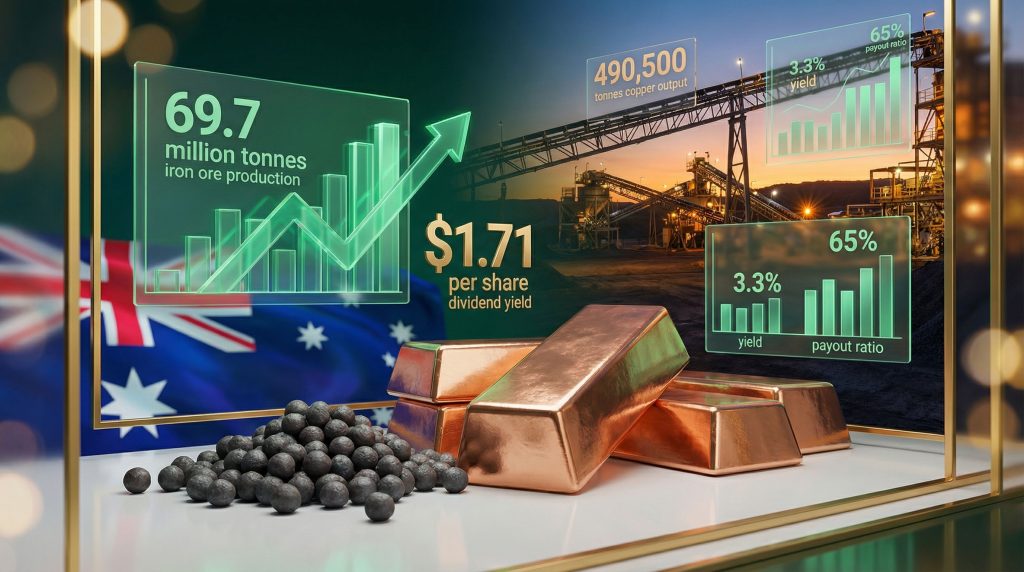
- Iron ore production: 69.7 million tonnes (+5% YoY)
- Average iron ore price received: +4% YoY improvement
- Copper production: 490,500 tonnes (-4% YoY decline)
- Average copper price received: +32% YoY appreciation
The divergence between production volumes and price realization highlights the complex operational environment facing integrated mining companies. While copper production experienced quarterly declines, margin expansion from price appreciation more than compensated for volume shortfalls, demonstrating the importance of commodity price exposure in earnings generation.
Currency dynamics add additional complexity to revenue conversion, particularly for Australian-listed companies with global operations. The interaction between commodity pricing (typically denominated in USD) and reporting currency (AUD) creates natural hedging mechanisms that can either amplify or dampen underlying operational performance depending on exchange rate movements.
Supply chain disruption effects continue rippling through global mining operations, creating both challenges and opportunities for companies with diversified asset portfolios. Consequently, operational flexibility becomes increasingly valuable as logistics constraints and geopolitical tensions reshape traditional trade flows between producing regions and consuming markets.
When big ASX news breaks, our subscribers know first
What Do Production Metrics Reveal About Operational Excellence?
BHP's Q2 FY2026 operational performance demonstrates the company's ability to optimise production across diverse commodity portfolios while maintaining pricing power in volatile markets. The 5% year-on-year increase in iron ore production to 69.7 million tonnes reflects both operational improvements and strategic capacity utilisation decisions aligned with market conditions.
The copper segment presents a more nuanced operational picture, with quarterly production declining 4% year-on-year to 490,500 tonnes despite management upgrading full-year production guidance. This apparent contradiction signals confidence in second-half production trajectory and suggests that quarterly volatility may mask underlying operational improvements across the copper asset portfolio.
Strategic Guidance Updates:
- FY2026 copper production: Upgraded to 1,900-2,000 kilotonnes
- Previous guidance range: 1,800-2,000 kilotonnes
- Guidance upgrade reasoning: Stronger delivery across assets
Management commentary suggests that operational excellence initiatives are generating measurable improvements across multiple assets simultaneously. The decision to raise production guidance mid-year typically indicates either successful operational optimisation programs or favourable project development timelines that exceed initial expectations.
Asset portfolio diversification provides operational resilience during periods of commodity price volatility or regional disruptions. The company's exposure spans multiple geographic regions and commodity types, creating natural diversification benefits that smooth production profiles and reduce dependence on single-asset performance.
Technology adoption in mining operations continues advancing, with AI transforming mining operations contributing to operational efficiency improvements. These technological investments often require significant upfront capital commitments but generate long-term operational advantages through reduced costs and improved asset utilisation rates.
Capital allocation decisions reflect management's assessment of long-term commodity demand trends balanced against immediate cash flow generation requirements. The ongoing investment in projects like Jansen potash demonstrates commitment to diversifying beyond traditional iron ore and copper into agricultural commodity exposure.
How Should Investors Interpret Dividend Policy Framework?
BHP's dividend approach reflects the company's commitment to providing consistent income returns while maintaining financial flexibility for strategic investments and operational requirements. The dividend history shows AUD $1.71 per share distributed over the preceding 12-month period through two fully-franked payments, providing tax advantages for Australian resident investors.
Dividend Analysis Framework:
| Metric | Current Position | Investor Implications |
|---|---|---|
| Annual Distribution | $1.71 per share | Fully-franked tax benefits |
| Implied Yield | 3.34% at $51.13 price | Income-focused positioning |
| Payment Structure | Semi-annual | Predictable cash flow timing |
| Tax Treatment | 100% franked | Enhanced after-tax returns |
The fully-franked structure provides significant value for Australian superannuation funds and resident taxpayers, effectively increasing the after-tax yield compared to unfranked distributions. This tax advantage becomes particularly valuable for investors in higher tax brackets or those seeking retirement income strategies.
Share price appreciation of 23.6% over the preceding 12-month period, combined with dividend income, generates total shareholder returns approaching 27% annually. This performance demonstrates the company's ability to deliver both capital growth and income returns simultaneously, appealing to diverse investor preferences.
Dividend sustainability depends on consistent cash flow generation across commodity price cycles. The company's operational diversification and cost management capabilities provide defensive characteristics that support dividend continuity even during challenging market conditions.
Forward dividend expectations remain tied to upcoming interim results, with investors anticipating management's assessment of cash flow generation capacity and capital allocation priorities. The timing of interim dividend announcements typically provides insights into management confidence regarding full-year earnings trajectory.
What Are the Key Risk Factors Facing Near-Term Performance?
China relations and trade dynamics represent the most significant external risk factor affecting BHP's operational and financial performance. The ongoing disputes over iron ore pricing mechanisms and reported export restrictions on Jimblebar Fines create uncertainty regarding the company's largest export market access. In addition, broader US‑China trade war impact continues affecting global commodity flows.
Geopolitical Risk Assessment:
- Primary concern: China trade relationship tensions
- Specific issue: Jimblebar Fines export restrictions
- Market impact: Potential revenue disruption
- Timeline: Second half FY2026 vulnerability
Iron ore export dependency on Chinese markets creates concentrated counterparty risk that extends beyond typical commodity price volatility. Alternative market development strategies become critical for reducing geographic concentration and maintaining pricing flexibility across global steel production regions.
Cost inflation pressures across mining operations reflect broader macroeconomic trends affecting labour, energy, and input costs. Mining operations require significant energy consumption and specialised labour, making them particularly sensitive to inflationary pressures that can compress operating margins despite favourable commodity prices.
Environmental compliance and ESG requirements continue expanding, creating both operational costs and strategic opportunities. Mining companies must balance increasing regulatory requirements with operational efficiency while positioning for potential carbon pricing mechanisms and environmental impact assessments.
Currency hedging strategies become increasingly complex as global macroeconomic uncertainty affects exchange rate volatility. The natural hedge provided by USD-denominated commodity revenues against AUD operating costs can become a liability during periods of AUD strength or USD weakness. Therefore, implementing effective market volatility hedging strategies becomes crucial.
Capital project execution risks remain elevated given the complex nature of mining development projects and extended development timelines. Cost overruns, timeline delays, or technical challenges can significantly impact projected returns on major capital investments like the Jansen potash project.
How Do Professional Investment Recommendations Reflect Market Sentiment?
Investment analysis from professional research firms suggests varying outlooks for BHP shares, with some analysts maintaining cautiously optimistic positions despite expecting continued commodity price appreciation throughout 2026. According to recent analysis from The Motley Fool, this positioning reflects valuation concerns balanced against favourable underlying commodity fundamentals.
Furthermore, hold recommendations indicate that current share price levels may already reflect much of the positive commodity price outlook, leaving limited upside potential relative to downside risks. Professional analysts often issue hold ratings when fundamental conditions remain positive but valuation metrics suggest limited risk-adjusted return potential.
Professional Assessment Framework:
- Current recommendation: Hold (Various analysts)
- Commodity outlook: Continued price appreciation expected
- Sector rotation: Underweight investors likely to increase exposure
- Positioning: Blue-chip resource exposure preference
Market positioning analysis suggests that BHP represents the preferred vehicle for investors seeking resources sector exposure combined with dividend income characteristics. The combination of operational scale, dividend reliability, and commodity diversification makes it attractive for institutional portfolios requiring defensive characteristics within resource allocations.
Sector rotation dynamics indicate that investors currently underweight in resources may gradually increase exposure as commodity price trends become more established. BHP's market capitalisation and liquidity characteristics make it the natural beneficiary of institutional capital flows seeking resources sector exposure.
Technical analysis considerations include the stock's position relative to recent trading ranges and support levels. The 23.6% annual appreciation places shares well above historical averages, potentially limiting near-term upside momentum unless earnings results exceed current market expectations.
What Strategic Scenarios Could Drive Future Performance?
Commodity super-cycle positioning represents perhaps the most significant upside scenario for BHP's long-term performance trajectory. Infrastructure spending cycles across developing markets, combined with energy transition metal demand, could create sustained periods of elevated commodity prices that dramatically improve cash flow generation capacity.
The energy transition metal exposure provides strategic optionality as global decarbonisation efforts accelerate. Copper demand from electric vehicle manufacturing, renewable energy installations, and grid infrastructure upgrades could sustain higher price levels for extended periods, benefiting companies with existing production capacity.
Strategic Scenario Analysis:
| Scenario | Probability | Impact Level | Key Drivers |
|---|---|---|---|
| Super-cycle Extension | Moderate | High positive | Infrastructure + transition demand |
| China Reconciliation | Low-Moderate | Moderate positive | Trade relationship normalisation |
| ESG Leadership Premium | High | Moderate positive | Sustainability competitive advantage |
| Cost Inflation Pressure | High | Moderate negative | Operating margin compression |
Supply constraint scenarios across key commodities could provide significant pricing power advantages for established producers. New mine development typically requires 5-10 year lead times, creating potential supply-demand imbalances that favour existing operations with expansion optionality.
Green energy transition positioning creates competitive advantages for companies with appropriate commodity exposure and operational capabilities. ESG leadership in mining operations could command valuation premiums as institutional investors increasingly integrate sustainability criteria into investment decisions.
Market share dynamics in iron ore exports remain critical for maintaining pricing power and volume growth. The company's position as a low-cost producer with high-quality ore characteristics provides defensive advantages during periods of demand volatility or competitive pressure.
Alternative market development strategies become increasingly important as geopolitical tensions affect traditional trade relationships. Diversifying customer bases across multiple geographic regions reduces concentration risk and provides operational flexibility during trade disputes.
How Does Earnings Timing Affect Investment Decisions?
The proximity of upcoming earnings results creates both opportunities and risks for potential investors. Market sentiment often becomes more volatile immediately before major earnings announcements, as traders position for potential surprises in either direction. Consequently, share price movements can become amplified based on speculation rather than fundamental performance.
Historical earnings patterns suggest that BHP typically provides comprehensive guidance updates during interim results, making these announcements particularly significant for forward-looking investment decisions. Management commentary on production outlook, cost pressures, and capital allocation priorities often drives longer-term share price trends beyond immediate earnings impacts.
Pre-earnings positioning requires careful consideration of risk tolerance and investment timeframes. Short-term traders might seek to capitalise on earnings-driven volatility, while long-term investors may prefer waiting for post-results clarity before making investment decisions.
The next major ASX story will hit our subscribers first
Should Investors Consider BHP Ahead of Earnings Results?
Investment decision frameworks for BHP shares require balancing multiple competing considerations: commodity price outlook, operational execution capabilities, dividend sustainability, and valuation levels relative to earnings expectations. The upcoming H1 FY2026 results provide critical data points for assessing whether current share price levels accurately reflect fundamental value. However, the decision of should you buy BHP shares ahead of tomorrow's earnings results ultimately depends on individual investment circumstances.
Risk-adjusted return expectations must account for the inherent volatility of commodity-exposed investments while recognising the company's defensive characteristics through operational diversification and balance sheet strength. The combination of income generation and capital appreciation potential creates investment appeal for diverse portfolio objectives.
Investment Considerations Framework:
- Commodity exposure: Structural demand drivers intact
- Dividend reliability: Strong cash flow generation capacity
- Valuation assessment: Recent appreciation limits upside
- Risk profile: China relationship uncertainty remains
Portfolio diversification benefits extend beyond simple commodity exposure, encompassing geographic diversification, currency hedging characteristics, and exposure to multiple economic cycles simultaneously. These attributes provide portfolio stability during periods of economic uncertainty or market volatility.
Alternative investment approaches include sector ETF exposure versus individual stock selection, allowing investors to capture resource sector themes while reducing single-company risks. However, direct equity ownership provides dividend income advantages and specific exposure to BHP's operational excellence and strategic positioning.
The timing consideration around earnings announcements creates both opportunity and risk, with results potentially driving significant share price movements in either direction. Investors comfortable with this volatility may find attractive entry points, while risk-averse investors might prefer waiting for post-earnings clarity. Additional insights from professional investment platforms can help inform these decisions.
Long-term commodity outlook alignment remains critical for investment success, requiring assessment of whether current commodity price trends represent cyclical peaks or structural shifts toward sustainably higher levels driven by energy transition and infrastructure development requirements.
Key Metrics for Post-Earnings Evaluation:
| Focus Area | Critical Indicators | Performance Benchmarks |
|---|---|---|
| Revenue Growth | H1 vs prior periods | Double-digit growth expectations |
| Margin Expansion | EBITDA improvement | 45-50% target range |
| Cash Generation | Free cash flow yield | Above 8% annually |
| Capital Returns | Interim dividend | $0.80-0.90 range expected |
The investment proposition ultimately depends on individual risk tolerance, portfolio objectives, and conviction regarding commodity market dynamics. BHP's combination of operational scale, dividend consistency, and strategic commodity exposure creates compelling characteristics for long-term investors seeking resource sector participation with defensive qualities.
Market timing considerations suggest that current valuation levels may limit immediate upside potential, though strong operational performance and favourable commodity price trends could support continued share price appreciation. The key question remains whether recent gains accurately reflect future earnings potential or leave room for further appreciation.
Investors considering should you buy BHP shares ahead of tomorrow's earnings results must weigh the company's proven operational capabilities and strategic positioning against current valuation levels and ongoing geopolitical uncertainties. The decision requires careful assessment of individual investment objectives balanced against the inherent risks and opportunities present in global commodity markets.
Looking to Capitalise on Major ASX Mining Discoveries?
Discovery Alert's proprietary Discovery IQ model provides real-time alerts on significant ASX mineral discoveries, instantly empowering investors to identify actionable opportunities before broader market awareness develops. Explore how major mineral discoveries have historically generated substantial returns and begin your 14-day free trial today to position yourself ahead of the market.