July 17, 2026
Global commodity markets have entered an unprecedented period of systemic risk as critical energy infrastructure faces mounting operational constraints. The interconnected nature of modern energy supply chains means that disruptions in strategic transit routes can cascade through international markets within days, transforming regional conflicts into worldwide economic phenomena. Furthermore, the potential for Gulf oil exports halt demonstrates how regional tensions can rapidly evolve into global supply crises. Understanding these dynamics requires examining how financial markets respond to physical supply constraints, the limitations of policy interventions during crisis periods, and the structural vulnerabilities that define contemporary energy security.
Strategic Chokepoint Vulnerabilities in Global Energy Networks
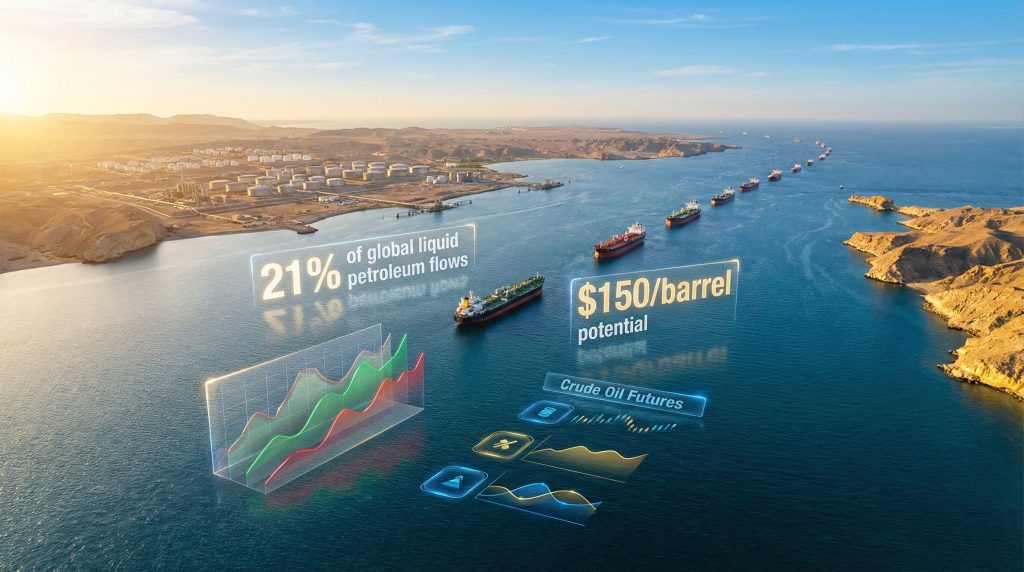
The Strait of Hormuz represents the world's most critical petroleum transit corridor, facilitating the movement of approximately 21 percent of global liquid petroleum flows on a daily basis. This narrow waterway processes roughly 20 million barrels per day, connecting major Gulf producers with international markets through the Gulf of Oman and Arabian Sea.
The geographic concentration of this throughput creates a singular point of failure for global energy supply chains. Current regional hostilities, which commenced on February 28, 2026, have effectively closed this vital shipping lane, creating what industry analysts describe as the most severe energy chokepoint crisis since the 1973 oil embargo.
The conflict has persisted for over one week, causing widespread disruption across the region and forcing the shutdown of multiple national airspaces. Moreover, the Saudi exploration impact on global markets becomes particularly relevant during such crises.
Regional Infrastructure Response Mechanisms
Alternative export infrastructure provides limited relief capacity during major chokepoint disruptions. Saudi Arabia maintains pipeline connections to Red Sea terminals, allowing continued crude deliveries despite Strait of Hormuz closures. According to Qatar's Energy Minister, who warned that war will force Gulf states to stop energy exports within weeks, Saudi oil giant Aramco has demonstrated its ability to deliver oil through these alternative routes, specifically via pipelines to the Red Sea, despite supply disruptions caused by ongoing regional conflicts.
However, this alternative infrastructure operates at significantly reduced capacity compared to normal Gulf export volumes. The Red Sea pipeline system cannot compensate for the full throughput typically handled through Hormuz transit routes, creating substantial supply gaps that manifest as price premiums in international markets.
Key Infrastructure Limitations:
- Red Sea pipeline capacity represents only a fraction of normal Gulf export volumes
- Alternative routing increases transportation costs and delivery timelines
- Limited storage capacity at alternative terminals creates bottleneck effects
- Insurance complications affect commercial vessel operations through alternative routes
Commercial Shipping and Insurance Market Dynamics
Force majeure declarations have become inevitable across Gulf energy producers as commercial shipping operations face unprecedented risks. Qatar's energy minister indicated that all exporters in the Gulf region will have to call force majeure within days if current conditions persist. These declarations suspend contractual delivery obligations, effectively halting normal commercial operations.
Maritime insurance markets respond to elevated risk scenarios by increasing premiums exponentially or withdrawing coverage entirely. The virtual closure of the Strait of Hormuz triggers extraordinary insurance requirements that make commercial shipping operations economically unviable, even when physical passage remains theoretically possible.
Insurance Market Response Framework:
| Risk Category | Market Response | Commercial Impact |
|---|---|---|
| War Risk Coverage | Premium escalation to prohibitive levels | Vessel owners suspend operations |
| Cargo Insurance | Blanket exclusions for Gulf routes | Buyers seek alternative suppliers |
| Transit Insurance | Force majeure clause activation | Commercial contracts suspended |
| Hull Insurance | Geographic exclusion zones | Fleet redeployment to safer routes |
When big ASX news breaks, our subscribers know first
Economic Cascade Effects and Market Intervention Strategies
Energy supply disruptions generate cascading effects that extend far beyond immediate commodity pricing impacts. The current crisis demonstrates how regional conflicts can rapidly transform into global economic challenges through interconnected supply chains and financial market mechanisms. Additionally, recent oil price rally analysis provides context for understanding current market movements.
Immediate Price Escalation Dynamics
Crude oil pricing has responded dramatically to supply constraints, with benchmark prices reaching $87.78 per barrel for Brent crude and $84.36 for West Texas Intermediate as of March 6, 2026. These figures represent significant increases from pre-crisis levels, with daily gains exceeding 2.77 percent for Brent and 4.41 percent for WTI.
Industry projections suggest potential escalation to $150 per barrel within two to three weeks if shipping disruptions persist. This represents a 77 percent increase from current pricing levels and would establish new historical peaks for crude oil valuations during peacetime market conditions.
Natural gas markets face even more severe pressure, with projections indicating potential increases to $40 per million British thermal units. This dramatic escalation reflects the halt of Qatar's liquefied natural gas production on March 2, which removed approximately 20 percent of global LNG supply from international markets. These developments align with broader natural gas price forecasts for the region.
Government Intervention Mechanisms and Limitations
Treasury Department responses have focused on financial market interventions rather than physical supply augmentation. Treasury Secretary Scott Bessent announced a temporary 30-day waiver allowing Indian refiners to purchase Russian oil, characterising this as a deliberately short-term measure that would not provide significant financial benefit to the Russian government as it only authorises transactions involving oil already stranded at sea.
This intervention strategy acknowledges India as an essential partner while expressing anticipation that New Delhi will ramp up purchases of US oil. The Treasury framed this approach as a stop-gap measure to alleviate pressure caused by attempts to take global energy markets hostage.
Policy Intervention Analysis:
Critical Assessment: Financial engineering provides temporary market stabilisation but cannot substitute for physical supply restoration during prolonged disruption scenarios. Markets will eventually adjust to the reality of reduced flows regardless of policy interventions.
Academic analysis suggests that such measures may work as short-term shock absorbers by calming markets and preventing immediate price spikes. However, financial engineering cannot permanently compensate for disrupted physical supply. Relying too heavily on financial tools risks creating distortions where prices no longer reflect actual supply conditions.
Strategic Reserve Deployment Considerations
Presidential policy frameworks indicate potential strategic petroleum reserve releases if domestic political pressures escalate. Economic analysis suggests that US leadership would not allow internal disruption to undermine political positioning before midterm elections, indicating strategic reserves would become available if needed.
The United States also maintains capacity to ramp up shale oil production, as higher prices make extraction more economically viable. Presidential statements on March 4 indicated that the US Navy may escort tankers through the Strait of Hormuz, representing a potential military solution to commercial shipping constraints.
Strategic Reserve Deployment Framework:
- Short-term relief: Strategic petroleum reserve releases provide 30-90 day supply buffers
- Production scaling: Higher prices enable economically marginal shale oil extraction
- Military escort: Naval protection could restore commercial shipping confidence
- International coordination: Allied strategic reserve coordination multiplies available supply
Regional Producer Response Strategies and Market Positioning
Gulf oil producers have implemented differentiated response strategies based on their individual infrastructure capabilities and geopolitical positioning. These approaches reveal how energy producers adapt to crisis conditions and position themselves for post-conflict market advantages. Consequently, understanding the tariff market impact becomes crucial in this context.
Saudi Arabia's Strategic Positioning
Saudi Aramco's crude oil differentials for April 2026 reflect the severe fragmentation of the regional energy market. Official selling prices demonstrated significant premiums for light crude grades across multiple international markets, indicating the kingdom's ability to command premium pricing during supply constraints.
Aramco Pricing Premium Analysis:
| Crude Grade | March Price vs. Oman/Dubai | April Price vs. Oman/Dubai | Premium Increase |
|---|---|---|---|
| Super Light | $2.15 | $4.15 | +$2.00 |
| Extra Light | $1.00 | $3.00 | +$2.00 |
| Light | $0.00 | $2.50 | +$2.50 |
| Medium | Positive territory | Higher positive | Sustained increase |
| Heavy | Positive territory | Higher positive | Sustained increase |
This pricing strategy demonstrates how Saudi Arabia leverages its position as a reliable supplier in a region where many other producers are either sanctioned, directly targeted, or logistically constrained. The kingdom's alternative pipeline infrastructure enables continued deliveries while competitors face operational shutdowns.
Qatar's LNG Market Impact
Qatar's liquefied natural gas production halt represents the most significant supply disruption in global LNG markets since the COVID-19 pandemic. The country's facilities account for roughly 20 percent of global supply, serving as a key resource that balances demand in both Asian and European markets.
Even if regional conflicts ended immediately, Qatar would require weeks to months to return to normal delivery cycles. This extended restart timeline reflects the technical complexity of LNG production operations and the cascade effects of infrastructure shutdowns on downstream supply chains.
Qatar LNG Disruption Timeline:
- March 2: LNG production halt implemented
- Immediate impact: 20% of global supply removed from markets
- Restart timeline: Weeks to months required for normal operations
- Market consequences: Asian and European supply constraints escalate
Alternative Supply Source Activation
Non-Gulf producers are positioning for potential market share gains during the supply disruption period. The United States maintains capacity to ramp up shale oil production as higher prices make extraction more economically viable. Russian oil sanctions waivers provide temporary supply augmentation, though these measures are characterised as deliberately short-term.
Venezuelan production capacity expansion represents another potential supply source, though infrastructure constraints and ongoing sanctions complicate rapid output increases. These alternative sources cannot immediately replace Gulf production volumes but provide partial supply offsets during extended disruptions.
Financial Market Dynamics and Investment Implications
Energy price shocks create complex challenges for financial markets and investment positioning. Current conditions demonstrate how supply disruptions affect multiple asset classes and require sophisticated risk management approaches. In particular, the critical raw materials transition becomes increasingly relevant during such volatility.
Sector-Specific Economic Exposure
Airlines and transportation industries face the most immediate exposure to fuel cost pressures. Regional carriers have implemented mass cancellations and emergency schedule adjustments, representing the aviation sector's most severe operational test since the COVID-19 pandemic.
Regional Aviation Response Summary:
- Etihad Airways: Limited commercial flight schedule resumption from March 6
- Emirates Airline: Reduced flight schedule following limited airspace reopening
- Qatar Airways: Scheduled flight operations temporarily suspended due to airspace closure
- Flynas: Limited exceptional flights between Saudi Arabia and Dubai
- Saudia Airlines: Flights canceled to Amman, Kuwait, Dubai, Abu Dhabi, Doha, and Bahrain
Chemical and petrochemical manufacturers with feedstock dependencies face supply chain disruptions that cascade through industrial production systems. Manufacturing facilities that cannot secure energy inputs implement production cuts or temporary shutdowns, creating shortages of downstream products.
Consumer Spending Pattern Analysis
Saudi Arabia's point-of-sale spending data provides insight into consumer behaviour during initial crisis periods. Spending rose 4.5 percent to SR14.5 billion ($3.8 billion) in the week ending February 28, though transaction volumes declined 4.6 percent to 210.53 million.
Consumer Spending Pattern Changes:
- Freight transport and postal services: +50.4% to SR121.35 million
- Apparel and clothing: +44.2% to SR1.9 billion
- Personal care transactions: +21.7% increase
- Pharmacies and medical supplies: +23.5% to SR254.51 million
- Food and beverages: -11.4% to SR2.33 billion
- Restaurants and cafes: -1.8% to SR1.22 billion
These patterns suggest consumers are adjusting spending priorities toward essential goods and services while reducing discretionary purchases in anticipation of extended economic uncertainty.
Investment Strategy Framework During Energy Volatility
Emerging market economies with energy import dependencies face the greatest currency and economic stability risks. Countries that rely heavily on Gulf energy imports must navigate potential balance of payments pressures and inflation acceleration as energy costs escalate.
Renewable energy technology providers benefit from transition acceleration as energy security concerns drive investment flows toward alternative energy infrastructure. Higher fossil fuel prices improve the economic competitiveness of renewable energy projects and accelerate deployment timelines.
Investment Positioning Considerations:
- Energy sector equities: Valuation implications during supply constraints create opportunities
- Currency hedging: Energy-importing economies require foreign exchange protection
- Alternative energy infrastructure: Investment acceleration in renewable technology
- Strategic commodity exposure: Diversified instruments provide portfolio protection
Long-Term Strategic Implications for Global Energy Security
Extended supply disruptions typically accelerate structural changes in global energy markets and security policies. The current crisis may catalyse fundamental shifts in energy trade relationships, infrastructure investment priorities, and strategic planning frameworks. Notably, concerns about Gulf oil exports halt could reshape long-term energy strategies globally.
Energy Transition Investment Acceleration
Higher fossil fuel prices improve the economic viability of renewable energy investments and accelerate deployment schedules across multiple sectors. Countries facing energy import dependency vulnerabilities prioritise domestic renewable energy capacity expansion to reduce exposure to external supply shocks.
Strategic petroleum reserve expansion requirements become political imperatives as governments recognise the limitations of existing emergency supply buffers. Current reserve levels prove insufficient to offset major chokepoint disruptions for extended periods, necessitating capacity increases and coordination mechanisms between allied nations.
Structural Change Drivers:
- Accelerated energy transition: Higher fossil fuel prices improve renewable energy economics
- Strategic reserve expansion: Emergency supply buffers require capacity increases
- Supply chain diversification: Energy security policies prioritise source diversification
- Alternative infrastructure: Investment flows toward chokepoint-independent energy systems
Geopolitical Trade Relationship Evolution
Gulf Cooperation Council bargaining power evolution reflects the strategic importance of reliable energy suppliers during crisis periods. Countries that maintain delivery capabilities during disruptions strengthen long-term commercial relationships and secure premium pricing arrangements.
Asian energy import dependency vulnerability exposure creates incentives for supply source diversification and alternative energy infrastructure development. European energy security policy recalibration follows similar patterns, emphasising supply chain resilience over cost optimisation.
North American energy export opportunity expansion benefits from Gulf supply disruptions as importing countries seek alternative suppliers. This shift potentially reshapes long-term energy trade flows and strengthens North American energy security positioning.
Economic Recovery and Market Normalisation Timeline
Market normalisation depends on conflict resolution and shipping lane security restoration, with restart timelines ranging from weeks to months depending on infrastructure damage assessment and insurance market confidence recovery. Physical supply restoration requires coordination between producers, shipping companies, and insurance markets.
Price peak constraints typically emerge from demand destruction thresholds, strategic reserve releases, alternative supply activation, and economic recession risks that reduce consumption. These natural market mechanisms establish ceiling levels for energy price escalation during supply disruptions, as highlighted in recent Gulf energy export warnings regarding potential shutdowns.
The next major ASX story will hit our subscribers first
Understanding Gulf Oil Export Disruptions
How do energy disruptions cascade through global supply chains?
Energy price increases affect manufacturing input costs, transportation expenses, and production scheduling across multiple industries. Factories facing higher energy costs implement production cuts or pass costs through to consumers, creating inflationary pressures throughout the economy.
Supply chain disruptions compound these effects by limiting availability of energy-intensive goods and materials. This cascade effect demonstrates why regional energy crises rapidly become global economic challenges.
What determines the effectiveness of strategic petroleum reserve releases?
Reserve release effectiveness depends on the scale of supply disruption, market psychology, coordination with allied nations, and duration of the crisis. Strategic reserves provide temporary supply buffers but cannot substitute for restored commercial production over extended periods.
Market confidence plays a crucial role in determining whether reserve releases stabilise pricing or merely delay price increases. The psychological impact often proves as important as the physical supply augmentation.
How do alternative energy infrastructure investments respond to oil price spikes?
Higher fossil fuel prices improve the economic competitiveness of renewable energy projects, accelerating investment decisions and deployment timelines. Governments facing energy security concerns prioritise alternative energy infrastructure to reduce import dependency.
This creates sustained investment flows that persist beyond immediate price spike periods. The current crisis may permanently alter the trajectory of global energy transition efforts.
What are the long-term implications for Gulf oil exports halt scenarios?
Producers that maintain reliable supply capabilities during crises strengthen their market positioning and secure premium pricing arrangements. Countries that cannot fulfil commercial obligations risk long-term market share losses as buyers diversify supply sources.
Regional conflicts may permanently alter energy trade relationships as importing nations prioritise supply security over cost considerations. These shifts often persist well beyond the resolution of immediate crises.
Disclaimer: This analysis is based on publicly available information and expert commentary. Energy market conditions remain highly volatile, and actual outcomes may differ significantly from current projections. Investors should conduct independent research and consider multiple scenarios when making investment decisions during periods of geopolitical uncertainty.
Ready to Capitalise on Energy Market Volatility?
Discovery Alert's proprietary Discovery IQ model delivers real-time alerts on significant ASX mineral and energy discoveries, instantly empowering subscribers to identify actionable opportunities during periods of heightened market volatility. Begin your 14-day free trial today and secure your market-leading advantage whilst global energy disruptions create exceptional investment conditions.