
August 6, 2026
The Growing Role of Global Copper Reserves in Modern Economic Strategy
Industrial metals markets reflect broader economic transitions more than most financial observers realise. When examining current copper inventory levels, traditional supply-demand equations reveal only part of a complex story involving geopolitical positioning, strategic resource accumulation, and fundamental shifts in how nations approach commodity security. The unprecedented accumulation patterns emerging across major exchanges suggest markets are responding to forces beyond conventional economic principles.
Central banks maintain gold reserves as monetary insurance, while governments increasingly view industrial metal stockpiles through similar strategic lenses. This paradigm shift transforms copper from a purely commercial commodity into a component of national economic security architecture. Understanding these dynamics becomes essential as inventory patterns signal broader structural changes in global resource allocation.
When big ASX news breaks, our subscribers know first
Current Global Copper Inventory Distribution and Market Implications
Exchange-Based Inventory Classifications
Physical copper stocks across major trading venues operate under distinct classification systems that determine metal availability and market accessibility. The London Metal Exchange (LME) maintains registered warehouses across multiple continents, while COMEX facilities concentrate primarily in North American locations. Shanghai Futures Exchange (SHFE) inventory reflects Asian regional demand patterns and Chinese domestic consumption requirements.
Refined copper represents the highest grade category, including electrolytically refined cathodes and continuous casting ingots suitable for immediate industrial application. Concentrate inventories contain unrefined copper ore requiring additional processing before end-use applications. Strategic national reserves operate independently from exchange-traded inventories, representing government-controlled stockpiles held for economic security purposes rather than commercial trading.
Unprecedented Inventory Accumulation Patterns
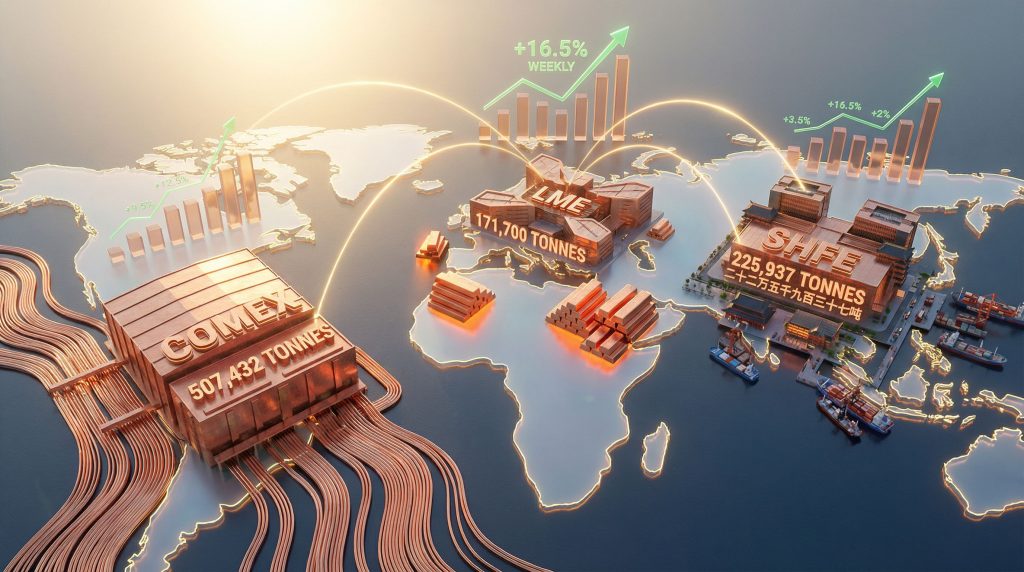
Recent data reveals extraordinary shifts in global copper inventory levels that challenge conventional market analysis. COMEX holdings reached 507,432 tonnes during the week of January 19-23, 2026, marking the first time exchange inventories exceeded 500,000 tonnes. This represents a 3.8% weekly increase and establishes a new benchmark for North American copper accumulation.
London Metal Exchange inventories expanded to 171,700 tonnes, reflecting a substantial 16.5% weekly growth rate and reaching levels not observed since May 2025. When combined with Shanghai Futures Exchange holdings, total visible inventory across the three primary copper exchanges reached 905,069 tonnes, representing 6.5% weekly growth and 21.9% accumulation compared to year-end 2025 levels.
| Exchange | Current Inventory (Tonnes) | Weekly Change | Regional Significance |
|---|---|---|---|
| COMEX | 507,432 | +3.8% | First time exceeding 500,000 tonnes |
| LME | 171,700 | +16.5% | Highest since May 2025 |
| SHFE | 225,937* | Estimated | Asian demand indicator |
| Total | 905,069 | +6.5% | 21.9% above 2025 close |
*SHFE figures represent estimates based on available reporting data
Historical Context and Market Transition Indicators
The current inventory expansion occurs against a backdrop of sustained copper price strength, creating apparent contradictions with traditional economic theory. Furthermore, the new york copper prices closed the referenced week at $5.86 per pound, despite inventory accumulation typically correlating with price weakness. The annual average of $5.91 per pound represents a remarkable 45.5% increase compared to 2025 levels.
This price-inventory divergence suggests structural market changes rather than cyclical adjustments. Historical patterns show inventory accumulation during periods of weak demand and price decline, yet current conditions demonstrate sustained price elevation alongside exceptional stockpiling activity.
The simultaneous occurrence of record inventory levels and elevated copper prices indicates fundamental shifts in how market participants view strategic metal accumulation versus traditional commercial storage economics.
Geopolitical Influences on Strategic Copper Accumulation
Trade Policy Implementation and Market Response
United States trade policy changes created measurable impacts on global copper inventory levels through systematic implementation of protective measures. Semi-finished copper tariffs implemented in August 2025 established the first phase of broader trade restrictions, while unwrought copper import limitations scheduled for 2027 create anticipatory market behaviour.
These policy measures generate arbitrage opportunities between different copper product categories. Semi-finished copper products face immediate trade barriers, incentivising importation of unwrought copper (cathodes, ingots) ahead of future restrictions. COMEX inventory expansion directly correlates with this policy timeline, as market participants position inventory ahead of regulatory changes.
Arbitrage Closure and Market Rebalancing
The closure of LME-COMEX arbitrage opportunities significantly reduced financial incentives for transatlantic copper shipments. Previously, price differentials between London and New York markets justified transportation and storage costs of approximately $3-5 per tonne monthly. When these differentials narrowed, arbitrage trading became uneconomical.
Despite arbitrage closure reducing traditional shipping incentives, COMEX inventories continued expanding, suggesting fundamental supply-demand forces rather than pure financial speculation drive accumulation patterns. This indicates strategic positioning by market participants anticipating future supply constraints or demand acceleration.
Regional Geopolitical Risk Assessment
Geopolitical tensions directly influence copper market psychology and pricing mechanisms. Recent de-escalation of Greenland-related diplomatic tensions contributed to 0.6% weekly copper price decline, demonstrating how quickly geopolitical risk premiums can adjust. The retreat from potential European tariff impositions moderated speculative appetite in metals markets without affecting underlying physical fundamentals.
Key geopolitical factors currently influencing copper markets:
• Trade policy uncertainty between major economic blocs
• Resource security initiatives by developed nations
• Strategic autonomy programmes in Europe and Asia
• Supply chain diversification requirements
• Critical minerals designation and associated policies
Economic Indicators Revealing Copper Market Health Dynamics
Chinese Demand Signal Interpretation
Yangshan premium collapse to $22 per tonne represents the lowest level in 18 months and provides critical insight into Chinese copper demand dynamics. This premium measures the price differential between imported copper and domestic Chinese copper prices. When Chinese refineries and consumers demand imported cathodes, they accept higher CFR (Cost and Freight) pricing, widening the premium.
The current 18-month low indicates weakening Chinese appetite for offshore copper supplies despite elevated global price levels. This contrasts with normal economic patterns where high prices attract demand, suggesting either Chinese domestic oversupply or demand destruction in key consumption sectors.
Production Balance and Supply Chain Analysis
The International Copper Study Group reported a 94,000-tonne surplus of refined copper for November 2025, indicating production exceeded consumption during that period. However, global copper supply forecast data reveals this surplus contributes to inventory accumulation across exchanges and reflects improved supply chain stability compared to previous supply-constrained periods.
Supply-side disruptions continue affecting global production:
• Mantoverde operations (Chile) suspended due to labour disputes
• Grasberg mine (Indonesia) operating at approximately 85% capacity
• Various smaller mines experiencing weather-related disruptions
• Transportation and logistics challenges in key producing regions
Despite these disruptions, the November surplus suggests overall production resilience and adequate inventory buffer management by producers and consumers. In addition, the codelco copper strategy demonstrates how major producers adapt to changing market conditions.
Price Performance vs. Fundamental Indicators
Copper's 45.5% annual price increase occurred alongside inventory expansion, creating apparent market contradictions. Traditional commodity analysis suggests inventory accumulation should pressure prices downward, yet sustained price strength indicates demand expectations or strategic accumulation motivations override typical commercial storage economics.
The combination of elevated copper inventory levels, compressed Chinese import premiums, and production surpluses typically correlates with price weakness. Current market conditions suggest non-commercial factors, including strategic stockpiling and geopolitical risk premiums, influence pricing mechanisms more significantly than pure supply-demand calculations.
Exchange Dynamics and Global Copper Price Formation
Inter-Exchange Arbitrage Mechanics
LME-COMEX arbitrage traditionally provided price convergence mechanisms between European and North American copper markets. When price differentials exceed transportation and storage costs, traders profit by purchasing metal on the cheaper exchange and selling on the expensive exchange. This arbitrage activity typically maintains price alignment between major trading venues.
Recent arbitrage closure indicates price convergence has occurred, reducing financial incentives for continued metal shipment to the United States. However, COMEX inventory expansion continued despite reduced arbitrage profitability, suggesting strategic rather than purely financial motivations drive accumulation.
Shanghai Futures Exchange Regional Influence
SHFE inventory trends provide insight into Asian copper demand and regional supply adequacy. Chinese domestic consumption represents approximately 50% of global copper demand, making SHFE inventory levels critical indicators for global market balance. Yuan-denominated copper contracts on SHFE offer Chinese participants hedging mechanisms independent of dollar-based pricing volatility.
Asian premium structures, including the Yangshan premium, create regional price discovery mechanisms that influence global copper pricing. When Asian premiums compress, it typically indicates adequate regional supply relative to demand, reducing urgency for international copper procurement. Consequently, australia-canada copper investment strategies must consider these regional dynamics.
Warehouse Economics and Storage Incentives
Exchange warehouse operations involve complex economics balancing storage costs, financing rates, and metal availability. Warehouse operators charge daily storage fees, typically $0.45-0.85 per tonne daily depending on location and services provided. These costs create carrying charges that influence inventory holding decisions.
| Exchange | Daily Storage Rate | Load-Out Rate | Delivery Locations |
|---|---|---|---|
| COMEX | $0.50-0.80/tonne | 3,000 tonnes/day | Limited US facilities |
| LME | $0.45-0.85/tonne | Variable by location | Global warehouse network |
| SHFE | RMB 3-5/tonne | High capacity | Chinese regional centres |
Financial incentives for inventory holding include contango market structures where future prices exceed spot prices by amounts greater than storage costs. When these conditions exist, inventory accumulation becomes financially attractive independent of supply-demand fundamentals.
Future Market Trajectory Analysis and Strategic Implications
Short-Term Inventory Outlook
Current copper inventory levels suggest market abundance in the immediate term, though several factors could rapidly change supply-demand balance. Q1 2026 consumption forecasts indicate potential demand recovery as Chinese manufacturing activity increases seasonally and global infrastructure spending accelerates.
Potential inventory drawdown catalysts:
• Seasonal demand acceleration in construction and manufacturing
• Resolution of major mine disruptions increasing consumption confidence
• Strategic reserve releases reducing commercial inventory pressure
• Geopolitical tensions resuming and increasing hoarding behaviour
Medium-Term Structural Market Changes
Energy transition demand for copper continues expanding as electrification accelerates globally. Electric vehicle production requires 4-6 times more copper per unit than internal combustion engines, while renewable energy infrastructure demands substantial copper for power transmission and storage systems.
Grid modernisation projects worldwide require extensive copper installations for smart grid capabilities and renewable energy integration. For instance, gold and copper exploration activities reflect these long-term demand drivers that suggest current inventory accumulation may represent strategic positioning ahead of sustained consumption growth rather than oversupply concerns.
Long-Term Resource Security Considerations
Three primary inventory trajectory scenarios emerge from current market conditions:
1. Continued Strategic Stockpiling Scenario:
Governments and corporations maintain elevated inventory levels as insurance against supply disruptions, creating permanently higher baseline inventory requirements.
2. Market Normalisation and Inventory Reduction:
Trade tensions resolve and normal commercial inventory patterns resume, leading to gradual destocking and price pressure.
3. Supply Disruption and Emergency Drawdown:
Major supply disruptions force rapid inventory depletion, creating supply shortages and sharp price increases.
Each scenario carries distinct implications for market participants and requires different strategic approaches to inventory management and price risk mitigation.
The next major ASX story will hit our subscribers first
Investment and Risk Management Implications
Portfolio Positioning Strategies
Current copper inventory levels create both opportunities and risks for various market participants. Mining companies benefit from elevated prices but face uncertainty regarding inventory overhang effects on future pricing. Manufacturing companies with significant copper exposure face decisions regarding forward purchasing versus inventory management optimisation.
Copper ETF flows typically correlate with investor sentiment regarding metal fundamentals, though current conditions create mixed signals. High inventory levels suggest bearish fundamentals, while strong pricing and energy transition demand provide bullish counterarguments.
Corporate Risk Assessment Frameworks
Supply chain resilience considerations increasingly override pure cost optimisation in corporate copper procurement strategies. Companies weigh inventory carrying costs against supply disruption risks, leading to higher average inventory levels across industries.
Strategic inventory management now requires balancing traditional carrying costs against supply security benefits, fundamentally changing corporate working capital optimisation calculations.
Risk management considerations include:
• Forward contract coverage for anticipated consumption requirements
• Inventory level optimisation balancing costs and security
• Supplier diversification reducing single-source dependencies
• Financial hedging strategies managing price volatility exposure
• Force majeure and supply disruption contingency planning
Critical Monitoring Metrics for Market Participants
Essential Data Points for Strategic Decision-Making
Weekly inventory changes across all three major exchanges provide the most immediate indicators of market balance shifts. COMEX, LME, and SHFE inventory movements create leading indicators for price direction and supply adequacy assessment.
Regional premium structures including the Yangshan premium, European treatment charges, and US domestic premiums reveal demand strength in key consumption regions. These premiums provide earlier signals than inventory data for demand changes.
Refined copper production vs. consumption balance reported by the International Copper Study Group offers monthly insights into fundamental supply-demand conditions independent of inventory movements or financial market speculation. Furthermore, detailed tracking through copper price analysis provides additional market intelligence.
Strategic Market Positioning Guidelines
Current market conditions require sophisticated understanding of multiple factors influencing copper inventory levels and pricing mechanisms. Supply chain diversification becomes essential for companies with significant copper exposure, while inventory management optimisation requires balancing costs against security benefits.
Market participants should monitor geopolitical developments, trade policy changes, and energy transition demand trends that could rapidly alter copper market dynamics. The unprecedented nature of current inventory patterns suggests traditional analysis methods may provide incomplete guidance for strategic decision-making.
This analysis provides educational information regarding copper market dynamics and inventory trends. Market participants should conduct independent research and consult qualified professionals before making investment or strategic business decisions. Commodity markets involve substantial risks, and past performance does not guarantee future results.
Ready to Capitalise on Strategic Copper Market Opportunities?
Discovery Alert's proprietary Discovery IQ model delivers real-time alerts on significant copper and mineral discoveries across the ASX, instantly empowering subscribers to identify actionable opportunities ahead of the broader market. Begin your 30-day free trial today and secure your market-leading advantage in this dynamic commodity landscape.