August 11, 2026
When the Refinery Becomes the Battlefield: Understanding the Global Diesel Crunch
Every major energy crisis in modern history has eventually traced back to a single chokepoint, whether a pipeline, a port, or a political decision. The current global diesel crunch is different in character because its chokepoint is not a single location but an entire industrial layer: the refining infrastructure that transforms crude oil into the fuel that actually powers civilisation. Understanding why diesel has become the stress point of the global energy system in 2026 requires looking past crude oil price volatility and examining the structural vulnerabilities that have been building for more than a decade.
When big ASX news breaks, our subscribers know first
The Structural Anatomy of a Diesel Supply Crisis
What Separates a Diesel Shortage from a Crude Oil Price Spike
Diesel is a middle distillate, meaning it occupies a specific boiling range in the refining process between lighter products like naphtha and heavier residual fuel oils. This technical distinction matters enormously because it means diesel supply depends not only on crude oil availability but on the continuous, functioning operation of complex refinery infrastructure capable of processing crude into usable product fractions.
Even in periods of adequate crude supply, diesel can fall into shortage when refining capacity is damaged, geographically constrained, or structurally insufficient to meet demand. The current crisis is being driven by exactly this dynamic: a simultaneous collision of supply-side refinery disruption and demand-side seasonal pressure arriving at the worst possible moment.
The Three Converging Forces Behind the 2026 Global Diesel Crunch
| Pressure Factor | Region Primarily Affected | Key Market Impact |
|---|---|---|
| Ukrainian drone strikes on Russian refineries + export ban | Europe, Asia | Reduced middle distillate output; Russia's domestic supply priority enforced |
| Strait of Hormuz disruptions curtailing Gulf refinery exports | Global | Sharp contraction in globally traded diesel volumes |
| Structural EU refinery closures (long-term capacity erosion) | European Union | Permanently diminished domestic refining buffer |
Each of these forces would be significant in isolation. Their simultaneous convergence has produced a supply dislocation that is qualitatively different from typical commodity price cycles. Furthermore, OPEC's market influence has proven insufficient to counterbalance the disruptions occurring at the refinery layer rather than at the crude production level.
How Global Diesel Inventories Reached a Critical Low
A Decade of Structural Refinery Erosion in Europe
The European refining sector has been contracting steadily since the aftermath of the 2008 financial crisis. Approximately 30 European refineries were permanently closed between 2009 and 2024, a sustained capacity reduction driven by weak refining margins, declining domestic fuel demand, and the increasing cost burden of EU emissions compliance frameworks.
A further 400,000 barrels per day of European refining capacity was scheduled for closure in 2025 as stricter Brussels emissions reduction rules pushed operational costs beyond economic viability for older, less efficient facilities. This long-cycle capacity destruction has transformed the EU from a trade-oriented refining bloc into a structurally import-dependent fuel market, one that is acutely exposed to any tightening in global refined product availability. Consequently, European gas prices and diesel costs are now both subject to the same import dependency pressures.
Russia's Export Ban and the Ripple Effects Through Atlantic Markets
Russia holds the position of the world's second-largest diesel exporter, making disruptions to its export flows a globally significant event rather than a regional concern. Ukrainian drone strikes on Russian refinery infrastructure during 2026 materially reduced domestic refining throughput, prompting Moscow to impose a diesel export ban to protect internal supply security.
The knock-on consequences extend well beyond direct Russian diesel importers. Countries including Brazil and Turkey, which had historically absorbed substantial volumes of Russian diesel, were abruptly redirected into the global Atlantic Basin market as competing buyers. This displacement effect has placed additional competitive pressure on European buyers already struggling with depleted inventories and reduced refinery capacity.
A less commonly understood aspect of the Russian refinery situation is that Ukraine's drone campaign specifically targeted processing units rather than crude storage, meaning the damage has been concentrated at the refining layer rather than at the crude extraction level. This is strategically significant: disrupting a refinery's cracking and distillation units takes it offline in ways that are far more difficult and time-consuming to repair than crude production outages, and the resulting deficit falls specifically on middle distillates like diesel rather than on crude oil supply broadly.
U.S. Diesel Exports: Record Volumes at a Domestic Cost
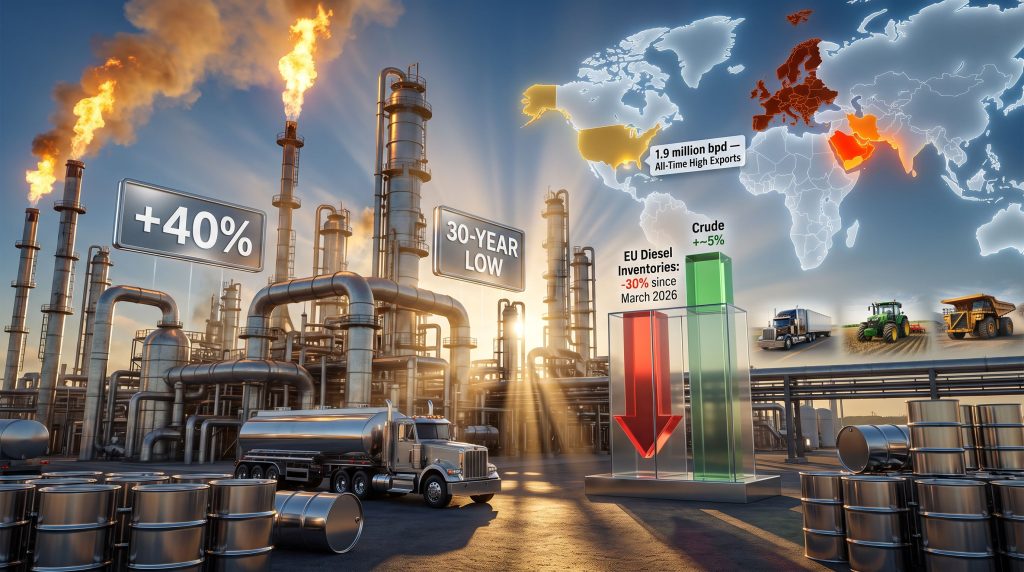
U.S. diesel exports reached an all-time high during the first week of August 2026, averaging 1.9 million barrels per day. For the preceding five weeks, exports had held at approximately 1.5 million barrels per day, already running well above historical norms. Because U.S. refinery utilisation rates cannot be rapidly increased, these sustained exports have drawn down domestic diesel inventories rather than coming from incremental production.
The result is that U.S. diesel stockpiles have fallen to their lowest level since 1996, a 30-year inventory low, precisely as peak winter demand and refinery maintenance season are converging on the calendar. Market analysts, including Kpler's head of clean petroleum products Zameer Yusof, have noted that Gulf Coast refiners cannot sustain indefinite export volumes to Northwest Europe given their own domestic supply obligations (Bloomberg, August 2026).
Critical Risk: The withdrawal of U.S. diesel exports as a relief valve would remove the single most active source of global supply offsetting the Russia and Gulf refinery disruptions simultaneously.
Which Regions Face the Greatest Diesel Supply Risk?
Europe: Structurally the Most Exposed Market
European diesel prices surged approximately 40% between mid-June and early August 2026, against a crude oil price increase of only around 5% over the same period (Bloomberg, August 2026). This divergence between crude and diesel price performance is itself a diagnostic signal: it confirms the crisis is refinery- and logistics-driven, not a crude supply event.
EU diesel inventories contracted by roughly 30% between March and August 2026, with peak seasonal demand still ahead. A compounding factor specific to Europe is the architecture of its Russia-related sanctions, which has eliminated access not only to Russian-origin diesel but also to diesel produced in third-party countries, including India and Turkey, when that diesel was refined from Russian crude. This significantly narrows the EU's available import options at the moment of greatest supply tightness.
Eugene Lindell, head of refined products at consultancy FGE NexantECA, characterised Europe's position as having a severe diesel problem that will likely translate into extremely elevated flat prices and political pressure (Bloomberg, August 2026).
Southeast Asia: Active Shortages Already Underway
Diesel supply shortfalls are not a theoretical future risk in Southeast Asia; they are an operational reality as of August 2026. Reuters reported that palm oil farming operations across the region were experiencing disrupted harvesting schedules and sharply higher fuel costs due to diesel shortages. Agricultural diesel dependency in tropical farming economies makes these supply disruptions directly consequential for food supply chains, not merely for transportation costs.
The Middle East: The Refining Hub That Cannot Export
Persian Gulf refineries represent a critical node in globally traded diesel supply, historically serving both Asian and European import markets. Ongoing disruptions to tanker movements through the Strait of Hormuz have sharply curtailed product export volumes from Gulf refineries. Bank of America has estimated that stabilising oil and product flows through the strait would require approximately ten times the current number of vessels operating in the corridor (OilPrice.com, August 2026), a scale of logistical intervention that is not imminent.
Oil analyst June Goh from Sparta Capital noted that the market had not fully recovered from refining losses in the Middle East while simultaneously absorbing the loss of Russian refining capacity, a dual compression of globally traded supply that creates sustained tightness rather than a temporary price spike (Bloomberg, August 2026).
Why Diesel Matters More Than Crude Oil to the Real Economy
The Industrial Economy's Direct Dependency on Middle Distillates
Diesel's economic significance extends far beyond its role as a transport fuel. It is the operational energy input for the physical economy across its most foundational sectors:
-
Agriculture: Tractors, harvesters, irrigation pumps, and cold-chain refrigeration for perishable produce all run on diesel, making food production costs directly sensitive to diesel price movements.
-
Construction: Heavy equipment including excavators, cranes, and concrete mixers, along with site logistics and material delivery, are diesel-dependent throughout the build cycle.
-
Mining: Haul trucks, drilling rigs, and ore processing equipment at most large mining operations globally consume diesel as their primary energy input. Higher diesel costs raise the break-even economics of ore extraction across every mined commodity.
-
Freight and logistics: Long-haul trucking, rail freight, and last-mile delivery networks are predominantly diesel-powered, meaning diesel price increases pass directly into freight cost surcharges across virtually every supply chain.
-
Maritime shipping: Bunker fuel derived from the same distillate pool powers bulk carriers and container vessels moving commodities and manufactured goods globally.
Joe DeLaura, senior energy strategist at Rabobank, articulated this dependency clearly: diesel functions as the operational energy underpinning agriculture, construction, mining, and the full distribution chain simultaneously, making it qualitatively different in economic significance from crude oil as a headline commodity (Wall Street Journal, August 2026).
How Diesel Price Inflation Transmits Through the Economy
The transmission mechanism from diesel price increases to broader consumer inflation follows a recognisable sequence:
-
Wholesale diesel prices rise as refinery supply tightens relative to seasonal demand.
-
Freight operators apply diesel surcharges to logistics contracts, raising the cost of moving goods.
-
Manufacturers and retailers absorb higher logistics inputs, compressing margins or passing costs forward into goods pricing.
-
Consumer price indices for food, construction materials, and manufactured goods register broad-based increases.
-
Central banks face renewed cost-push inflationary pressure at a time when monetary policy may already be constrained.
-
Governments face political pressure to intervene through fuel subsidies, price caps, or emergency reserve releases, each of which carries its own fiscal and market distortion costs.
Key Market Indicators Confirming the Severity of the Crunch
| Indicator | Data Point | What It Signals |
|---|---|---|
| U.S. ULSD futures single-session move | +11% | Severe volatility; unusual for a major industrial commodity |
| European diesel price increase (mid-June to Aug 2026) | +40% | Refinery and logistics crisis, not crude-driven |
| EU diesel inventory change (March to Aug 2026) | -30% | Rapid drawdown ahead of peak seasonal demand |
| U.S. diesel inventory level (Aug 2026) | Lowest since 1996 | 30-year low entering winter demand cycle |
| U.S. diesel export rate (record week, Aug 2026) | 1.9 million bpd | All-time high; analysts flag unsustainability |
Goldman Sachs has positioned diesel as the central stress point of the current global fuel market dislocation, noting that refining throughput declines and contracted diesel export flows from major refining hubs have created a structural deficit that elevated crude oil prices alone cannot resolve.
The next major ASX story will hit our subscribers first
Is There Any Near-Term Relief on the Horizon?
Why the Standard Supply Levers Are Constrained
The usual mechanisms that buffer commodity supply disruptions are either unavailable or limited in their near-term capacity:
-
U.S. Gulf Coast refiners face domestic inventory obligations and scheduled maintenance windows that will constrain sustained export availability regardless of international demand signals.
-
Asian refiners are managing their own regional supply pressures and are structurally unlikely to redirect meaningful diesel volumes toward European buyers.
-
Middle Eastern refinery exports remain constrained by Hormuz logistics and geopolitical uncertainty, with no clear resolution timeline in place.
-
New refinery construction requires multi-year permitting, financing, and construction timelines that offer no short-cycle supply relief.
The Natural Gas Compounding Factor
The diesel crisis does not exist in isolation from broader European energy security concerns. European natural gas storage levels dropped to their lowest seasonal position since 2011 ahead of winter 2026-2027, creating a parallel energy vulnerability operating on a similar timeline. LNG buyers have been holding back purchases in anticipation of lower prices, a strategy that carries significant risk if demand arrivals outpace the available procurement window.
The combination of depressed diesel inventories and below-average gas storage creates a dual-fuel vulnerability for European industrial and residential energy consumers entering the peak winter demand period. In addition, the oil market disruption stemming from ongoing geopolitical tensions continues to undermine confidence in near-term supply stabilisation.
Scenario Analysis: Three Pathways for the Global Diesel Crunch
Scenario 1: Managed Tightness (Base Case)
Hormuz disruptions ease partially through diplomatic progress by Q4 2026. U.S. diesel exports moderate as domestic inventory obligations reassert priority. European diesel prices stabilise at elevated levels, approximately 20-25% above pre-crisis baselines. Economic impact is significant but contained primarily to freight cost inflation rather than physical supply rationing.
Scenario 2: Extended Disruption (Stress Case)
Russia's export ban remains active through the Northern Hemisphere winter. Hormuz shipping volumes stay suppressed. EU diesel inventories fall to critical operational minimums. Rationing begins to emerge as a policy consideration in the most import-dependent EU member states, and freight cost inflation transmits broadly into consumer price indices.
Scenario 3: Cascading Crisis (Tail Risk)
Simultaneous diesel and natural gas shortfalls converge in the same winter quarter across Europe. Industrial curtailments begin in energy-intensive manufacturing sectors. Governments are forced into emergency fuel market interventions. Globally, the crisis accelerates long-cycle refinery investment decisions, though no new capacity arrives in time to provide near-term relief.
Disclaimer: These scenarios are analytical projections based on current market conditions and publicly available data. They are not investment advice and should not be treated as predictions. Energy market conditions are subject to rapid and unpredictable change.
The Geopolitical Dimensions of the 2026 Diesel Crisis
Energy Warfare at the Refinery Layer
Ukraine's sustained drone campaign against Russian refinery infrastructure has introduced a strategically significant new dimension to energy conflict: targeting the refining layer rather than crude extraction. Damaging processing units, particularly fluid catalytic crackers and hydrocracking units that produce middle distillates, creates supply deficits that are narrowly product-specific and substantially harder to reverse than crude production outages.
The strategic logic is precise: taking crude oil offline raises headline prices broadly, but taking diesel-producing refinery units offline creates an acute shortage in the specific fuel that underpins industrial activity while leaving crude supply relatively intact. Bloomberg's reporting on oil traders racing against time highlights how unprepared global markets were for disruption at this specific layer of the supply chain.
Sanctions Architecture Narrowing EU Import Options
A less-discussed dimension of the EU's diesel exposure is the self-reinforcing effect of its sanctions architecture. By prohibiting not only Russian-origin diesel but also diesel produced from Russian crude in third-country refining hubs, the EU has eliminated a meaningful volume of globally available product from its own procurement market.
This policy-driven supply constraint compounds the physical disruptions from the Hormuz situation and Russian export ban, leaving European buyers competing in an already compressed pool of available Atlantic Basin supply. Furthermore, the energy export challenges facing resource-producing nations like Australia demonstrate how broadly this global disruption is reverberating across supply networks.
Frequently Asked Questions: Global Diesel Crunch Explained
What is causing the global diesel crunch in 2026?
The current shortage reflects three simultaneous disruptions: Ukrainian drone damage to Russian refinery infrastructure leading to an export ban, sharply reduced product flows from Persian Gulf refineries due to Strait of Hormuz constraints, and a long-term structural decline in European refining capacity. These factors have converged with seasonal demand increases and historically low inventory levels.
Why are diesel prices rising faster than crude oil prices?
Diesel requires functioning refinery infrastructure to produce. When that infrastructure is damaged or geographically constrained, diesel supply tightens even when crude is available. European diesel prices rose approximately 40% from mid-June to August 2026, while crude oil added only around 5% over the same period, confirming this is a refinery and logistics problem rather than a crude supply event.
Which countries face the greatest risk from the diesel shortage?
European Union member states are structurally most exposed due to decades of refinery closures and import dependency. Southeast Asian agricultural economies are experiencing active operational disruptions. The United States is drawing down 30-year-low domestic inventories to sustain record export volumes, creating a domestic supply risk heading into the winter demand cycle.
How does a diesel shortage affect everyday consumers?
Higher diesel prices increase freight costs across entire supply chains, raising prices for food, manufactured goods, and construction materials. Energy-intensive sectors including agriculture and mining absorb direct cost increases. In the most severe scenarios, fuel rationing and industrial curtailments become policy responses with economy-wide consequences.
What would resolve the global diesel crunch?
Resolution would require some combination of restored refinery operations in Russia or the Middle East, eased Hormuz shipping constraints, new refining capacity entering service, or significant demand-side reduction. None of these outcomes appear likely to materialise quickly, suggesting elevated diesel prices and tight inventories will persist through at least the 2026-2027 winter season.
Key Takeaways: The Global Diesel Crunch at a Glance
-
The global diesel crunch is fundamentally a refinery and logistics crisis, not a crude oil supply problem.
-
Three simultaneous disruptions — Russian export ban, Hormuz constraints, and EU refinery closures — have converged at the most demanding point in the seasonal demand calendar.
-
U.S. diesel inventories stand at a 30-year low entering peak winter demand, with record export rates drawing down stockpiles faster than they can be replenished.
-
European diesel prices are up 40% since mid-June 2026 while crude has added only around 5%, a price divergence that precisely maps the structural nature of the disruption.
-
Diesel underpins agriculture, construction, mining, freight, and distribution, making this crisis a broad macroeconomic inflation risk with transmission channels into virtually every sector of the physical economy.
-
Near-term relief is structurally limited across every major potential supply source, and the crisis is more likely to intensify before conditions improve.
For additional coverage of global refined fuel markets, Hormuz disruptions, and European energy security dynamics, OilPrice.com offers ongoing reporting at oilprice.com.
Want to Stay Ahead of Commodity Market Disruptions Affecting ASX Mining Stocks?
When diesel costs surge across agriculture, construction, and mining operations, the ripple effects reach every corner of the resources sector — and timing matters. Discovery Alert's proprietary Discovery IQ model scans ASX announcements in real time, instantly identifying significant mineral discoveries and actionable investment opportunities before the broader market reacts; explore historic examples of exceptional discovery returns and begin your 14-day free trial today to position yourself ahead of the next major market move.