August 24, 2026
Global Economic Resilience Through Strategic Resource Partnerships
Resource scarcity represents one of the most significant systemic risks facing modern economies, as traditional supply chains become increasingly vulnerable to geopolitical disruptions and market concentration. The emergence of EU–Saudi roundtable on critical raw materials partnerships between major economic blocs and resource-rich nations reflects a fundamental transformation in how countries approach economic security. These collaborations extend beyond conventional trade relationships, creating integrated frameworks that encompass exploration, processing, manufacturing, and recycling across entire value chains.
Modern mineral partnerships prioritise resilience over efficiency, acknowledging that diversified supply networks provide greater long-term stability than cost-optimised single-source arrangements. Furthermore, this strategic shift becomes particularly evident when examining how economic powers are restructuring their resource acquisition strategies to reduce dependency on concentrated suppliers while fostering mutual development opportunities with emerging resource producers.
When big ASX news breaks, our subscribers know first
Understanding the EU's Resource Independence Framework
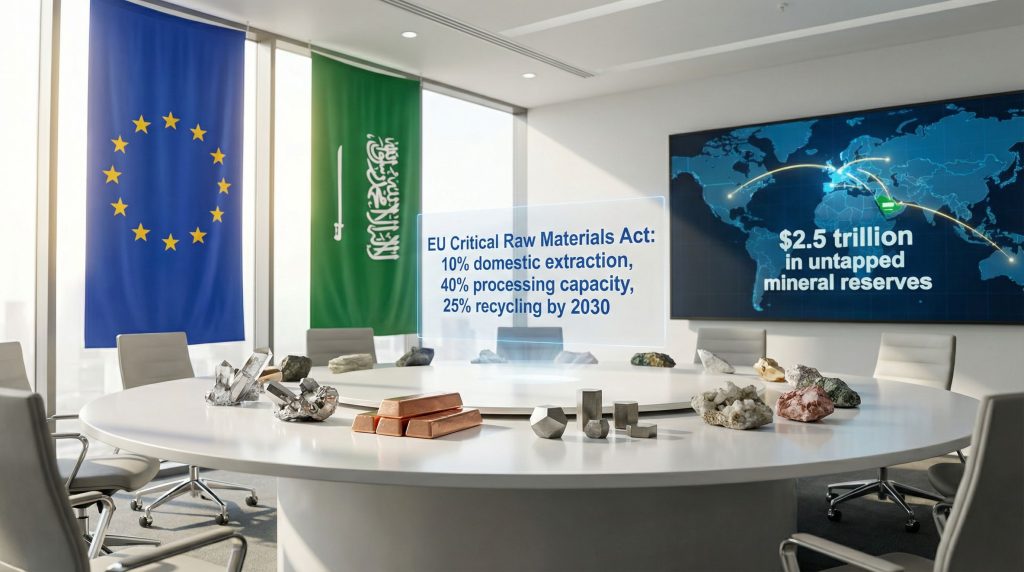
Europe's approach to critical raw materials independence reflects decades of strategic planning culminating in comprehensive legislative and policy frameworks. The EU Critical Raw Materials Act establishes quantified targets requiring 10% domestic extraction, 40% processing capacity, and 25% recycling rates for essential minerals by 2030. These targets represent ambitious departures from current dependency patterns, particularly given Europe's limited domestic mineral resources.
In addition, the ResourceEU action plan, launched in late 2025, provides the operational framework for achieving these independence objectives. This strategic initiative encompasses multiple implementation pillars designed to reduce single-supplier vulnerabilities while building resilient supply networks across diverse geographic regions.
Strategic Minerals Under EU Focus:
• Lithium: Essential for battery manufacturing in electric vehicles and renewable energy storage systems
• Rare earth elements: Critical components in wind turbines, solar panels, and defence applications
• Cobalt: Fundamental for electric vehicle battery production and energy storage technologies
• Gallium and germanium: Specialised applications in semiconductor manufacturing and telecommunications
As EU Ambassador to Saudi Arabia Christophe Farnaud emphasised, "As the European Union advances the implementation of its Critical Raw Materials policy, international cooperation is indispensable to building secure, diversified, and sustainable value chains. Saudi Arabia is a key partner in this effort."
The EU's approach recognises that domestic extraction alone cannot satisfy European mineral requirements, making international partnerships essential for achieving resource security objectives. However, the framework prioritises cooperation with politically stable, resource-rich nations capable of developing integrated value chain partnerships rather than simple commodity export relationships.
Saudi Arabia's Mineral Sector Transformation Strategy
Saudi Arabia's economic diversification through Vision 2030 positions the Kingdom as an emerging critical raw materials powerhouse, leveraging geological advantages and strategic investment to capture value across mineral value chains. The transformation extends beyond oil dependency reduction toward establishing globally competitive mineral processing and manufacturing capabilities.
Geological surveys have identified approximately $2.5 trillion in untapped mineral reserves across the Kingdom, representing significant potential for international partnerships. This resource base includes diverse mineral categories aligned with global critical materials demand patterns, particularly as countries pursue critical minerals energy transition strategies.
Saudi Arabia's Mineral Portfolio:
| Mineral Category | Development Status | Strategic Applications |
|---|---|---|
| Lithium deposits | Significant reserves mapped | Battery manufacturing, energy storage |
| Copper resources | Major deposits identified | Infrastructure, renewable energy |
| Rare earth elements | Early exploration phase | Technology manufacturing, defence |
| Phosphate reserves | World's third-largest | Fertiliser production, food security |
Saudi Deputy Minister for Mining Development Turki Al-Babtain articulated the Kingdom's strategic positioning: "Developing globally competitive mineral hubs and sustainable value chains is a central pillar of Saudi Vision 2030 and the Kingdom's industrial transformation. Our engagement with the European Union through this dialogue to strengthen upstream and downstream integration, attract high-quality investment, and advance responsible mining and processing."
The Saudi approach emphasises integrated value chain development rather than raw material exports, positioning the Kingdom as a regional processing hub capable of supplying refined products to international markets. Furthermore, this strategy aligns with global trends toward midstream processing consolidation and supply chain regionalisation, similar to how Saudi Arabia exploration licenses are attracting international attention.
The Future Minerals Forum serves as the institutional mechanism through which Saudi Arabia coordinates international mineral sector partnerships, providing platforms for investment attraction and technology transfer agreements with global partners.
ResourceEU and Global Supply Chain Restructuring
ResourceEU represents Europe's most comprehensive response to critical raw materials vulnerabilities, launched in late 2025 to address systematic dependencies on concentrated suppliers. The initiative aims to secure reliable supplies of lithium, rare earths, and cobalt while reducing dependency on single suppliers, particularly China's dominant processing capacity.
China currently controls approximately 85% of global rare earth processing capacity, creating systemic vulnerabilities for Western economies dependent on these materials for renewable energy, defence, and technology applications. Moreover, ResourceEU explicitly addresses this concentration risk through diversified partnership development and domestic capacity building.
ResourceEU Implementation Strategy:
• Enhanced domestic extraction capabilities through member state mining development
• Strategic stockpiling mechanisms for supply chain disruption protection
• Advanced recycling infrastructure development supporting circular economy objectives
• International partnership frameworks with politically stable resource producers
• Sustainable mining technology adoption ensuring environmental compliance
Valere Moutarlier, Deputy Director-General for European Industry Decarbonisation at the European Commission, emphasised that ResourceEU and the EU Critical Raw Materials Act provide "a clear framework to strengthen Europe's resilience while deepening its cooperation with international partners."
The initiative recognises that supply chain diversification requires comprehensive cooperation extending beyond traditional buyer-seller relationships toward integrated value chain partnerships encompassing exploration, processing, manufacturing, and recycling activities. Consequently, this reflects the big pivot on critical minerals that many nations are implementing.
Risk Mitigation Through Diversification:
Supply chain vulnerability assessments demonstrate that single-supplier dependencies create cascading risks across multiple industries simultaneously. The ResourceEU framework addresses these vulnerabilities through systematic diversification strategies that enhance economic security while fostering mutual development opportunities with partner nations.
Advanced Partnership Models Beyond Traditional Trade
The EU–Saudi roundtable on critical raw materials exemplifies modern strategic partnerships that transcend conventional commodity trading relationships. These comprehensive frameworks integrate multiple cooperation levels, from upstream exploration through downstream manufacturing, creating mutual dependency structures that enhance relationship stability.
Comprehensive Cooperation Framework:
• Upstream Integration: Joint exploration and extraction projects sharing technological expertise and financial risks
• Midstream Processing: Shared refining and processing facilities reducing transportation costs and adding value domestically
• Downstream Manufacturing: Technology transfer agreements enabling finished goods production capabilities
• Recycling Networks: Circular economy implementation creating closed-loop material flows
• Investment Mobilisation: Private capital attraction through institutional cooperation and risk sharing
The inaugural EU-Saudi Business and Investment Dialogue on Advancing Critical Raw Materials Value Chains demonstrates the operational complexity of modern resource partnerships. Furthermore, organised through a "Team Europe approach" coordinating multiple institutions, the framework involves the EU Delegation to Saudi Arabia, European Chamber of Commerce in the Kingdom, and Future Minerals Forum cooperation.
This multi-stakeholder institutional structure reflects the sophisticated coordination required for comprehensive value chain partnerships, extending beyond government-to-government agreements toward business ecosystem development. Additionally, these arrangements are part of broader mining industry evolution trends.
Partnership structures incorporate joint venture mechanisms, equity participation arrangements, and technology licensing agreements that create sustained cooperation incentives for all participants. These arrangements reduce transaction costs while building institutional relationships that enhance partnership durability.
Geopolitical Drivers of Resource Diversification
Contemporary geopolitical tensions have accelerated strategic resource diversification initiatives, as single-supplier dependencies become increasingly viewed as economic security vulnerabilities. China's dominance in rare earth processing creates particular concerns for Western nations implementing clean energy and defence technology strategies.
The concentration of critical materials processing in geopolitically sensitive regions poses systemic risks to industries dependent on these inputs. Rare earth elements essential for renewable energy systems, defence technology, electronics manufacturing, and battery production face supply disruption risks that could affect entire economic sectors simultaneously.
Supply Chain Vulnerability Mechanisms:
Traditional single-supplier arrangements create systemic risks that extend beyond individual companies to entire industrial ecosystems. The EU–Saudi roundtable on critical raw materials partnership model demonstrates how strategic diversification can enhance economic security while creating mutual development opportunities that benefit both partners.
The January 2026 timing of the inaugural EU-Saudi roundtable reflects the urgency with which major economies are pursuing alternative supply arrangements. This timeline acceleration demonstrates how geopolitical considerations now drive resource partnership development cycles, particularly as mining consolidation trends reshape the industry landscape.
European Commission emphasis on "secure, sustainable, and diversified critical raw materials value chains" reflects acknowledgment that traditional cost-optimisation strategies must accommodate geopolitical risk factors. The terminology shift from efficiency to resilience represents fundamental changes in strategic resource planning.
The next major ASX story will hit our subscribers first
Investment Implications and Market Opportunities
The EU–Saudi roundtable on critical raw materials partnership creates substantial investment opportunities across the complete value chain, from exploration and extraction through processing, manufacturing, and recycling. Saudi Arabia's commitment to significant mining investments by 2035 establishes the Kingdom as an attractive destination for European technology providers and financial institutions.
Investment Opportunity Categories:
• Mining technology and equipment supply for extraction and processing operations
• Processing facility development creating regional refining capabilities
• Transportation and logistics infrastructure supporting material movement and storage
• Environmental and sustainability solutions ensuring compliance with ESG standards
• Digital mining and automation technologies improving operational efficiency and safety
The partnership framework facilitates private capital mobilisation through institutional cooperation and risk-sharing mechanisms. European financial institutions gain access to Saudi Arabia's resource development projects, while Saudi sovereign wealth vehicles can participate in European processing and manufacturing investments.
Investment Risk Mitigation:
| Risk Category | Mitigation Strategy | Partnership Benefits |
|---|---|---|
| Geological uncertainty | Joint exploration sharing | Reduced individual exposure |
| Processing technology | Technology transfer agreements | Capability development |
| Market access | Integrated value chains | Guaranteed supply relationships |
| Regulatory compliance | Shared ESG frameworks | Standardised operating procedures |
The investment framework incorporates sustainable finance mechanisms ensuring environmental and social governance compliance throughout the partnership. This approach addresses investor requirements for responsible resource development while meeting regulatory standards in both European and Saudi markets.
Environmental and Social Governance Integration
Modern critical raw materials partnerships must incorporate comprehensive ESG frameworks ensuring sustainable development and community benefit sharing. The EU-Saudi dialogue emphasises responsible resource development aligned with international environmental and social standards.
ESG Integration Requirements:
• Environmental impact assessment protocols for all mining and processing activities
• Community engagement and benefit-sharing mechanisms ensuring local development
• Worker safety and rights protection meeting international labour standards
• Biodiversity conservation measures protecting ecosystems and wildlife habitats
• Carbon footprint reduction strategies supporting climate change mitigation objectives
The partnership framework recognises that sustainable resource development requires balancing extraction activities with environmental protection and community development objectives. This approach ensures long-term operational viability while meeting stakeholder expectations for responsible business practices.
ESG compliance creates competitive advantages in accessing international capital markets and meeting regulatory requirements in both European and Saudi jurisdictions. Investment institutions increasingly require comprehensive sustainability frameworks for resource sector financing.
Sustainable Development Integration:
Environmental and social governance frameworks ensure that critical raw materials partnerships contribute to sustainable development objectives while meeting immediate resource security needs. This approach creates long-term value for all stakeholders through responsible resource management practices.
Future Scenarios and Market Transformation Potential
The EU–Saudi roundtable on critical raw materials partnership could catalyse broader regional cooperation, potentially extending to other GCC nations and African resource producers. This model may influence similar partnerships between major economies and resource-rich developing nations.
Potential Market Transformation Scenarios:
• Scenario 1: Successful implementation achieving 25% reduction in EU single-supplier dependence by 2030
• Scenario 2: Model replication across multiple regions creating new global supply chain networks
• Scenario 3: Technology transfer success positioning Saudi Arabia as regional processing hub
The partnership success could establish precedents for international resource cooperation, influencing similar arrangements between other major economies and resource-rich nations. This replication potential creates opportunities for systematic supply chain diversification across multiple regions.
Market transformation impacts extend beyond immediate partnership participants to global critical raw materials markets. Enhanced price stability through diversified supply sources could reduce volatility while increased processing capacity outside China could create competitive dynamics benefiting end users.
Long-term Strategic Implications:
Successful EU-Saudi cooperation demonstrates that comprehensive resource partnerships can address supply chain vulnerabilities while fostering mutual economic development. These models may become templates for future international resource cooperation as countries prioritise economic security alongside traditional efficiency considerations.
Global Critical Raw Materials Market Impact
The EU-Saudi partnership represents significant shifts toward multilateral resource cooperation, potentially influencing pricing mechanisms, supply chain structures, and investment flows across global critical raw materials markets. This collaboration establishes new benchmarks for international resource partnerships.
Market Impact Projections:
• Enhanced price stability through diversified supply sources reducing market concentration risks
• Increased processing capacity development outside traditional suppliers creating competitive alternatives
• Accelerated recycling and circular economy solutions reducing primary extraction dependency
• Strengthened supply chain resilience against geopolitical and natural disruptions
The partnership model demonstrates how strategic cooperation can create win-win outcomes for both resource importers and exporters. European access to diversified supply sources combines with Saudi industrial development objectives, creating sustainable mutual benefits.
Global critical raw materials markets may experience structural changes as major economies implement similar diversification strategies. These changes could reduce market concentration while creating opportunities for resource-rich developing nations to capture greater value from mineral endowments.
Investment Flow Redirection:
International capital flows toward critical raw materials projects may increase substantially as major economies prioritise supply chain diversification. This trend creates opportunities for resource-rich nations while potentially reducing returns in traditional supplier regions.
Disclaimer: This analysis contains forward-looking projections and scenarios that involve significant uncertainties. Market developments, geopolitical changes, and technological advances may materially affect actual outcomes. Readers should conduct independent research and consider multiple scenarios when making investment or business decisions related to critical raw materials markets.
The inaugural EU-Saudi roundtable on critical raw materials marks a pivotal moment in global resource cooperation, demonstrating how strategic partnerships can address supply chain vulnerabilities while fostering mutual economic development. As economies transition toward clean energy and digital technologies, such comprehensive collaborations become increasingly essential for economic security and sustainable growth. The success of this partnership model could influence international resource cooperation for decades, establishing frameworks that balance economic security with sustainable development objectives.
Ready to Capitalise on Critical Minerals Investment Opportunities?
Discovery Alert's proprietary Discovery IQ model delivers real-time alerts on significant ASX mineral discoveries, instantly empowering subscribers to identify actionable opportunities ahead of the broader market as global resource partnerships reshape supply chains. Understand why major mineral discoveries can generate substantial returns by exploring Discovery Alert's dedicated discoveries page, then begin your 30-day free trial today to position yourself ahead of these transformative market shifts.