August 10, 2026
Understanding the Global Economic Vulnerability to Energy Supply Shocks
Modern economies operate through complex interdependencies that create systemic vulnerabilities to energy supply disruptions. The potential for a global recession if Iran war worsens represents one of the most significant economic risks facing policymakers today. Unlike previous decades when energy markets remained relatively isolated from broader economic systems, today's globalised supply chains and just-in-time manufacturing processes amplify the transmission effects of oil price volatility across all sectors simultaneously.
The current geopolitical landscape presents unprecedented challenges as traditional energy security frameworks face stress from multiple directions. Central banks worldwide confront the difficult balance between maintaining price stability and supporting economic growth amid persistent inflationary pressures that predate recent Middle Eastern tensions.
When big ASX news breaks, our subscribers know first
The Mechanics of Energy-Driven Economic Contraction
Energy supply shocks operate through distinct transmission mechanisms that differentiate them from conventional demand-side recessions. When oil prices spike due to supply constraints, the immediate impact cascades through three primary channels that create compounding economic pressures.
Direct Cost Transmission Effects
Manufacturing sectors experience immediate margin compression as energy represents a significant input cost across virtually all production processes. Transportation-intensive industries face particularly acute pressures, with logistics costs potentially increasing by 15-25% during sustained oil price rally above $100 per barrel.
The agricultural sector demonstrates especially high vulnerability due to diesel fuel dependency for equipment operation and fertiliser production. Food price inflation typically follows energy price increases with a 2-3 month lag, creating secondary inflationary waves that persist even after initial energy price stabilisation.
Supply Chain Disruption Patterns
Global supply chains optimised for cost efficiency rather than resilience face critical stress points during energy crises. Container shipping costs correlate directly with bunker fuel prices, while air freight becomes prohibitively expensive for many non-essential goods categories.
Manufacturing hubs in energy-intensive regions may reduce production capacity, forcing companies to source from alternative suppliers at higher costs. This geographical reallocation of production creates temporary supply shortages and price increases across multiple product categories simultaneously.
Consumer Spending Reallocation Dynamics
Household budget constraints intensify as energy costs consume larger portions of disposable income. Lower-income households typically allocate 8-12% of total spending to energy costs, compared to 3-5% for higher-income brackets, creating disproportionate demand destruction in discretionary spending categories.
This spending reallocation reduces demand for durable goods, recreational services, and non-essential retail categories while increasing demand for energy-efficient alternatives and public transportation options.
Regional Economic Exposure Assessment
Different economic regions demonstrate varying levels of vulnerability to energy supply disruptions based on domestic production capacity, strategic reserve holdings, and sectoral composition. Understanding these regional differences provides insight into potential recession transmission patterns and policy response effectiveness.
European Union: Critical Dependency Challenges
European economies face the highest systematic risk from Middle Eastern energy disruptions due to limited domestic production capacity and recent supply chain restructuring following reduced Russian energy imports. Industrial production remains heavily dependent on imported natural gas trends and petroleum products.
| Risk Factor | Current Status | Recession Impact |
|---|---|---|
| Natural gas import dependency | 65% of consumption | Production curtailment risk |
| Strategic petroleum reserves | 90-day import coverage | Limited buffer capacity |
| Industrial energy intensity | 150% of OECD average | Severe margin compression |
| Alternative supply capacity | 25% increase needed | 18-month development timeline |
Germany's manufacturing sector demonstrates particular vulnerability with energy costs representing 12-15% of total industrial input costs. Sustained oil prices above $120 per barrel could force temporary production shutdowns in energy-intensive industries including steel, aluminium, and chemical manufacturing.
The European Central Bank faces constrained policy options due to existing inflationary pressures and limited fiscal space in several member countries. Interest rate increases to combat energy-driven inflation could accelerate recessionary pressures across the eurozone.
United States: Domestic Production Advantages with Global Linkages
Despite significant domestic energy production capabilities, the United States remains exposed to global energy price volatility through integrated commodity markets and supply chain dependencies. Furthermore, US oil production decline requires 6-12 months to respond fully to price incentives.
The Federal Reserve's dual mandate creates complex policy challenges during energy-driven inflationary periods. Historical precedent from the 1970s demonstrates the difficulty of maintaining employment levels while controlling energy-driven price increases through monetary policy alone.
Strategic Petroleum Reserve Utilisation
Current SPR holdings of approximately 400 million barrels provide theoretical coverage for 60 days of total petroleum consumption or 200 days of import replacement. However, release rates are constrained to 1-2 million barrels per day maximum sustainable levels.
Emergency coordination with International Energy Agency member countries could provide additional 1.5 billion barrels of strategic reserves, though political coordination challenges may limit effectiveness during crisis periods.
Emerging Market Differentiation Patterns
Energy-importing developing economies face disproportionate recession risks due to limited fiscal capacity for energy subsidy programmes and higher vulnerability to capital flight during crisis periods. Currency depreciation amplifies imported energy costs, creating compounding inflationary pressures.
High-Risk Emerging Markets:
- Turkey: 85% energy import dependency
- India: 70% petroleum import reliance
- Thailand: 65% energy import exposure
- South Korea: 80% total energy imports
Energy-Exporting Beneficiaries:
- Saudi Arabia: Fiscal breakeven at $65/barrel
- UAE: Production capacity increases available
- Kazakhstan: Pipeline alternatives operational
- Norway: North Sea production surge capability
Central Bank Policy Framework Constraints
Energy-driven inflation creates unique challenges for central bank policy frameworks designed primarily to address demand-side economic fluctuations. Traditional monetary policy tools demonstrate reduced effectiveness against supply-side price shocks while creating risks of overtightening that could accelerate recessionary pressures.
The Stagflation Policy Dilemma
Central banks face the "impossible trinity" of simultaneously addressing inflation control, economic growth support, and financial stability maintenance during energy crises. Interest rate increases effective against demand-driven inflation may prove counterproductive during supply-constrained inflationary periods.
Policy Tool Effectiveness Analysis
| Intervention Method | Short-term Impact | Long-term Effectiveness | Recessionary Risk |
|---|---|---|---|
| Emergency rate increases | Limited inflation control | Demand destruction | High |
| Quantitative easing | Financial market support | Inflationary amplification | Moderate |
| Forward guidance | Expectation management | Limited credibility | Low |
| Targeted lending programmes | Sectoral support | Moral hazard creation | Moderate |
Historical analysis from previous energy crises demonstrates that aggressive monetary tightening during supply shocks typically amplifies recessionary pressures without effectively controlling underlying inflationary forces. The 1979-1981 Federal Reserve policy response created severe recession while failing to address core energy price drivers.
Inflation Expectation Management Challenges
Energy price volatility creates risks of inflation expectation "de-anchoring" where businesses and consumers begin incorporating higher baseline inflation assumptions into pricing and wage negotiations. This psychological shift can perpetuate inflationary pressures even after initial energy price spikes moderate.
Survey data indicates that inflation expectations become less responsive to central bank communications during energy crisis periods. Market-based inflation expectations derived from Treasury Inflation-Protected Securities often diverge significantly from survey measures during supply shock periods.
Financial Market Transmission Amplification
Energy supply disruptions create cascading effects through financial markets that can amplify underlying economic impacts beyond direct energy cost increases. Market volatility, credit tightening, and sectoral reallocation effects interact to create systemic financial stability risks.
Equity Market Sectoral Rotation Dynamics
Energy crises typically trigger massive capital reallocation as investors anticipate differential sectoral impacts. Historical analysis shows that energy-intensive sectors experience 20-35% valuation declines within 30 days of sustained oil price increases above $100 per barrel.
Vulnerable Sectors Performance:
- Airlines: Average -28% during energy crises
- Chemical manufacturers: -22% typical decline
- Transportation logistics: -18% average impact
- Consumer discretionary: -15% spending reduction effects
Beneficiary Sectors:
- Traditional energy: +35% average appreciation
- Alternative energy: +25% crisis premium
- Defence contractors: +12% geopolitical risk premium
- Utilities: +8% defensive positioning benefits
Market volatility indices historically increase 40-60% during energy supply disruptions, creating broader financial market instability beyond fundamental economic impacts. Options markets demonstrate significant volatility term structure inversions as short-term uncertainty increases dramatically.
Credit Market Stress Point Analysis
Energy cost increases strain corporate cash flows across multiple sectors simultaneously, potentially triggering credit rating downgrades and tightening lending conditions. Corporate bond spreads typically widen 100-200 basis points for energy-intensive industries during sustained price spikes.
Bank lending standards tighten as financial institutions reassess credit risk under higher input cost scenarios. Small and medium enterprises face particular challenges as they lack negotiating power with suppliers and customers to pass through cost increases immediately.
Currency Market Disruption Patterns
Energy crises create significant currency volatility as trade balances shift and capital flows respond to changing economic prospects. Energy-importing countries typically experience currency depreciation that amplifies imported inflation while energy exporters benefit from current account improvements.
Emerging market currencies demonstrate particular vulnerability due to limited foreign exchange reserves and higher sensitivity to capital flight during crisis periods. Currency depreciation creates feedback loops where higher import costs necessitate further monetary tightening.
What Could Trigger a Recession Amid Iran Tensions?
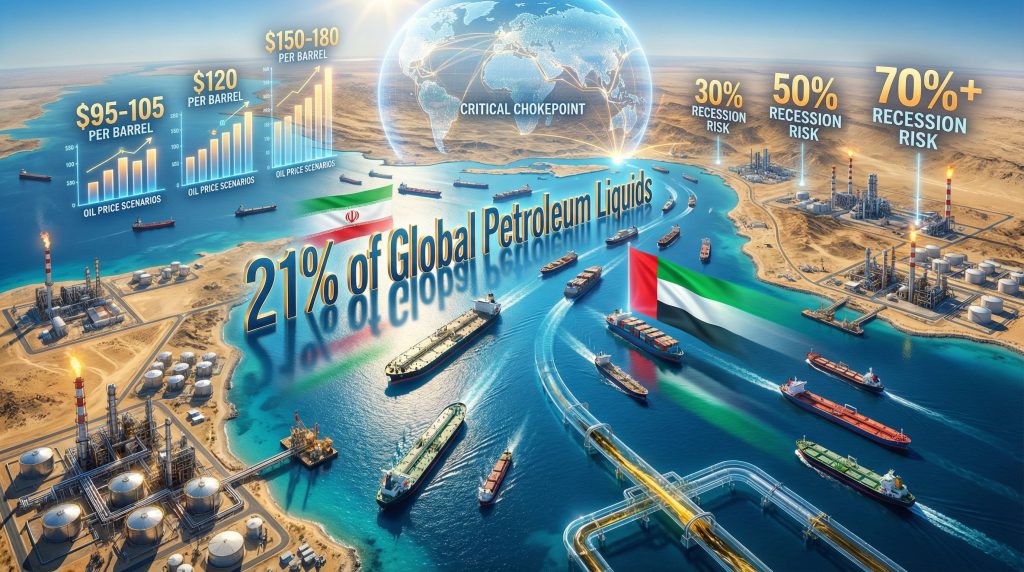
The potential for a global recession if Iran war worsens depends on several interconnected factors that could rapidly transform regional conflict into worldwide economic disruption. According to the IMF's latest analysis, three specific scenarios could trigger global recession conditions.
First, sustained closure of the Strait of Hormuz would immediately remove 20-25% of global oil supply from markets, creating price shocks exceeding those seen during the 1973 embargo. Second, broader regional escalation involving Saudi infrastructure could potentially disrupt an additional 10-12% of global production capacity.
Third, the combination of energy disruption with existing inflation and tariffs pressures could create a perfect storm scenario where monetary policy tools prove insufficient to address simultaneous supply-side and demand-side economic pressures.
The next major ASX story will hit our subscribers first
Strategic Economic Mitigation Frameworks
Effective crisis response requires coordinated utilisation of strategic reserves, alternative supply development, and targeted fiscal measures. Historical precedent demonstrates that early, decisive action can significantly reduce recession probability compared to delayed policy responses.
International Strategic Reserve Coordination
The International Energy Agency coordinates strategic petroleum reserve releases among 31 member countries controlling approximately 1.5 billion barrels of emergency stocks. However, release mechanisms require consensus among major economies and face logistical constraints on delivery timing.
Global Strategic Reserve Capacity:
| Country | Reserve Volume | Days of Import Coverage | Maximum Release Rate |
|---|---|---|---|
| United States | 400 million barrels | 200 days | 2.0 million bpd |
| Japan | 145 million barrels | 180 days | 1.2 million bpd |
| Germany | 55 million barrels | 90 days | 0.4 million bpd |
| South Korea | 35 million barrels | 85 days | 0.3 million bpd |
Coordinated releases can theoretically add 4-5 million barrels per day to global supply, equivalent to approximately 4-5% of total global consumption. However, market psychology effects often exceed physical supply impacts as traders anticipate policy responses.
Alternative Energy Infrastructure Acceleration
Energy crises historically catalyse accelerated alternative energy deployment through emergency policy measures and increased private investment. The 1973 oil embargo prompted significant nuclear power expansion programmes, while 2008 price spikes accelerated renewable energy development.
Current alternative energy capacity could potentially offset 15-20% of petroleum consumption through accelerated electric vehicle adoption, industrial process substitution, and residential heating conversion. However, infrastructure constraints limit short-term substitution possibilities.
How Would Global Markets React to Iran War Escalation?
The prospect of a global recession if Iran war worsens would trigger immediate defensive repositioning across asset classes as investors anticipate widespread economic disruption. Global market volatility would likely increase exponentially within the first 48-72 hours of significant escalation.
Equity markets would experience sector rotation favouring defensive positions, while commodity markets could see unprecedented price spikes. According to recent economic impact studies, oil prices could reach $150-200 per barrel within weeks of serious conflict escalation.
Currency markets would demonstrate extreme volatility as safe-haven demand concentrates in the US dollar, Japanese yen, and Swiss franc while emerging market currencies face severe pressure from capital flight.
Long-term Economic Structural Transformation
Major energy disruptions often accelerate existing trends toward economic regionalisation and supply chain restructuring. Countries prioritise trade relationships with reliable energy suppliers while businesses reassess operational strategies to reduce energy dependency vulnerabilities.
Energy Security Premium Integration
Post-crisis economic structures typically incorporate higher "energy security premiums" in planning and investment decisions. This manifests through increased strategic inventory holding, supply chain diversification investments, and alternative energy infrastructure development prioritisation.
Capital allocation shifts toward energy efficiency improvements and domestic energy production capabilities. Real estate markets demonstrate increased valuation premiums for energy-efficient properties and proximity to reliable energy infrastructure.
Investment Strategy Framework Development
Energy-driven recession risks require portfolio strategy modifications that account for both defensive positioning and opportunity identification during crisis periods. Traditional recession hedging strategies may prove insufficient during supply-side driven economic contractions.
Investors typically employ sector rotation strategies emphasising utilities, consumer staples, and healthcare while reducing exposure to discretionary spending and energy-intensive manufacturing sectors. Real assets including commodities and inflation-protected securities provide portfolio hedging against energy-driven inflation.
The severity of a global recession if Iran war worsens would ultimately depend on conflict duration, international response effectiveness, and the resilience of emergency energy supply mechanisms. Early intervention and coordinated policy responses remain essential for minimising economic disruption while addressing underlying geopolitical tensions that threaten global energy security.
Investment strategies during energy-driven economic disruptions require careful analysis of both defensive positioning and opportunity identification. Historical precedent suggests that early positioning adjustments and patient capital deployment during crisis periods can generate significant long-term returns while protecting against systematic recession risks.
Looking to Capitalise on Energy Market Volatility During Geopolitical Tensions?
Discovery Alert provides instant notifications on significant ASX mineral discoveries using its proprietary Discovery IQ model, enabling subscribers to identify actionable opportunities in energy and commodity markets ahead of broader market movements. Visit Discovery Alert's dedicated discoveries page to understand how historic mineral discoveries have generated substantial returns during periods of market uncertainty, then begin your 14-day free trial to position yourself strategically ahead of the market.