August 6, 2026
Understanding the Global Electric Vehicle Transformation
The automotive industry stands at a critical juncture where traditional market hierarchies face unprecedented disruption. The BYD overtakes Tesla in electric vehicle sales phenomenon exemplifies how rapidly the competitive landscape can shift, particularly as critical minerals energy transition requirements reshape manufacturing priorities. Electric vehicle adoption patterns reveal fundamental shifts in consumer preferences, manufacturing capabilities, and geopolitical influence across global supply chains.
Recent market developments indicate that the transition from internal combustion engines to electric propulsion systems has accelerated beyond most industry projections. However, this transformation encompasses complex dynamics involving battery technology advancement, charging infrastructure deployment, and supply chain crisis in critical minerals that extend far beyond vehicle assembly operations.
When big ASX news breaks, our subscribers know first
How BYD Achieved Global Electric Vehicle Leadership
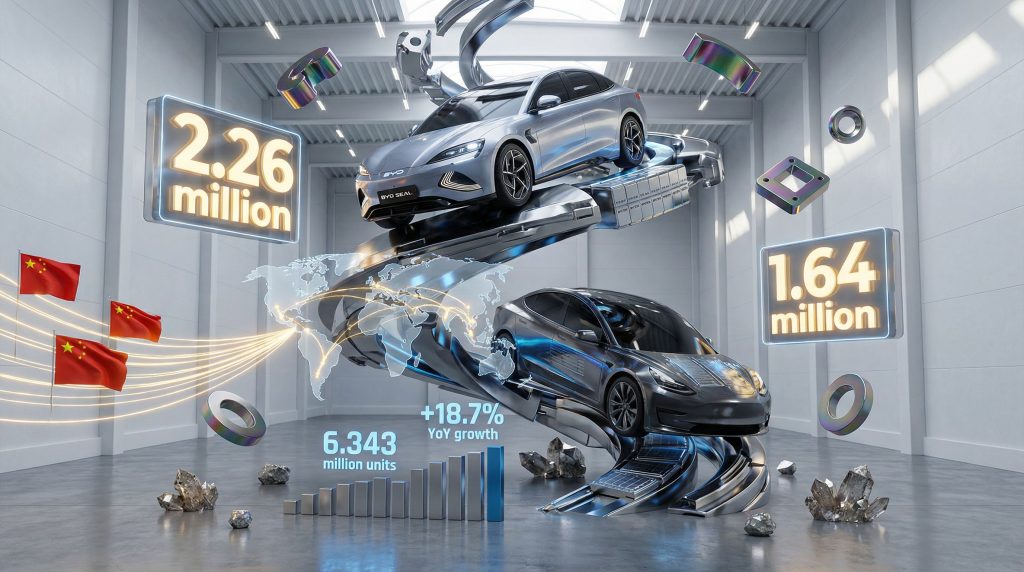
The Chinese manufacturer's ascension to the world's largest battery-electric vehicle producer represents more than statistical achievement. BYD delivered approximately 2.26 million pure electric vehicles in 2025, establishing a commanding lead over Tesla's 1.64 million deliveries and marking the first time a Chinese company has claimed the global BEV crown. This 620,000-unit differential signals a fundamental restructuring of automotive industry power dynamics.
Vertical Integration as Market Advantage
BYD's competitive positioning stems from comprehensive supply chain control spanning multiple critical components. Furthermore, this integrated approach enables cost optimisation unavailable to competitors relying on external suppliers, particularly in mass-market segments where pricing pressure remains intense:
• Battery cell manufacturing with proprietary lithium iron phosphate (LFP) and ternary chemistry production
• Semiconductor fabrication for vehicle electronics and battery management systems
• Rare earth magnet integration reducing dependency on external suppliers
• Motor assembly operations optimised for specific vehicle architectures
The company's Blade Battery technology demonstrates this integration advantage, allowing consistent installation across multiple vehicle platforms despite varying size requirements and target demographics.
Portfolio Diversification Strategy
Unlike Tesla's premium-focused approach, BYD operates simultaneously across price segments:
| Vehicle Category | Price Range (USD) | Examples | Target Market |
|---|---|---|---|
| Entry-level city vehicles | Under $10,000 | Seagull model | Price-sensitive urban consumers |
| Mid-range family vehicles | $15,000-$25,000 | Qin/Song series | Middle-class households |
| Premium offerings | $40,000-$60,000 | Han/Tang models | Luxury segment competitors |
This tiered strategy maximises market capture across diverse consumer demographics while reducing dependency on any single price segment's performance fluctuations.
Tesla's Delivery Decline and Market Implications
Tesla's second consecutive year of declining deliveries reveals structural challenges beyond cyclical market fluctuations. The company's 8-9 percent annual contraction in 2025 reflects multiple converging factors that highlight broader electric vehicle market maturation dynamics.
Policy Environment Impact
The elimination of US federal EV incentives under the Trump administration created immediate market friction. In addition, the Trump tariffs market impact effectively increased net vehicle costs for American consumers, with the $7,500 federal tax credit removal translating to approximately $100-150 higher monthly payments for financed purchases over typical 5-7 year loan terms.
This policy shift occurred precisely when Tesla's core US market faced increased competitive pressure from both traditional manufacturers' electric offerings and Chinese imports where permitted through existing trade frameworks.
Product Lifecycle Challenges
Tesla's aging model lineup demonstrates the risks of extended product cycles in rapidly evolving markets:
• Model Y (launched 2020): Five years without comprehensive redesign
• Model 3 (launched 2017): Eight years with incremental updates only
• Cybertruck production challenges limiting capacity for proven models
Industry analysis suggests the Cybertruck reached approximately 280,000-300,000 units in 2024, below initial production guidance while potentially constraining higher-demand Model Y manufacturing capacity.
Chinese Automotive Export Surge Reshaping Trade
Chinese automotive exports reached 6.343 million units through November 2025, representing 18.7 percent year-over-year growth with projections exceeding 7 million units annually. This export acceleration indicates systematic overcapacity management through international market expansion rather than organic global demand growth.
Geographic Expansion Patterns
Chinese manufacturers prioritise markets with favourable regulatory environments. However, the broader US-China trade war impact continues to influence strategic market selection:
• Southeast Asia: Thailand manufacturing partnerships, reduced import duties
• Latin America: Brazil market leadership in imported electric vehicles
• Selective European markets: Where tariff barriers remain manageable
• Africa and Middle East: Infrastructure development partnerships
This expansion strategy creates new competitive pressures for established Western automakers while providing Chinese manufacturers outlet capacity for domestic overproduction challenges.
Manufacturing Capacity Utilisation
The International Energy Agency reports that electric vehicle sales exceeded 17 million units in 2024, representing over 20 percent of global car sales. Projections for 2025 anticipate exceeding 20 million units at approximately 25 percent of global automotive sales, driven by 25 percent year-over-year growth rates.
However, this growth concentrates primarily in Chinese domestic markets and select international regions, creating uneven demand distribution that Chinese manufacturers address through aggressive export strategies.
Economic Forces Driving Industry Consolidation
The electric vehicle sector transitions from volume-focused competition toward profitability-based survival criteria. Consequently, companies must now demonstrate sustainable gross margins and positive cash flow generation rather than delivery growth alone.
The "Elimination Round" Economics
Market dynamics reveal clear differentiation between scale leaders and struggling manufacturers:
Scale Advantages:
• Raw material procurement leverage through larger volume commitments
• Manufacturing efficiency improvements across integrated facilities
• R&D cost distribution across broader vehicle portfolios
• International expansion capital availability
Competitive Pressures:
• Intense domestic Chinese competition creating deflationary pricing
• Consumer preference shifts toward feature-rich, lower-priced alternatives
• Regulatory uncertainty in key export markets
• Battery technology advancement requiring continuous investment
Profitability Versus Volume Metrics
While BYD overtakes Tesla in electric vehicle sales volume, unit sales leadership does not automatically translate to financial dominance. Tesla's higher average selling prices (ASP) relative to BYD's mass-market focus suggests different business model orientations where absolute revenue and net income comparisons may favour Tesla despite lower delivery volumes.
Critical Role of Hybrid Technologies
Global adoption patterns reveal hybrid electric vehicles (HEVs) demonstrating stronger growth in markets with infrastructure limitations or policy uncertainties. For instance, regional preferences indicate market-specific adoption trajectories rather than uniform global electric vehicle preference.
Regional Hybrid Preference Patterns
European Market Dynamics:
Hybrid vehicles serve as "bridge technology" during charging network development, with ACEA data showing hybrid adoption rising substantially across 2019-2023 while petrol/diesel shares decline steadily.
US Market Hybrid Strength:
Reuters reporting for 2025 indicates gas trucks, SUVs, and hybrid vehicles driving demand growth while EV market share softened in late-year retail sales. According to CNBC, this pattern emerged following federal incentive eliminations and suggests consumer preference flexibility based on economic incentives rather than categorical technology adoption.
Technology Integration Requirements
Both BEV and hybrid technologies require rare earth permanent magnets (NdPr, Dy/Tb) for motor efficiency, creating strategic dependencies on Chinese-controlled supply chains regardless of final assembly location. Furthermore, this materials requirement extends beyond pure electric vehicles to encompass the broader electrified vehicle category.
The next major ASX story will hit our subscribers first
Rare Earth Dependencies in Electric Vehicle Competition
The electric vehicle industry's expansion creates increasing demand for critical materials controlled predominantly by Chinese supply chains. Understanding these dependencies reveals strategic vulnerabilities for Western manufacturers and policy makers.
Critical Material Supply Chains
Rare Earth Permanent Magnets:
• Neodymium-Praseodymium (NdPr): Primary magnetic material for EV motors
• Dysprosium-Terbium (Dy/Tb): High-temperature performance enhancement
• Processing concentration: China controls approximately 85-90% of global processing capacity
• Mining distribution: While mining occurs globally, processing remains concentrated
Western Supply Chain Development Challenges
US and European efforts to establish independent rare earth processing capacity face significant obstacles:
Timeline Challenges:
• Processing facility construction requires 3-5 year development periods
• Environmental permitting extends development timelines substantially
• Technical expertise concentration in Chinese facilities
• Capital investment requirements exceeding $1 billion for meaningful capacity
Economic Competitiveness:
• Chinese processing costs benefit from scale economies and established infrastructure
• Western facilities must achieve cost parity while meeting environmental standards
• Government subsidies required to offset initial competitive disadvantages
This dependency structure provides Chinese manufacturers inherent cost advantages regardless of final vehicle assembly location, extending beyond direct Chinese automotive exports to encompass the broader supply chain architecture.
Investment Implications of Market Leadership Transition
The transition where BYD overtakes Tesla in electric vehicle sales creates significant implications for automotive sector investment strategies and risk assessment frameworks. Moreover, electric vehicles transforming mining operations adds another dimension to the industry's evolution.
Winner-Loser Dynamics Among Chinese Manufacturers
Scale Leader Advantages:
• BYD, Geely: Cost advantages through vertical integration and volume procurement
• International expansion capabilities: Capital availability for overseas manufacturing investments
• Technology development resources: R&D funding for next-generation platforms
• Financial resilience: Ability to withstand pricing pressure and market volatility
Smaller Manufacturer Challenges:
• Capital requirements: Difficulty funding expansion and technology development simultaneously
• Pricing pressure vulnerability: Limited ability to compete on cost while maintaining profitability
• Market access barriers: Insufficient scale for international expansion investments
• Technology licensing dependencies: Reliance on external suppliers for critical components
Global Automotive Sector Restructuring
Traditional Western automakers confront accelerated competitive timelines requiring substantial capital allocation toward electric vehicle development while managing declining internal combustion engine revenues. This dual transition creates complex resource allocation challenges and cash flow management requirements.
Strategic Response Requirements:
• Manufacturing facility conversion: Retooling existing plants for electric vehicle production
• Supply chain diversification: Reducing Chinese dependency for critical materials
• Technology partnership development: Accelerating electric vehicle capability development
• Market positioning adjustments: Competing effectively against Chinese price-performance ratios
Trade Policy Impact on Electric Vehicle Competition
Western governments face complex balancing acts between consumer electric vehicle adoption goals and domestic industry protection measures. Policy frameworks increasingly emphasise tariff structures and local content requirements as primary competitive tools.
Regulatory Response Patterns
Current Policy Frameworks:
• US: Eliminated federal EV incentives while maintaining tariffs on Chinese vehicles
• European Union: Implementing additional tariffs on Chinese electric vehicle imports
• Local content requirements: Increasing emphasis on domestic manufacturing and assembly
• Critical materials security: Strategic mineral stockpiling and processing capacity development
Market Access Strategy Evolution
Chinese manufacturers must navigate increasingly complex regulatory environments while maintaining cost competitiveness:
Localisation Strategies:
• Thailand: BYD establishing domestic manufacturing through joint ventures
• Brazil: Positioning as leading imported electric vehicle brand
• Mexico: Potential North American market access through USMCA frameworks
• European partnerships: Joint ventures and technology licensing arrangements
These strategies require substantial capital investments while regulatory environments remain dynamic and potentially hostile to Chinese automotive expansion.
Future Outlook for Global Electric Vehicle Markets
The market leadership transition where BYD overtakes Tesla in electric vehicle sales signals broader industry restructuring extending beyond these two companies toward comprehensive automotive sector transformation. The Guardian reports on this significant shift in the global automotive landscape.
Competitive Landscape Evolution Through 2026
Technology Development Acceleration:
• Battery technology: Improved energy density and charging speed capabilities
• Autonomous systems: Integration of driver assistance and self-driving technologies
• Manufacturing efficiency: Continued cost reduction and quality improvement initiatives
• Charging infrastructure: Rapid expansion and standardisation efforts globally
Market Maturation Indicators:
• Profitability focus: Transition from volume growth to sustainable margin generation
• Consumer preference crystallisation: Clear differentiation between price and feature priorities
• Infrastructure adequacy: Charging network coverage meeting mainstream adoption requirements
• Policy stability: Clearer regulatory frameworks reducing investment uncertainty
Supply Chain Realignment Dynamics
Automotive supply chains continue evolving toward regional clusters where rare earth processing, battery manufacturing, and final assembly locations become strategic considerations for both market access and cost optimisation.
Regional Cluster Development:
• North America: US-Mexico manufacturing integration with Canadian mineral resources
• Europe: Nordic rare earth development with Central European manufacturing
• Asia-Pacific: Chinese dominance extending through Southeast Asian partnerships
• Emerging markets: Local assembly operations reducing transportation costs and tariffs
The transition represents early stages of broader structural shifts that will continue reshaping global automotive production and consumption patterns throughout the remainder of the decade.
This analysis incorporates data from automotive industry reporting, government policy announcements, and manufacturing statistics current through January 2026. Electric vehicle market dynamics remain subject to rapid change based on policy developments, technology advancement, and evolving consumer preferences across regional markets.
Ready to Invest in the Electric Vehicle Transformation?
The rapid shifts in electric vehicle leadership highlight emerging opportunities across critical mineral supply chains and electrification technologies. Discover how Discovery Alert's proprietary Discovery IQ model instantly identifies significant ASX mineral discoveries related to battery materials, rare earths, and the resources powering this global transformation, giving you actionable insights ahead of the broader market.