June 4, 2026
The Mechanics of Global Energy Dependencies Under Stress
Modern energy markets operate through intricate webs of fiscal relationships, where government revenues directly correlate with commodity pricing dynamics and geopolitical stability. When major energy exporters face revenue pressures, these disruptions cascade through international markets, creating opportunities for some players whilst threatening others. Understanding these mechanisms becomes crucial as traditional energy powerhouses confront unprecedented challenges to their economic foundations, particularly when examining the US economy and tariffs affecting global trade patterns.
The interdependence between energy revenues and state budgets creates vulnerabilities that extend far beyond domestic policy considerations. Countries heavily reliant on hydrocarbon exports find themselves exposed to volatile pricing cycles, sanctions regimes, and structural market shifts that can fundamentally alter their fiscal positions within months rather than years.
When big ASX news breaks, our subscribers know first
Russia Faces Sharp Drop in Oil Tax Revenue: The Numbers Behind the Crisis
Recent data reveals the severity of Russia's current fiscal challenges, with petroleum-derived tax receipts experiencing dramatic declines throughout 2025. The confluence of multiple pressure points has created an unprecedented revenue shortfall that threatens to reshape both domestic policy and international energy flows. Furthermore, this situation has contributed to broader market instability, as seen in recent oil price crash analysis examining global petroleum dynamics.
Revenue Structure Under Pressure
Russia's federal budget traditionally derives approximately 40% of its total revenues from oil and gas taxation, creating extraordinary sensitivity to commodity price movements and export volume fluctuations. Current trajectories suggest these energy-related receipts may fall to just 70% of their previous year levels, representing a critical shortfall in government financing.
| Revenue Metric | Previous Performance | Current Trajectory | Projected Shortfall |
|---|---|---|---|
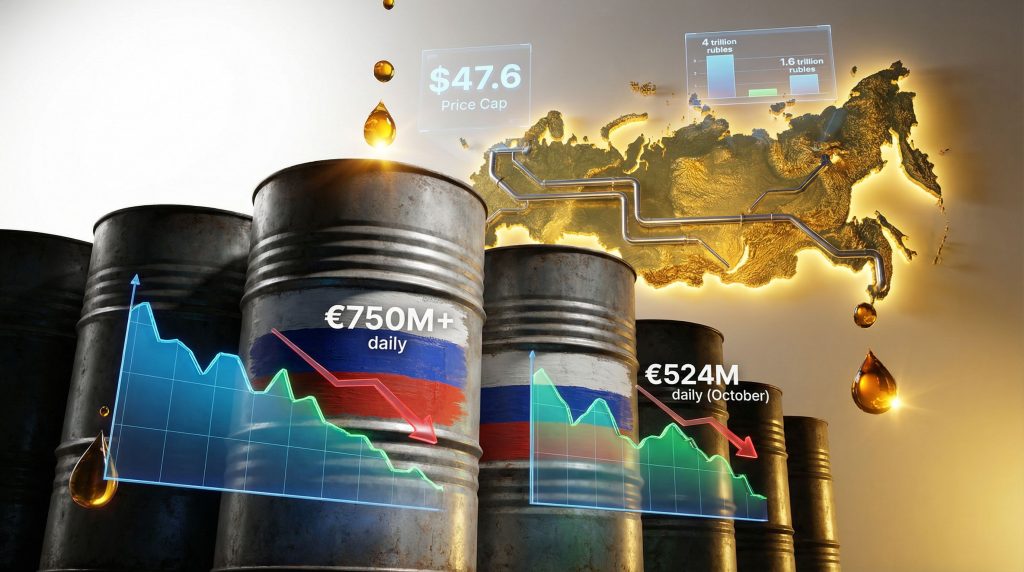
| Monthly Export Earnings | Peak levels above €750M daily | Current €524M daily (October) | 30% decline |
| Required Q4 Collections | 1.6 trillion rubles projected | 1.2 trillion rubles achieved | 25% gap |
| Budget Share Impact | 40% federal revenue dependency | Declining to 28% share | Critical reduction |
The October 2025 figures demonstrate the accelerating nature of this revenue collapse, with daily export earnings dropping substantially below historical averages. This represents more than a temporary market adjustment; it signals a structural shift in Russia's ability to generate foreign currency through energy exports.
Shadow Fleet Economics and Transport Disruptions
Recent developments in maritime logistics have compounded Russia's revenue challenges significantly. Alternative shipping routes now require 70% longer transit times, dramatically increasing operational costs whilst reducing delivery efficiency. This represents a fundamental shift in the economics of Russian energy exports.
The shadow fleet operations, whilst providing some sanctions circumvention capabilities, operate at substantially higher costs than traditional shipping arrangements. Insurance premiums have surged for vessels operating outside Western frameworks, whilst the extended routing requirements add significant time and fuel costs to each delivery.
Key operational impacts include:
- Tanker routes extending journey times by 70% or more
- Insurance coverage costs surging for non-compliant vessels
- Price discounts widening against international benchmarks
- Reduced overall export volume capacity due to logistics constraints
Western Sanctions Architecture: Targeting Production Capacity
The October 2025 sanctions package marked a qualitative shift in enforcement strategy, moving beyond traditional financial and technology restrictions to directly target production capabilities. This approach focuses on constraining actual export volumes rather than merely complicating payment mechanisms or technology transfers. Consequently, these measures are now tariffs impacting markets across multiple sectors globally.
Production Giants Under Pressure
The targeting of Rosneft and Lukoil represents a strategic escalation, as these entities collectively control approximately half of Russia's total production capacity. Unlike previous sanctions focused on peripheral activities, these measures directly impact the core revenue-generating operations of the Russian energy sector.
This production-focused approach creates immediate impacts on:
- Export volume capabilities
- International market access
- Financing for future development projects
- Technology acquisition for upstream operations
Price Cap Mechanisms: Economic Pressure Points
The G7 price ceiling framework, when fully enforced, demonstrates significant revenue destruction potential. Analysis of October data suggests that effective implementation of the $47.6 per barrel cap could have eliminated €1.36 billion from monthly revenues alone, representing a 15% reduction in peak collection periods.
Aggressive Scenario Modelling
More stringent price cap scenarios present even greater challenges to Russian fiscal stability. Modelling suggests that a $30 per barrel ceiling could destroy up to 36% of peak month revenues, whilst still maintaining profitability at the wellhead level given Russia's estimated $15 production cost floor.
The effectiveness of price caps lies not in making production unprofitable, but in constraining the fiscal resources available to the state through dramatically reduced tax receipts.
This mechanism creates a particularly challenging situation where production remains economically viable at the operational level, but state revenues fall below critical thresholds needed for government functioning.
Non-Energy Revenue Performance and Diversification Challenges
Moscow's attempts to reduce fiscal dependency on hydrocarbon revenues through tax increases and administrative measures have yielded mixed results. However, whilst non-petroleum revenues show growth rates of approximately 10% year-over-year, this expansion fails to offset the magnitude of energy revenue declines.
The Reality of Economic Diversification
Several factors complicate Russia's revenue diversification efforts:
- Inflation Impact: 8% CPI inflation and 4-5% GDP deflator rates mask real growth in alternative revenue streams
- Coverage Limitations: Non-energy sources cover only 88% of current expenditure requirements
- Collection Efficiency: Economic deceleration reduces business activity across multiple tax categories
The 4 Trillion Ruble Challenge
Government projections called for raising 4 trillion rubles through diversification efforts, yet implementation has fallen short of targets. Economic contraction and reduced private sector activity have undermined collection efficiency across personal income taxes, corporate profits, and value-added tax categories.
Global Market Contagion Risks and Opportunities
Russia's fiscal stress creates ripple effects extending well beyond domestic policy constraints, generating both risks and opportunities across international energy markets. For instance, recent developments highlight how OPEC production impact decisions influence global pricing mechanisms.
Energy Market Implications
The revenue crisis creates multiple pressure points for global energy systems:
Supply-Side Effects:
- Reduced investment in upstream development projects
- Potential production curtailments if fiscal pressures intensify
- Decreased capacity for price competition in international markets
Market Structure Changes:
- Increased demand for alternative energy suppliers
- Price volatility as markets adjust to supply uncertainty
- Opportunities for market share gains by competitors
Geopolitical Spillover Effects
Beyond energy markets, the fiscal crisis creates broader international implications:
- Regional Stability: Reduced capacity for external military commitments and regional interventions
- Alliance Dynamics: Pressure on relationships with energy-importing partner countries
- Sanctions Effectiveness: Demonstration of economic pressure campaign success encouraging similar measures
The next major ASX story will hit our subscribers first
Recession Scenarios and Economic Modelling
Multiple pathways toward economic contraction emerge from current fiscal pressures, with varying degrees of severity depending on external factors and policy responses. Additionally, broader Russian sanctions impact across multiple sectors compound these economic challenges.
Optimistic Adjustment Scenario
In the most favourable case, gradual economic adjustment could limit GDP decline to 2-3% through:
- Oil price stabilisation above $50 per barrel
- Current sanctions enforcement levels maintaining status quo
- Domestic consumption adjusting gradually to reduced government spending
- Successful implementation of some revenue diversification measures
Pessimistic Contraction Scenario
More severe outcomes could produce 5-7% GDP contractions through:
- Further sanctions expansion targeting additional sectors
- Oil prices falling below $45 per barrel sustained periods
- Accelerated capital flight reducing domestic investment
- Currency instability undermining import capacity
Policy Response Options and Constraints
Moscow's response capabilities remain limited but include several potential approaches, each carrying distinct economic and political costs. In addition, international coordination efforts continue to strengthen sanctions enforcement mechanisms.
Fiscal Adjustment Mechanisms
Spending Reductions:
- Cuts to non-essential government programmes and infrastructure projects
- Reduced social spending and public sector employment
- Deferral of major capital expenditure initiatives
Revenue Enhancement:
- Additional tax burden on domestic economy
- Increased extraction rates on remaining profitable sectors
- Asset privatisation of state-owned enterprises
Monetary and Financial Measures
Central bank and financial system interventions could include:
- Enhanced capital controls restricting outflows
- Interest rate manipulation to support currency stability
- Strategic drawdowns from sovereign wealth fund reserves
- Direct market interventions in foreign exchange markets
Global Energy Security Implications
Russia faces sharp drop in oil tax revenue, which could fundamentally reshape international energy architecture, creating lasting changes in supply patterns and market dynamics. This crisis demonstrates how quickly established market structures can shift under coordinated international economic pressure.
Market Share Redistribution
The revenue constraints create opportunities for alternative suppliers to gain permanent market position:
| Beneficiary Sector | Opportunity Type | Implementation Timeline | Risk Assessment |
|---|---|---|---|
| Middle East Producers | Volume replacement | 6-18 months | Low-Medium |
| U.S. Shale Operations | Market share expansion | 1-3 years | Medium |
| Alternative Energy | Accelerated adoption | 2-5 years | Medium-High |
| LNG Infrastructure | Diversification demand | 3-7 years | Medium |
Infrastructure Investment Patterns
Reduced Russian capacity expansion creates gaps in global energy infrastructure development:
- Pipeline Networks: Decreased investment in expansion projects
- Refining Capacity: Limited modernisation and efficiency improvements
- Exploration Activities: Reduced upstream development in challenging regions
- Technology Development: Constrained R&D spending on advanced extraction methods
Investment Strategy Implications
The fiscal crisis creates distinct investment opportunities and risks across energy markets, requiring careful analysis of timing and market positioning. Furthermore, broader geopolitical shifts influence investment decisions across multiple sectors.
Sector-Specific Opportunities
Energy Security Premium: Countries seeking supply diversification create demand for alternative sources, potentially supporting price premiums for reliable suppliers outside the Russian sphere.
Infrastructure Development: Gaps in Russian capacity expansion create opportunities for infrastructure investment in competing regions, particularly in pipeline networks and port facilities.
Technology Transfer: Reduced Russian technological development opens markets for Western energy technology providers in third countries.
Risk Assessment Framework
Investors must consider multiple risk factors when evaluating energy market opportunities:
- Geopolitical Stability: Potential for conflict escalation affecting broader regional markets
- Sanctions Compliance: Evolving regulatory requirements affecting investment decisions
- Market Volatility: Price instability during transition periods creating timing challenges
- Capital Allocation: Competition for investment capital as multiple opportunities emerge simultaneously
FAQ: Understanding Russia's Energy Revenue Crisis
Q: How sustainable are current Russian spending levels given revenue declines?
A: Based on current revenue trajectories and reserve depletion rates, significant fiscal adjustments appear necessary within 12-18 months to maintain basic government operations. According to Forbes analysis, the mounting fiscal pressure suggests limited sustainability under current conditions.
Q: Will reduced Russian investment affect global oil prices long-term?
A: Decreased upstream investment could tighten future supply availability, potentially supporting prices despite current oversupply concerns. However, this effect may be offset by increased investment in alternative sources.
Q: Are current sanctions achieving their intended economic pressure objectives?
A: Revenue data suggests sanctions are successfully constraining Russian fiscal resources, though full effectiveness depends on sustained international enforcement and coordination. Recent reports from The Straits Times indicate export revenues have reached their lowest levels since the invasion began.
Q: How might energy importers adjust their supply strategies?
A: Many countries are actively diversifying supply sources, investing in alternative infrastructure, and accelerating renewable energy adoption to reduce dependency on Russian exports.
Long-Term Market Evolution and Strategic Implications
Russia faces sharp drop in oil tax revenue represents more than a temporary adjustment period; it signals potential fundamental changes in global energy market structure and geopolitical relationships. The combination of sustained economic pressure, technological isolation, and reduced investment capacity creates conditions for lasting shifts in international energy flows.
The implications extend across multiple dimensions of global energy security, from supply chain reliability to price discovery mechanisms. As traditional patterns of energy trade evolve, new opportunities emerge for both established and emerging market participants to capture market share and establish lasting competitive advantages.
Understanding these dynamics becomes crucial for energy sector participants, policymakers, and investors seeking to navigate the changing landscape of global energy markets. Consequently, the current crisis provides a window into how quickly established market structures can shift under the pressure of coordinated international economic measures and evolving geopolitical realities.
Ready to Navigate Energy Market Disruptions?
Russia's energy revenue crisis highlights how quickly global market dynamics can shift, creating both risks and opportunities for investors. Discovery Alert's proprietary Discovery IQ model delivers real-time alerts on significant mineral discoveries across the ASX, helping subscribers identify actionable investment opportunities during periods of market volatility and capitalise on emerging trends before the broader market catches on. Begin your 30-day free trial today to secure your market-leading advantage in these uncertain times.