August 3, 2026
The Evolution of Global Energy Independence Through Strategic Resource Positioning
The architecture of global energy security faces unprecedented transformation as technological innovations in extraction and processing converge with shifting geopolitical priorities. While traditional energy supply chains have relied on concentrated production regions serving diverse international markets, the emergence of distributed production capabilities fundamentally alters the strategic calculus governing energy independence. Modern liquefaction technologies, combined with abundant unconventional resource bases, enable previously import-dependent nations to transition toward export capacity that reshapes international energy relationships.
This transition extends beyond mere commodity flows to encompass broader questions of economic sovereignty, supply chain resilience, and strategic alliance formation. Nations possessing both substantial resource endowments and advanced processing infrastructure increasingly leverage energy exports as instruments of economic diplomacy while domestic consumers benefit from economies of scale that reduce per-unit energy costs. The intersection of domestic energy security with international market participation creates opportunities for sustained economic growth through export revenue generation while maintaining competitive domestic energy pricing.
When big ASX news breaks, our subscribers know first
How Will Doubling U.S. LNG Export Capacity Transform Global Energy Markets?
The Strategic Foundation: America's Natural Gas Production Revolution
The United States achieved a historic milestone in natural gas production, with output expected to reach 109 billion cubic feet per day (Bcf/d) in 2026, establishing new all-time production records. Furthermore, this production surge parallels crude oil achievements, where domestic output reached 13.6 million barrels per day in 2025, demonstrating the maturation of unconventional extraction technologies across major production basins. These production benchmarks provide the fundamental supply foundation necessary for expanded liquefaction capacity and international market penetration.
The regulatory environment supporting this expansion accelerated dramatically following policy changes in early 2025. The Department of Energy authorized 17.6 Bcf/d of LNG exports in 2025, representing more than 70 percent greater volume than currently exported by the world's second-largest LNG supplier. This authorization velocity indicates that infrastructure capacity additions will proceed rapidly to meet policy objectives for doubling export capacity by the decade's conclusion.
Modern liquefaction technology improvements have reduced the energy intensity of gas-to-liquid conversion processes, enhancing the overall carbon efficiency of exports relative to competing international suppliers. Moreover, the integration of natural gas production sites with midstream gathering systems and liquefaction facilities enables economies of scope across the supply chain, reducing per-unit costs for liquefaction and transportation.
| Production Metric | 2025 Achievement | 2026 Projection |
|---|---|---|
| Natural Gas Production | 106 Bcf/d | 109 Bcf/d |
| Crude Oil Production | 13.6 million b/d | Growth expected |
| LNG Export Authorizations | 17.6 Bcf/d | Development continuing |
The Gulf Coast geographic concentration of liquefaction infrastructure creates integrated industrial clusters where upstream suppliers, midstream compressors, and liquefaction terminals function as coordinated systems. This geographic consolidation reduces transportation distances from production areas to export terminals and enables shared infrastructure investments in marine terminals, backup supply facilities, and specialised port infrastructure.
Geopolitical Energy Architecture: U.S. Market Position vs. Global Competitors
The trajectory toward doubling U.S. LNG export increase positions the United States to become the world's largest LNG exporter by 2030, fundamentally reshaping global energy supply architecture. Current market structure shows Qatar maintaining the largest export capacity at approximately 14-15 Bcf/d, followed by Australia at 11 Bcf/d, with the United States currently in third position at approximately 8-9 Bcf/d.
Strategic advantages for U.S. suppliers include optimal geographic positioning for serving both Atlantic and Pacific Basin markets. The Atlantic Basin location enables relatively rapid transit times to European and Atlantic African markets compared to Middle Eastern suppliers serving Pacific destinations. Additionally, the North American supply chain integration combining Canadian conventional supply with U.S. unconventional production creates a vertically integrated system where supply chain disruptions in one jurisdiction can be compensated through imports from adjacent territories.
The Department of Energy's 2024 LNG export study determined that LNG exports function as an economic multiplier, expanding job creation, increasing gross domestic product, and strengthening national security through enhanced energy diplomacy.
Physical characteristics of Gulf Coast terminal locations provide systematic operational advantages relative to international competitors. The absence of seasonal shipping disruptions, deeper natural harbours requiring minimal dredging, and proximity to the Panama Canal create cost advantages that enable competitive pricing for price-sensitive spot market volumes.
Key Strategic Advantages:
• Geographic proximity to major importing regions in Asia-Pacific and Europe
• Year-round shipping access without seasonal weather disruptions
• Integrated North American supply chain spanning multiple jurisdictions
• Advanced regulatory framework enabling accelerated project development
• Deep-water port infrastructure supporting large-scale LNG carrier operations
What Economic Multiplier Effects Drive LNG Export Growth?
Investment Capital Flows and Project Economics
The Department of Energy's authorisation of 17.6 Bcf/d in 2025 represents a capital commitment exceeding $150-175 billion in infrastructure investments, based on typical costs of $8-10 billion per Bcf/d of new liquefaction capacity. This massive capital deployment demonstrates the scale of economic transformation accompanying export capacity expansion.
A landmark partnership announcement exemplifies these economic multiplier effects. In June 2025, JERA, a Tokyo-based Japanese energy company, committed to purchasing up to 5.5 million tonnes per year (mtpa) of LNG from U.S. suppliers through 20-year offtake agreements. This partnership projects economic contributions exceeding $200 billion to U.S. gross domestic product over the contract term and is estimated to support more than 50,000 U.S. jobs annually.
| Economic Impact Category | Annual Contribution | Total Contract Value |
|---|---|---|
| GDP Contribution | $10 billion annually | $200+ billion over 20 years |
| Job Creation | 50,000+ positions | Sustained employment |
| Capital Investment | $8-10 billion per Bcf/d | $150-175 billion total |
Supply Chain Integration Benefits
Modern liquefaction facility economics require substantial fixed cost investments that must be amortised over 40-50 year operating periods. The capital intensity of liquefaction infrastructure creates economies of scale where larger facilities achieve lower per-unit capital costs than smaller installations. In addition, supply chain integration with natural gas production and midstream gathering enables cost sharing of common infrastructure including compressors, pipelines, and storage facilities.
Project financing structures typically require 30-40 percent equity capital and 60-70 percent debt financing, with debt investors demanding long-term offtake agreements providing revenue certainty for debt service. The 20-year commitment structure provides contracted revenue streams enabling debt capital to flow at favourable rates, reducing equity capital requirements and enabling project economics to support competitive export pricing.
The Economic Dominance Financing Programme, created under recent tax legislation, provides government financing mechanisms supporting natural gas project development. This programme reduces capital costs for new projects by lowering the required rate of return for project financing approval, enabling lower export pricing and accelerating project development timelines.
Regional Economic Development Patterns
Workforce development in LNG facility construction represents a significant economic multiplier throughout Gulf Coast regions. A typical 5 Bcf/d liquefaction train requires 4,000-5,000 construction workers over 4-5 years, creating direct income payments totalling $600-800 million annually during construction phases. The operational workforce of 200-300 permanent positions per facility commands premium wages of $80,000-120,000 annually, reflecting technical skill requirements and creating income that generates consumption-based multiplier effects in regional economies.
Regional Development Benefits:
• Construction phase: 4,000-5,000 workers per facility
• Operations phase: 200-300 permanent high-wage positions
• Annual construction payroll: $600-800 million
• Permanent operations payroll: $16-36 million annually
• Supply chain procurement: Local and regional vendor utilisation
Port infrastructure modernisation requirements accompanying LNG export expansion create additional economic development opportunities. Specialised marine terminals, regasification facilities for backup supply, and enhanced channel maintenance support maritime industry cluster formation while improving regional competitiveness for other industrial sectors requiring port access.
How Do Export Authorisation Policies Shape Market Dynamics?
Regulatory Framework Evolution and Market Access
The transformation of LNG export authorisation processes demonstrates the critical role regulatory frameworks play in determining market development velocity. The previous administration implemented a pause on LNG export approvals in January 2024, citing environmental review requirements despite internal studies showing U.S. LNG exports did not correlate with greenhouse gas emission increases or domestic energy cost escalation.
Policy reversals implemented in early 2025 removed regulatory barriers that previously constrained export development. The rescission of restrictions on LNG export approvals and the elimination of prohibitions on LNG bunkering (LNG use as marine fuel) fundamentally altered the regulatory environment supporting export expansion. These changes enabled JAX LNG, a small coastal facility near Jacksonville, Florida, to resume operations supporting maritime transportation markets.
Consequently, the streamlined authorisation process now enables projects to proceed from regulatory approval to construction phases without extended delays in commencement dates. This regulatory evolution provides confidence to upstream producers and liquefaction facility developers that authorised capacity will be permitted to operate according to projected timelines, reducing project development risk and improving financing terms.
Strategic Reserve Management and Export Balance
The coordination between export capacity expansion and strategic reserve management demonstrates sophisticated policy integration addressing both international market opportunities and domestic energy security requirements. The Strategic Petroleum Reserve refill programme, initiated in November 2025 with contracts for one million barrels of crude oil delivery, exemplifies this balanced approach to energy policy, demonstrating how US economy and tariffs policies integrate with energy infrastructure development.
According to the American Gas Association, natural gas utilisation over the last 17 years has generated inflation-adjusted savings of $1.6 trillion compared to 2008 recovery prices, equating to $3,445 in savings for the average American household.
Domestic price stability mechanisms ensure that export growth does not compromise affordable energy access for residential and commercial consumers. Historical analysis indicates that export capacity expansion typically correlates with sustained domestic production growth, enabling simultaneous satisfaction of international and domestic demand without supply constraints that would elevate domestic pricing.
Policy Integration Framework:
• Strategic reserve coordination with export timing
• Domestic supply security during peak export periods
• Environmental review streamlining without compromising standards
• International trade agreement integration
• Emergency response protocols during supply disruptions
What Global Demand Drivers Sustain Long-Term Export Growth?
Asian Market Transformation and Energy Security Priorities
Japan's energy diversification strategy following the Fukushima incident created sustained demand for reliable LNG supply sources, with JERA's commitment to U.S. suppliers representing a strategic pivot toward North American supply chain integration. The 5.5 mtpa annual commitment reflects Japan's priority for supply source diversification that enhances energy security through reduced dependence on Middle Eastern suppliers concentrated in geopolitically volatile regions.
South Korea's industrial decarbonisation pathway similarly drives demand for cleaner-burning natural gas as a transition fuel replacing coal-fired power generation. Korean industrial policy emphasises natural gas as an intermediate step toward renewable energy deployment while maintaining industrial competitiveness through reliable baseload power generation. This transition fuel strategy creates sustained demand for long-term LNG supply contracts supporting Korean economic development objectives.
China's natural gas transition from coal dependency represents the largest potential market expansion for international LNG suppliers. Chinese environmental policy prioritising air quality improvement in major metropolitan areas drives coal-to-gas switching in power generation and industrial heating applications. The scale of Chinese energy consumption suggests that even modest percentage increases in natural gas market share translate into substantial absolute demand increases.
European Energy Independence Acceleration
European energy independence priorities accelerated dramatically following geopolitical tensions that highlighted supply source concentration risks. Russian pipeline replacement strategies require diversified LNG supply sources capable of delivering volumes previously supplied through fixed pipeline infrastructure. European industrial competitiveness depends on reliable gas supply at predictable pricing, creating demand for long-term supply contracts with politically stable suppliers.
The European Union's carbon transition framework positions natural gas as a bridge fuel enabling renewable energy integration while maintaining grid stability during intermittent renewable generation periods. This policy framework creates sustained demand for LNG supply supporting European economic decarbonisation without compromising industrial competitiveness during the transition period. However, the US–China trade impacts on energy markets demonstrate how broader geopolitical considerations influence regional energy security strategies.
| Region | Primary Drivers | Demand Projection |
|---|---|---|
| Japan | Energy diversification post-Fukushima | 5.5 mtpa committed to U.S. |
| South Korea | Industrial decarbonisation | Sustained long-term growth |
| China | Coal-to-gas transition | Largest absolute demand potential |
| European Union | Russian supply replacement | Bridge fuel for renewables |
Emerging Market Penetration Opportunities
Southeast Asian markets demonstrate rapidly expanding LNG demand driven by economic development and urbanisation trends. Countries including Vietnam, Thailand, and Philippines show increasing natural gas utilisation for power generation and industrial applications as economic development elevates energy consumption patterns. These markets represent substantial growth opportunities for U.S. LNG suppliers capable of providing reliable supply at competitive pricing.
Latin American markets, particularly Mexico and Brazil, show increasing integration with North American energy infrastructure through pipeline connections and LNG import terminals. Mexico's proximity to U.S. production regions enables both pipeline gas exports and LNG supply for coastal industrial facilities, creating diversified market opportunities for U.S. natural gas suppliers.
Emerging Market Characteristics:
• Southeast Asia: Economic development driving energy demand
• Latin America: Infrastructure integration with North American suppliers
• Africa: Industrial development requiring reliable baseload power
• India: Coal replacement for air quality improvement
• Middle East: Domestic consumption growth exceeding production
How Will Technology Innovations Scale Export Efficiency?
Floating LNG Terminal Development
Floating LNG (FLNG) technology represents a paradigm shift enabling offshore liquefaction that reduces environmental footprint while accelerating deployment timelines. FLNG platforms eliminate the requirement for onshore terminal construction, reducing project development periods from 5-7 years to 3-4 years through modular construction in shipyards followed by towing to production sites.
The reduced environmental impact of FLNG operations appeals to regulatory authorities concerned about coastal ecosystem disruption associated with traditional onshore terminals. Furthermore, floating platforms can be repositioned based on production field development or market demand changes, providing operational flexibility that onshore terminals cannot match. This mobility enables optimisation of production field economics by relocating processing capacity to follow resource development patterns.
Offshore liquefaction platforms leverage existing offshore oil and gas production expertise while requiring minimal coastal infrastructure development. The integration with offshore production platforms enables field development in remote locations where onshore terminal construction would be economically prohibitive due to distance from population centres or environmental sensitivity concerns.
Digital Optimisation and Smart Grid Integration
Real-time demand forecasting systems enable LNG suppliers to optimise production scheduling based on international market conditions and domestic demand patterns. Advanced analytics incorporating weather forecasting, economic activity indicators, and seasonal demand patterns improve capacity utilisation while reducing operational costs through predictive maintenance and inventory optimisation.
Blockchain applications in LNG trade settlements reduce transaction costs and settlement time while improving transparency for international buyers requiring supply chain verification for regulatory compliance. Smart contracts enable automatic payment processing upon delivery confirmation, reducing counterparty risk and improving cash flow for suppliers operating on extended payment terms.
Technology Integration Benefits:
• Real-time production optimisation based on market conditions
• Predictive maintenance reducing operational downtime
• Blockchain settlement systems improving transaction efficiency
• IoT monitoring enhancing safety and environmental compliance
• Smart grid integration enabling demand response capabilities
Internet of Things (IoT) monitoring systems improve safety protocols while optimising energy efficiency throughout the liquefaction process. Sensor networks monitoring temperature, pressure, and flow rates enable real-time optimisation of liquefaction train performance while providing early warning systems for equipment maintenance requirements or safety protocol activation. For instance, AI transforming drilling technologies demonstrate how advanced systems enhance operational efficiency.
The next major ASX story will hit our subscribers first
What Risk Mitigation Strategies Address Market Volatility?
Price Risk Management Through Contract Diversification
Long-term offtake agreements spanning 20-year terms provide revenue stability that enables project financing while protecting against short-term price volatility. The JERA partnership structure exemplifies this approach, with 20-year commitments providing contracted revenue streams supporting debt service requirements while enabling competitive pricing through volume commitments and operational scale.
Spot market flexibility integration enables suppliers to capture pricing premiums during periods of tight global supply while maintaining base revenue through long-term contracts. This hybrid approach optimises revenue generation by allocating approximately 70-80 percent of capacity to long-term contracts while reserving 20-30 percent for spot market optimisation based on real-time pricing conditions.
Portfolio diversification across multiple importing regions reduces concentration risk while enabling suppliers to optimise delivery scheduling based on seasonal demand patterns and regional price differentials. European winter demand peaks offset Asian summer air conditioning demand, enabling year-round capacity utilisation optimisation and revenue stability.
Environmental Compliance and Carbon Footprint Reduction
Methane emission reduction technologies address international regulatory requirements while improving operational efficiency. Advanced leak detection systems utilising satellite monitoring and ground-based sensors enable rapid identification and repair of fugitive emissions, reducing environmental impact while optimising resource utilisation throughout the supply chain.
Carbon capture integration with LNG facilities creates opportunities for carbon-neutral or carbon-negative operations that appeal to environmentally conscious international buyers implementing corporate sustainability requirements. In addition, the integration of renewable energy sources for liquefaction power requirements further reduces carbon intensity while potentially qualifying for premium pricing from buyers prioritising environmental compliance.
The Department of Energy's September 2023 study revealed that U.S. LNG exports did not correlate with domestic greenhouse gas emission increases or energy cost escalation, providing regulatory foundation for continued export expansion.
Geopolitical Risk Assessment Framework
Supply route security through naval protection capabilities ensures reliable delivery to international markets during periods of geopolitical tension. The U.S. naval presence in major shipping lanes provides supply chain security that competing suppliers may be unable to guarantee, creating strategic advantages for U.S. LNG exports serving markets prioritising supply security over marginal cost differences. However, tariffs impact markets through trade policy changes can influence these relationships.
Alternative market development strategies enable suppliers to redirect capacity during supply disruptions or geopolitical tensions affecting specific regions. The development of relationships with importers across multiple continents provides operational flexibility enabling continued operations even when specific bilateral relationships experience temporary disruption.
Risk Mitigation Framework:
• 20-year contract terms providing revenue stability
• Regional diversification reducing concentration risk
• Environmental technology integration
• Naval protection for supply route security
• Multiple market development for operational flexibility
How Do Infrastructure Investments Support Sustained Growth?
Pipeline Network Expansion Requirements
Interstate natural gas pipeline capacity additions enable transportation of incremental production from major basins to coastal liquefaction terminals. The Permian Basin, Marcellus Shale, and Haynesville Shale production regions require enhanced pipeline infrastructure to accommodate growing production volumes destined for export markets while maintaining adequate capacity for domestic consumption.
Gathering system optimisation in major production basins improves efficiency in consolidating production from individual wells into transmission pipeline networks. Advanced compression station technology reduces energy consumption for gas transportation while increasing throughput capacity through existing pipeline infrastructure, deferring requirements for additional pipeline construction in environmentally sensitive areas.
The integration of pipeline infrastructure with storage facilities enables optimisation of seasonal production patterns and export scheduling. Underground storage capacity additions near major liquefaction terminals provide operational flexibility for managing production timing variations and optimising liquefaction train capacity utilisation during maintenance periods or demand fluctuations.
Port and Terminal Modernisation Programmes
Major LNG export terminal capacity expansions demonstrate the scale of infrastructure investment supporting doubled export capacity objectives. Current projects under development represent billions of dollars in terminal infrastructure including liquefaction trains, marine loading facilities, and storage tank installations necessary to accommodate projected export volumes.
| Terminal Development | Capacity Addition | Investment Timeline | Completion Schedule |
|---|---|---|---|
| Calcasieu Pass LNG | 12.0 mtpa | $10+ billion | 2026-2027 |
| Port Arthur LNG | 13.5 mtpa | $12+ billion | 2027-2028 |
| Rio Grande LNG | 27.0 mtpa | $18+ billion | 2027-2029 |
| Golden Pass LNG | 15.6 mtpa | $10+ billion | 2024-2025 |
Throughput efficiency improvements enable existing terminals to increase export capacity without proportional expansion of physical infrastructure. Advanced loading arm technology reduces vessel turnaround times while improving safety protocols, enabling higher annual throughput from existing marine terminal berths. These efficiency gains provide cost-effective capacity increases compared to constructing additional terminal facilities.
Transportation Fleet Development
LNG carrier construction and leasing markets require substantial expansion to accommodate doubled U.S. LNG export increase capacity by 2030. Each major liquefaction terminal requires dedicated vessel capacity for reliable delivery scheduling, with typical requirements of 6-8 dedicated vessels per 5 mtpa of annual export capacity. The specialised nature of LNG carriers requires 3-4 year construction periods, necessitating early planning for fleet capacity expansion.
Specialised vessel technology development enables service to previously inaccessible markets through Arctic shipping routes or shallow-water ports lacking deep-water berthing facilities. Ice-class LNG carriers enable year-round service to Northern European markets while shallow-draft vessel designs expand market access to developing economies with limited port infrastructure.
Fleet Development Requirements:
• 6-8 dedicated vessels per 5 mtpa terminal capacity
• 3-4 year vessel construction timelines
• Specialised technology for Arctic and shallow-water routes
• Fuel efficiency improvements reducing transportation costs
• Advanced cargo containment systems improving safety
What Competitive Advantages Sustain U.S. Market Leadership?
Resource Base Depth and Production Scalability
The United States possesses proven natural gas reserves exceeding 500 trillion cubic feet with probable reserves potentially doubling this total, providing resource foundation supporting decades of sustained export growth. Unconventional gas production technology leadership enables cost-competitive extraction from shale formations while conventional offshore resources provide additional supply sources for coastal liquefaction facilities.
Production scalability through horizontal drilling and hydraulic fracturing technology enables rapid capacity increases responding to market demand without requiring exploration and development timelines associated with conventional offshore resources. The ability to increase production within 12-18 months of drilling commencement provides supply flexibility enabling U.S. suppliers to respond to market opportunities faster than competitors requiring 3-5 year offshore field development periods.
Cost competitiveness compared to international suppliers reflects both abundant resource base characteristics and advanced extraction technology. U.S. wellhead gas pricing typically maintains significant discounts to international LNG pricing, providing margin for competitive export pricing while generating attractive returns for liquefaction facility operators and upstream suppliers.
Financial Market Access and Project Financing
Capital market depth for large-scale infrastructure projects enables U.S. suppliers to access financing for multi-billion dollar terminal development at competitive rates. The domestic financial market's capacity for energy infrastructure financing exceeds the requirements for projected LNG export expansion, reducing financing constraints that might limit development velocity in other jurisdictions.
Government policy support through financing programmes including the Economic Dominance Financing Programme reduces project capital costs while providing additional financing capacity for marginal projects. The combination of private capital markets and government financing support creates optimal conditions for rapid infrastructure development supporting doubled export capacity objectives.
Risk-sharing mechanisms with international partners enable project financing structures where equity commitments from importing nations support debt financing approval. JERA's long-term offtake commitments provide revenue certainty enabling attractive debt terms while reducing equity requirements for project developers, accelerating project development timelines through improved financing availability.
Strategic Alliance Formation
The JERA partnership model demonstrates how long-term supply relationships create mutual benefits extending beyond simple commodity transactions. JERA's commitment to multiple U.S. suppliers rather than single-source arrangements reflects the depth of U.S. supplier capabilities while providing importers with supply security through diversified procurement strategies.
Technology sharing agreements with importing nations create additional value streams beyond commodity sales while strengthening bilateral relationships supporting sustained export opportunities. Technical cooperation in liquefaction technology, environmental monitoring systems, and safety protocols creates intellectual property licensing revenue while building operational partnerships supporting long-term commercial relationships.
Joint venture structures for overseas market development enable U.S. suppliers to participate in LNG infrastructure development in importing nations, creating integrated supply chains spanning production, liquefaction, transportation, and regasification. These partnerships provide additional revenue sources while strengthening commercial relationships through shared investment and operational integration.
How Will Market Expansion Impact Domestic Energy Security?
Domestic Price Stability During Export Growth
Historical analysis of export growth versus domestic pricing demonstrates that sustained production increases typically enable simultaneous satisfaction of export demand and domestic consumption without supply constraints elevating domestic costs. Gas prices currently averaging $2.90 per gallon represent four-year lows, with fuel available under $3 per gallon in 43 states, indicating that production growth has outpaced combined domestic and export demand.
Regional price differential management through pipeline capacity expansion ensures that export growth benefits reach domestic consumers through competitive pricing while avoiding supply bottlenecks that could create regional price disparities. The integration of production regions with both domestic and export markets creates competitive dynamics benefiting consumers through economies of scale in production and transportation infrastructure.
Industrial user protection mechanisms ensure that export growth does not compromise domestic manufacturing competitiveness through elevated energy costs. Natural gas cost advantages supporting U.S. manufacturing competitiveness are maintained through production growth exceeding export capacity additions, while long-term supply contracts provide price stability for industrial consumers requiring predictable energy costs for capital investment planning.
Strategic Reserve Coordination
Strategic Petroleum Reserve refill timing coordination with export capacity additions demonstrates integrated energy policy addressing both domestic security and international market opportunities. The November 2025 contracts for one million barrels of crude oil delivery exemplify coordination between reserve management and production growth supporting both objectives simultaneously.
Emergency response protocols during supply disruptions ensure domestic energy security through priority allocation mechanisms while maintaining international commercial commitments. The regulatory framework provides authority for temporary export restrictions during national emergency conditions while international agreements include force majeure provisions protecting long-term commercial relationships.
Energy Security Integration:
• Reserve refill coordination with production growth
• Emergency response protocols prioritising domestic supply
• International Energy Agency coordination requirements
• Force majeure provisions in export contracts
• Strategic stockpile maintenance during export expansion
What Long-Term Scenarios Define Market Evolution Through 2030?
High-Growth Scenario: 25 Bcf/d Capacity Achievement
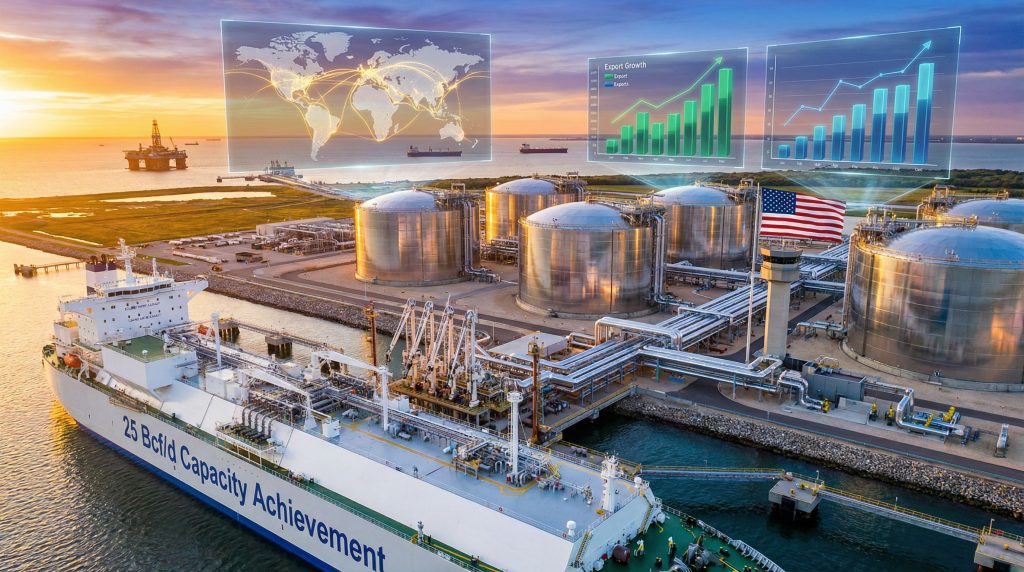
The achievement of 25 Bcf/d export capacity by 2030 would require infrastructure investments exceeding $200 billion while creating employment for more than 100,000 workers across construction, operations, and support services. This scenario assumes continued regulatory support, sustained international demand growth, and successful project financing for major terminal developments currently in planning phases.
Market share implications for global LNG trade indicate that 25 Bcf/d capacity would establish the United States as the dominant global supplier, controlling approximately 30-35 percent of total international LNG trade. This market position would provide significant leverage in international energy diplomacy while generating annual export revenue exceeding $80-100 billion depending on prevailing international pricing conditions.
Economic impact projections suggest that doubled export capacity could contribute 2-3 percent annually to U.S. GDP growth while generating federal tax revenue exceeding $15-20 billion annually through corporate income taxes, payroll taxes, and royalty payments from federal land production. Regional economic development in Gulf Coast states would accelerate through industrial cluster formation and high-wage employment creation.
Moderate Growth Scenario: Regulatory and Environmental Constraints
Environmental review timeline extensions could limit capacity additions to 18-20 Bcf/d by 2030, representing substantial growth while acknowledging potential regulatory delays affecting project development schedules. This scenario assumes continued environmental compliance requirements without return to export approval moratoriums that previously constrained development.
Alternative energy transition impacts on long-term demand growth could moderate international market expansion as importing nations accelerate renewable energy deployment. However, natural gas demand for grid stability during renewable energy integration and industrial process heating applications would sustain growth even under aggressive decarbonisation scenarios.
Competitive responses from international suppliers including Qatar's North Field expansion and Australian project development could intensify price competition while expanding total global LNG trade volume. Furthermore, as energy transition strategies evolve, U.S. suppliers would maintain competitive advantages through cost structure and supply reliability while market share stabilises at levels reflecting comparative advantages rather than market dominance.
Market Disruption Scenarios
| Risk Category | Probability Assessment | Mitigation Strategy | Recovery Timeline |
|---|---|---|---|
| Geopolitical Disruption | Moderate | Naval protection, alternative markets | 6-12 months |
| Technology Breakthrough | Low | R&D investment, partnership | 2-3 years |
| Climate Policy Changes | High | Environmental technology, compliance | 1-2 years |
| Economic Recession | Moderate | Contract flexibility, cost reduction | 12-18 months |
| Supply Chain Disruption | Low | Domestic sourcing, inventory | 3-6 months |
Geopolitical disruptions affecting major shipping routes could temporarily constrain export capacity while alternative routing and naval protection measures are implemented. The development of relationships with importers across multiple regions provides operational flexibility enabling continued operations through supply route diversification and alternative delivery mechanisms.
Technology breakthroughs in renewable energy storage or hydrogen production could accelerate demand transitions away from natural gas in certain applications. However, the timeline for large-scale deployment of alternative technologies suggests that natural gas demand would remain substantial throughout the 2030s even under aggressive technology adoption scenarios.
Climate policy changes imposing carbon pricing or emissions restrictions could increase operational costs while creating incentives for carbon capture integration and methane emission reduction technology deployment. U.S. LNG capacity expansion demonstrates the industry's technology leadership in environmental compliance, providing competitive advantages enabling adaptation to evolving regulatory requirements while maintaining cost competitiveness.
This analysis incorporates public information from government sources and industry announcements. Market projections involve inherent uncertainty and should be considered alongside comprehensive risk assessments. For additional context on global LNG market dynamics, readers seeking detailed investment guidance should consult qualified financial advisors familiar with energy sector dynamics and individual risk tolerance parameters.
Looking for Energy Market Investment Opportunities?
Discovery Alert provides instant notifications on significant ASX mineral discoveries, including critical energy transition commodities, powered by its proprietary Discovery IQ model. Subscribers gain access to real-time insights on actionable trading and investment opportunities in the rapidly evolving energy sector, ensuring quick and informed decisions ahead of broader market movements. Begin your 30-day free trial today to position yourself at the forefront of Australia's resource market opportunities.