May 14, 2026
Understanding the Critical Vulnerabilities in Global Energy Infrastructure
Modern energy markets operate under assumptions of stability and predictable supply chains that recent geopolitical events have fundamentally challenged. The interconnected nature of global liquefied natural gas systems creates concentration risks that traditional risk assessment models have consistently underestimated. When critical infrastructure becomes targets in regional conflicts, the ripple effects extend far beyond immediate geographic boundaries, reshaping entire market dynamics and forcing a complete reassessment of energy security challenges frameworks.
The scale of disruption possible when major energy hubs face operational challenges reveals how dependent global markets have become on a relatively small number of mega-facilities. These infrastructure concentration points represent single points of failure that can eliminate substantial portions of global supply capacity, creating immediate scarcity conditions that cascade through international markets with unprecedented speed and severity.
When big ASX news breaks, our subscribers know first
What Makes the Ras Laffan Attack and Global LNG Supply Crisis Historically Significant?
The Magnitude of Global Market Disruption
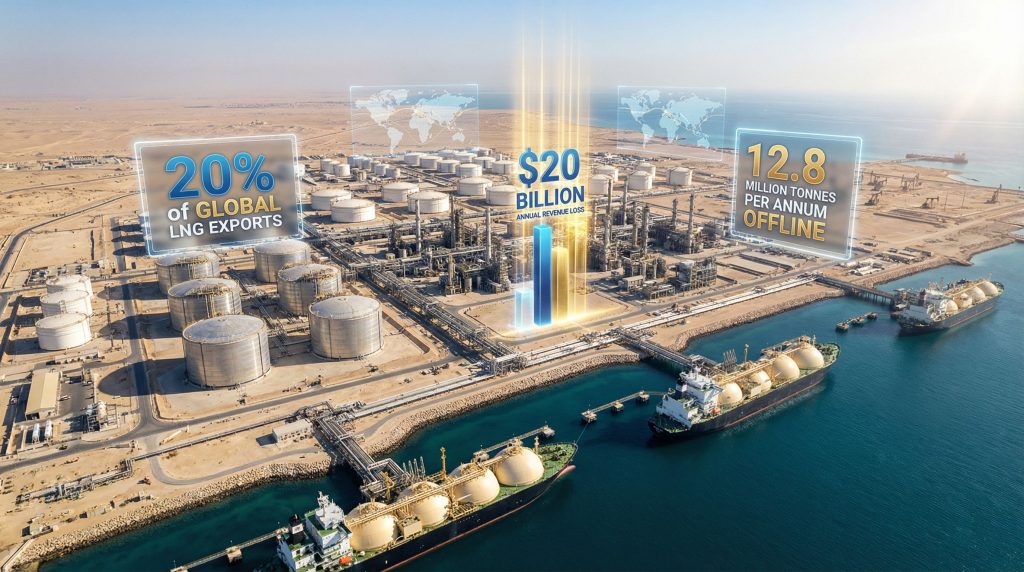
The recent crisis at Qatar's Ras Laffan complex has eliminated approximately 12.8 million tonnes per annum from global LNG markets, representing roughly 17% of Qatar's total export capacity. This volume disruption equals the entire annual natural gas consumption of several major European economies combined, creating an immediate supply deficit that cannot be easily compensated through existing alternative sources.
Qatar's position as controller of approximately 20% of global LNG exports means that operational disruptions at Ras Laffan directly impact energy security across multiple continents. The facility serves as the operational heart of the world's largest LNG export hub, with 90% of Qatari exports traditionally destined for Asian markets. This concentration has created acute competitive dynamics as Asian importers now compete directly with European buyers for increasingly scarce alternative supplies.
Key Impact Metrics:
• $20 billion annual revenue loss for QatarEnergy
• Force majeure declarations affecting China, South Korea, Italy, and Belgium
• 3-5 year estimated recovery timeline for full capacity restoration
• Complete reversal of projected global LNG surplus conditions through 2030
Infrastructure Vulnerability as Systemic Market Risk
The incident has revealed critical weaknesses in global energy system design that prioritised efficiency and cost optimisation over resilience and redundancy. Unlike previous supply disruptions affecting pipeline networks or smaller facilities, this event targeted the concentrated heart of global LNG export capacity, exposing how vulnerable just-in-time delivery models become when critical nodes face operational challenges.
Primary Vulnerability Factors:
| Risk Category | Specific Vulnerability | Global Impact |
|---|---|---|
| Geographic Concentration | 20% of global supply from single complex | Immediate scarcity conditions |
| Infrastructure Design | Limited redundancy in mega-facilities | Extended recovery timelines |
| Supply Chain Integration | Just-in-time delivery dependencies | Cascade effects across regions |
| Security Assumptions | Underestimated conflict exposure | Fundamental risk model revision |
The crisis represents what industry analysts characterise as the most significant energy infrastructure disruption since the 1973 oil embargo, establishing a new reference point for understanding systemic energy security vulnerabilities. This comparison suggests that despite five decades of technological advancement and market evolution, fundamental concentration risks in global energy systems have remained largely unaddressed.
Transformation of Market Expectations
Prior to these events, market consensus had coalesced around predictions of an approaching "LNG tsunami" driven by capacity expansions across Qatar, the United States, Canada, and African projects. Industry forecasts consistently projected oversupply conditions emerging by the late 2020s, with accompanying price declines and increased market flexibility.
The elimination of projected surplus conditions has fundamentally inverted these expectations, shifting market dynamics from anticipated abundance to confirmed scarcity. This represents more than a temporary supply disruption; it constitutes a complete reassessment of the structural assumptions underlying LNG market development and investment strategy components.
Market Narrative Transformation:
• Previous expectation: Global LNG surplus by 2028-2030
• Current reality: Extended tightness through early 2030s
• Investment implications: Enhanced focus on security over cost optimisation
• Risk assessment: Integration of geopolitical infrastructure vulnerability
How Are Global Supply Chains Adapting to the Ras Laffan Attack and Global LNG Supply Crisis?
Immediate Supply Chain Restructuring Dynamics
The elimination of Qatari export volumes has triggered immediate rebalancing of global LNG flows, with traditional supply relationships being rapidly restructured as buyers compete for increasingly scarce alternative sources. Asian importers, historically receiving the majority of Qatari exports, now face direct competition with European utilities for spot market cargoes, fundamentally altering decades-established trading patterns.
Regional Adaptation Strategies:
| Region | Primary Response | Alternative Sources | Implementation Timeline |
|---|---|---|---|
| Asia-Pacific | Demand destruction, industrial curtailment | U.S. Gulf Coast, Australian projects | 6-18 months |
| Europe | Premium pricing for spot cargoes | Norwegian pipeline, U.S. exports | 12-24 months |
| Middle East | Regional supply reallocation | Omani LNG, UAE domestic production | 3-12 months |
Constraints on Alternative Supply Development
Analysis of replacement capacity reveals significant limitations across all potential alternative sources. The United States, despite being the world's largest LNG exporter, operates near full capacity with limited spare production available for immediate deployment. Existing contractual commitments further constrain the ability to redirect volumes toward markets experiencing acute supply deficits.
Alternative Supply Source Analysis:
United States:
• Operating near maximum export capacity
• New projects face cost inflation and regulatory challenges
• Existing volumes largely committed under long-term contracts
Canadian Projects:
• Limited near-term capacity additions
• Volumes already committed to Asian buyers
• Extended development timelines for new facilities
African Developments:
• Exposed to security and execution risks
• Limited immediate capacity expansion potential
• Infrastructure vulnerability concerns
Norwegian Supply:
• Very limited spare production capacity
• Pipeline infrastructure constraints
• Seasonal demand variations
LNG Shipping and Logistics Constraints
The global LNG carrier fleet faces significant operational constraints that amplify the impact of production capacity reductions. Many vessels operate under long-term charter arrangements, directly limiting their availability for spot market adjustments during periods of supply tightness.
Current shipping constraints include increased congestion at loading and discharge terminals, resulting in higher demurrage costs and longer voyage times. Furthermore, the blocking of the Strait of Hormuz due to heightened security risks has complicated logistics, requiring vessel rerouting and generating additional insurance premiums.
Shipping Impact Factors:
• Fleet utilisation: Limited spot market vessel availability
• Transit disruptions: Extended voyage times due to security routing
• Insurance costs: Elevated premiums for Middle East operations
• Port congestion: Increased loading and discharge delays
• Effective supply reduction: Delayed deliveries reduce available market supply
Evolution of Contract Structures and Risk Management
The supply crisis has accelerated a fundamental shift in LNG contracting strategies, with buyers and sellers moving away from spot market flexibility toward long-term security arrangements. Utilities and industrial consumers are prioritising supply certainty over price optimisation, recognising that availability has become more critical than cost competitiveness.
Emerging Contract Characteristics:
• Extended durations: Shift from 5-10 year terms to 15-20 year arrangements
• Higher take-or-pay percentages: Increased minimum volume commitments
• Enhanced force majeure provisions: Broader protection against supply disruptions
• Geographic diversification requirements: Multiple source supply portfolios
• Alternative supply clauses: Backup arrangement provisions
What Are the Geopolitical Implications of the Ras Laffan Attack and Global LNG Supply Crisis?
Fundamental Shifts in Regional Power Dynamics
The supply crisis has created significant alterations in global energy diplomacy, with traditional supplier-buyer relationships being reassessed through new frameworks of infrastructure vulnerability and political stability. The $20 billion annual revenue loss for QatarEnergy represents substantial fiscal pressure that extends beyond commercial considerations into strategic policy implications.
United States Position Enhancement:
The crisis has elevated the United States' role as a critical swing supplier for global markets, providing increased leverage in energy diplomacy. American LNG export capacity becomes strategically valuable not just for commercial reasons but as a tool for supporting allied nations facing supply security challenges.
European Energy Strategy Revision:
European policymakers are implementing renewed focus on supply source diversification, moving beyond cost optimisation toward security prioritisation. This includes increased investment in LNG import infrastructure and development of strategic reserve capabilities modelled on petroleum stockpiling systems.
Asian Import Strategy Evolution:
Asian nations are fundamentally restructuring their energy procurement approaches, shifting from cost optimisation to security prioritisation. This transformation includes increased bilateral energy partnerships and development of regional LNG trading hubs to reduce dependence on individual supplier relationships.
Infrastructure Security as National Priority
The events have elevated energy infrastructure protection to the highest levels of national security planning across major economies. Moreover, governments are reassessing the vulnerability of critical energy assets and implementing enhanced protection measures that extend beyond traditional security frameworks.
Enhanced Security Measures:
• Military protection expansion for LNG facilities and critical infrastructure
• Cybersecurity upgrades for operational control systems
• International cooperation frameworks for infrastructure protection
• Insurance market restructuring for political and conflict risk coverage
Risk Category Redefinition
The crisis has introduced what analysts characterise as a new category of systematic risk: the possibility that large-scale LNG infrastructure is no longer immune from geopolitical conflict. This represents a fundamental reassessment of political risk models previously used in LNG project financing and procurement strategies.
Rebuilding confidence in the global LNG system is not expected before the early 2030s, suggesting that reputational and risk perception damage extends well beyond the physical repair timeframe. This timeline implies sustained premium pricing and heightened security requirements across the entire sector.
Long-term Confidence Rebuilding Requirements:
• Demonstrated infrastructure resilience through successful protection measures
• Alternative supply source development reducing single-point dependencies
• Enhanced international security cooperation for energy infrastructure protection
• Market mechanism evolution incorporating geopolitical risk pricing
How Will Pricing Dynamics Evolve Following the Ras Laffan Attack and Global LNG Supply Crisis?
Structural Price Floor Establishment
The elimination of projected LNG surpluses has established a new structural price floor for global natural gas markets, replacing previous expectations of declining prices through 2030 with scenarios of sustained elevation. The crisis has fundamentally altered the supply-demand balance assumptions underlying market pricing mechanisms, creating conditions that mirror recent natural gas price trends.
Price Scenario Framework:
| Recovery Scenario | European TTF ($/MMBtu) | Asian JKM ($/MMBtu) | Probability Assessment |
|---|---|---|---|
| Rapid Recovery (2027-2028) | $12-15 | $13-16 | 25% |
| Extended Tightness (2027-2032) | $18-25 | $20-28 | 50% |
| Prolonged Supply Crisis (2027-2035) | $30-45 | $35-50 | 25% |
Regional Price Convergence Breakdown
Historical price relationships between regional markets have been disrupted as supply constraints create localised scarcity premiums. The traditional convergence between European and Asian prices has given way to significant regional disparities driven by competition for limited alternative supplies.
Market Fragmentation Indicators:
• Asian premium expansion: $5-8/MMBtu above European prices
• Increased price volatility: Daily swings of 10-15% becoming common
• Basis risk amplification: Growing divergence between long-term contracts and spot markets
• Currency hedging complexity: Enhanced due to price uncertainty and volatility
Impact on Industrial Demand Patterns
High-energy-intensive industries are implementing rapid adaptation strategies to manage the transformed cost environment. Consequently, the crisis has accelerated structural changes in industrial energy consumption patterns, with significant implications for global manufacturing competitiveness.
Industrial Sector Responses:
| Sector | Primary Adaptation Strategy | Implementation Timeline | Demand Impact |
|---|---|---|---|
| Fertiliser Production | Production curtailment, plant closures | Immediate | 15-25% capacity reduction |
| Steel Manufacturing | Fuel switching to coal alternatives | 3-6 months | 10-15% gas demand decline |
| Petrochemicals | Feedstock optimisation, efficiency gains | 6-12 months | 20-30% efficiency improvement |
| Power Generation | Accelerated renewable deployment | 12-24 months | 5-10% gas displacement |
What Investment Opportunities Are Emerging from the Ras Laffan Attack and Global LNG Supply Crisis?
LNG Infrastructure Development Acceleration
The supply crisis has created unprecedented investment opportunities across the LNG value chain, with projects previously considered marginal becoming economically attractive under the new price environment. The fundamental shift from oversupply expectations to confirmed scarcity has enhanced project economics across multiple development stages.
Priority Investment Categories:
Liquefaction Capacity Expansion:
• U.S. Gulf Coast brownfield expansions: Leveraging existing infrastructure for rapid capacity additions
• Canadian West Coast greenfield developments: Accessing Asian markets with enhanced supply security premiums
• African LNG project acceleration: Mozambique and Senegalese projects gaining renewed investment interest
• Floating LNG deployment: Enabling rapid capacity deployment in emerging markets
Regasification Infrastructure Enhancement:
• European import terminal expansion: Meeting increased security-driven demand
• Asian hub development projects: Creating regional trading and storage capabilities
• Floating Storage and Regasification Units (FSRUs): Providing flexible import capacity
• Small-scale LNG distribution networks: Serving previously uneconomical markets
Technology Innovation Investment Drivers
The crisis has highlighted the need for more resilient and flexible LNG infrastructure, driving investment toward technologies that enhance supply chain robustness and operational flexibility. Innovation focus areas reflect lessons learned from the concentration risks exposed by recent events.
Technology Investment Priorities:
| Technology Category | Investment Focus | Market Driver | Development Timeline |
|---|---|---|---|
| Modular Liquefaction | Distributed production systems | Reduced concentration risk | 3-5 years |
| Advanced Storage | Enhanced buffer capacity | Supply security requirements | 2-4 years |
| Digital Twin Systems | Predictive maintenance | Operational resilience | 1-3 years |
| Fuel Switching Technology | Multi-fuel industrial systems | Demand flexibility | 2-5 years |
Regional Investment Attraction Shifts
Investment capital is flowing toward projects in politically stable regions with secure shipping routes, while developments in higher-risk areas face increased scrutiny and higher financing costs. Additionally, the crisis has fundamentally altered the risk-return calculations underlying LNG project development, particularly given ongoing global market disruptions.
Investment Location Preferences:
Enhanced Attractiveness:
• North American projects: Political stability and established infrastructure
• Australian developments: Secure shipping routes and regulatory certainty
• Norwegian expansions: European market proximity and stability
Increased Scrutiny:
• Middle Eastern projects: Elevated geopolitical risk assessment
• African developments: Infrastructure security concerns
• Emerging market initiatives: Enhanced political risk evaluation
The next major ASX story will hit our subscribers first
How Are Industrial Consumers Adapting Their Energy Strategies?
Fuel Switching and Demand Management Implementation
High-energy-intensity industries are implementing comprehensive adaptation strategies to manage the transformed cost environment, with the crisis accelerating structural changes in industrial energy consumption patterns. The speed and scale of these adaptations reflect the severity of the supply constraint impact on manufacturing economics.
Industrial Adaptation Strategies:
Fertiliser Industry:
• Immediate production curtailment: 15-25% capacity reductions across major producers
• Plant closure decisions: Temporary shutdowns of highest-cost facilities
• Raw material substitution: Shifting to alternative nitrogen sources where technically feasible
Steel Manufacturing:
• Coal substitution acceleration: 10-15% reduction in natural gas demand through fuel switching
• Electric arc furnace optimisation: Enhanced efficiency to reduce overall energy intensity
• Production scheduling adjustments: Shifting operations to periods of lower gas prices
Petrochemical Sector:
• Feedstock optimisation: 20-30% efficiency improvements through process modifications
• Product mix adjustments: Focusing on higher-value, lower-energy-intensity products
• Regional production shifts: Moving capacity to areas with better energy supply security
Supply Chain Resilience Building
Industrial consumers are fundamentally restructuring their energy procurement strategies to build resilience against future supply disruptions, moving beyond traditional cost optimisation toward comprehensive risk management frameworks. Furthermore, these changes reflect Australia's broader energy exports challenges in the current environment.
Resilience Strategy Implementation:
• Multi-source contracting: Geographic diversification across multiple suppliers and regions
• On-site storage expansion: Building buffer capacity for critical production operations
• Alternative fuel infrastructure: Developing dual-fuel capabilities for operational flexibility
• Demand response capabilities: Installing systems for rapid consumption adjustment during price spikes
Long-term Industrial Strategy Evolution
The crisis is driving fundamental changes in industrial location decisions and investment strategies, with energy security becoming a primary factor in manufacturing competitiveness assessments. Companies are reassessing global production networks through the lens of energy supply vulnerability.
Strategic Considerations:
| Decision Factor | Traditional Priority | Post-Crisis Priority | Impact on Investment |
|---|---|---|---|
| Energy Costs | Primary cost optimisation | Security-adjusted total cost | Location reassessment |
| Supply Reliability | Assumed availability | Active risk management | Infrastructure investment |
| Contract Strategy | Spot market flexibility | Long-term security arrangements | Premium willingness |
| Technology Choice | Efficiency maximisation | Fuel flexibility priority | Multi-fuel systems |
What Are the Long-Term Scenarios for Global LNG Markets?
Scenario 1: Rapid Recovery and Market Normalisation (2027-2028)
This optimistic scenario assumes successful restoration of Qatari capacity within the shorter timeframe range and absence of additional supply disruptions across other major export facilities.
Key Scenario Assumptions:
• Ras Laffan repairs completed by Q4 2027 through accelerated reconstruction efforts
• No escalation of regional conflicts affecting other Middle Eastern energy infrastructure
• Successful commissioning of delayed U.S. and Canadian expansion projects
• Stable shipping and logistics networks with normalised insurance and security costs
Projected Market Outcomes:
• Gradual price normalisation to $8-12/MMBtu range by 2029
• Restoration of supply surplus conditions supporting renewed buyer market dynamics
• Partial reversal of long-term contracting trends as spot market flexibility returns
• Renewed focus on cost competitiveness over pure security considerations
Scenario 2: Extended Tightness and Market Restructuring (2027-2032)
This scenario assumes prolonged repair timelines and continued geopolitical tensions that constrain both restoration of Qatari capacity and development of alternative supply sources.
Key Scenario Assumptions:
• Ras Laffan restoration delayed to 2030-2031 due to technology access and security concerns
• Continued Middle East instability affecting new project development and existing operations
• Limited success in accelerating alternative supply sources due to capital and regulatory constraints
• Persistent shipping and logistics constraints maintaining elevated operational costs
Projected Market Outcomes:
• Sustained elevated prices in $15-25/MMBtu range through 2032
• Permanent structural shift toward long-term contracting and security-first procurement
• Accelerated demand destruction in price-sensitive industrial sectors
• Enhanced focus on supply source diversification driving new project development
Scenario 3: Supply Crisis and Energy System Transformation (2027-2035)
This scenario envisions additional supply disruptions triggering fundamental changes in global energy system architecture and consumption patterns.
Key Scenario Assumptions:
• Multiple LNG facilities affected by expansion of regional conflicts or infrastructure attacks
• Significant shipping route disruptions affecting global cargo delivery capabilities
• Accelerated government intervention in energy markets and allocation systems
• Massive acceleration of alternative energy deployment driven by supply security imperatives
Projected Market Outcomes:
• Extreme price volatility with sustained peaks above $40/MMBtu
• Fundamental acceleration of renewable energy and electrification projects
• Industrial reshoring decisions based on energy security rather than cost optimisation
• Government-directed energy allocation systems replacing market mechanisms
How Should Stakeholders Position for the New Market Reality?
Strategic Recommendations for Market Participants
The transformed LNG market environment requires fundamental reassessment of business strategies across all participant categories, with security and resilience considerations taking precedence over traditional cost optimisation approaches.
For LNG Producers:
• Prioritise supply security over volume maximisation in contract negotiations
• Invest in infrastructure protection and operational redundancy systems
• Develop flexible production capabilities enabling rapid market response
• Build strategic partnerships for technology sharing and security enhancement
For Industrial Consumers:
• Implement comprehensive fuel switching capabilities across production systems
• Develop long-term supply relationships with multiple geographically diverse providers
• Invest in energy efficiency and demand flexibility technologies
• Consider geographic relocation based on regional energy security profiles
For Financial Investors:
• Focus on projects in politically stable regions with established regulatory frameworks
• Prioritise infrastructure with built-in security features and operational redundancy
• Evaluate full lifecycle geopolitical risk in project assessment frameworks
• Consider opportunities in energy transition technologies as hedges against fossil fuel volatility
For Policymakers:
• Develop strategic LNG reserve capabilities modelled on petroleum stockpiling systems
• Enhance international cooperation on energy infrastructure protection
• Create regulatory frameworks supporting supply source diversification
• Balance energy security requirements with climate transition objectives
Risk Management Framework Evolution
The crisis has demonstrated the need for enhanced risk management frameworks that incorporate geopolitical infrastructure vulnerability as a primary consideration rather than a secondary factor in decision-making processes.
Enhanced Risk Assessment Components:
| Risk Category | Traditional Assessment | Enhanced Framework | Mitigation Strategy |
|---|---|---|---|
| Supply Security | Contract reliability focus | Infrastructure vulnerability analysis | Geographic diversification |
| Price Risk | Market volatility management | Geopolitical premium incorporation | Long-term hedging strategies |
| Operational Risk | Technical failure emphasis | Security threat integration | Enhanced protection systems |
| Investment Risk | Commercial return focus | Political stability weighting | Stable jurisdiction preference |
What Does This Mean for Global Energy Transition?
Acceleration vs. Delay Dynamics in Energy Transformation
The LNG supply crisis creates conflicting pressures on the global energy transition timeline, with high natural gas prices accelerating renewable energy adoption while simultaneously creating supply security concerns that may slow the retirement of coal and nuclear capacity.
Transition Impact Analysis:
Acceleration Factors:
• Enhanced renewable competitiveness due to elevated fossil fuel prices
• Improved economics for industrial electrification projects
• Increased government support for energy independence initiatives
• Enhanced carbon pricing effectiveness through higher baseline fuel costs
Delay Factors:
• Grid stability concerns limiting rapid deployment of intermittent renewable sources
• Industrial fuel switching to coal as short-term natural gas alternative
• Extended nuclear plant operation to maintain baseload capacity
• Delayed gas plant retirements to preserve supply security
Long-Term Energy System Architecture Evolution
The crisis may represent a fundamental turning point toward more resilient and diversified energy systems, potentially accelerating the transition away from fossil fuel dependence while simultaneously highlighting the complexity of managing that transition without compromising supply security.
System Evolution Drivers:
• Enhanced focus on energy independence driving domestic renewable development
• Increased investment in storage and grid flexibility to manage supply variability
• Accelerated development of synthetic fuels and hydrogen production capabilities
• Greater emphasis on demand-side management and energy efficiency improvements
Investment Implications for Energy Transition Technologies
The supply crisis has created enhanced investment attractiveness for technologies that provide energy security benefits alongside climate transition advantages, fundamentally altering the risk-return calculations for renewable energy and related infrastructure investments.
Technology Investment Priorities:
| Technology Category | Security Benefit | Climate Benefit | Investment Driver |
|---|---|---|---|
| Battery Storage | Grid stability enhancement | Renewable integration | Dual benefit optimisation |
| Hydrogen Production | Fuel flexibility creation | Decarbonisation pathway | Supply security hedge |
| Smart Grid Systems | Demand response capability | Efficiency improvement | Resilience enhancement |
| Synthetic Fuels | Import independence | Carbon neutral potential | Strategic substitution |
External Links and Broader Context
According to the Financial Review's analysis, the LNG markets could face year-long turmoil following the facility disruption. The situation has prompted extensive analysis from Bloomberg's energy team, which has documented the extensive damage at the Ras Laffan site.
The transformation of global LNG markets following the Ras Laffan crisis represents more than a temporary supply disruption. It marks a fundamental shift in how energy security, market dynamics, and investment strategies must be conceptualised in an increasingly interconnected yet vulnerable global energy system. The long-term implications extend beyond energy markets to encompass industrial competitiveness, geopolitical relationships, and the pace of global energy transition efforts.
Looking to Capitalise on Energy Market Disruptions?
Discovery Alert's proprietary Discovery IQ model delivers real-time alerts on significant ASX mineral discoveries, helping investors capitalise on energy transition opportunities and critical minerals exploration ahead of major market movements. Explore Discovery Alert's discoveries page to understand how historic mineral discoveries have generated substantial returns during previous energy market transformations, then begin your 14-day free trial to position yourself strategically in today's evolving energy landscape.