August 7, 2026
Understanding Global Energy Market Disruption Through Geopolitical Lens
Modern commodity markets operate within an increasingly interconnected web of geopolitical risks that can transform pricing dynamics within hours of diplomatic developments. The energy sector, particularly crude oil, remains uniquely vulnerable to supply chain disruptions originating from political tensions in resource-rich regions. US-Iran conflict oil prices demonstrate how rapidly speculative positioning can amplify fundamental supply-demand imbalances, creating sustained periods of elevated volatility that extend far beyond initial trigger events.
The petroleum industry's dependence on geographically concentrated production assets creates systematic vulnerabilities that traditional hedging mechanisms struggle to address effectively. When diplomatic relations deteriorate between major powers and oil-producing nations, market participants face unprecedented uncertainty regarding future supply availability, transportation security, and infrastructure integrity.
When big ASX news breaks, our subscribers know first
How Geopolitical Risk Premiums Reshape Commodity Pricing
Financial markets consistently demonstrate amplified responses to Middle Eastern political developments, with crude futures experiencing disproportionate volatility relative to actual supply disruptions. Recent market activity illustrates this phenomenon clearly, as Brent crude futures reached $71.66 per barrel, representing their highest settlement in approximately six months, while West Texas Intermediate crude closed at $66.43 per barrel. These price levels followed consecutive daily advances of nearly 2% each, building on a previous 4% surge that established the foundation for sustained upward momentum.
The current environment shows how oil price movements can be significantly influenced by broader geopolitical tensions. Furthermore, the trade war impact on global markets demonstrates similar patterns of speculation-driven volatility.
Market Psychology and Fear-Driven Trading Patterns
Energy market specialists observe that anticipatory trading often generates more significant price movements than actual supply constraints. According to industry analysis, market participants respond to perceived threats with position adjustments that create self-reinforcing price spirals. As CNN reports, oil and gold prices have surged amid escalating US-Iran tensions, with analysts warning of further increases if diplomatic efforts fail.
This psychological component explains why crude prices can sustain elevated levels for extended periods even when physical supply chains remain operational. Speculative positioning amplifies fundamental price movements by 25-40% during crisis periods, as algorithmic trading systems and momentum-following strategies create additional buying pressure that extends beyond rational risk assessment.
Supply-Demand Fundamentals Versus Risk Premiums
Current inventory data reveals the complex interaction between geopolitical sentiment and physical market conditions. US crude stocks declined by 9 million barrels during the week ending February 13, 2026, contradicting analyst expectations for a 2.1 million barrel increase. This unexpected drawdown occurred alongside increased refining utilization rates and higher export volumes, demonstrating how fundamental demand patterns can reinforce geopolitical price pressures.
The implications of tariffs and markets become particularly relevant when considering how trade policies can compound energy price volatility. Additionally, US economy tariffs create additional complexity in assessing price impacts across commodity markets.
Critical Infrastructure Vulnerabilities in Global Oil Transit
The concentration of petroleum transportation through specific geographic chokepoints creates systematic risks that affect global energy security regardless of production capacity levels. The most significant vulnerability lies within maritime shipping lanes that handle disproportionate volumes of international crude trade.
Strait of Hormuz: The Ultimate Supply Chain Bottleneck
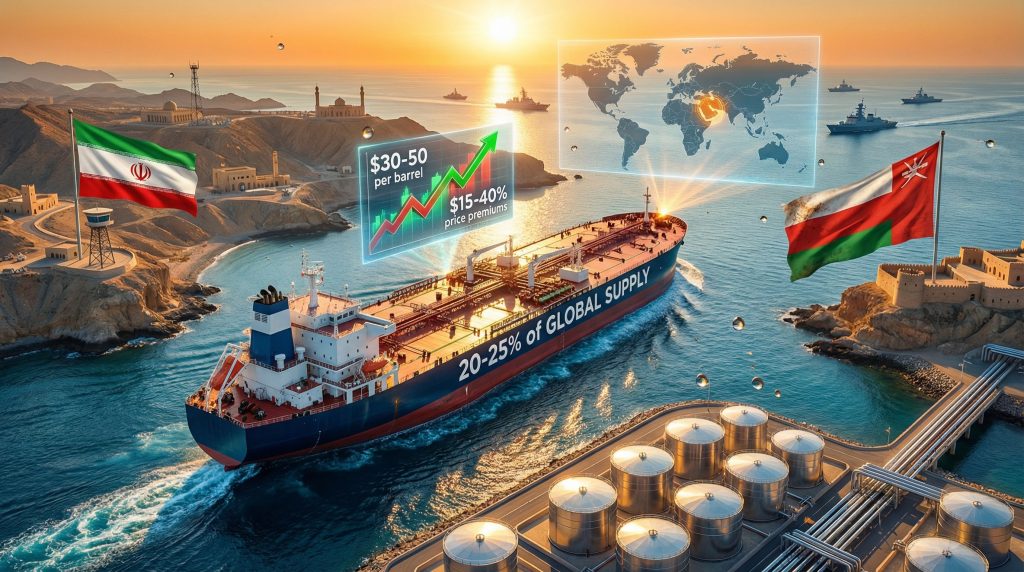
Approximately 20% of global crude oil supply transits through the Strait of Hormuz, making this narrow waterway the most critical energy infrastructure chokepoint worldwide. Recent military activities in the region demonstrate how easily this transit route can be disrupted, as Iran temporarily shut down the Strait for several hours during military drills and announced plans for joint naval exercises with Russia.
| Transit Metric | Current Volume | Disruption Scenario | Economic Impact |
|---|---|---|---|
| Daily Oil Flow | 18-22 million barrels | Complete closure possible | $4-6 billion daily trade loss |
| Alternative Capacity | 8-10 million barrels via pipelines | 60-70% supply gap | 6-18 month rerouting |
| Insurance Costs | Standard maritime rates | 400-600% increase during conflict | $50-100 million additional daily costs |
| Strategic Reserves | 90-120 day global buffer | Insufficient for extended closure | Economic recession risk |
Regional Export Infrastructure Assessment
Saudi Arabia's crude oil exports recently fell to 6.988 million barrels per day, representing their lowest level since September 2025, according to Joint Organizations Data Initiative figures. This reduction may reflect either operational adjustments or anticipatory supply management in response to escalating regional tensions. However, the OPEC production impact on global markets remains a critical factor in determining long-term price trajectories.
The kingdom maintains several critical export terminals and pipeline systems that could face disruption during sustained regional conflict:
- Ras Tanura Terminal: Handles approximately 6 million barrels per day
- East-West Pipeline: 5 million barrel daily capacity to Red Sea ports
- Ju'aymah Terminal: Major crude export facility serving Asian markets
- Yanbu Terminal: Alternative export route bypassing Persian Gulf transit
Conflict Escalation Scenarios and Price Impact Modelling
Military confrontation between major powers and regional oil producers creates multiple potential disruption pathways, each generating distinct price trajectories based on scope, duration, and infrastructure impact severity.
Limited Diplomatic Escalation Framework
Initial conflict phases typically involve enhanced military positioning, economic sanctions, and diplomatic pressure campaigns without direct infrastructure targeting. Price increases of $8-12 per barrel commonly occur during these periods, driven primarily by risk premium expansion rather than supply loss.
Current developments exemplify this scenario, with the US deploying aircraft carriers, warships, and jets to the region while Iran conducts rocket launch preparations across southern territories. These positioning moves create market uncertainty without immediate supply disruption, generating sustained but moderate price pressures.
Infrastructure Targeting and Production Disruption
More severe scenarios involve direct attacks on oil production facilities, export terminals, or transportation infrastructure. Historical analysis suggests price increases of $20-35 per barrel during such phases, with recovery timelines extending 8-15 months depending on damage severity and repair complexity.
Iranian military capabilities include advanced drone and missile systems capable of targeting regional oil infrastructure across multiple countries. Successful attacks on major Saudi facilities could eliminate 2-4 million barrels per day of export capacity, creating immediate supply shortages that overwhelm strategic reserve release capabilities.
Regional Maritime Warfare Implications
Complete disruption of Persian Gulf shipping represents the most severe scenario, potentially eliminating 15-18 million barrels per day of crude exports while creating cascading effects across global refinement and distribution networks. Price increases exceeding $60-80 per barrel become possible under these conditions, with recovery requiring 18-36 months for full infrastructure reconstruction and maritime security restoration.
According to Yahoo Finance, oil prices could spike as much as $15 per barrel if US-Iran tensions escalate from rhetoric to actual military action.
The combination of Iran's anti-ship missile capabilities, mine-laying potential, and submarine assets creates multiple vectors for sustained maritime disruption that conventional military responses struggle to address quickly.
Macroeconomic Transmission Mechanisms and Global Impact
Energy price shocks generate complex economic effects that extend far beyond direct fuel costs, creating inflationary pressures, consumption adjustments, and monetary policy challenges across developed and emerging economies.
Inflation Pass-Through Dynamics
Transportation and logistics costs increase exponentially during energy price spikes, affecting virtually all goods and services throughout supply chains. Manufacturing sectors with high energy intensity face particularly severe margin compression, while consumer-facing industries experience demand destruction as household budgets shift toward energy expenses.
Central banks encounter difficult policy tradeoffs when energy-driven inflation coincides with economic growth concerns. Interest rate increases become less effective during supply-side price shocks, while monetary easing risks amplifying inflationary expectations and currency depreciation pressures.
Regional Economic Vulnerability Assessment
| Economic Region | Energy Import Dependence | GDP Impact Estimate | Policy Response Capacity |
|---|---|---|---|
| European Union | 90% oil imports | 2-4% GDP contraction | Limited fiscal space |
| Japan/South Korea | 95%+ import dependence | 3-5% economic impact | Strong reserve positions |
| India/Southeast Asia | 85% import reliance | 4-7% growth reduction | Variable policy flexibility |
| Sub-Saharan Africa | Net exporter benefits | Mixed regional effects | Infrastructure constraints |
Currency Market and Capital Flow Implications
Oil-importing nations typically experience currency depreciation during sustained energy price increases, as current account deficits expand and capital flows shift toward resource-rich economies. This creates additional inflationary pressure through import price increases that compound direct energy cost impacts.
Emerging market economies face particularly severe balance-of-payments stress, often requiring International Monetary Fund support or substantial reserve depletion to maintain currency stability during extended energy price shock periods.
Strategic Response Mechanisms and Market Adaptation
Government and industry responses to geopolitical energy disruption involve multiple coordinated mechanisms designed to moderate price impacts while maintaining essential supply availability.
Strategic Petroleum Reserve Coordination
The International Energy Agency coordinates strategic reserve releases among member nations to address supply disruptions, with combined reserves totalling approximately 1.5 billion barrels. However, current release capacity of 4-6 million barrels per day proves insufficient to offset major Persian Gulf supply losses exceeding 15 million barrels daily.
Recent inventory data indicates that strategic reserves face competing demands from both crisis response requirements and normal commercial operations. US strategic reserves currently hold approximately 380 million barrels, providing roughly 20-25 days of import replacement capacity during severe disruption scenarios.
Alternative Supply Source Development
US shale oil production maintains flexibility to increase output by approximately 1-1.5 million barrels per day within 6-12 months, though this expansion requires sustained price levels above $60-70 per barrel to justify drilling investments. Pipeline and processing infrastructure constraints limit rapid scaling beyond these volumes.
Canadian oil sands operations provide additional production potential of 300,000-500,000 barrels per day, while Brazilian deepwater projects could contribute similar volumes with longer development timelines. However, these alternative sources require 12-24 months to achieve meaningful production increases.
OPEC+ Strategic Response Capacity
Saudi Arabia maintains spare production capacity of 2-3 million barrels per day, representing the primary mechanism for offsetting supply disruptions during regional conflicts. However, this capacity becomes unavailable if Saudi facilities face direct attack or if the kingdom reduces exports as a precautionary measure during escalating tensions.
United Arab Emirates and Kuwait possess additional spare capacity totalling approximately 800,000-1.2 million barrels per day, though their proximity to potential conflict zones creates similar vulnerability concerns that limit effective crisis response capability.
The next major ASX story will hit our subscribers first
Investment Strategy Implications Across Energy Sectors
Sustained geopolitical uncertainty creates both opportunities and risks across energy-related investment categories, with traditional risk-return relationships becoming less predictable during crisis periods.
Upstream Exploration and Production Value Creation
Energy companies with geographically diversified asset portfolios typically outperform during Middle Eastern crises, as production from politically stable regions commands premium valuations. North American shale producers benefit significantly from sustained price increases above $65 per barrel, enabling rapid drilling programme expansion and cash flow generation.
Offshore production platforms in West Africa, North Sea, and Gulf of Mexico gain strategic value as alternatives to Middle Eastern supply sources. Brazilian Petrobras and Norwegian Equinor exemplify companies positioned to capture market share during Persian Gulf disruptions.
Investment strategies focusing on reserve quality and political stability generate superior returns compared to pure production volume metrics during extended geopolitical uncertainty periods.
Infrastructure and Transportation Investment Themes
Pipeline development projects connecting alternative supply sources to major consumption centres receive enhanced government support and private investment during crisis periods. Trans-Canada pipeline systems and European pipeline diversification projects become strategic priorities rather than purely commercial ventures.
LNG terminal capacity expansion accelerates in import-dependent regions seeking supply source diversification. Floating LNG storage and regasification units provide flexible infrastructure solutions that reduce dependence on fixed pipeline systems vulnerable to geopolitical disruption.
Renewable Energy Transition Acceleration
Energy security concerns drive accelerated renewable energy investment as governments prioritise domestic energy production capability. Solar and wind manufacturing capacity expansion receives strategic funding support that reduces traditional return-on-investment requirements.
Grid-scale energy storage projects gain strategic importance for managing intermittent renewable generation while reducing fossil fuel dependence. Battery manufacturing supply chains become critical infrastructure investments warranting government support and private capital allocation.
Long-Term Structural Market Evolution
Sustained geopolitical tensions fundamentally alter global energy market structures, creating permanent changes in trading patterns, infrastructure development priorities, and international cooperation frameworks.
Supply Chain Resilience and Diversification Imperatives
Energy import diversification becomes a national security priority rather than an economic optimisation decision. Countries develop multiple supply source requirements and minimum domestic production mandates that reshape international trade flows permanently.
Regional energy cooperation agreements expand to reduce dependence on volatile geopolitical regions. Asian LNG purchasing consortiums and European renewable energy sharing frameworks exemplify structural changes that persist beyond immediate crisis periods.
Technology Innovation and Energy Independence
Advanced drilling technologies receive enhanced research funding to maximise domestic production potential in previously uneconomical formations. Carbon capture and storage systems enable continued fossil fuel utilisation while addressing environmental concerns and energy security simultaneously.
Synthetic fuel production capabilities develop as strategic alternatives to conventional petroleum imports, with power-to-liquids technologies and biomass conversion systems receiving substantial government and private investment support.
Geopolitical Alliance Restructuring
Energy partnership agreements between historically non-aligned nations create new diplomatic relationships that prioritise supply security over traditional political considerations. Technology sharing frameworks enable rapid infrastructure development in strategic partnership countries.
Joint strategic reserve management systems develop among allied nations to enhance collective crisis response capacity while reducing individual country vulnerability to supply disruptions.
Risk Assessment and Market Outlook
Current US-Iran conflict oil prices dynamics present multiple scenario pathways that could reshape global energy markets for extended periods, with outcomes depending largely on conflict scope, duration, and international response coordination effectiveness.
Probability-weighted price projections suggest 60-85% likelihood of sustained prices above $70 per barrel during the next 6-12 months, assuming continued diplomatic tensions without direct military confrontation. Higher-impact scenarios involving infrastructure targeting carry 25-35% probability but would generate price increases exceeding $90-110 per barrel.
Market structure changes including increased volatility, expanded risk premiums, and altered trading relationships appear likely to persist regardless of immediate conflict resolution, as supply chain vulnerability concerns drive permanent strategic adjustments across consuming nations and producing regions.
Consequently, current US-Iran conflict oil prices represent just the beginning of potentially significant market restructuring. Moreover, the US-Iran conflict oil prices situation demonstrates how quickly geopolitical tensions can transform from diplomatic disagreements into substantial economic disruptions affecting global energy security.
Investment implications favour diversified energy portfolios with enhanced exposure to politically stable production regions, alternative energy infrastructure, and energy security technologies that reduce dependence on geopolitically volatile supply sources. Traditional energy sector valuations may require permanent adjustment to reflect heightened geopolitical risk premiums and structural market changes.
This analysis incorporates current market conditions and geopolitical developments as of February 2026. Energy market participants should monitor ongoing diplomatic developments, infrastructure security assessments, and strategic reserve utilisation rates for updated risk evaluation. Investment decisions should consider individual risk tolerance and diversification requirements appropriate for volatile commodity market conditions.
Ready to Navigate Complex Commodity Market Volatility?
Discovery Alert's proprietary Discovery IQ model delivers real-time alerts on significant ASX mineral discoveries, helping investors identify actionable opportunities ahead of market-moving developments in energy and resource sectors. During periods of heightened geopolitical uncertainty and commodity price volatility, subscribers gain critical insights that enable informed positioning across exploration and mining opportunities. Begin your 14-day free trial today to secure your market-leading advantage.