May 14, 2026
Global Energy Market Dynamics Shape Regional Economic Performance
Energy-producing economies worldwide face complex challenges in balancing resource extraction with long-term economic sustainability. These nations must navigate volatile commodity markets while developing alternative revenue streams to reduce dependency on finite natural resources. Understanding how major oil-producing countries achieve this balance provides insight into broader oil geopolitics trends affecting global energy security and regional stability.
The relationship between petroleum output and national economic performance demonstrates the intricate connections between geological resources, geopolitical strategy, and fiscal policy. Furthermore, when examining energy-dependent economies, several key factors emerge: production capacity utilization, price volatility management, and diversification progress. These elements combine to determine whether natural resource wealth translates into sustained economic development or creates cyclical boom-bust patterns.
When big ASX news breaks, our subscribers know first
Understanding the Kingdom's Economic Acceleration Framework
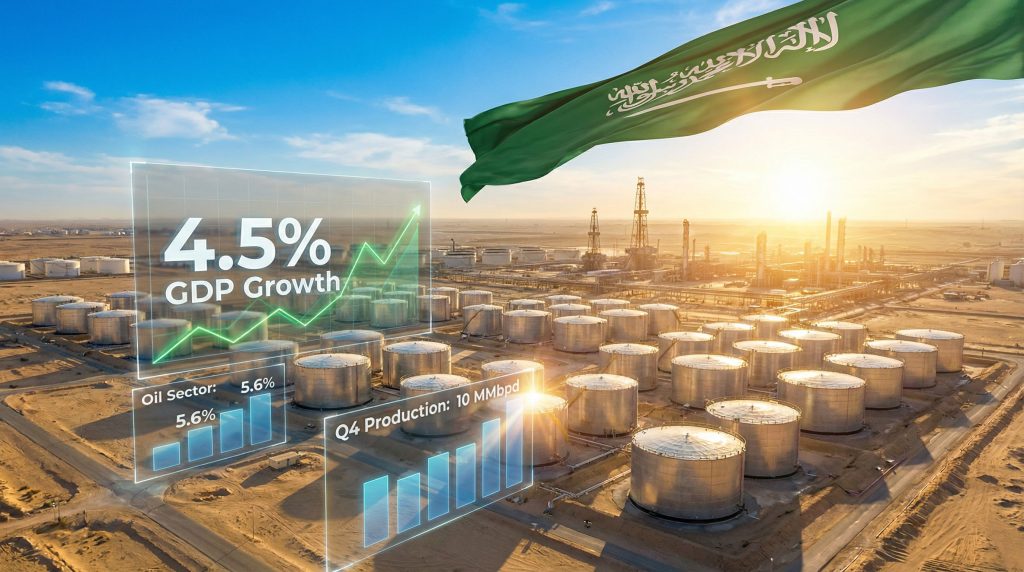
Saudi Arabia's oil GDP growth achieved remarkable momentum in 2025, with the kingdom posting its strongest economic expansion since 2022. The 4.5% overall GDP growth represents a significant acceleration driven primarily by petroleum sector activities, which expanded at 5.6% during the year.
| Economic Indicator | 2025 Performance | Growth Driver Analysis |
|---|---|---|
| Overall Real GDP Growth | 4.5% | Strongest since 2022 |
| Oil Sector Expansion | 5.6% | Primary growth engine |
| Non-Oil Sector Rate | Decelerated for third year | Still largest contributor |
| Q4 Production Level | 10 MMbpd | Highest since early 2023 |
| Q4 GDP Growth | 4.9% year-over-year | Accelerating momentum |
The petroleum sector's resurgence as the dominant growth driver marks a notable shift in economic dynamics. However, while Saudi Arabia oil GDP growth patterns historically showed cyclical fluctuations, the 2025 performance demonstrates how coordinated supply management can align national economic objectives with global market responsibilities.
Despite oil sector leadership, non-oil activities maintained their position as the largest single contributor to economic expansion, contributing 2.7 percentage points to overall growth compared to oil's 1.4 percentage points. This distribution reflects ongoing diversification efforts under Vision 2030, even as petroleum revenues provide the primary acceleration mechanism.
"The kingdom's economic framework demonstrates how resource-rich nations can leverage natural advantages while building alternative growth foundations for long-term sustainability."
What Economic Factors Enabled Saudi Arabia's 4.5% GDP Expansion?
Several interconnected factors drove the kingdom's economic acceleration, with petroleum production increases serving as the catalyst for broader expansion. The OPEC+ supply strategy implemented in mid-2025 provided the foundation for enhanced output levels, while domestic economic policies optimised the revenue impact.
Production Strategy Implementation:
• Mid-2025 supply policy adjustments coordinated through OPEC+ agreements
• Strategic cooperation with Russia-led consortium members
• Market balancing approach combining revenue maximisation with global stability
• Output optimisation maintaining spare capacity for future flexibility
The 10 million barrels per day achieved in Q4 2025 represents the highest production level since early 2023, indicating both technical capacity and strategic willingness to increase market supply. Consequently, this output level reflects careful calibration between maximum revenue generation and sustainable reservoir management practices.
Sectoral Growth Distribution Analysis:
Oil sector activities contributed 1.4 percentage points to the 4.5% overall expansion, while non-oil sectors provided 2.7 percentage points despite experiencing their third consecutive year of growth deceleration. In addition, government activities added a marginal 0.1 percentage point, reflecting fiscal discipline measures aimed at spending efficiency improvements.
The Saudi Arabia oil GDP growth pattern demonstrates how petroleum revenues create multiplier effects throughout the economy. For instance, upstream production increases generate employment in drilling, engineering, and geological services, while downstream processing activities expand to accommodate higher crude throughput volumes.
Why Did Oil Production Surge Drive Economic Momentum?
The petroleum sector's 5.6% growth rate in 2025 reflects both volume increases and favourable price conditions that emerged during the year. Q4 specifically achieved 10.4% year-over-year expansion, indicating acceleration within the year as production policies took full effect.
OPEC+ Coordination Mechanisms
The Organization of the Petroleum Exporting Countries Plus agreement structure enables coordinated supply management among major producers. Furthermore, understanding the broader OPEC meeting impact helps explain how Saudi Arabia, as the largest OPEC member and world's leading oil exporter, exercises significant influence over these decisions alongside Russia, which leads the non-OPEC contingent.
Technical Production Optimisation
• Reservoir management balancing current output with long-term capacity preservation
• Infrastructure utilisation maximising existing field productivity
• Technology deployment enhancing recovery rates from mature assets
• Capacity flexibility maintaining ability to adjust production based on market conditions
The increase to 10 MMbpd in Q4 2025 demonstrates Saudi Aramco's operational capability to scale production efficiently. However, this level suggests the kingdom operates well below maximum sustainable capacity, preserving strategic flexibility for future market interventions or emergency supply requirements.
Market Timing Analysis
The mid-2025 production increase coincided with evolving global energy dynamics, including geopolitical tensions affecting other major producing regions. Brent crude prices topped $70 per barrel in late January 2026 for the first time in months, reflecting both supply-demand fundamentals and geopolitical risk premiums. This development aligns with recent oil price rally analysis examining how geopolitical factors influence commodity markets.
"Strategic production increases under OPEC+ agreements demonstrate how coordinated supply management serves multiple objectives: global market stability, domestic revenue enhancement, and long-term capacity preservation."
How Does Oil Revenue Translate Into Broader Economic Performance?
The petroleum sector's role as approximately 50% of total economic output creates significant revenue multiplication effects throughout the Saudi economy. Understanding these transmission mechanisms explains how production increases generate broader economic expansion beyond direct oil sector activities.
Revenue Multiplication Framework:
Direct Impact: Government petroleum revenues from crude sales and royalties
Upstream Employment: Geological teams, drilling crews, production engineers, maintenance specialists
Supply Chain Activation: Steel suppliers, equipment manufacturers, transportation services, logistics providers
Downstream Processing: Refining operations, petrochemical production, LNG facilities
Fiscal Distribution: Government spending on infrastructure, public sector wages, social programmes
Employment Creation Patterns
| Employment Category | Direct Jobs | Indirect Support | Economic Impact |
|---|---|---|---|
| Upstream Operations | Production crews, engineers | Equipment suppliers, logistics | High-skill, high-wage positions |
| Downstream Processing | Refinery workers, technicians | Chemical industry, manufacturing | Value-added industrial jobs |
| Government Services | Public sector expansion | Construction, professional services | Broad-based employment growth |
| Private Sector Growth | Energy services, consulting | Banking, retail, hospitality | Diversified economic activity |
The Saudi Arabia oil GDP growth transmission operates through both government budget channels and private sector investment. Enhanced petroleum revenues enable increased infrastructure spending, which generates construction employment and stimulates materials demand. Simultaneously, private companies benefit from expanded business opportunities in energy services, technology provision, and professional consulting.
Fiscal Policy Integration
Government officials acknowledge petroleum income is becoming less important relative to diversification objectives, yet the data demonstrates oil remains the critical swing factor in economic performance. This apparent contradiction reflects the timing difference between stated long-term objectives and current economic realities.
What Role Do Global Oil Price Fluctuations Play in GDP Volatility?
Oil price movements create immediate impacts on Saudi economic performance due to petroleum's dominant role in government revenues and export earnings. The kingdom's exposure to price volatility requires sophisticated risk management strategies to maintain economic stability. Moreover, recent developments in trade war oil movements demonstrate how international trade tensions can compound these challenges.
Price Impact Analysis Framework
| Price Range (Brent Crude) | Revenue Impact | GDP Growth Correlation | Investment Climate Response |
|---|---|---|---|
| $60-70 per barrel | Moderate revenue flows | Stable 3-4% growth potential | Cautious private investment |
| $70-80 per barrel | Enhanced government income | Accelerated 4-5% expansion | Increased business confidence |
| $80+ per barrel | Maximised petroleum revenues | Rapid growth above 5% | Strong foreign investment flows |
Recent Price Dynamics
Brent crude topped $70 per barrel in late January 2026, marking the first time in months that prices reached this threshold. The price increase reflected geopolitical tensions involving Iran, Israel, and the United States, demonstrating how regional conflicts create risk premiums affecting Saudi revenues. These dynamics mirror broader patterns discussed in analyses of tariffs economic impact on global commodity markets.
Volatility Management Strategies:
• Production flexibility allowing output adjustments based on price conditions
• Strategic reserves providing buffer against short-term market disruptions
• Diversification investments reducing long-term dependence on oil price fluctuations
• Fiscal discipline managing spending levels to accommodate price variability
The kingdom's stock exchange dropped the most since April following the January 2026 geopolitical tensions, indicating investor sensitivity to conflict risks that could affect oil prices and regional stability. This market response demonstrates how external factors beyond Saudi control can influence domestic economic confidence.
Risk Premium Calculations
Geopolitical events affecting Middle Eastern oil supplies typically add $5-15 per barrel in risk premiums to global crude prices. For Saudi Arabia, these premiums provide revenue benefits but also create economic uncertainty that can offset positive price impacts through reduced investment and consumer confidence.
The next major ASX story will hit our subscribers first
How Does Economic Diversification Balance Oil Dependency?
Vision 2030 implementation progress continues advancing despite petroleum sector resurgence, with non-oil activities maintaining their role as the largest contributor to GDP expansion even while experiencing growth deceleration for the third consecutive year.
Diversification Progress Metrics
Non-oil sectors contributed 2.7 percentage points to 2025's 4.5% GDP growth, demonstrating their continued importance even as petroleum activities accelerated. However, the deceleration trend indicates challenges in achieving sufficient momentum to independently drive growth comparable to oil sector performance.
Sectoral Rebalancing Dynamics:
• Manufacturing expansion developing industrial capacity beyond petroleum processing
• Financial services growth establishing regional banking and investment hubs
• Tourism development leveraging cultural heritage and modern infrastructure
• Technology sector investment building digital economy foundations
• Renewable energy projects creating alternative energy export opportunities
"Economic diversification efforts demonstrate how resource-rich economies can gradually reduce petroleum dependency while leveraging oil revenues to fund the transition to more sustainable growth models."
Investment Allocation Efficiency
Government spending strategy adjustments focus on enhanced efficiency rather than total expenditure increases. This approach reflects lessons learnt from previous oil boom cycles where rapid spending expansion created inflation and project inefficiencies.
Private Sector Development
The kingdom's economic transformation requires significant private sector expansion to reduce government employment dominance. Current Saudi Arabia oil GDP growth provides fiscal resources to support this transition through infrastructure investment and regulatory reforms that encourage entrepreneurship.
What Are the Investment Implications of Saudi Arabia's GDP Performance?
The 4.5% GDP expansion in 2025 creates multiple investment themes for both domestic and international capital allocation. Understanding these opportunities requires analysis of sectoral performance trends, government policy direction, and regional risk factors.
Market Confidence Indicators
According to Trading Economics, the International Monetary Fund upgraded its 2026 growth forecast for Saudi Arabia to 4.5% from 4.0%, citing benefits of higher oil production and healthy non-oil sector performance. This revision indicates institutional confidence in the kingdom's economic momentum sustainability.
Investment Opportunity Categories
| Sector | Investment Thesis | Risk Factors | Return Potential |
|---|---|---|---|
| Energy Infrastructure | Upstream capacity expansion, downstream processing | Oil price volatility, geopolitical tensions | High returns, cyclical patterns |
| Diversification Projects | Manufacturing, tourism, technology | Execution risks, market development | Medium-term growth, transformation upside |
| Financial Services | Regional hub development, Islamic finance | Regulatory changes, competition | Steady growth, regional integration |
| Real Estate | Urban development, mega-projects | Demographic shifts, economic cycles | Infrastructure beneficiaries, long-term |
Foreign Direct Investment Attraction
Enhanced Saudi Arabia oil GDP growth performance improves the kingdom's investment attractiveness by demonstrating economic resilience and government revenue sustainability. International investors evaluate both short-term profitability opportunities and long-term transformation potential when considering Saudi market entry.
Capital Market Development
Stock exchange volatility following geopolitical tensions illustrates investor sensitivity to external risk factors. However, the underlying economic performance provides fundamental support for equity valuations, particularly in energy-related sectors and diversification beneficiaries.
How Do Regional Geopolitical Factors Influence Economic Stability?
Middle Eastern geopolitical dynamics create both opportunities and challenges for Saudi economic performance. The kingdom's role as a regional stability anchor becomes increasingly important as tensions involving Iran, Israel, and the United States affect global energy markets.
Conflict Risk Assessment
Recent tensions that drove Brent crude above $71 per barrel demonstrate how regional conflicts create immediate economic impacts through energy price volatility. Saudi Arabia benefits from higher oil prices but faces increased uncertainty that can offset revenue gains through reduced investment confidence.
Strategic Positioning Analysis:
• Regional leadership role promoting diplomatic solutions to reduce conflict risks
• Energy security provider maintaining spare production capacity for emergency supply
• Economic hub development attracting international business despite regional instability
• Defence cooperation strengthening security relationships with major powers
Economic Resilience Mechanisms
The kingdom's ability to maintain 4.5% GDP growth despite regional tensions demonstrates economic resilience built through diversification efforts and fiscal discipline. This stability positions Saudi Arabia as a regional safe haven for investment and business operations.
Global Energy Security Contributions
As reported by Arab News, Saudi Arabia's increased oil production serves dual purposes: supporting global energy security while driving domestic economic expansion through enhanced petroleum revenues. This role becomes more critical during periods of geopolitical instability affecting other major producing regions.
"Regional geopolitical tensions create complex trade-offs between higher oil revenues and increased economic uncertainty, requiring sophisticated risk management to optimise overall economic performance."
What Economic Challenges Could Affect Future Growth Sustainability?
Despite strong 2025 performance, Saudi Arabia oil GDP growth faces several structural challenges that could affect long-term sustainability. Addressing these issues requires continued policy adaptation and strategic investment in economic transformation.
Oil Price Dependency Risks
Continued reliance on petroleum income creates vulnerability to external price shocks beyond Saudi control. Global economic slowdowns, renewable energy adoption, and alternative supplier development could reduce long-term demand for Saudi crude, affecting revenue stability.
Diversification Implementation Challenges:
• Non-oil sector deceleration for three consecutive years indicates execution difficulties
• Private sector development requires cultural and regulatory changes beyond government control
• International competition from other regional hubs seeking similar economic transformation
• Skill development needs requiring substantial education and training investments
Structural Economic Adjustments
| Challenge Category | Specific Issues | Mitigation Strategies | Success Metrics |
|---|---|---|---|
| Revenue Concentration | 50% oil sector dependence | Accelerated diversification investment | Non-oil revenue growth rates |
| Employment Structure | Government sector dominance | Private sector job creation incentives | Private employment ratios |
| Investment Efficiency | Mega-project execution risks | Enhanced project management systems | Return on investment measures |
| Regional Competition | Other Gulf state development | Unique value proposition development | Market share indicators |
Fiscal Sustainability Requirements
Government spending efficiency improvements become crucial as oil price cycles create revenue volatility. The current adjustment strategy focusing on enhanced efficiency rather than total expenditure reduction provides a model for managing future fiscal challenges.
Long-term Economic Transition
Balancing current growth momentum with future resilience requires careful resource allocation between immediate revenue opportunities and long-term transformation investments. The Saudi Arabia oil GDP growth success in 2025 provides fiscal resources to accelerate this transition if deployed strategically.
Conclusion: Evaluating Saudi Arabia's Economic Growth Trajectory
The kingdom's 4.5% GDP expansion in 2025 represents a significant economic achievement demonstrating how strategic petroleum production management can drive broader economic performance. The 5.6% oil sector growth rate provided the primary catalyst, while non-oil sectors maintained their role as the largest contributor to overall expansion despite experiencing deceleration trends.
Key Performance Drivers:
• OPEC+ coordination enabling strategic production increases to 10 MMbpd in Q4 2025
• Price optimisation with Brent crude reaching above $70 per barrel
• Fiscal discipline improving government spending efficiency
• Diversification progress maintaining non-oil sector contribution despite challenges
The IMF's upgraded forecast to 4.5% growth for 2026 indicates institutional confidence in the sustainability of current economic momentum. However, long-term success requires continued progress on diversification objectives while managing inherent volatility from petroleum market exposure.
Strategic Outlook Assessment
| Growth Component | 2025 Impact | Future Sustainability | Risk Factors |
|---|---|---|---|
| Oil Production | Primary growth engine | OPEC+ policy dependent | Price volatility, geopolitical tensions |
| Non-Oil Sectors | Largest contributor | Diversification progress critical | Execution challenges, competition |
| Government Policy | Efficiency improvements | Fiscal discipline maintenance | Political consistency requirements |
| Regional Positioning | Energy security leadership | Geopolitical stability crucial | Conflict escalation risks |
The challenge ahead involves maintaining economic momentum while reducing long-term dependency on petroleum revenues through sustained Vision 2030 implementation. Saudi Arabia oil GDP growth in 2025 provides both the fiscal resources and policy validation needed to pursue this dual objective effectively.
Investment and economic analysis involves inherent uncertainties, and future performance may differ from historical trends. This analysis is for educational purposes and does not constitute investment advice. Readers should conduct independent research and consult qualified professionals before making financial decisions.
Ready to Capitalise on ASX Energy and Mining Discoveries?
Discovery Alert's proprietary Discovery IQ model delivers real-time alerts on significant ASX mineral and energy discoveries, providing subscribers with immediate insights into actionable trading opportunities before the broader market reacts. Just as Saudi Arabia leverages strategic petroleum production to drive economic growth, savvy investors can position themselves ahead of major ASX discovery announcements that often generate substantial returns similar to historical successes like De Grey Mining and WA1 Resources.