May 16, 2026
The Anatomy of Global Energy Market Tensions in 2026
Energy markets rarely operate in isolation from broader macroeconomic and political forces, yet the petroleum landscape entering 2026 presents an unprecedented contradiction. Structural oversupply fundamentals are colliding head-on with escalating international security risks, creating a complex pricing environment where oil surplus and geopolitical risks must be carefully balanced through sophisticated risk assessment frameworks. This dynamic reflects deeper shifts in global energy architecture, where producer coordination mechanisms face mounting pressure from both competitive market forces and state-level strategic objectives.
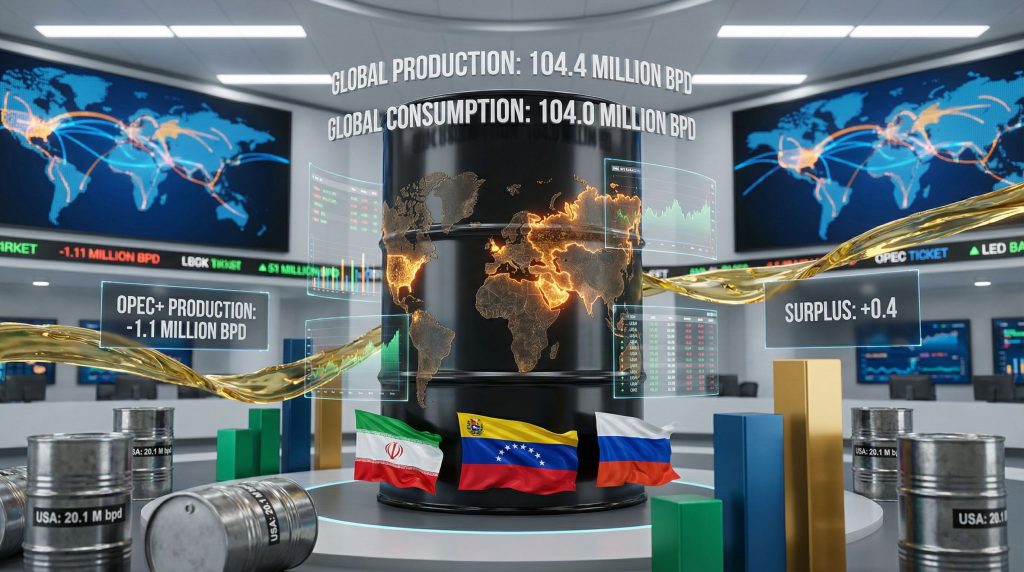
The International Energy Agency projects a substantial crude oil surplus of approximately 3.8 million barrels per day throughout 2026, representing one of the most significant oversupply conditions in recent market history. Yet petroleum futures maintain elevated trading ranges, with Brent crude holding above $60 per barrel and West Texas Intermediate sustaining levels above $57 as of early January 2026. This disconnect between fundamental economics and price discovery mechanisms reveals how market participants are weighing competing forces in an increasingly complex global energy system.
When big ASX news breaks, our subscribers know first
Understanding Production Dynamics Behind Global Oil Surplus
The structural oversupply driving 2026 market conditions stems from sustained production growth across multiple non-OPEC+ regions, creating competitive pressure that traditional cartel mechanisms struggle to counteract. Throughout 2025, petroleum output expanded significantly across the Americas, with producers ranging from the United States to Guyana maintaining aggressive development schedules despite declining price environments. Furthermore, this production expansion occurred simultaneously with demand growth deceleration, particularly across major consuming regions including Asia and Europe.
Key Production Growth Contributors:
- United States shale formations continue delivering consistent output increases through technological efficiency improvements
- Brazilian pre-salt offshore developments add substantial new capacity with low marginal production costs
- Canadian oil sands operations benefit from infrastructure expansion and processing optimisation
- Guyanese offshore discoveries represent entirely new production streams entering global markets
The magnitude of this supply expansion has overwhelmed demand growth patterns, creating persistent inventory accumulation across major trading hubs. Strategic petroleum reserves in consuming nations have expanded capacity utilisation, while commercial storage facilities approach constraint levels in several regions. Consequently, this physical market tightness in storage infrastructure, paradoxically, has not translated into price support due to the overwhelming scale of surplus production.
Demand dynamics present their own complexities, with consumption growth patterns showing significant regional variation. Asian markets, traditionally the primary driver of global oil demand expansion, have demonstrated slower growth trajectories due to economic restructuring and accelerated renewable energy deployment. Chinese consumption patterns, while still expanding, show moderation compared to historical growth rates, while Indian demand growth remains robust but insufficient to absorb global surplus volumes.
The seasonal consumption patterns typical of early-year trading periods exacerbate these fundamental imbalances. January through March traditionally represents weaker demand months due to post-holiday economic slowdown and reduced heating requirements in northern hemisphere markets. In addition, this seasonal effect compounds the structural oversupply, creating particularly acute pressure on petroleum prices during the first quarter of 2026.
OPEC+ Strategic Response to Market Oversupply
The Organisation of Petroleum Exporting Countries and its alliance partners face their most challenging market environment since the 2014-2016 price collapse, requiring sophisticated coordination mechanisms to navigate competing objectives of market share preservation and price stabilisation. The alliance's decision-making process reflects recognition that traditional production cut strategies may prove insufficient given the scale of non-member production growth and the complexity of current geopolitical dynamics.
On January 4, 2026, key OPEC+ members led by Saudi Arabia convened virtually to address market conditions through what industry observers characterise as a production pause rather than accelerated cuts. This strategic approach represents a middle path between aggressive market intervention and complete market share competition, acknowledging both the limitations of cartel influence in current market conditions and the risks of abandoning coordination mechanisms entirely.
OPEC+ Production Management Strategy:
| Strategic Element | Implementation Method | Market Impact |
|---|---|---|
| Production Pause | Three-month supply freeze | Prevents additional oversupply |
| Quota Discipline | Below-target operations | Provides price floor support |
| Baseline Review | 2027 target negotiations | Addresses long-term capacity |
The alliance faces what market analysts describe as a classic producer dilemma: maintaining price levels through supply restraint while potentially sacrificing market share to more aggressive competitors, or defending production volumes at the expense of price stability. Current market positioning suggests OPEC+ leadership believes coordinated restraint remains preferable to unrestricted competition, despite the limitations of this approach given non-member production growth.
Financial market positioning reflects broader scepticism about OPEC+ effectiveness in current conditions. Commodity advisers maintain 91% short positions in Brent crude futures, up from 82% in previous reporting periods, while holding 73% short positions in WTI contracts. This overwhelmingly bearish positioning indicates market participants expect fundamental oversupply conditions to dominate pricing despite OPEC+ coordination efforts.
The technical challenge facing the alliance involves calibrating production responses to market conditions without triggering competitive reactions from non-member producers. Historical precedent suggests that overly aggressive cuts can incentivise increased production from rivals, while insufficient market intervention may result in prolonged price weakness that undermines member state fiscal stability.
Critical Geopolitical Risk Factors Affecting Global Oil Markets
Iran: Currency Collapse and Regional Security Implications
Iranian petroleum markets face unprecedented disruption from the convergence of domestic economic crisis and escalating international tensions. The Iranian rial has collapsed to historic lows, triggering widespread demonstrations across Tehran and other major cities for multiple consecutive days. This internal instability occurs against a backdrop of renewed sanctions enforcement and diplomatic confrontation with the United States, creating a complex environment where oil surplus and geopolitical risks intersect most dramatically.
Iran historically ranked as the world's ninth-largest crude oil producer according to 2023 International Energy Agency data, though current production capacity remains uncertain due to sanctions-related constraints and domestic market disruptions. The country's strategic position controlling significant Persian Gulf shipping lanes adds complexity to any supply disruption scenarios, as infrastructure damage or military confrontation could affect regional petroleum flows beyond Iran's direct production.
President Trump's public statements regarding potential U.S. support for Iranian protesters have prompted Iranian officials to threaten retaliation against American forces in the region, escalating military risk factors beyond traditional economic sanctions. Consequently, this diplomatic escalation introduces the possibility of kinetic conflict that could disrupt not only Iranian production but also regional infrastructure critical for global petroleum transport.
The economic drivers of Iranian unrest suggest that revenue disruption from petroleum sanctions creates domestic political instability, establishing a feedback loop where sanctions effectiveness generates internal pressure that may trigger additional international intervention. This dynamic makes Iranian supply risk particularly difficult to model, as economic and political variables interact in unpredictable ways, highlighting broader Venezuelan policy shifts occurring across multiple sanctioned energy exporters.
Venezuela: Maritime Enforcement and Financial System Targeting
Venezuelan petroleum exports face intensified pressure from expanded U.S. enforcement mechanisms targeting both maritime transport and financial intermediaries facilitating oil trade. The Trump administration has implemented what officials describe as a maritime blockade, combined with sanctions against Chinese and Hong Kong entities involved in Venezuelan petroleum commerce.
This enforcement approach represents an evolution beyond traditional sanctions targeting Venezuelan state entities, extending to third-party companies and vessels accused of sanctions evasion. The strategy aims to reduce oil revenue available to the Maduro government while demonstrating enforcement capabilities that may influence other sanctioned petroleum exporters, particularly considering broader US–China trade impacts on energy commerce.
Venezuelan Enforcement Mechanisms:
- Maritime interdiction of vessels carrying Venezuelan crude
- Financial sanctions targeting Chinese trading companies
- Asset freezing for Hong Kong intermediaries
- Vessel designation and blacklisting procedures
The effectiveness of these measures depends largely on international cooperation, particularly from Asian nations that serve as primary markets for Venezuelan petroleum exports. Chinese demand for Venezuelan crude provides alternative revenue streams that may limit sanctions impact, while complex ship-to-ship transfer operations can obscure cargo origins and complicate enforcement efforts.
However, market participants monitor Venezuelan developments for broader implications about sanctions enforcement against other petroleum exporters. The precedent established by maritime blockade tactics and third-party financial system targeting may influence enforcement approaches toward Iran and Russia, creating systemic risks beyond Venezuela's immediate production capacity.
Russia-Ukraine Conflict: Black Sea Infrastructure Vulnerability
The ongoing Russia-Ukraine conflict continues generating petroleum market uncertainty through attacks on energy infrastructure across the Black Sea region. Recent strikes have targeted port facilities, refineries, and transportation networks that serve both domestic markets and export operations, demonstrating the vulnerability of energy systems in active conflict zones.
Kazakhstan, as an OPEC+ alliance member, has experienced production impacts from attacks on the Caspian Pipeline Consortium infrastructure, illustrating how regional conflicts can affect petroleum flows from neighbouring countries. These incidents highlight the interconnected nature of energy infrastructure and the potential for localised conflicts to generate broader market disruptions.
Black Sea Energy Infrastructure Risk Assessment:
| Asset Category | Vulnerability Level | Strategic Importance | Recovery Timeline |
|---|---|---|---|
| Export Terminals | High | Critical for European supply | 6-12 months |
| Refinery Capacity | Medium | Regional fuel security | 3-6 months |
| Pipeline Networks | Medium-Low | Distribution flexibility | 1-3 months |
The conflict's persistence despite diplomatic peace initiatives suggests that infrastructure targeting may continue throughout 2026, creating ongoing uncertainty for petroleum markets. European energy security considerations add complexity to supply chain planning, as alternative routing mechanisms require substantial lead times and may face capacity constraints.
Furthermore, military analysts note that energy infrastructure represents high-value strategic targets that can generate economic impact disproportionate to military resources required for attacks. This dynamic suggests that infrastructure vulnerability will remain a persistent risk factor as long as the conflict continues, regardless of broader military developments.
Market Mechanisms Balancing Fundamental Economics with Risk Premiums
Current petroleum pricing reflects sophisticated market mechanisms attempting to balance contradictory forces: overwhelming fundamental bearishness from supply surplus conditions against persistent upward pressure from geopolitical risk premiums. This balance operates through complex financial market dynamics where speculative positioning, risk assessment, and physical market constraints interact to determine price discovery.
The surplus forecast functions as what analysts describe as a shock absorber against potential output disruptions, meaning that oil surplus and geopolitical risks must overcome substantial fundamental bearishness to generate sustained price increases. This dynamic explains why significant international tensions have produced relatively modest price movements compared to historical precedent during tighter market conditions.
Price Discovery Mechanisms:
- Fundamental floor: Oversupply suggests natural price levels below $55/barrel for Brent
- Geopolitical premium: Security risks maintain trading ranges above $60/barrel
- Volatility amplification: Uncertainty creates larger daily price swings
- Forward curve distortion: Contango development reflects surplus expectations
Middle Eastern crude benchmarks experience particular weakness, with regional Dubai contracts facing heavy selling pressure during Asian trading windows. This regional price weakness reflects both proximity to geopolitical risks and reduced demand from Asian refiners dealing with economic slowdown and increased product inventory levels.
Financial market positioning reveals how professional traders are managing these competing dynamics. The overwhelming short positioning in petroleum futures indicates broad consensus that fundamental economics will ultimately dominate geopolitical factors, while options markets show increased demand for protection against supply disruption scenarios, reflecting insights from recent oil price rally insights analysis.
The contango structure in petroleum futures curves suggests market participants expect current oversupply conditions to persist throughout 2026, with forward prices remaining below spot levels across multiple contract months. Consequently, this pricing structure incentivises storage accumulation while signalling expectations that current geopolitical tensions will not generate sustained supply disruptions.
Regional Market Responses and Trading Dynamics
Asian Market Integration and Demand Patterns
Asian petroleum markets demonstrate particular sensitivity to the interaction between surplus conditions and geopolitical risks, as the region serves both as a major demand centre and as a primary destination for Middle Eastern crude exports. Chinese and Indian consumption patterns, while still expanding, show moderation that fails to absorb surplus production volumes, creating downward pressure on regional pricing benchmarks.
Refinery utilisation rates across Asia reflect cautious operational planning, with processing margins compressed by abundant crude supplies and weaker product demand. This operational environment reduces Asian refiners' willingness to pay premium prices for crude oil, contributing to regional price weakness particularly evident in Dubai benchmark contracts.
Storage economics across Asian markets approach constraint levels, with tank farm utilisation rates nearing capacity limits in key trading hubs including Singapore and Fujairah. This physical market tightness in storage infrastructure paradoxically contributes to price weakness, as market participants become increasingly reluctant to accumulate additional inventory without substantial price discounts.
Atlantic Basin Considerations
North American and European petroleum markets demonstrate different response patterns to current market dynamics, reflecting regional supply-demand balances and infrastructure characteristics. West Texas Intermediate crude maintains relative price strength compared to international benchmarks, supported by robust North American production growth and regional refinery demand patterns.
European market conditions reflect the intersection of surplus global supplies with regional energy security concerns related to the Russia-Ukraine conflict. Strategic petroleum reserve policies across European Union member states create additional demand for crude oil accumulation, providing some support for Atlantic basin pricing despite global oversupply conditions.
In addition, transportation economics between Atlantic and Pacific markets create arbitrage opportunities that help integrate global pricing, though shipping capacity constraints and insurance considerations related to geopolitical risks add complexity to these trading patterns. These dynamics complement broader natural gas trends affecting energy market integration.
The next major ASX story will hit our subscribers first
Investment Implications and Market Positioning Strategies
Upstream Sector Analysis
Petroleum exploration and production companies face dramatically different operating environments depending on asset quality, geographical location, and cost structure characteristics. Low-cost producers with breakeven points below $40 per barrel maintain sustainable operations and potential expansion opportunities, while higher-cost operations face margin compression and potential curtailment decisions.
Geopolitical exposure creates significant valuation differentials between companies operating in stable jurisdictions versus those with assets in higher-risk regions. This risk premium affects not only current cash flow valuations but also long-term development planning and capital allocation strategies across the upstream sector.
Investment Criteria for Upstream Assets:
- Cost structure: Sub-$40 breakeven essential for sustainability
- Jurisdiction risk: Stable regulatory environments command premiums
- Technology integration: Efficiency improvements critical for competitiveness
- Infrastructure access: Transportation and processing capacity advantages
Technological advancement in petroleum extraction and processing continues creating operational efficiency improvements that partially offset price pressure. Companies successfully implementing digital optimisation, enhanced recovery techniques, and automated operations demonstrate superior margin preservation during challenging price environments.
Downstream and Midstream Opportunities
Petroleum refining operations benefit from abundant crude oil supplies and price volatility that creates margin expansion opportunities for complex refineries capable of processing multiple crude types. Storage and transportation assets generate enhanced returns as market participants seek infrastructure capacity to manage surplus supplies and geopolitical risks.
Trading operations across the petroleum complex face increased opportunity sets from price volatility and geographical arbitrage possibilities, though risk management becomes increasingly critical as geopolitical factors introduce additional uncertainty variables beyond traditional supply-demand analysis.
However, midstream infrastructure companies with strategic asset locations benefit from increased utilisation rates as market participants seek alternatives to geopolitically exposed transportation routes. Pipeline capacity, storage facilities, and processing infrastructure in stable jurisdictions command premium valuations and enhanced growth prospects.
Long-Term Market Evolution and Energy Transition Implications
Accelerated Renewable Energy Economics
Persistent low petroleum prices create paradoxical effects on global energy transition dynamics, simultaneously improving the economic competitiveness of alternative energy sources while potentially extending fossil fuel consumption in price-sensitive markets. This dynamic affects long-term investment planning across the energy sector and influences policy development in both producing and consuming nations.
Renewable energy project economics benefit from reduced competing fuel costs, making solar, wind, and storage technologies increasingly attractive for new capacity additions. Nevertheless, existing fossil fuel infrastructure may experience extended operational lifespans as lower petroleum prices improve the economics of continued operation versus replacement with alternative technologies.
Transportation sector evolution faces similar contradictory pressures, where lower petroleum prices reduce the immediate economic incentive for electric vehicle adoption while simultaneously providing fiscal space for governments to implement supportive policies for alternative fuel infrastructure development.
Geopolitical Realignment and Strategic Reserve Policies
Current market conditions may accelerate strategic realignment among both petroleum exporting and importing nations, as persistent surplus conditions test traditional cooperation mechanisms while geopolitical risks demonstrate the importance of energy security planning. These developments require careful analysis considering oil price stagnation analysis across different policy scenarios.
Producer nation coordination faces increasing strain as revenue pressures intensify competition for market share, potentially leading to fundamental restructuring of cartel mechanisms or the development of alternative cooperation frameworks. The effectiveness of current OPEC+ arrangements during extended surplus periods will influence future producer coordination strategies.
Strategic Reserve Policy Evolution:
- Capacity expansion: Government stockpiling during low-price periods
- Diversification strategies: Reducing dependency on specific suppliers
- Infrastructure development: Alternative transportation and storage systems
- Cooperative mechanisms: Regional security partnerships for energy supply
Consuming nations demonstrate increased interest in strategic reserve accumulation during low-price periods, creating additional demand that provides some market support while building inventory buffers against future supply disruptions. These strategic reserve policies represent long-term institutional responses to current market volatility.
External Market Analysis and Industry Perspectives
Market participants must consider broader industry perspectives on current petroleum market dynamics, particularly as major financial institutions adjust their outlook for 2026. According to recent analysis from Yahoo Finance, "Oil prices continue to face headwinds from oversupply concerns while geopolitical tensions provide support", reflecting the complex balance between fundamental and risk factors driving current price discovery mechanisms.
Furthermore, comprehensive market assessment requires understanding of surplus-driven price pressures that have characterised global petroleum markets throughout 2025, establishing the baseline conditions against which geopolitical risks must be measured for their market impact effectiveness.
Conclusion: Navigating Complex Energy Market Equilibrium
The petroleum market environment entering 2026 exemplifies how global energy systems must accommodate multiple competing pressures simultaneously: structural economics, geopolitical security considerations, financial market dynamics, and long-term transition planning. Success in this environment requires sophisticated analysis frameworks that integrate traditional supply-demand modelling with geopolitical risk assessment, financial market psychology, and strategic behaviour analysis.
Key Market Navigation Principles:
- Fundamental analysis must incorporate geopolitical scenario planning
- Risk management requires diversification across geographical and operational dimensions
- Investment strategies should emphasise flexibility and operational efficiency
- Strategic planning must account for both immediate market pressures and long-term structural evolution
The interaction between oil surplus and geopolitical risks creates a dynamic market environment where traditional relationships between supply, demand, and price may not follow historical patterns. Market participants who develop sophisticated frameworks for analysing these multi-dimensional relationships while maintaining operational flexibility will be best positioned to navigate the complex equilibrium defining global energy markets throughout 2026.
This market evolution reflects broader changes in global economic and political systems, where energy security considerations increasingly intersect with international security planning, domestic political stability, and long-term sustainability objectives. Understanding these intersections becomes essential for successful participation in modern energy markets.
Ready to Navigate Complex Energy Market Opportunities?
Energy markets are experiencing unprecedented volatility as oil surplus and geopolitical risks create both challenges and opportunities for astute investors. Discovery Alert's proprietary Discovery IQ model delivers real-time alerts on significant ASX mineral discoveries, helping investors identify actionable opportunities across the resources sector while broader energy markets navigate these complex dynamics. Begin your 30-day free trial today at Discovery Alert and position yourself ahead of market movements.