August 20, 2026
Global energy markets face unprecedented volatility as traditional supply chains confront systematic disruption through escalating geopolitical tensions. The interconnected nature of modern petroleum infrastructure creates cascading vulnerabilities that extend far beyond immediate conflict zones, reshaping how markets price risk and allocate capital across energy sectors. Furthermore, the impact of the U.S.-Iran conflict on oil market dynamics demonstrates how regional disputes can rapidly escalate into global economic disruptions.
Strategic Chokepoint Vulnerabilities in Global Oil Supply
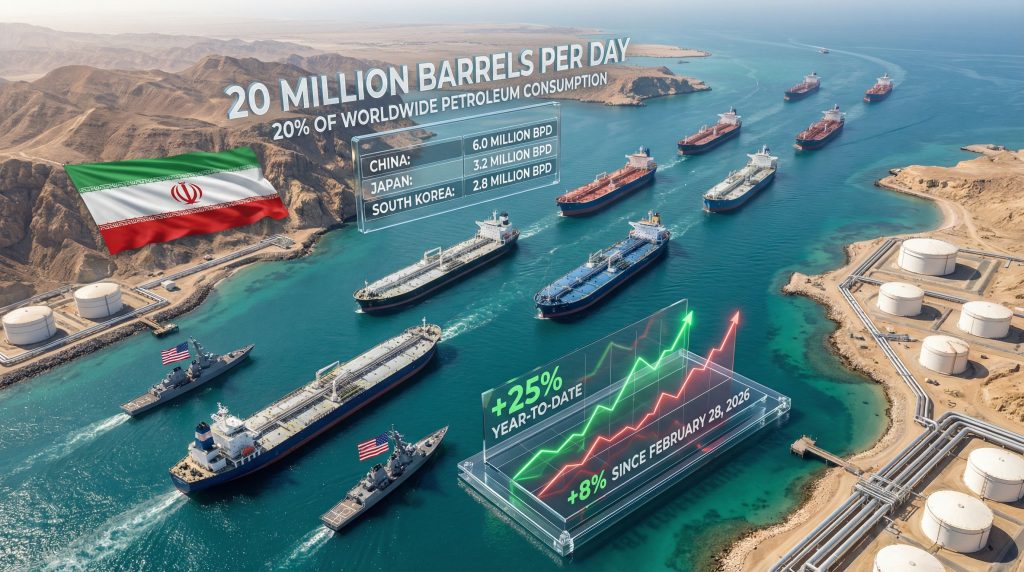
The Strait of Hormuz represents the world's most critical energy transit bottleneck, facilitating approximately 21 million barrels per day of crude oil and refined products. This narrow waterway, spanning just 21 miles at its narrowest point, controls roughly 21% of global petroleum liquids movement, making it indispensable to international energy security frameworks.
Recent disruptions have exposed the fragility of concentrated supply routes, with oil prices climbing 8% following initial conflict escalation and advancing 25% year-to-date as markets incorporate extended risk premiums. Moreover, the impact of the U.S.-Iran conflict on oil market dynamics extends beyond immediate price movements, fundamentally altering how energy traders assess geopolitical risk scenarios.
Key Transit Dependencies:
• Asian economies: 85% of Japan's oil imports traverse the strait
• China: 6.0 million barrels daily representing 17% of total consumption
• South Korea: 2.8 million barrels daily accounting for 70% of imports
• India: 2.1 million barrels daily comprising 45% of total supply
• European markets: 1.9 million barrels daily representing 15% of imports
The closure of this strategic passage creates what energy economists term "convex risk pricing," where the probability of extreme supply disruptions carries disproportionate market weight compared to baseline scenarios. Additionally, this situation highlights broader energy transition challenges that many nations face.
When big ASX news breaks, our subscribers know first
Market Psychology and Price Discovery Mechanisms
Energy markets demonstrate heightened sensitivity to geopolitical developments through multiple transmission channels beyond traditional supply-demand fundamentals. The psychological component of oil pricing has intensified as traders incorporate tail-risk scenarios into forward curve calculations.
Volatility Amplification Factors:
• Risk premium expansion due to uncertainty duration estimates
• Strategic reserve limitations constraining government intervention capacity
• Alternative route bottlenecks through Red Sea and pipeline systems
• Insurance market disruption affecting tanker operations and financing costs
Oil market participants increasingly price scenarios where infrastructure damage could persist for extended periods, creating sustained supply constraints that strategic petroleum reserves cannot indefinitely offset. The International Energy Agency estimates current global reserves could sustain a complete Strait of Hormuz closure for 60-90 days before requiring significant demand destruction.
Consequently, analysts note how this crisis reflects broader patterns similar to previous trade war impact scenarios on global markets.
Alternative Infrastructure and Supply Chain Adaptation
Regional producers have accelerated utilisation of bypass infrastructure to mitigate chokepoint dependencies. Saudi Arabia's East-West Pipeline system can transport 5 million barrels daily to Red Sea terminals, while the UAE's strategic pipeline to Fujairah port provides 1.8 million barrels daily of alternative export capacity.
However, these alternatives cannot fully compensate for Strait of Hormuz capacity during extended closures. Iraq's northern export routes through Turkey add 600,000 barrels daily but remain vulnerable to separate regional instabilities. For instance, the Saudi exploration strategy focuses on developing such alternative infrastructure networks.
Pipeline Capacity Analysis:
| Route | Capacity (Million bpd) | Strategic Significance |
|---|---|---|
| Saudi East-West | 5.0 | Primary Gulf bypass |
| UAE to Fujairah | 1.8 | Critical alternative |
| Iraq-Turkey | 0.6 | Northern corridor |
| Iran-Turkey | 0.3 | Limited alternative |
These infrastructure limitations underscore the systemic vulnerability of global energy supply chains to single-point-of-failure scenarios in critical transit zones.
Economic Transmission Mechanisms and Inflation Dynamics
Rising oil prices create immediate inflationary pressures across major economies through direct energy costs and indirect supply chain effects. Transportation fuel increases directly impact consumer price indices, while petrochemical input costs affect manufacturing sectors ranging from plastics to pharmaceuticals.
Inflationary Transmission Channels:
- Direct effects: Gasoline, diesel, and heating oil price increases
- Industrial inputs: Chemical feedstocks and manufacturing energy costs
- Transportation networks: Freight and logistics cost escalation
- Consumer behaviour: Discretionary spending reduction amid energy cost pressures
Central banks face complex policy trade-offs when energy price shocks create stagflationary conditions. Higher oil prices simultaneously increase inflation while reducing economic output potential, complicating traditional monetary policy responses that typically address either inflation or growth concerns independently.
Furthermore, these dynamics mirror concerns about US inflation and tariffs affecting the broader economic landscape.
Regional Economic Vulnerability Assessment
Asian economies demonstrate the highest exposure to Middle Eastern oil supply disruptions due to geographic proximity and established trade relationships. Japan's 85% import dependency on Strait of Hormuz transit creates acute vulnerability to extended closures, while China's 17% exposure represents significant absolute volumes despite lower percentage dependence.
European energy security calculations now incorporate dual challenges from reduced Russian energy access and potential Middle Eastern supply constraints. This combination creates complex diversification pressures as alternative suppliers face capacity limitations.
Regional Vulnerability Matrix:
| Region | Import Dependency | Strategic Reserve Days | Alternative Sources |
|---|---|---|---|
| Northeast Asia | High (60-85%) | 90-180 days | Limited options |
| Europe | Moderate (15-30%) | 90-120 days | North Sea, Africa |
| North America | Low (5-15%) | 180+ days | Domestic production |
Government Policy Interventions and Market Stabilisation
U.S. Treasury Secretary Scott Bessent indicated that crude markets remain well-supplied despite ongoing conflicts, with hundreds of millions of barrels stored in vessels outside the Persian Gulf region. Government interventions include naval escort services and political risk insurance for tanker operations.
The Trump administration's commitment to provide safe passage through strategic waterways represents direct government intervention in energy market functioning. These measures aim to reduce transportation risk premiums embedded in oil pricing while maintaining supply chain continuity for allied nations.
Policy Response Framework:
• Naval protection: U.S. Navy escort services for commercial tankers
• Risk insurance: Political risk coverage for maritime energy transport
• Strategic reserves: Coordinated release mechanisms among IEA members
• Alternative routes: Investment acceleration in bypass infrastructure
Additionally, these policy responses must consider the OPEC production impact on global supply balances.
How Long Might These Disruptions Last?
Different conflict duration scenarios create varying impacts on global oil market equilibrium. Limited escalation lasting 2-4 weeks typically generates 15-25% price premiums through risk pricing mechanisms, while extended conflicts spanning 2-6 months could drive prices 40-60% above baseline levels.
Infrastructure damage scenarios present the most severe market disruption potential. Sustained damage to export facilities or pipeline networks could maintain elevated prices for 6-12 months, with 80-120% price increases reflecting actual supply constraints rather than risk premiums alone.
Market Impact Scenarios:
| Duration | Price Impact | Economic Risk | Policy Response |
|---|---|---|---|
| 2-4 weeks | +15-25% | Temporary inflation | Reserve releases |
| 2-6 months | +40-60% | Regional slowdown | Demand management |
| 6-12 months | +80-120% | Recession risk | Emergency rationing |
| 12+ months | +150%+ | Severe disruption | Economic restructuring |
The next major ASX story will hit our subscribers first
Long-Term Structural Market Changes
Extended geopolitical tensions may permanently alter how energy markets incorporate risk premiums into pricing structures. This shift could accelerate renewable energy investment as a hedge against geopolitical volatility while expanding strategic reserve capacity across major consuming nations.
Supply chain regionalisation pressures increase as countries seek to reduce single-point-of-failure dependencies. This trend could reshape traditional energy trade patterns, potentially creating new supplier-consumer relationships and altering geopolitical alliance structures around energy security cooperation.
Structural Evolution Indicators:
• Renewable acceleration: Clean energy investment increases as geopolitical hedge
• Reserve expansion: Strategic petroleum reserve capacity growth
• Infrastructure redundancy: Multiple supply route development
• Regional partnerships: Energy security alliance formation
The impact of the U.S.-Iran conflict on oil market dynamics extends beyond immediate price movements to fundamental changes in how global energy systems structure themselves against systematic risks. Market participants and policymakers must prepare for sustained volatility while building resilience frameworks capable of withstanding future geopolitical shocks.
In addition, experts suggest that the current oil market volatility could have lasting implications for global energy security.
The current crisis serves as a comprehensive stress test for global energy market resilience, potentially catalysing permanent changes in supply chain design and risk management approaches across the petroleum sector.
These developments highlight the interconnected nature of modern energy security challenges, where regional conflicts can rapidly escalate into global economic disruptions affecting multiple sectors and geographic regions simultaneously.
Want to Capitalise on Energy Market Volatility?
Discovery Alert's proprietary Discovery IQ model delivers real-time alerts on significant ASX mineral discoveries, instantly empowering subscribers to identify actionable opportunities ahead of the broader market during times of energy sector uncertainty. Begin your 14-day free trial today and secure your market-leading advantage whilst traditional energy markets face unprecedented disruption.