May 17, 2026
Global energy markets face unprecedented transformation as traditional supply-demand relationships give way to complex dynamics shaped by technological innovation, geopolitical realignments, and evolving consumption patterns. The intersection of abundant fossil fuel reserves with strategic energy security imperatives creates a multifaceted investment landscape where conventional wisdom no longer applies, particularly as energy transition dynamics reshape traditional market structures.
Current oil and gas market trends reveal structural oversupply conditions coexisting with premium valuations for assets positioned within critical infrastructure networks. This apparent contradiction reflects deeper shifts in how markets value energy security over pure commodity exposure, fundamentally altering investment thesis frameworks across the sector.
Structural Oversupply Dynamics Reshape Energy Investment Calculus
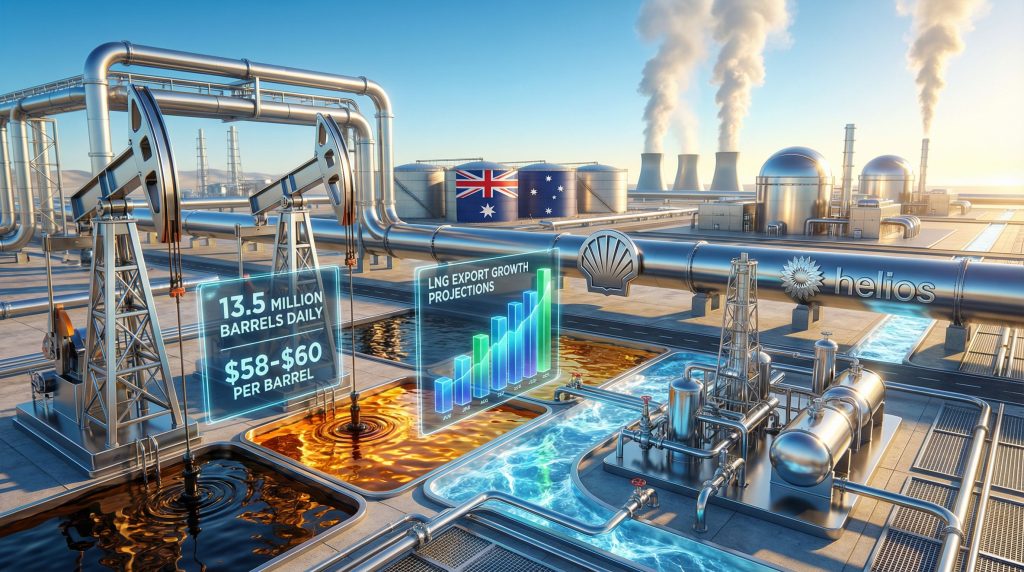
The contemporary energy landscape demonstrates how abundant supply capacity can coexist with strategic positioning premiums. Global crude production maintains historic highs at 13.5 million barrels per day in the United States alone, while proven reserves suggest availability extending beyond 200 years at current consumption rates.
These fundamentals create distinctive market behavior patterns. Despite geopolitical tensions across traditional supply regions, OPEC oil price stagnation demonstrates how capacity buildout over previous decades has fundamentally altered price discovery mechanisms. Market analysis indicates pricing ranges of $58-$60 per barrel persist even during regional conflicts, illustrating structural oversupply conditions rather than scarcity premiums.
The strategic implications extend beyond simple supply-demand calculations. Iran's production capacity of 4 million barrels daily can be readily offset through North American capacity expansion, demonstrating how geographic diversification has reduced traditional geopolitical risk premiums. This shift creates opportunities for disciplined capital allocation toward assets with sustainable competitive advantages rather than crisis-driven speculation.
Regional Market Differentiation
Australia's east coast energy dynamics exemplify how regional supply-demand imbalances create targeted investment opportunities. Structural shortages emerging from 2028 onwards result from declining production from established fields coinciding with accelerated coal phase-out policies requiring flexible generation capacity.
This regional transformation positions natural gas as evolving from transitional technology to strategic anchor of stability for power grids and energy-intensive industries. The economic logic driving this shift reflects the dispatchability requirements that renewable energy sources cannot reliably provide without substantial battery storage infrastructure. Furthermore, natural gas price forecast models suggest sustained demand patterns supporting regional infrastructure investments.
Corporate restructuring within this environment demonstrates value creation through strategic focus. Eastern Gas's recent market debut through an oversubscribed AUD 5 million placement indicates strong institutional appetite for pure-play regional gas exposure, validating specialized asset positioning over diversified commodity exposure.
When big ASX news breaks, our subscribers know first
Integrated Energy Corporations Navigate Transition Complexity
Major energy corporations demonstrate divergent strategic approaches to capital allocation amid transition pressures. These differences create distinct risk-return profiles within seemingly similar business models, requiring sophisticated analysis beyond traditional sector categorisation.
Shell's Infrastructure-Centric Strategy
Shell's positioning emphasises infrastructure modernisation with LNG portfolio expansion targeting 30% volume increases by 2030. This approach prioritises supply security positioning through existing network optimisation rather than aggressive renewable deployment, according to the oil and gas industry outlook from leading industry analysts.
The company's emission reduction framework reflects conservative timeline management: balanced energy transition maintaining fossil fuel profitability while pursuing moderate emissions reductions. This strategy acknowledges European supply security requirements following geopolitical disruptions.
Financial metrics support stability-focused positioning: dividend yields of 3.5-5.5% with P/E ratios of 12-14 for 2026 provide defensive characteristics during volatile market conditions. Share prices trading approximately 5% below all-time highs near EUR 37.30 suggest resilient investor confidence in the strategic framework.
BP's Accelerated Transformation Approach
BP demonstrates higher risk tolerance through aggressive renewable energy deployment across solar and onshore wind projects, complemented by advanced bioenergy integration. Net-zero emissions targeting by 2045 represents five-year advancement over Shell's timeline, reflecting willingness to accept transition execution risks.
Despite strategic ambition, valuation metrics indicate market scepticism. Current pricing at EUR 6.05 remains almost 50% below all-time highs despite 12% appreciation over twelve months. This discount reflects uncertainty regarding transformation execution capabilities and timeline feasibility.
The strategic differential creates portfolio construction considerations: Shell offers stability during transition uncertainty, while BP provides potential upside from successful transformation execution. Both maintain attractive dividend sustainability with similar yield ranges and P/E ratios.
Small Modular Reactor Technology Disrupts Traditional Energy Frameworks
Advanced nuclear technologies represent transformational potential within energy investment strategies, though current valuations reflect significant growth expectations requiring regulatory navigation and operational proof-of-concept delivery.
Small Modular Reactor development targeting 15-50 MW capacity ranges addresses specific industrial applications, particularly artificial intelligence infrastructure and data centre requirements. Sodium-cooled fast reactor designs offer differentiated value propositions through compact design and higher fuel efficiency compared to traditional light water reactor approaches.
Table: SMR Technology Competitive Positioning
| Technology Category | Power Output | Primary Applications | Regulatory Timeline | Investment Risk |
|---|---|---|---|---|
| Sodium-Cooled Fast Reactors | 15-50 MW | Industrial/Data Centres | Extended approval process | High |
| Light Water SMR | 50-300 MW | Grid-scale deployment | Established pathway | Medium-High |
| Micro-Reactor Concepts | 1-20 MW | Remote/Military applications | Early stage | Very High |
The competitive landscape distinguishes between proven light water reactor scaling versus advanced reactor concepts requiring extended regulatory approval timelines. Current market valuations approaching USD 11 billion for leading SMR developers already reflect significant growth expectations, creating opportunity-risk profiles heavily dependent on regulatory progress and operational implementation success.
Data Centre Demand Transformation
Exponential growth in computational infrastructure creates base-load electricity demand requiring reliable, low-carbon energy sources. This trend particularly favours SMR technology due to modularity matching data centre expansion patterns and proximity requirements reducing transmission infrastructure needs.
Advanced reactor designs provide competitive advantages through higher fuel efficiency and operational flexibility compared to traditional nuclear generation. However, implementation timelines extending beyond 10+ years require patient capital and sophisticated risk management frameworks.
Carbon Credit Integration Creates Hybrid Investment Opportunities
Policy mechanisms increasingly create investment opportunities bridging traditional and renewable energy sectors through enhanced recovery techniques and renewable diesel production capabilities. In addition, green transition catalysts demonstrate how policy frameworks support infrastructure development across energy value chains.
45Q carbon tax credit expansions incentivise enhanced oil recovery while renewable diesel production approaches 250,000 barrels daily through refinery co-processing capabilities. These policy frameworks demonstrate how traditional energy infrastructure can participate in decarbonisation initiatives while maintaining operational profitability.
LNG Export Growth Dynamics
United States LNG export capacity growth of 7% annually with potential doubling by 2030 transforms domestic natural gas pricing dynamics. Each 1 bcf/d export increase above baseline projections adds approximately 2.5% to domestic prices, creating arbitrage opportunities between regional markets.
This infrastructure development supports long-term investment themes around energy security and supply chain diversification. European demand for reliable natural gas supplies, combined with domestic production capacity, creates sustained cash flow visibility for LNG infrastructure investments.
Strategic reserve management policies increasingly focus on supply security rather than price stabilisation, creating opportunities for private sector storage and logistics infrastructure investment across the value chain.
Pure-Play Investment Strategies Through Corporate Restructuring
Value creation through strategic unbundling demonstrates how focused asset management enables clearer valuation methodologies and targeted capital deployment within energy sector investments.
Pure One Corporation's Cooper Basin positioning through majority ownership of Eastern Gas illustrates pure-play investment strategy benefits. The Windorah project maintains resource profiles comparable to significantly higher-valued competitors while current market capitalisation of approximately AUD 30 million suggests substantial disconnect from underlying asset values.
Research analysis values Pure One's Eastern Gas stake at AUD 37 million, exceeding the entire market capitalisation of the parent company. This valuation gap reflects market inefficiencies in conglomerate structures versus focused asset positioning.
Expected annual sales around AUD 42 million relative to current market capitalisation indicates moderate valuation ratios compared to industry benchmarks. The strategic unbundling through Eastern Gas's separate ASX listing enables clearer value recognition while maintaining operational control through majority ownership.
Technology-Neutral Portfolio Expansion
Following corporate rebranding from Pure Hydrogen to Pure One, strategic positioning encompasses battery electric vehicles, fuel cell drives, swappable battery systems, and refuelling infrastructure. This diversified approach reduces single-technology risk while maintaining exposure to mobility transformation trends.
Hydrogen generator capabilities for decentralised energy supply address both backup solution requirements and primary power source applications for energy-intensive data centres. This positioning aligns with growing computational infrastructure demands requiring reliable, clean energy sources.
Geopolitical Risk Management in Energy Investment Strategies
Contemporary geopolitical risk assessment requires understanding of supply chain adaptability and strategic reserve management rather than traditional crisis-premium calculations. Consequently, trade war impacts on global energy flows create both challenges and opportunities for strategic positioning.
Russian oil redirection to Chinese markets demonstrates supply chain flexibility, with 0.5 mb/d increases illustrating how global distribution networks adapt to disruptions. These patterns reduce traditional geopolitical risk premiums in oil pricing while creating opportunities for strategic positioning within resilient supply networks.
North American capacity expansion capabilities provide offset mechanisms for regional supply disruptions. This geographic diversification reduces traditional Middle Eastern supply dependency while creating investment opportunities in domestic energy infrastructure, according to the latest global oil market analysis from regulatory authorities.
Strategic petroleum reserve policies focus on supply security rather than price stabilisation, supporting private sector investment in storage and logistics infrastructure across energy value chains.
The next major ASX story will hit our subscribers first
Industrial Decarbonisation Investment Flows
Manufacturing sector transition strategies create multi-billion dollar investment opportunities across clean hydrogen, advanced biofuels, and carbon capture technologies representing comprehensive energy value chain transformation.
Industrial applications require base-load electricity capacity with low-carbon characteristics, favouring both natural gas for immediate transition needs and advanced nuclear technologies for long-term sustainability. This dual-pathway approach creates investment opportunities across technology categories and implementation timelines.
Key Industrial Decarbonisation Investment Categories:
• Clean hydrogen production infrastructure for steel and chemical manufacturing
• Advanced biofuel production facilities serving aviation and marine transport
• Carbon capture and storage networks supporting heavy industry emissions reduction
• Advanced nuclear technologies providing reliable industrial base-load power
Manufacturing Transition Timeline Analysis
Industrial decarbonisation timelines vary significantly across sectors, creating distinct investment opportunity windows. Steel production transformation requires 15-20 year implementation cycles, while chemical manufacturing may achieve significant emissions reductions within 5-10 year timeframes through process optimisation.
These timeline differentials support diversified investment approaches combining immediate cash flow generation from established technologies with long-term positioning in transformational solutions requiring extended development periods.
Investment Portfolio Construction Framework
Current market conditions favour sophisticated portfolio construction combining stable cash flow generation from established players with selective exposure to transformational technologies and regional growth opportunities.
Risk-adjusted return optimisation requires understanding of technology development timelines, regulatory approval processes, and market timing considerations across energy sector categories.
Investment Category Risk-Return Matrix:
• Integrated Oil Majors: Low-medium risk profile with steady dividend income plus modest growth potential over 3-7 year time horizons
• Regional Gas Producers: Medium risk exposure with high growth potential over 5-10 year periods through infrastructure access and production expansion
• SMR Technology: High risk investments with transformational return potential over 10+ year development cycles
• LNG Infrastructure: Medium-high risk profile supporting stable cash flows over 15-25 year contract terms
Valuation Discipline Requirements
Oversupply conditions in traditional energy markets create attractive entry points for quality assets, while emerging technologies require careful valuation discipline given regulatory uncertainty and execution risks inherent in transformational business models.
Timing considerations become critical when evaluating growth stage technologies with significant upside potential but extended commercialisation timelines. Portfolio construction benefits from combining defensive dividend-yielding positions with selective growth exposure aligned with individual risk tolerance and investment horizon parameters.
Market psychology increasingly focuses on supply security and infrastructure resilience rather than pure commodity exposure, creating opportunities for assets positioned within critical supply networks regardless of short-term price volatility.
Strategic Positioning for Energy Market Evolution
The contemporary energy investment landscape requires sophisticated integration of macro-economic trend analysis, technological disruption assessment, and geopolitical risk management capabilities. Success demands portfolio construction balancing stable cash flow generation with selective exposure to transformational opportunities.
Oil and gas market trends demonstrate how abundance and scarcity can coexist within the same commodity complex, depending on strategic positioning and infrastructure access. This evolution creates opportunities for disciplined investors capable of distinguishing between headline-driven speculation and fundamental value creation.
Understanding regional supply-demand imbalances, corporate strategic differentiation, and technology development timelines provides frameworks for identifying sustainable competitive advantages within evolving energy markets. The intersection of traditional energy expertise with emerging technology capabilities increasingly determines long-term investment success across the sector.
Investment decisions should be based on comprehensive analysis of individual financial circumstances and risk tolerance. Energy sector investments carry inherent volatility and regulatory risks that may impact returns. This analysis is for informational purposes and does not constitute personalised investment advice.
Looking to Capitalise on Energy Market Transformations?
Discovery Alert's proprietary Discovery IQ model delivers real-time notifications about significant ASX mineral discoveries, including critical energy transition materials and emerging resource opportunities that could benefit from the shifting energy landscape. Transform complex market dynamics into actionable investment insights and begin your 14-day free trial today to stay ahead of energy sector opportunities.