May 16, 2026
How Global Energy Markets Adapt to Supply Chain Disruptions
Modern petroleum trading networks demonstrate remarkable adaptability when confronted with supply constraints, revealing sophisticated mechanisms that extend far beyond simple price adjustments. The intricate relationships between production hubs, transportation corridors, and consuming markets create a complex web of dependencies that can shift dramatically during periods of uncertainty. Furthermore, recent events have shown how quickly Middle East crude premiums spike in response to geopolitical tensions.
Understanding these dynamics requires examining how risk premiums integrate into commodity valuations, reflecting not just immediate supply concerns but also longer-term strategic positioning by market participants. The petroleum sector's response to disruptions illuminates broader principles of global supply chain resilience and the economic forces that drive energy security planning.
When big ASX news breaks, our subscribers know first
What Drives Premium Structures in Volatile Energy Markets?
Energy market premiums emerge from a sophisticated interplay of physical constraints and psychological factors that extend well beyond traditional supply-demand calculations. When regional tensions escalate, traders incorporate multiple risk factors into their pricing models, creating cascading effects throughout global energy networks. Consequently, these disruptions trigger widespread oil price movements that ripple across international markets.
Transportation Bottleneck Economics
The fundamental mechanics of petroleum transportation reveal why certain crude grades command dramatically different premiums during crisis periods. Dubai benchmark crude reached unprecedented premium levels of $19.63 per barrel during recent supply disruptions, while Oman crude hit $19.15 per barrel and Murban crude reached $17.87 per barrel. These figures represent the highest levels in available trading records dating from 2018.
Critical chokepoint vulnerabilities create immediate pricing pressure. In addition, these constraints often lead to what analysts describe as oil price stagnation in traditional supply routes:
• Strait of Hormuz dependencies affect approximately 21% of global petroleum liquids transit
• Alternative routing costs can add $3-8 per barrel in transportation expenses
• Insurance premium escalations during geopolitical tensions often triple standard rates
• Port congestion factors create additional delays averaging 5-14 days for alternative routes
Risk Assessment Methodologies
Commodity traders employ sophisticated models that incorporate multiple uncertainty variables when establishing premium structures. The Exchange of Futures for Swaps (EFS) spread between Brent crude and Dubai swaps widened dramatically to $10.42 per barrel, compared to just 69 cents at the beginning of 2026, illustrating how quickly market dynamics can shift.
Professional risk assessment frameworks consider various factors. However, these assessments must also account for broader economic implications, including how US economy tariffs affect global energy trade patterns:
• Geopolitical stability indices weighted by production capacity exposure
• Infrastructure vulnerability mappings for critical supply route dependencies
• Alternative supply activation timelines ranging from 1-4 weeks depending on source
• Market depth measurements for maintaining liquidity during stressed conditions
How Do Alternative Supply Sources Reshape Global Energy Flows?
When traditional supply routes face disruption, the global energy system demonstrates remarkable flexibility through rapid activation of alternative sources, though this adaptability comes with significant cost implications and operational challenges. Moreover, these disruptions often coincide with broader trade war impact on global commodity flows.
Non-Traditional Supply Activation Patterns
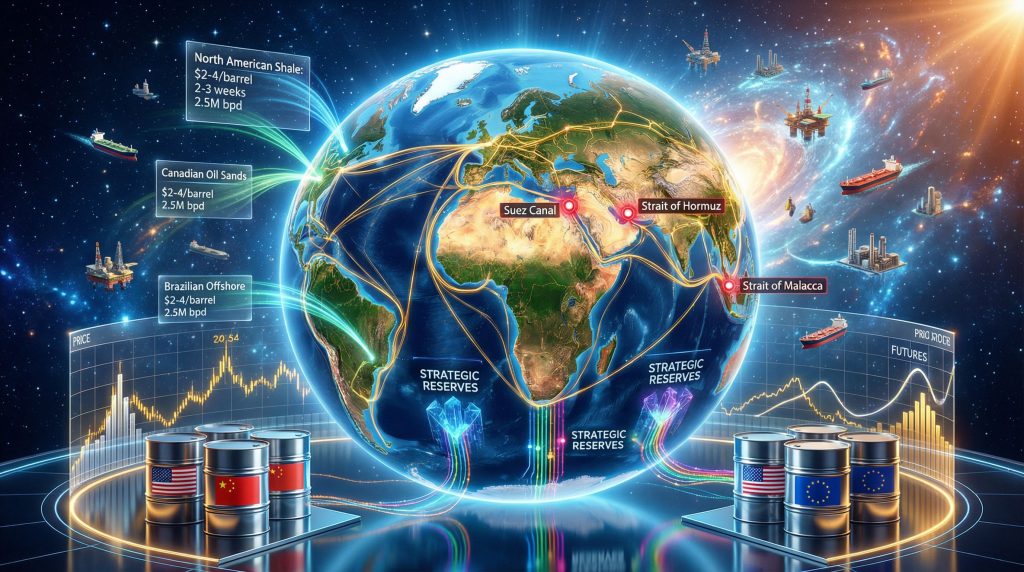
| Supply Source | Typical Premium | Activation Timeline | Maximum Capacity | Quality Specifications |
|---|---|---|---|---|
| North American Shale | $2-4/barrel | 2-3 weeks | 2.5M bpd | Light Sweet (35-45° API) |
| Canadian Oil Sands | $3-6/barrel | 1-2 weeks | 1.8M bpd | Heavy Sour (18-22° API) |
| Brazilian Deep Water | $4-7/barrel | 3-4 weeks | 1.2M bpd | Medium Sweet (28-32° API) |
| West African Light | $1-3/barrel | 1 week | 2.1M bpd | Light Sweet (37-42° API) |
Canadian TMX crude demonstrated this flexibility by narrowing its discount to just $1 per barrel relative to ICE Brent, compared to over $4 per barrel a month prior, as Asian refiners actively sought alternative feedstock sources. Furthermore, this shift illustrates how supply disruptions can sometimes trigger an unexpected oil price rally in alternative sources.
Transportation Infrastructure Reallocation
The petroleum industry's ability to rapidly reconfigure transportation networks reveals sophisticated logistics capabilities that remain largely invisible during normal market conditions. Pipeline capacity previously dedicated to domestic consumption can be redirected toward export terminals within days, while tanker fleets undergo strategic repositioning to serve alternative loading facilities.
Emergency transportation scaling mechanisms include several key components. For instance, these systems can rapidly accommodate changing market conditions:
• Pipeline flow reversal capabilities activated within 48-72 hours
• Rail transportation surge capacity potentially handling 500,000-750,000 bpd additional volumes
• Truck convoy coordination for critical supply corridor maintenance
• Strategic port utilisation switching from import to export configurations
Which Market Assessment Mechanisms Adapt During Crisis Conditions?
Price discovery agencies face unprecedented challenges when traditional delivery mechanisms become unavailable, requiring rapid methodology adjustments to maintain market functionality whilst preserving transparency and accuracy in benchmark assessments. Additionally, these situations often coincide with periods where Middle East crude premiums spike dramatically.
Assessment Methodology Modifications
S&P Global Platts implemented significant changes to its Dubai crude price assessment methodology by excluding several major crude grades from delivery nominations. The removal of Qatari al-Shaheen, UAE's Upper Zakum, and Murban loading from Jebel Dhanna port reduced deliverable crude options by approximately 70%, fundamentally altering the benchmark's composition.
This dramatic reduction concentrated price discovery around:
• Murban loading from Fujairah port – maintaining accessibility despite regional tensions
• Oman crude streams – providing continued liquidity through alternative export routes
• Simplified grade specifications – focusing on the most readily available and liquid crude types
Market Assessment Reality: When traditional delivery mechanisms face disruption, price assessment agencies typically reduce deliverable crude specifications by 60-70% during major supply constraints, concentrating on the most liquid and accessible grades to maintain price discovery functionality whilst preserving market transparency.
Corporate Procurement Strategy Evolution
Major energy companies demonstrate remarkable agility in adjusting procurement strategies during supply disruptions. TotalEnergies exemplified this adaptability by securing nine Oman and Murban cargoes within a four-day period through the Platts trading window, representing aggressive positioning in a constrained market environment.
Strategic procurement adjustments typically involve:
• Quality specification flexibility – accepting wider crude grade variations
• Delivery timing modifications – extending acceptance windows for delayed shipments
• Geographic sourcing diversification – activating previously unused supply relationships
• Financial hedging recalibration – adjusting risk management strategies for new market conditions
What Economic Indicators Signal Market Recovery Trajectories?
Recovery from energy supply disruption events follows predictable patterns that sophisticated market participants monitor closely to optimise operational strategies and investment positioning during volatile periods. However, the timing and intensity of these patterns can vary significantly based on underlying geopolitical factors.
Multi-Phase Recovery Timeline Analysis
Immediate Recovery Signals (1-7 days):
• Insurance rate normalisation for petroleum tanker traffic routes
• Futures curve structural changes shifting from backwardation to contango patterns
• Options volatility surface adjustments reflecting reduced uncertainty premiums
• Spot market transaction volume returning to historical average ranges
Short-term Stabilisation (1-4 weeks):
• Alternative supply utilisation rates reaching optimal capacity levels
• Refinery margin compression patterns indicating feedstock availability improvements
• Strategic reserve deployment announcements by major consuming nations
• Shipping route diversification success measured by reduced transportation premiums
Medium-term Normalisation (1-3 months):
• Production capacity restoration timelines for affected facilities
• Infrastructure repair completion schedules for damaged transportation corridors
• Diplomatic resolution progress indicators affecting long-term supply security
• Market share redistribution among producing regions
How Do Refining Operations Demonstrate Supply Chain Flexibility?
Regional refineries showcase remarkable operational adaptability during feedstock supply constraints, implementing rapid crude slate modifications and processing adjustments to maintain output levels whilst managing quality specifications. Consequently, these adaptations help maintain market stability even when Middle East crude premiums spike unexpectedly.
Operational Flexibility Mechanisms
Refinery operational adjustments during supply disruptions reveal sophisticated engineering capabilities:
• Crude slate optimisation algorithms – real-time feedstock quality matching
• Product yield modification protocols – maximising high-value output streams
• Processing rate calibrations – accommodating different crude characteristics
• Quality specification adjustments – maintaining market supply whilst managing product standards
Economic Impact Assessment Frameworks
Refining margin volatility during feedstock transitions provides insights into operational cost structures:
Margin Volatility Patterns:
- Initial compression phase – 2-5 days of reduced profitability
- Optimisation period – 1-2 weeks of process fine-tuning
- Stabilisation phase – 3-4 weeks of normalised operations
- Strategic repositioning – long-term crude sourcing relationship adjustments
The next major ASX story will hit our subscribers first
What Role Do Financial Markets Play in Energy Price Discovery?
Financial markets provide essential price discovery and risk management functions during physical market disruptions, often serving as the primary mechanism for establishing fair value when spot markets experience reduced liquidity or operational constraints. Furthermore, these markets help stabilise pricing when supply disruptions threaten global energy security.
Derivatives Market Functionality During Crisis
The derivatives market demonstrates remarkable resilience during physical supply disruptions, maintaining liquidity and price transparency when spot markets face operational challenges. Futures curve evolution provides critical insights into market expectations for supply restoration timelines and long-term price trajectories.
Key derivatives market indicators include:
• Contango/backwardation structures – reflecting supply timing expectations
• Open interest concentration – indicating institutional positioning changes
• Options skew patterns – revealing asymmetric risk assessments
• Swap curve dynamics – providing forward-looking supply security valuations
Investment Flow Analysis During Disruptions
Institutional investment flows during energy supply disruptions reveal sophisticated portfolio management strategies:
Commodity Fund Positioning:
- Systematic trend-following strategies – capturing momentum during price movements
- Mean reversion positioning – anticipating supply restoration timing
- Cross-asset correlation trading – managing energy exposure within broader portfolios
- Volatility harvesting techniques – monetising increased price uncertainty
How Do Government Policies Influence Market Stabilisation?
Government intervention strategies during energy supply disruptions can either amplify or dampen market volatility, depending on policy timing, coordination effectiveness, and communication clarity with market participants. In addition, these policies must consider broader economic implications of sustained energy price volatility.
Strategic Reserve Deployment Effectiveness
Strategic petroleum reserve releases require careful coordination to maximise market impact whilst preserving long-term supply security capabilities. Optimal deployment strategies consider market timing, volume coordination among consuming nations, and communication protocols to manage market expectations effectively.
Policy Intervention Analysis:
• Release timing optimisation – coordinating with market liquidity patterns
• Volume calibration strategies – balancing immediate relief with reserve preservation
• International cooperation mechanisms – maximising collective policy impact
• Market communication protocols – managing expectations whilst maintaining policy flexibility
Regulatory Flexibility Implementation
Emergency regulatory adjustments demonstrate government adaptability during supply constraints:
• Environmental standard modifications – temporary fuel specification adjustments
• Import duty suspensions – reducing costs for alternative crude sources
• Transportation regulation flexibility – expediting emergency supply route approvals
• Strategic stockpile coordination – optimising government and commercial inventory management
What Long-Term Structural Changes Result From Supply Disruptions?
Major energy supply disruption events often catalyse permanent changes in global energy market structures, creating new trading relationships, infrastructure investment priorities, and risk management approaches that persist long after immediate crises resolve. Moreover, these changes frequently establish new baseline conditions where Middle East crude premiums spike more readily during future uncertainty periods.
Infrastructure Investment Acceleration
Supply disruption events frequently trigger accelerated infrastructure development programmes designed to enhance supply chain resilience and reduce future vulnerability to similar disruptions.
Investment Priority Areas:
• Transportation route diversification – developing alternative pipeline and shipping corridors
• Storage capacity expansion – increasing strategic and commercial inventory capabilities
• Processing flexibility improvements – enhancing refinery feedstock adaptability
• Digital monitoring systems – implementing advanced supply chain visibility technologies
Market Structure Evolution Patterns
Long-term market structural changes typically emerge gradually following major supply disruption events:
• Trading relationship diversification – establishing new supplier-buyer partnerships
• Risk management protocol upgrades – implementing enhanced supply security measures
• Technology adoption acceleration – deploying advanced monitoring and assessment tools
• Regulatory framework adaptations – updating policies to address identified vulnerabilities
Investment Thesis Development
Energy supply disruptions create investment opportunities that extend beyond traditional energy sector boundaries:
Emerging Investment Themes:
- Supply chain resilience technologies – companies developing monitoring and optimisation solutions
- Alternative transportation infrastructure – pipeline, rail, and shipping capacity developers
- Energy storage solutions – strategic and commercial inventory management systems
- Geographic diversification plays – energy companies with global supply chain capabilities
Disclaimer: This analysis is for educational purposes only and does not constitute investment advice. Energy market conditions can change rapidly, and past performance does not predict future results. Investors should conduct thorough research and consult qualified professionals before making investment decisions.
Looking for Opportunities in Energy Market Disruptions?
Discovery Alert's proprietary Discovery IQ model identifies significant ASX mineral discoveries that could benefit from energy sector volatility and supply chain disruptions, delivering real-time alerts on companies positioned to capitalise on commodity price movements. Explore historic examples of major mineral discoveries and begin your 14-day free trial today to stay ahead of market-moving announcements in the resources sector.